
Algebra and Expressions
Master variables, substitution, patterns and word problems for IB MYP 2 Maths
Quick facts
Algebra is arithmetic with letters standing in for numbers that change, are unknown, or aren't worth writing out every time — a taxi fare, a pattern rule, a ticket profit. In IB MYP 2 Mathematics, Algebra and Expressions builds the vocabulary and skills every later topic depends on: telling variables apart from constants, substituting values correctly, spotting the rule behind a number pattern, and turning a real-world scenario into an accurate algebraic model. Examiners reward precise language and careful order of operations far more than 'having the right idea' — a missing bracket or a fee folded into the wrong place can quietly wreck an otherwise correct method. This teaser covers the five ideas that matter most for Criterion A and B assessments, with the traps students fall into every year. For the full step-by-step examples, formula derivations and complete practice set, head to the full RevisionPrep notes linked below.
What you’ll be able to do
Variables, Constants and Key Vocabulary
A variable is a letter representing a number that can change or is currently unknown, while a constant is a fixed value that never changes within the expression. A coefficient is the number multiplying a variable, and a term is a single piece of the expression separated from others by or . The letter chosen never matters — what matters is its job: in , could represent hours, sandwiches or figure numbers, and the rules stay identical.
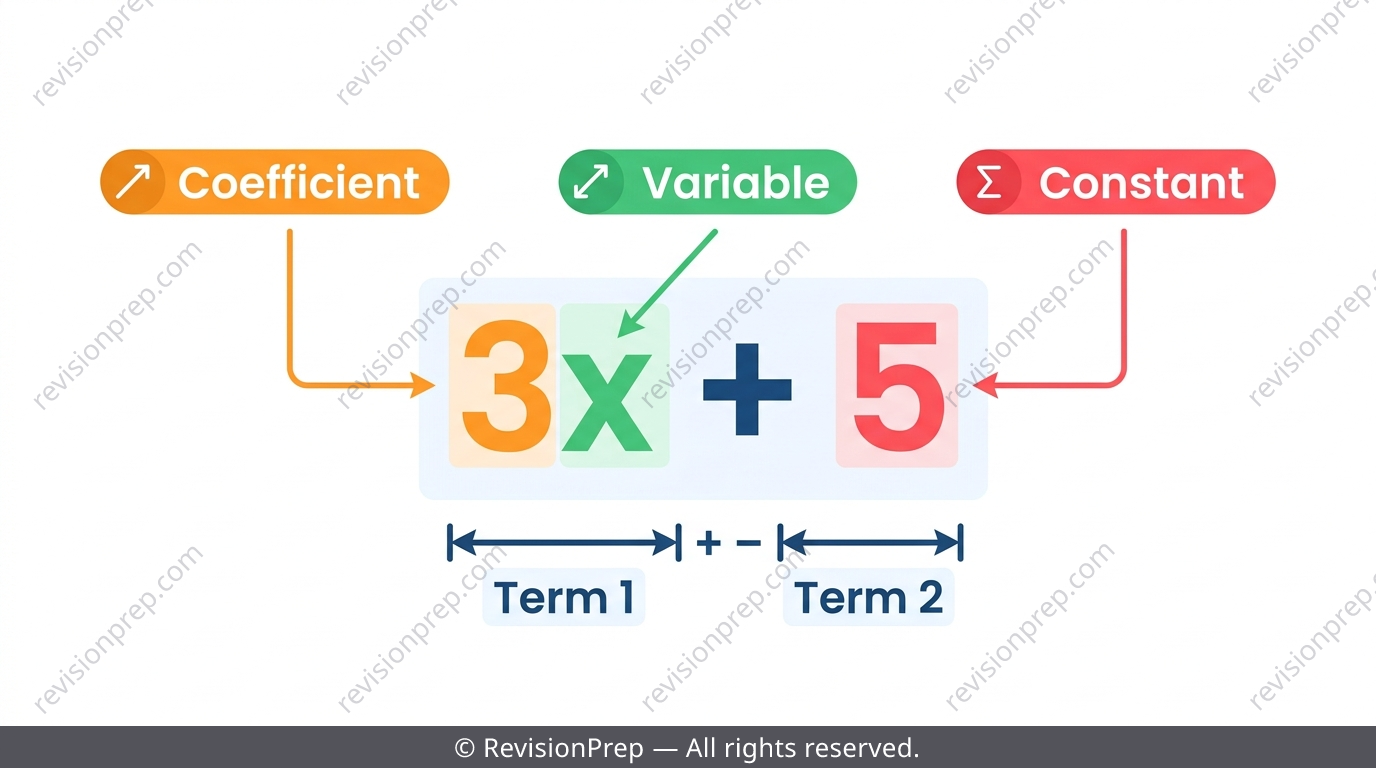
| Term | Meaning | Example in 3x + 5 |
|---|---|---|
| Variable | Letter that can change | |
| Coefficient | Number multiplying the variable | 3 |
| Constant | Fixed value with no variable attached | 5 |
Exam tip
Number of terms = number of or signs, plus one.
Common mistake
Calling every number in an expression 'the constant' — e.g. saying 3 is the constant in , when 3 is actually the coefficient.
Mini summary
A coefficient multiplies a variable; a constant stands completely alone.
Writing Expressions From Patterns
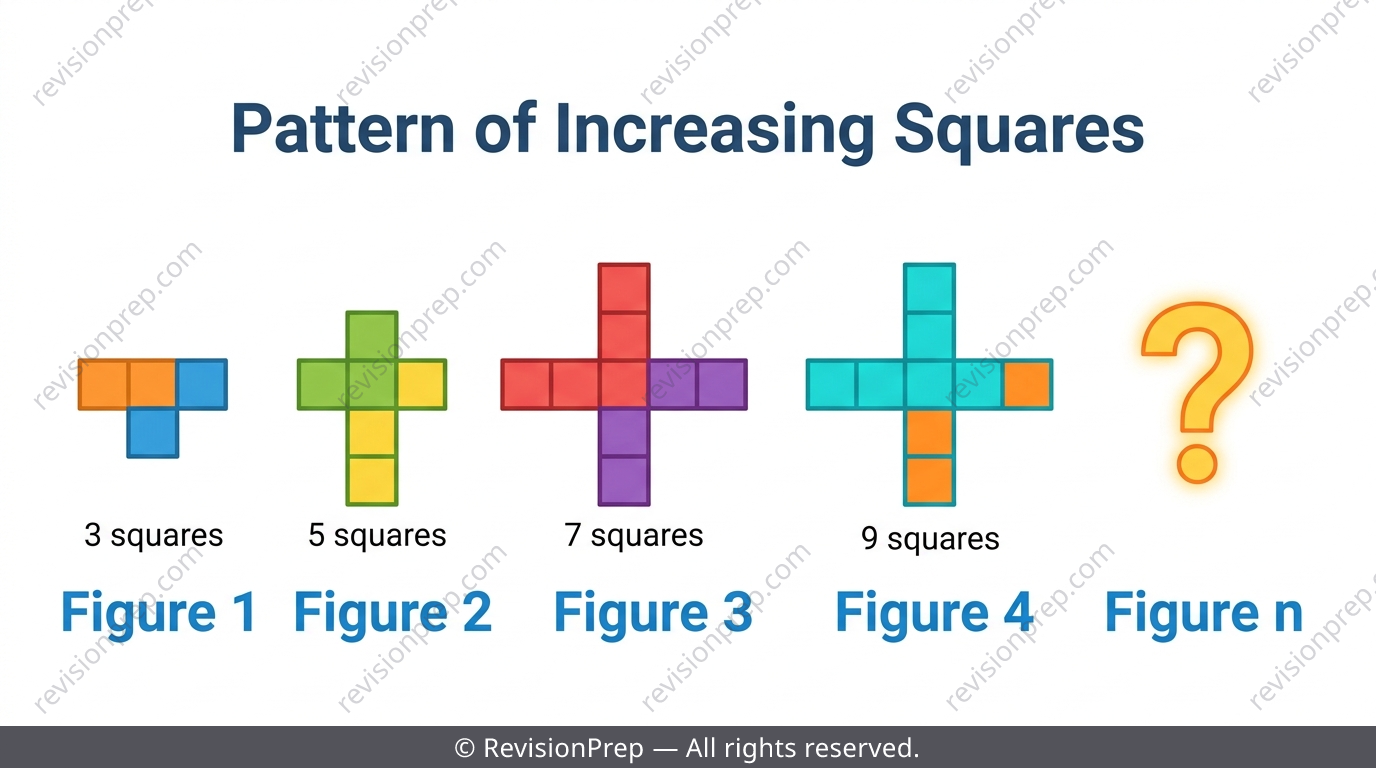
To turn a number pattern into an algebraic rule, first find the constant difference between consecutive terms — this becomes the coefficient of . Test coefficient × 1 against the first given term, adjust with a constant if needed, then verify the rule against a second term before finalising. Skipping the verification step is the fastest way to submit a rule that only half-matches the pattern.
Exam tip
Always check your rule against at least two given values, not just the first one.
Common mistake
Stopping at the coefficient and writing the rule as just when the pattern actually needs a constant added, e.g. .
Mini summary
Find the common difference for the coefficient, then adjust with a constant and verify.
Substitution Into Expressions and Formulae
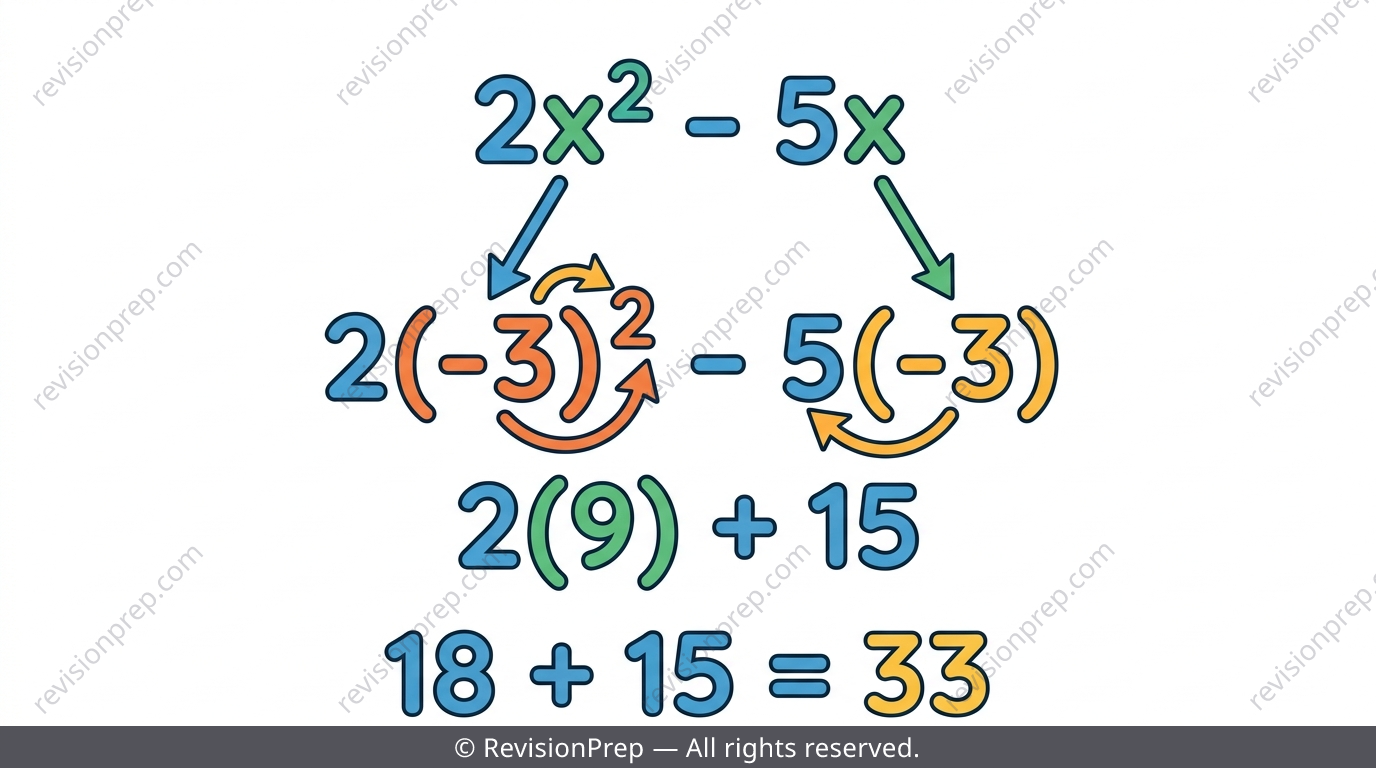
Substitution means replacing every occurrence of a variable with its given value, then simplifying using the correct order of operations — brackets and powers first, then multiplication/division, then addition/subtraction. Always write the substituted line before simplifying, since this secures a method mark on its own, and always wrap a negative substituted value in brackets before applying a power. In formulae such as , multiply or divide before adding the constant term.
Exam tip
Markschemes award a method mark for the correctly substituted (but not yet simplified) expression, even if the final arithmetic slips.
Common mistake
Substituting a negative value without brackets, e.g. treating at as , which squares only the 3 and flips the sign of the answer.
Mini summary
Substitute first, bracket negatives, then apply BODMAS — never change the structure of the expression.
Modelling Word Problems: Fixed Cost + Rate
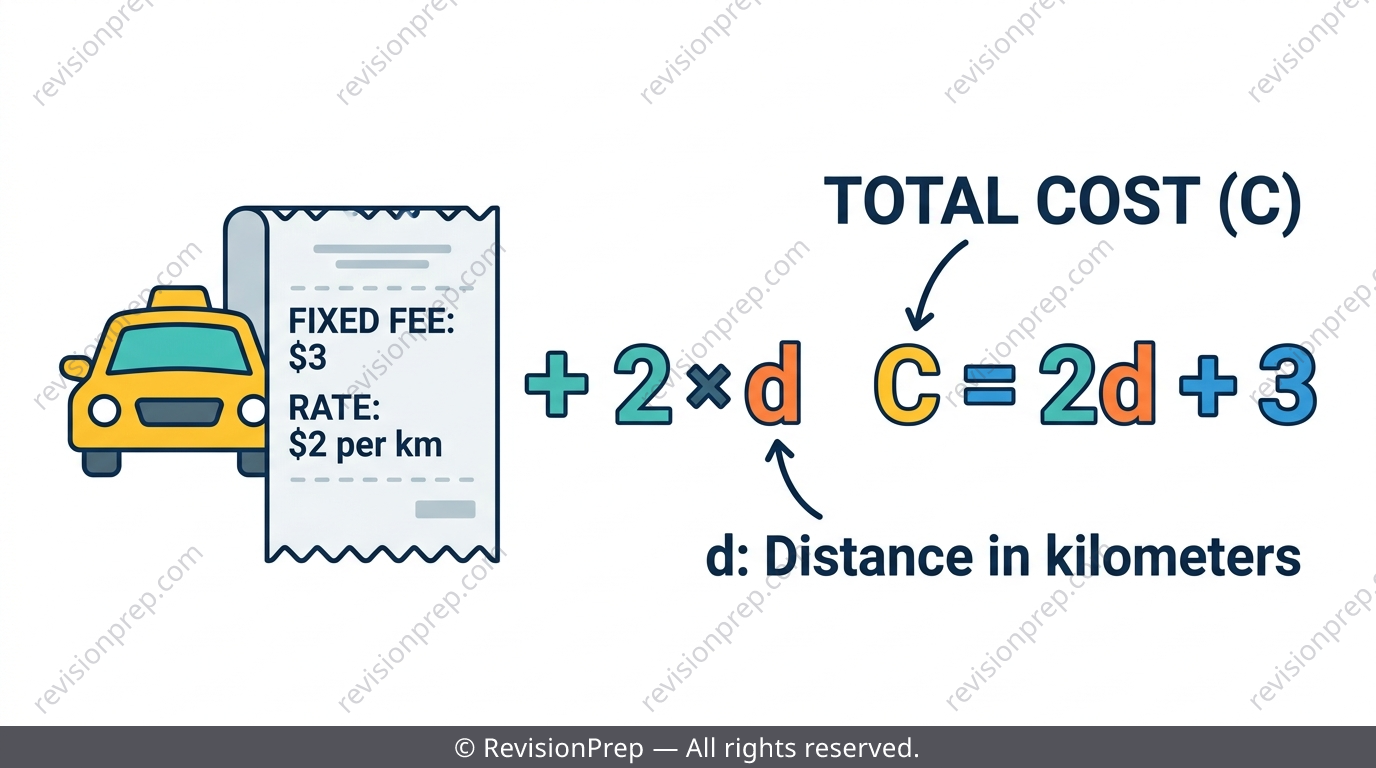
Every algebra word problem splits into a fixed constant (paid once, no matter what) and a rate × variable term (multiplies with quantity). Define your letter in words first — this is a required mark, not decoration — then combine as total = (rate × variable) + fixed constant. A model with a non-zero constant never scales proportionally: doubling the input does not double the output, because the fixed part stays the same.
Exam tip
If asked for a limitation, name something specific to the context — 'ignores bulk discounts' or 'assumes x must be a whole number' — generic answers like 'it's not accurate' score zero.
Common mistake
Folding a fixed fee inside the same bracket as the variable cost, e.g. writing instead of , which multiplies the fee by every unit bought.
Mini summary
Split fixed vs. per-unit costs first, then combine — never bracket a constant with the variable.
Common Exam Traps in Algebra Questions
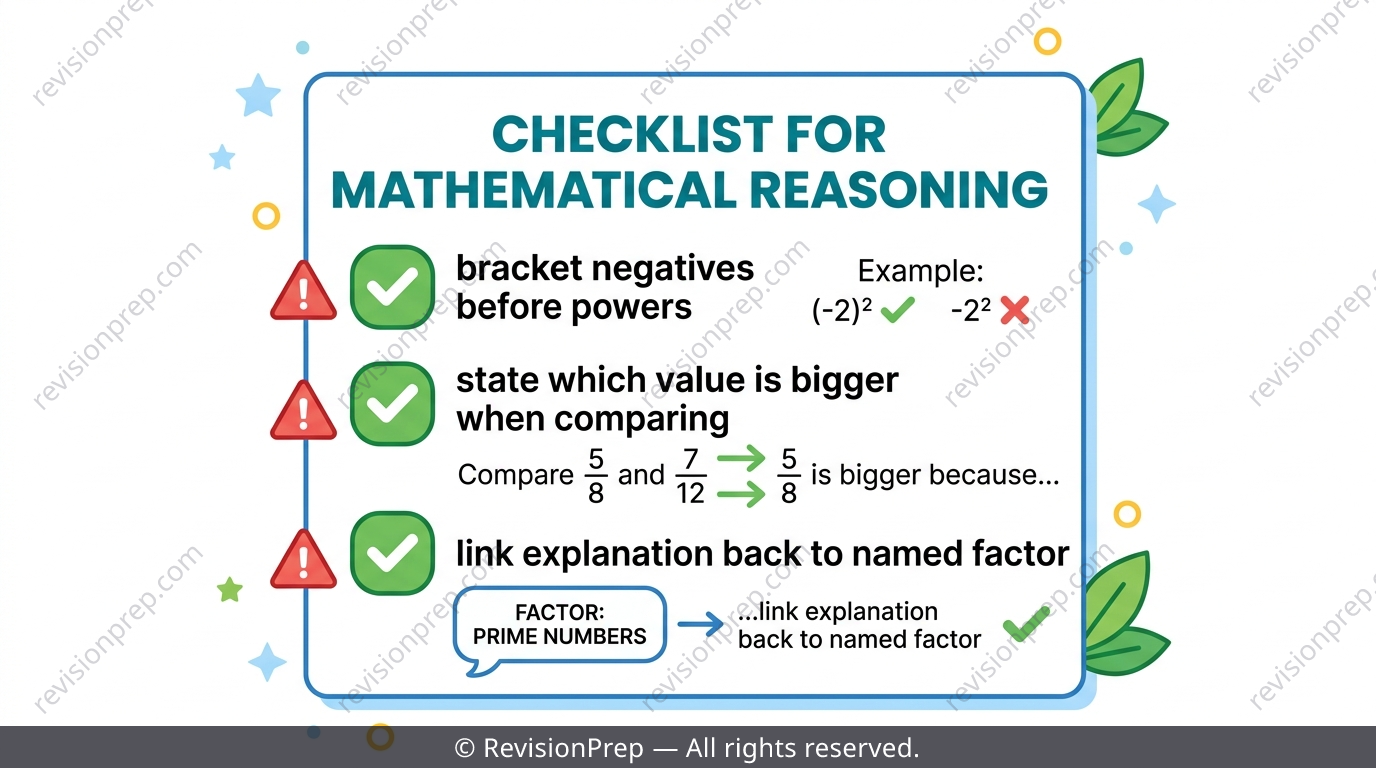
Beyond bracket and substitution slips, students often lose marks by giving a numerical answer without comparing it, or by naming a missing factor in a model without explaining why it matters. If a question says 'explain', link your answer back to the specific factor named — repeating 'so it's not accurate' with no connection loses the mark even when the first part was correct.
Exam tip
When comparing two results (e.g. two break-even points), always state which is smaller/larger and by how much — a side-by-side answer alone isn't a comparison.
Common mistake
Assuming any rate × variable + constant model scales proportionally — this is only true when the constant is zero.
Mini summary
Explain answers by linking back to the named factor, and always state comparisons explicitly.
Quick formula sheet
Practice questions
- In the expression $4x + 7$, identify the coefficient and the constant.
- Evaluate $3x + 2$ when .
- How many terms are in the expression $5x - 3y + 8$?
- A pattern gives 4, 7, 10, 13 for figures 1, 2, 3, 4. Write an algebraic expression for figure .
- Evaluate when , showing the substituted line before simplifying.
- A market stall charges a $2 fixed stall fee plus $1.50 per item sold. Write an expression for total cost for items.
- A gym charges a $20 joining fee plus $8 per month. A friend claims that 6 months costs exactly twice as much as 3 months — is this correct? Justify your answer.
- Use to convert to Fahrenheit, showing every step of substitution.
- A delivery service models cost as , where is distance in km. Identify one factor this model does not include and explain why this makes the model inaccurate.
Frequently asked questions
What's the difference between a variable and a constant?+
A variable is a letter representing a number that can change or is unknown, while a constant is a fixed value that never changes within that expression or context.
How do I know if a number is a coefficient or a constant?+
Check what's directly attached to the variable: if a number multiplies a letter, it's the coefficient; if a number stands completely alone with no variable attached, it's the constant.
Why can't I write a fixed fee inside brackets with the variable cost?+
Doing so multiplies the fixed fee by the variable too, which changes the whole model rather than just causing a small arithmetic slip — always add a true fixed constant on its own outside any multiplication.
Do I need brackets when substituting negative numbers?+
Yes — always wrap a substituted negative value in brackets before applying a power, otherwise order of operations will only apply the power to part of the number and flip your sign.
How do I write an algebraic rule from a number pattern?+
Find the constant difference between consecutive terms to get the coefficient of , test it against the first term, adjust with a constant, then verify against a second given term.
Does RevisionPrep provide official IB past exam papers?+
No — RevisionPrep provides original mock papers and exam-style practice questions built from the IB MYP curriculum, not official past papers.
Ready to master Algebra and Expressions for IB MYP 2?
Related articles