
Geometry: Properties of Shape — IB MYP 2 Maths
Classify, prove, and compare shapes with the five rules that run through every MYP 2 geometry question
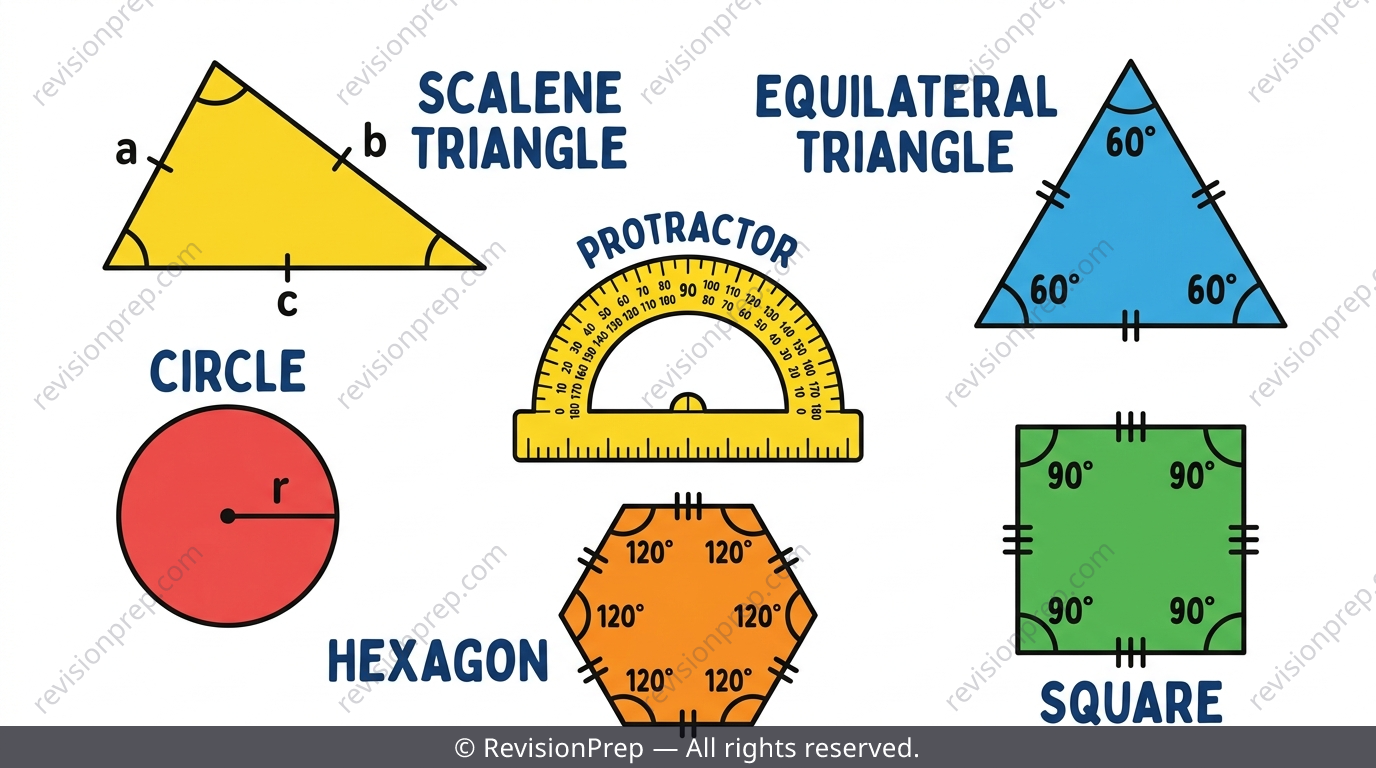
Quick facts
Properties of Shape is the MYP 2 unit where you stop just looking at a figure and start proving what it is. Every triangle and polygon gets two independent labels — one by sides, one by angles — and the exterior angle rule and interior angle sum formula are the proof engines behind almost every classification claim you'll make. Symmetry and tessellation ask whether a shape maps onto itself, while congruence and similarity compare two different figures using scale factor. Mixing up the Pythagorean inequality with the triangle inequality, or forgetting that area scales by and volume by , are the two most common ways marks slip away. This teaser walks through the five ideas examiners test most under Criterion A and D — the full revision note has every worked example, trap, and formula in depth.
What you’ll be able to do
Classifying Triangles and Polygons
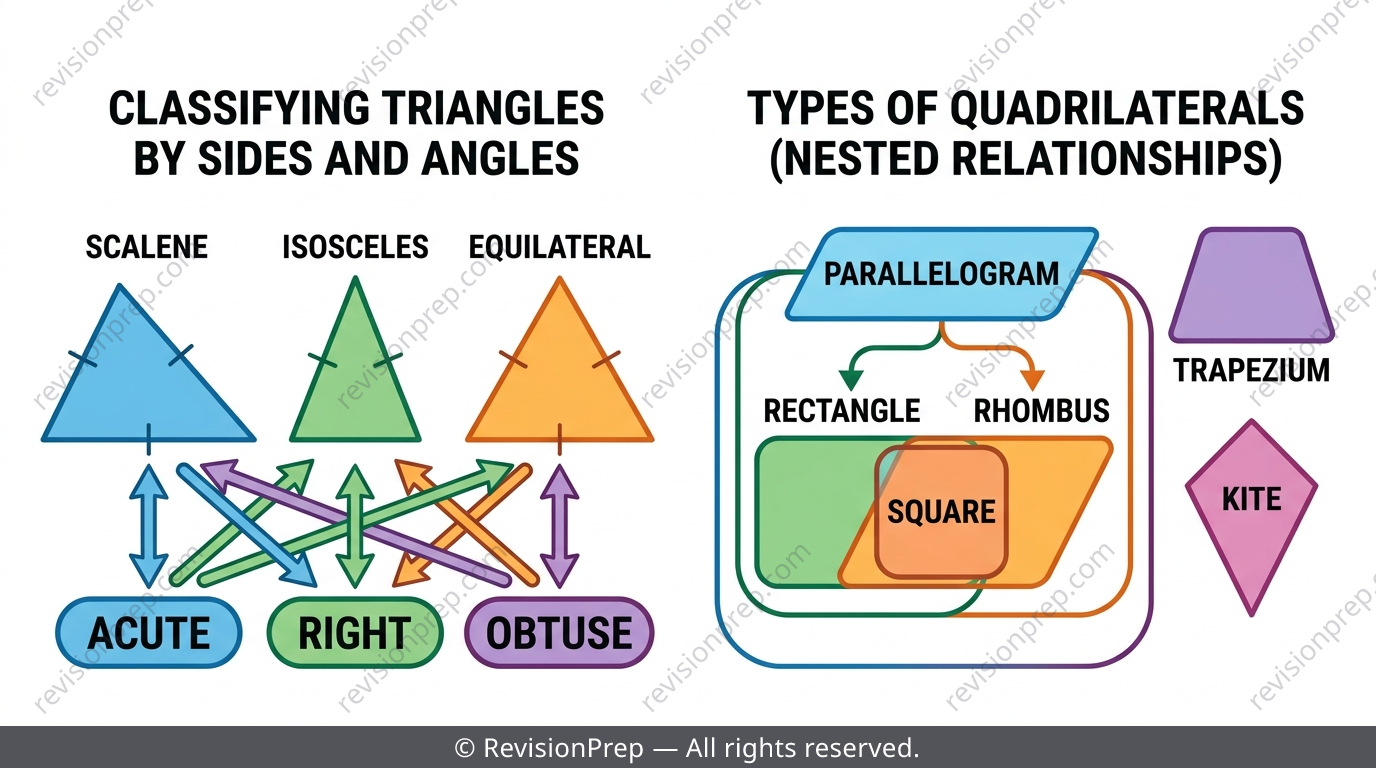
Every triangle needs two labels at once: by sides (scalene, isosceles, equilateral) and by angles (acute, right, obtuse) — a triangle can be scalene AND obtuse in the same breath. Quadrilaterals form a nested family: parallelograms include rectangles and rhombi, and a square is both at once, while a trapezium has exactly one pair of parallel sides and a kite has two pairs of adjacent equal sides. Always classify using the definition given in the question — some questions define isosceles as 'exactly two equal sides,' which excludes equilateral triangles even though other textbooks treat equilateral as a special case.
Exam tip
If a question defines a term (like isosceles) in its wording, use that exact definition — don't default to your general assumption.
Common mistake
Giving only one classification label (sides OR angles) when the question asks for both.
Mini summary
Triangles get two independent labels; quadrilaterals nest inside each other by their parallel-side and equal-side properties.
Angle Sum Rules: The Proof Engine
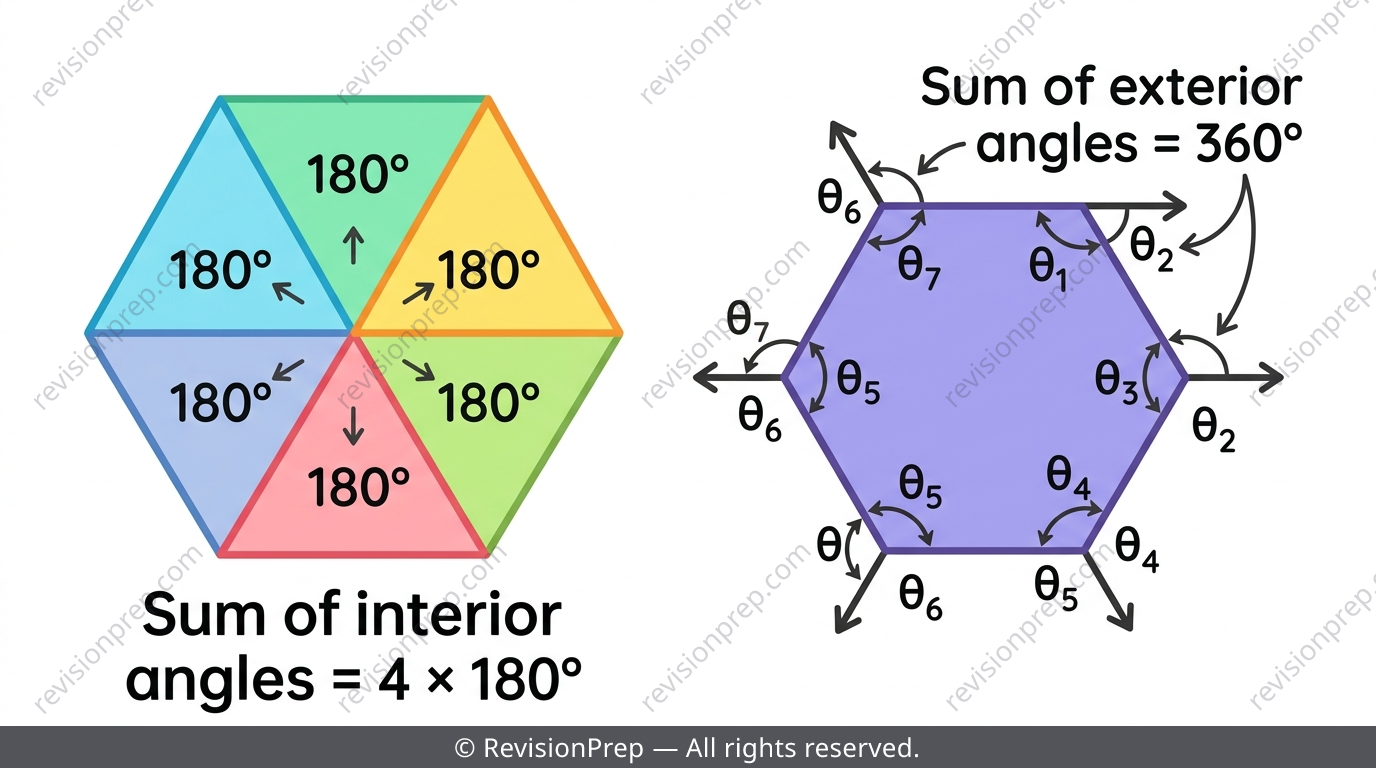
The interior angles of any triangle sum to , and splitting an n-sided convex polygon into (n−2) triangles from one vertex gives the general interior angle sum formula. Separately — and this trips students up — the exterior angles of ANY convex polygon always sum to , whether it's a triangle or a 20-gon. These two rules are independent proof tools, not the same fact restated.
Exam tip
Write for exterior angles and the formula for interior angles as two separate memorized facts — don't derive one from the other under time pressure.
Common mistake
Assuming the exterior angle sum changes with the number of sides — it never does, it's always 360°.
Mini summary
Interior angle sum depends on n; exterior angle sum is always 360° regardless of n.
Pythagorean Inequality vs Triangle Inequality
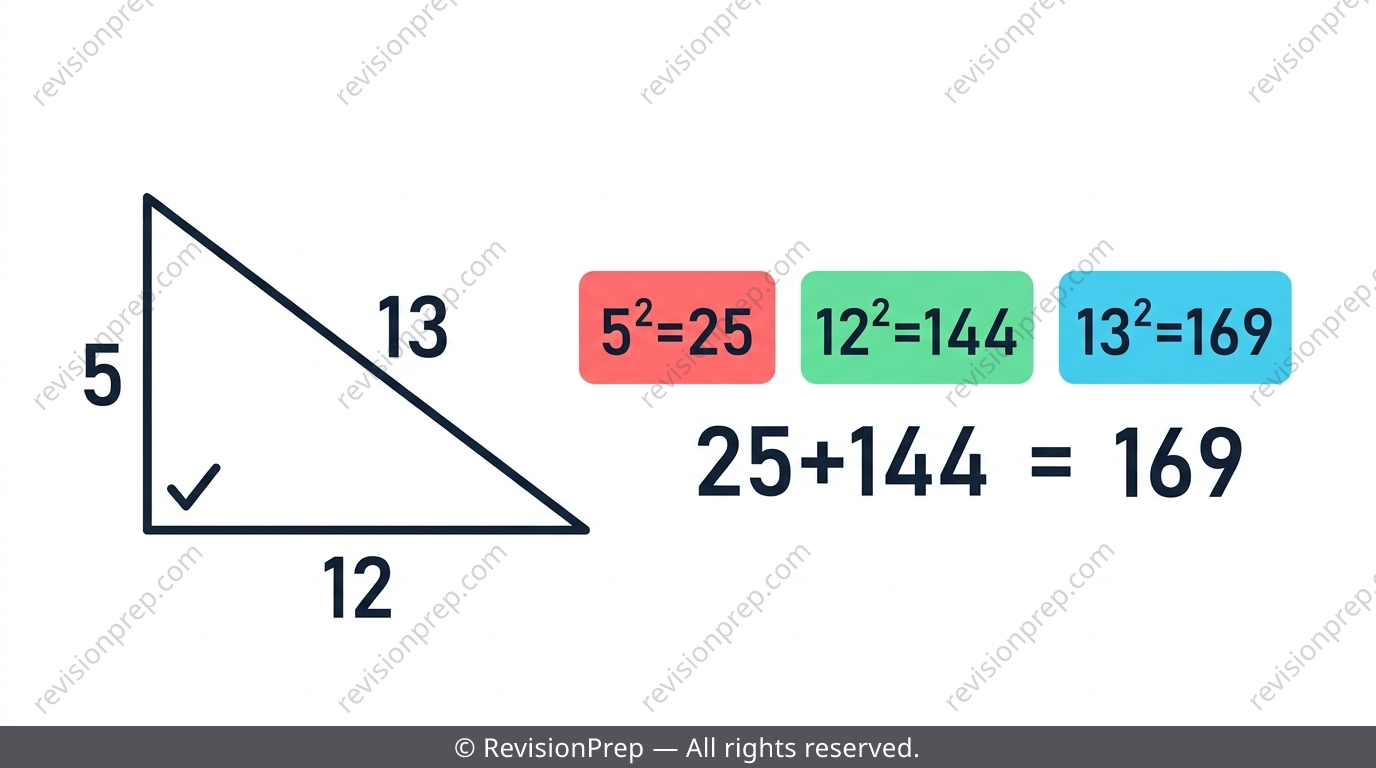
These two rules answer completely different questions. The triangle inequality (sum of any two sides > the third) checks whether a triangle can exist at all. The Pythagorean inequality compares to (using the longest side as c) to tell you the angle type: equal means right-angled, greater means acute, less means obtuse. Always identify the longest side first — squaring the wrong pair flips the inequality and gives the opposite classification.
Exam tip
Write out , , and as three separate numbers before comparing — this earns the justification mark even if later arithmetic slips.
Common mistake
Squaring the two shortest-looking numbers without confirming which side is actually longest, flipping the classification.
Mini summary
Triangle inequality = existence check; Pythagorean inequality = angle-type check using the longest side squared.
Symmetry and Tessellation
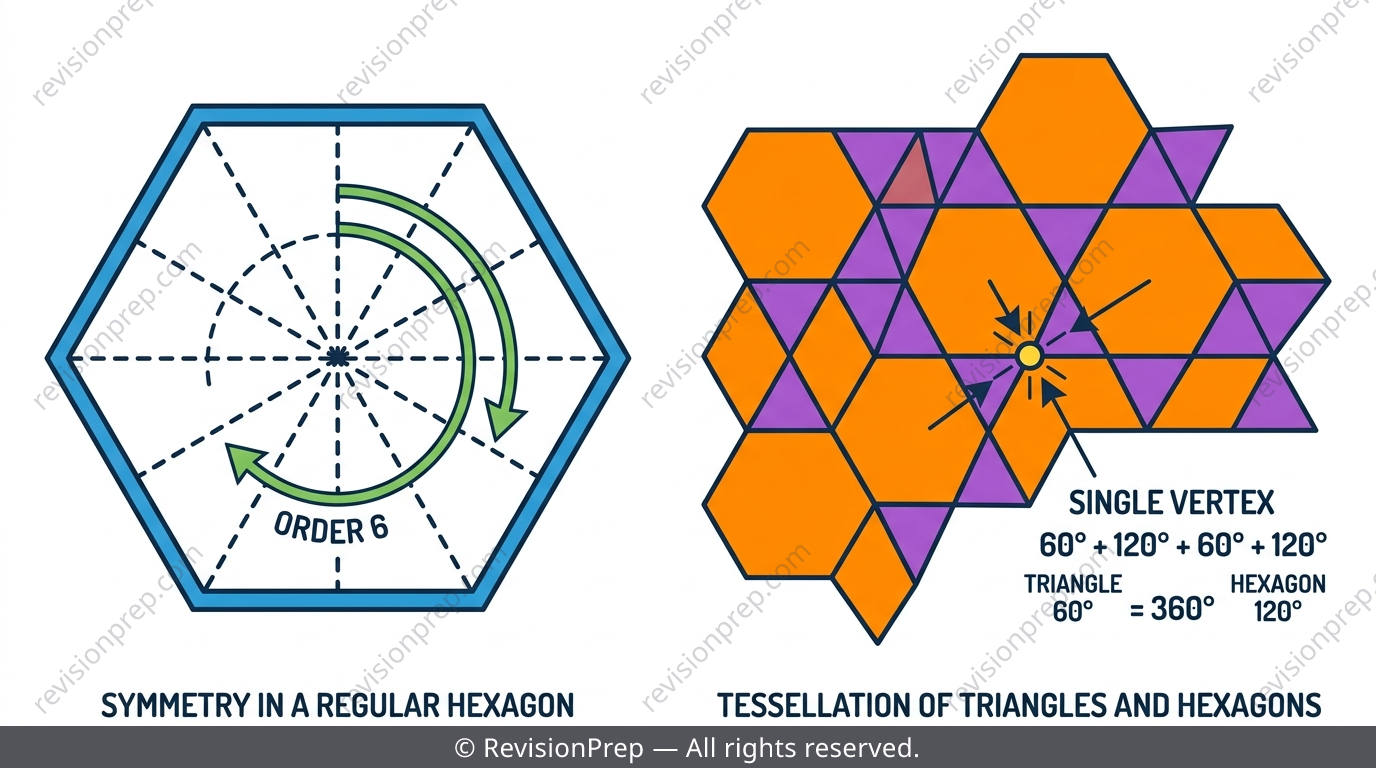
Line symmetry is the fold test — both halves match exactly across a line. Rotational symmetry order counts how many positions in one full 360° turn make the shape look identical to its start; a regular n-gon has n lines of symmetry and rotational order n. Only equilateral triangles (60°), squares (90°), and regular hexagons (120°) tessellate alone, because only these interior angles divide exactly into 360° at a vertex.
Exam tip
For semi-regular tessellations, add up the angles meeting at one vertex — if they total exactly 360°, the combination tiles perfectly.
Common mistake
Assuming any regular polygon can tessellate alone — most can't, only the three with angles dividing evenly into 360°.
Mini summary
Symmetry checks self-matching under fold or turn; tessellation checks whether angles at a vertex sum to exactly 360°.
Congruence and Similarity
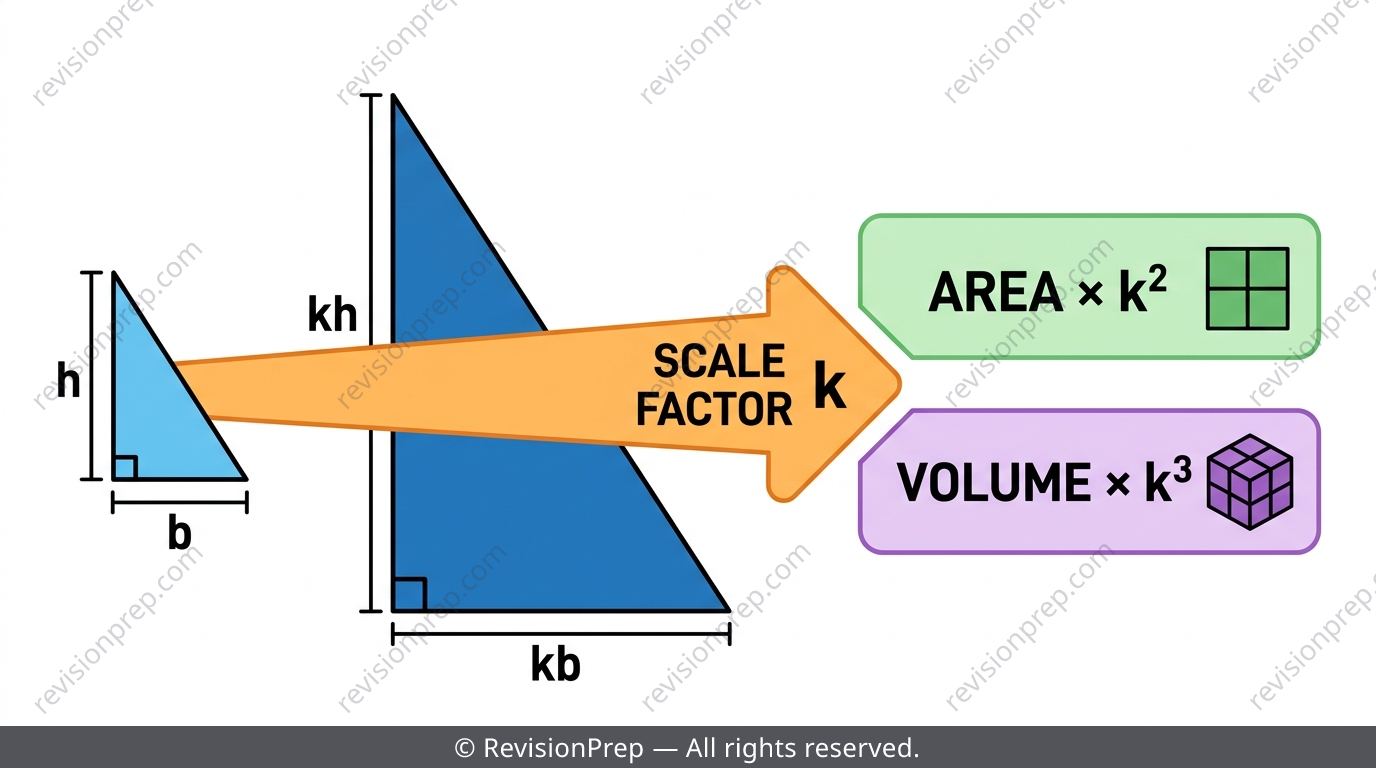
Congruent shapes are identical — same size, same shape, proven with SSS, SAS, ASA, AAS, or RHS. Similar shapes share the same shape but differ in size, linked by a single scale factor k; only two matching angles (AA) are needed to prove similarity, since the third angle must then match automatically. The critical trap: lengths scale by k, but area scales by and volume scales by — forgetting to square or cube k is the most tested error in this subtopic.
Exam tip
Before scaling area or volume, write k first, then explicitly square or cube it — don't multiply area or volume by k directly.
Common mistake
Multiplying area or volume by the scale factor k instead of or .
Mini summary
Congruent = identical; similar = same shape, scaled by k, with area scaling as and volume as .
Quick formula sheet
Practice questions
- Classify a triangle with sides 6, 6, 6 cm by both sides and angles.
- How many lines of symmetry does a regular hexagon have?
- State the condition needed for two triangles to be similar using the AA test.
- A triangle has sides 7, 8, 9 cm. Use the Pythagorean inequality to classify it by angle type.
- Find the sum of the interior angles of a regular octagon.
- Explain why a square can also be called both a rectangle and a rhombus.
- A carpenter cuts three wooden braces of 60 cm, 60 cm, and 85 cm, but each piece may be off by ±1 cm due to cutting tolerance. Explain how this could change the triangle's angle classification.
- Two similar triangles have a scale factor of 3. If the smaller triangle has an area of 12 cm², find the area of the larger triangle.
- Explain, using the interior angle sum formula, why the exterior angles of any convex polygon must sum to 360°.
Frequently asked questions
What is the difference between congruence and similarity?+
Congruent shapes are exactly identical in size and shape, proven with tests like SSS or SAS. Similar shapes share the same shape and equal angles but differ in size, connected by a single scale factor.
How do you classify a triangle by both sides and angles?+
Look at side lengths for scalene, isosceles, or equilateral, then separately check the largest angle for acute, right, or obtuse — both labels are usually needed together.
Why is the exterior angle sum always 360° for any polygon?+
Walking fully around the outside of any convex polygon completes exactly one full turn, so the exterior angles always total 360° regardless of how many sides the polygon has.
Which shapes tessellate on their own?+
Only equilateral triangles, squares, and regular hexagons tessellate alone, because their interior angles (60°, 90°, 120°) divide exactly into 360° at each vertex.
What's the difference between the triangle inequality and the Pythagorean inequality?+
The triangle inequality checks whether a triangle can exist at all (sum of any two sides must exceed the third). The Pythagorean inequality instead tells you the angle type by comparing a² + b² to c².
Does area scale the same way as length when a shape is enlarged?+
No. If lengths scale by factor k, area scales by k², and volume scales by k³ — forgetting to square or cube k is one of the most common mistakes in this topic.
Master Geometry: Properties of Shape for MYP 2
Related articles