
Equations, Inequalities & Formulae
IB MYP 2 Maths: the exact balancing rules, the one sign-flip trap, and how to turn words into working algebra
Quick facts
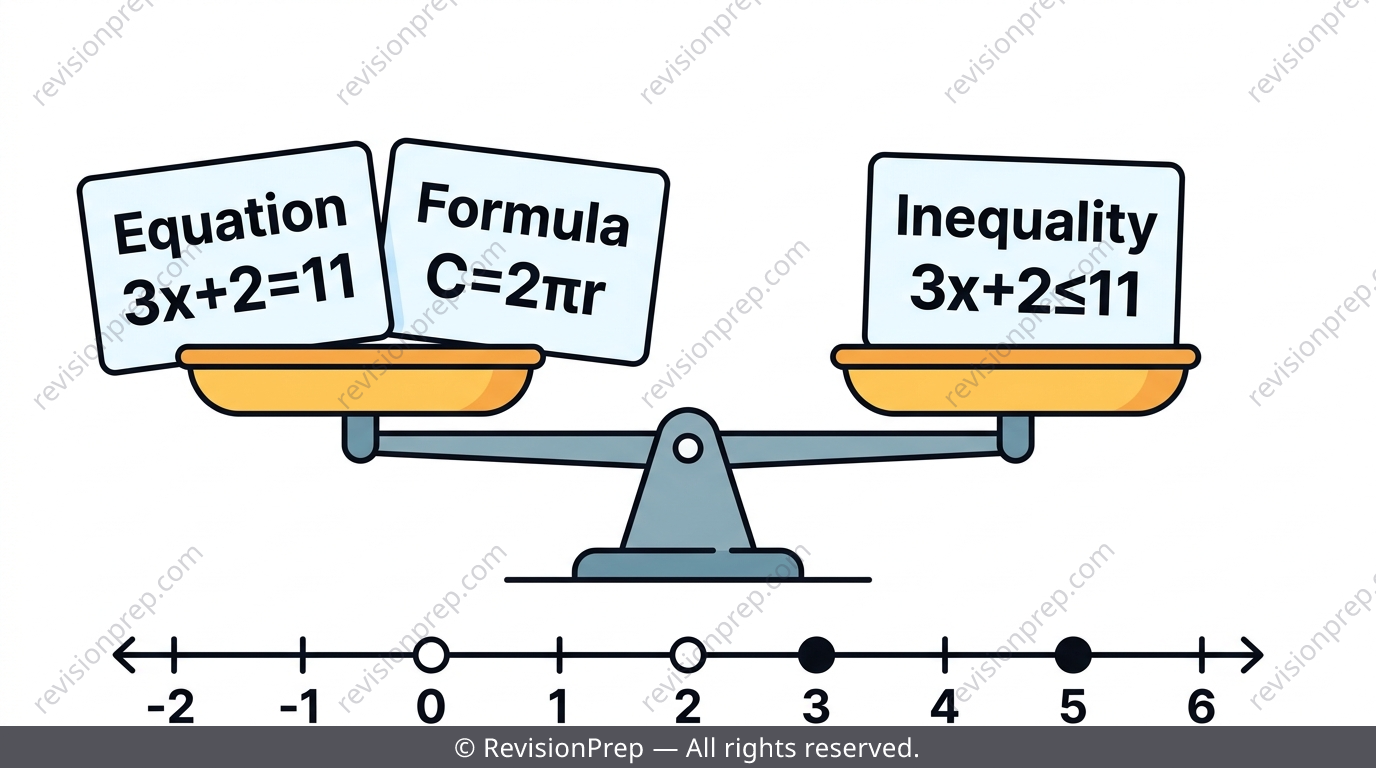
Equations, inequalities, and formulae all get manipulated with the same balancing rules — but each one is testing something slightly different. An equation gives you one exact answer, an inequality hands you a whole range of solutions, and a formula is a reusable rule you rearrange and substitute into rather than 'solve' once. In IB MYP 2 Maths, this topic shows up constantly across Number & Algebra units, and most marks are lost not on the algebra itself but on the small details: forgetting to flip an inequality sign, drawing the wrong circle on a number line, or mistranslating 'decreased by' into the wrong equation. This teaser walks through the five ideas examiners test most — enough to check your understanding fast, with the full worked examples, formula sheet, and practice questions waiting in the complete revision notes.
What you’ll be able to do
Equation vs Inequality vs Formula: What Each One Actually Claims
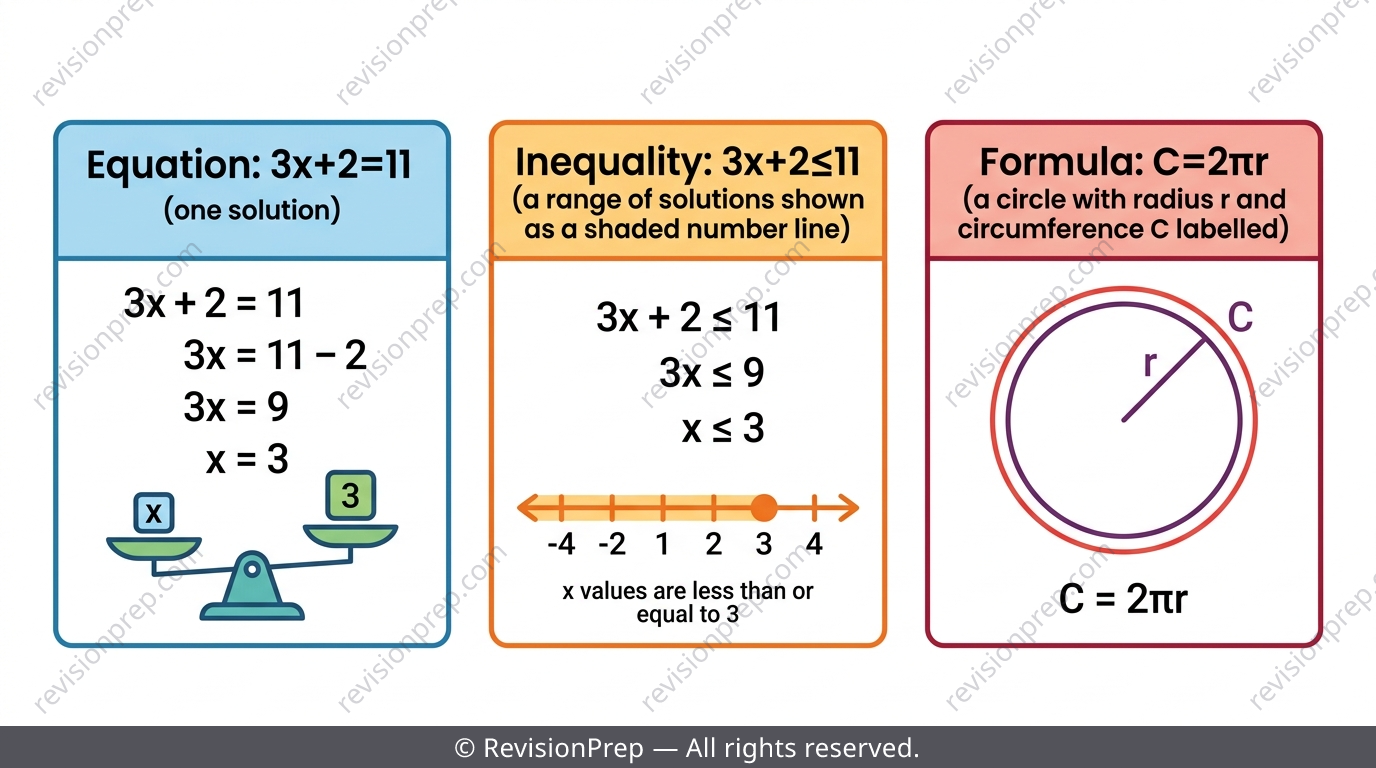
An equation like claims two expressions are exactly equal and has one solution. An inequality like claims one side is bigger, smaller, or not equal, giving infinitely many solutions instead of one. A formula like is a reusable rule linking several variables — you substitute into it rather than solve it once and discard it. All three use the same balancing steps: whatever you do to one side, you do to the other, in the same order.
| Feature | Equation | Inequality | Formula |
|---|---|---|---|
| Symbol used | = | <, >, ≤, ≥, ≠ | = |
| Number of solutions | Usually one | Infinitely many | One relationship, many uses |
| Goal | Find x | Find range of x | Change the subject, then substitute |
Mini summary
Same balancing rules for all three — but only inequalities carry the extra sign-flip rule.
Solving Inequalities and the One Extra Rule
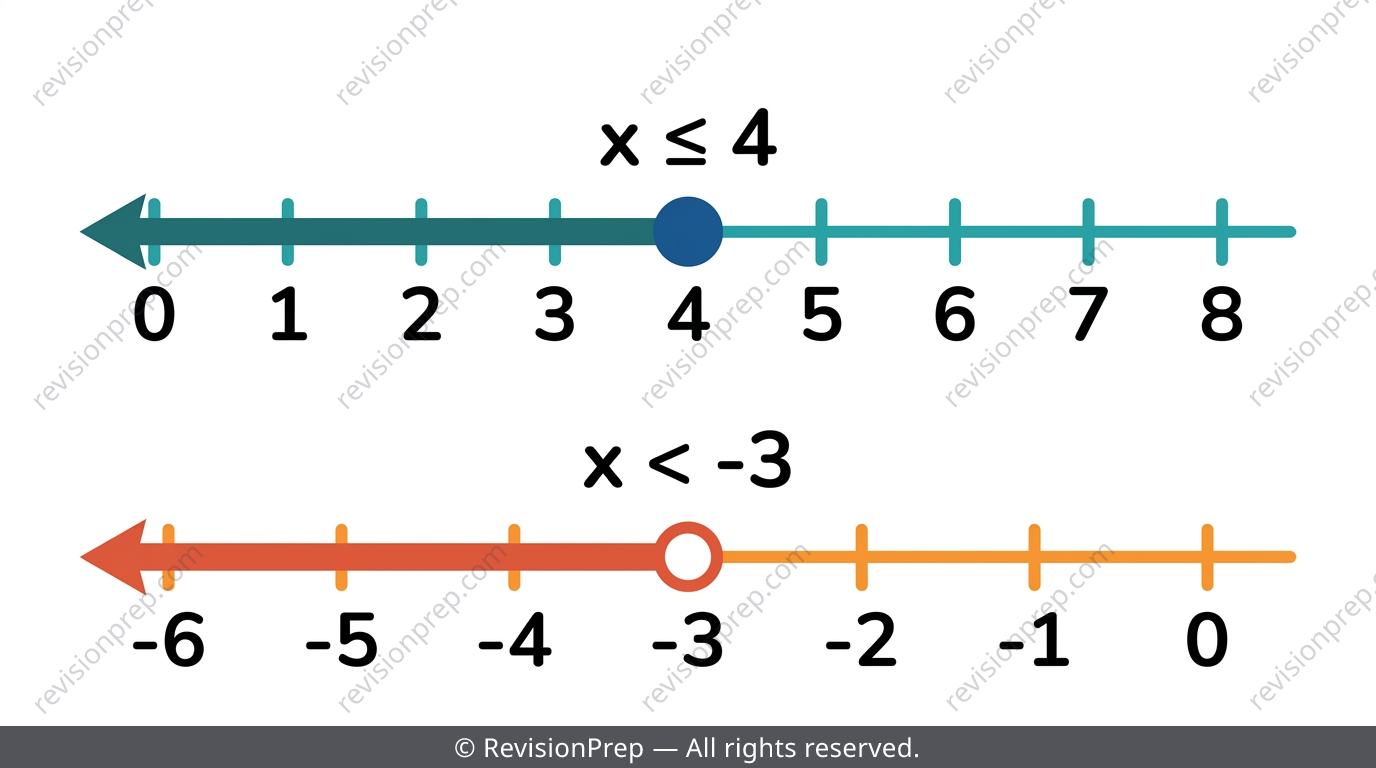
Solve an inequality exactly like an equation, using inverse operations to isolate the variable. The one difference: multiplying or dividing both sides by a negative number flips the direction of the sign — adding or subtracting a negative never does. On a number line, and use an open circle because the boundary is excluded, while and use a closed circle because the boundary value is a valid solution.
Exam tip
If asked why a closed circle is used, you must reference the boundary value being included — e.g. 'so itself is a valid solution' — not just restate what means.
Common mistake
Solving and writing instead of — the sign must flip the moment you divide by a negative, in the same step, not as an afterthought.
Mini summary
Same steps as equations, except: ×/÷ by a negative flips the sign, and ≤/≥ always get a closed circle.
Turning Word Problems into Equations
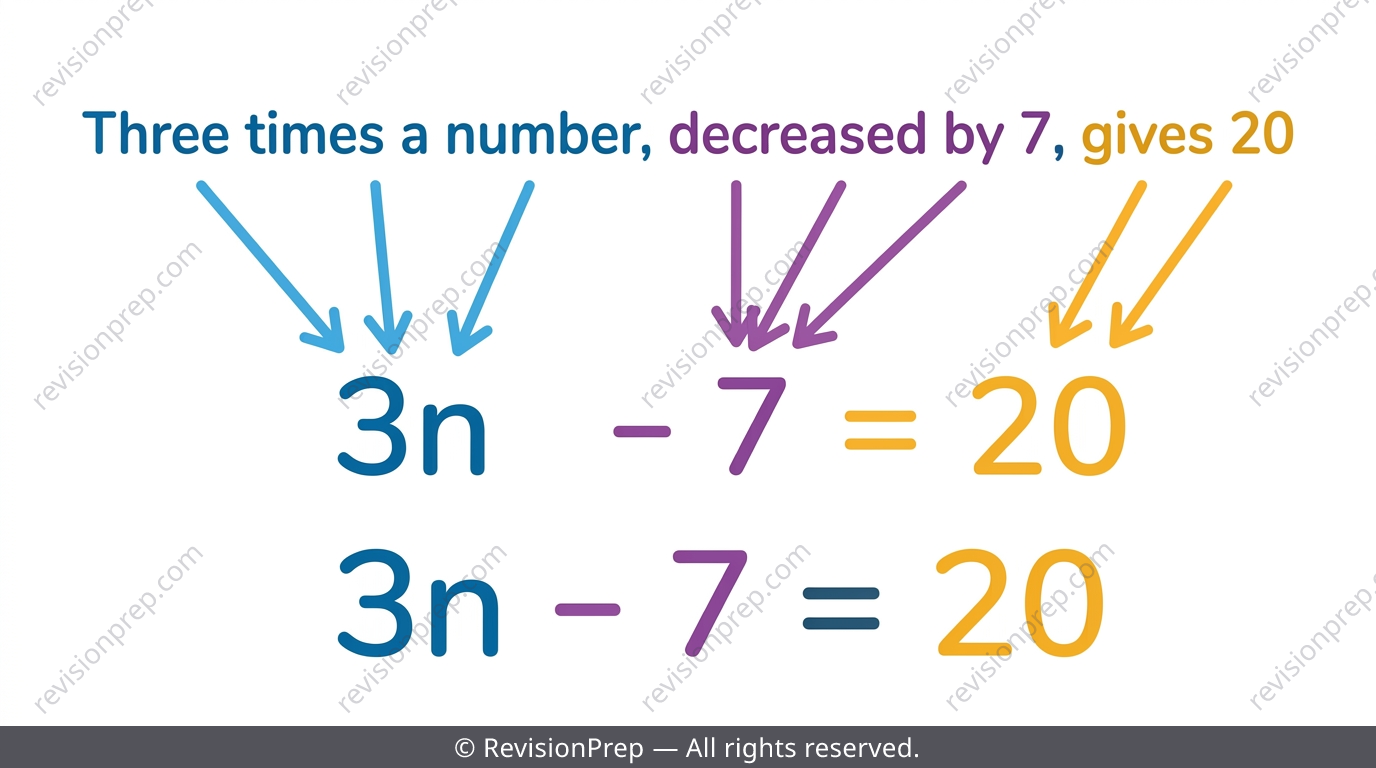
Word problems usually fail on translation, not algebra — the equation is easy once it's written correctly. Always name the unknown in words first ('let = the number'), since this earns a method mark on its own. Watch phrases like 'decreased by' and 'less than' carefully, as they can reverse the order you'd naturally write the terms.
Exam tip
Write 'let = ...' before touching any algebra — under MYP Criterion A this is often worth a mark by itself.
Common mistake
Writing instead of for 'three times a number, decreased by 7, gives 20' — this reverses which quantity is subtracted from which and gives a negative, wrong answer.
Mini summary
Define the variable in words, translate keyword by keyword, then solve and check the answer against the original sentence.
Rearranging Formulae to Change the Subject
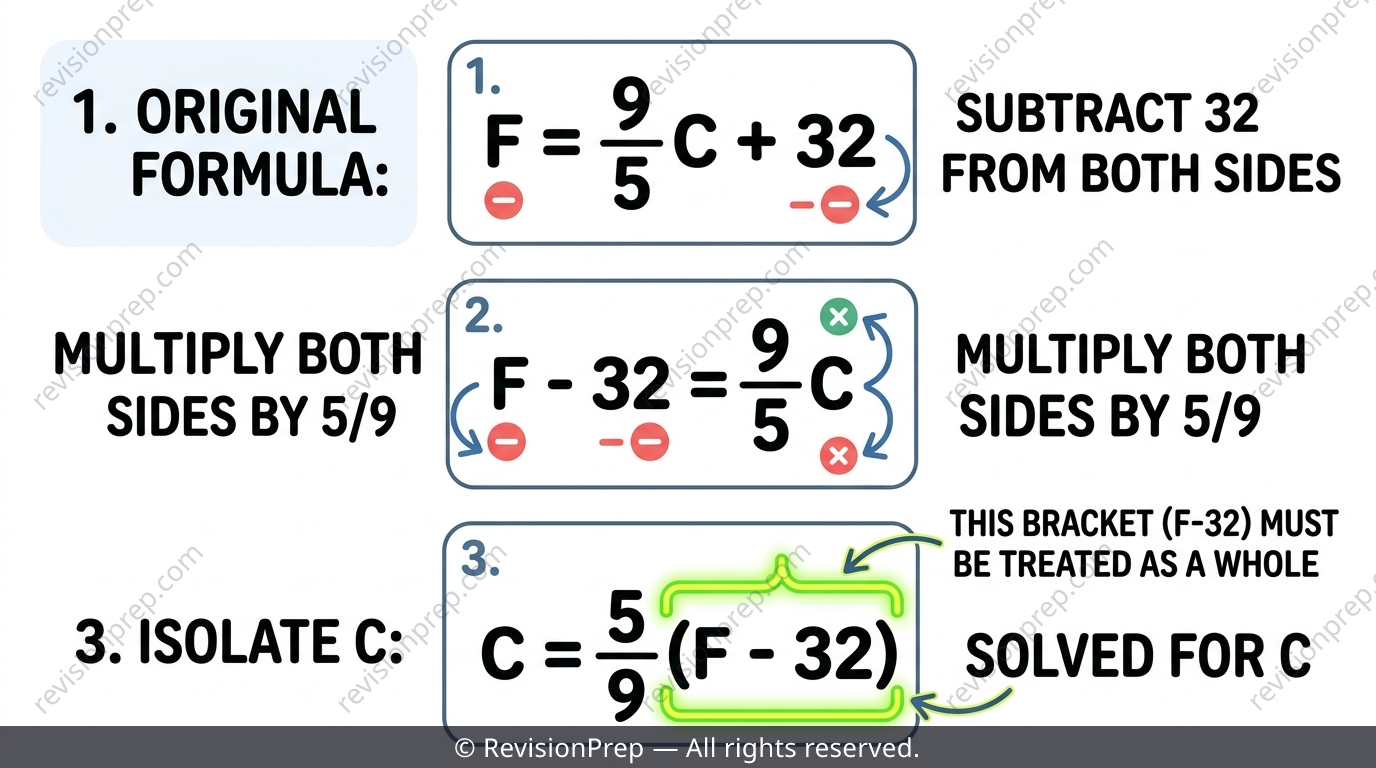
A formula's 'subject' is whichever letter stands alone on one side, and rearranging it uses the same balancing rules as solving for — other letters just get carried along instead of turning into numbers. Isolate the term with the target letter first by undoing addition/subtraction, then undo multiplication/division. If the target letter sits inside a bracket multiplied by something, that multiplier must be undone across the WHOLE bracket, not just one term.
Exam tip
Write each balancing step on its own line — formula-manipulation questions award method marks per step, so jumping straight to the final answer risks losing marks on a slip.
Common mistake
Rearranging and multiplying only the term by , writing instead of correctly distributing across the whole expression.
Mini summary
Isolate the term with the target letter, undo operations in reverse order, and distribute across brackets fully before substituting.
Compound Inequalities and Real-World Limitations
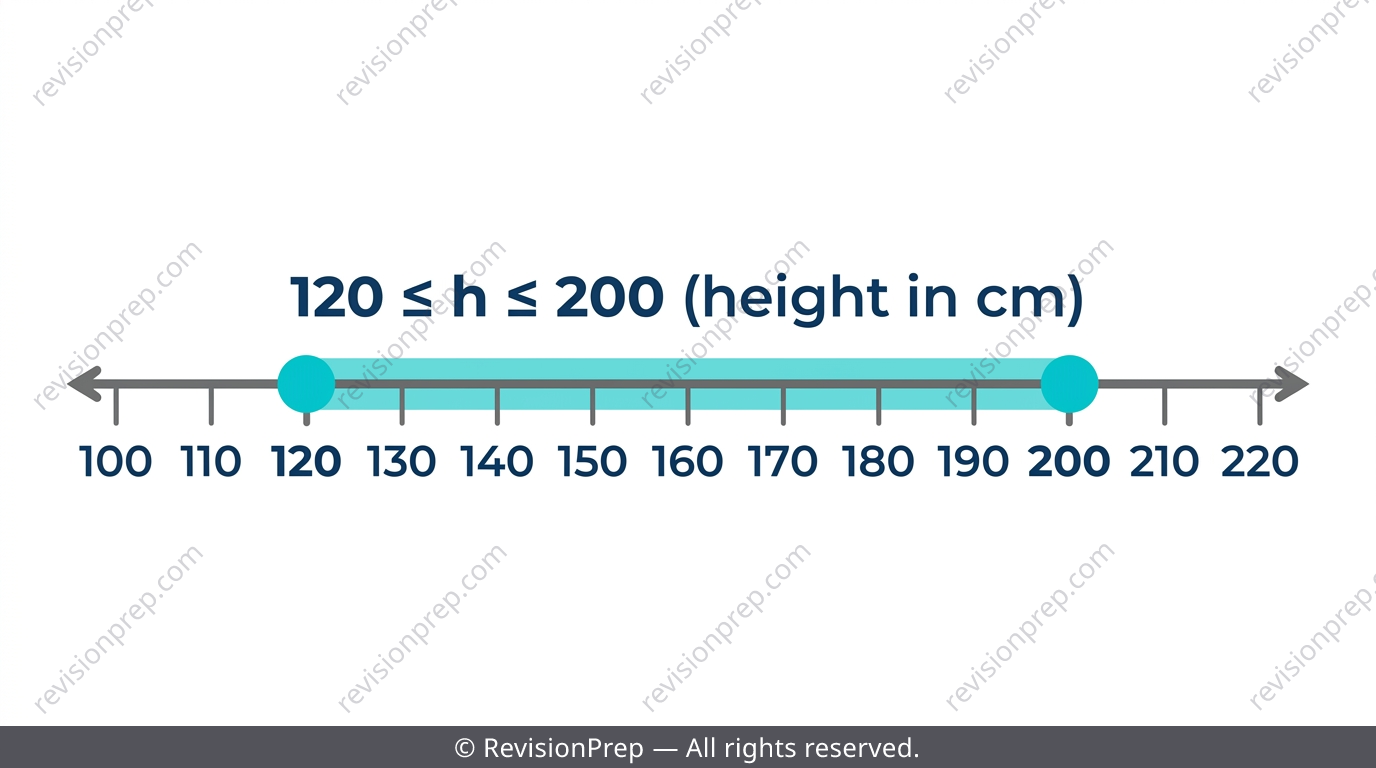
Two conditions can combine into one compound inequality, such as , meaning both conditions hold at the same time. In word problems, 'at least' means , 'no more than'/'at most' means , while 'more than' and 'fewer than' are strict (, ). Real-world models built from inequalities always have limitations — the maths boundary is exact, but the real situation usually isn't.
Exam tip
If asked for a limitation of a model, describe what the inequality fails to capture about the real situation — restating the rule itself earns zero marks.
Common mistake
For a theme park height rule, answering 'because some people are too short' instead of identifying what height alone fails to measure — this just restates the inequality rather than critiquing the model.
Mini summary
Compound inequalities combine two conditions on the variable; always question what a real-world inequality model can't account for.
Quick formula sheet
Practice questions
- Solve the inequality and represent the solution on a number line.
- Write an inequality for: 'a number is at least 15'.
- State whether the boundary value is included for the inequality .
- Solve , showing the step where the sign flips.
- Five less than twice a number is 17. Write and solve the equation for the number.
- Make the subject of the formula .
- A delivery service charges based on weight in kg using . Rearrange the formula to make the subject, then find when .
- A ride requires riders to be at least 130 cm and no more than 195 cm tall. Write the compound inequality, then state one limitation of this height-based model.
- Rearrange to make the subject, being careful with the bracket, and explain the common mistake students make here.
Frequently asked questions
What's the difference between an equation and an inequality?+
An equation claims two expressions are exactly equal and usually has one solution, while an inequality compares them using or and gives a whole range of solutions.
When do you flip an inequality sign?+
Only when you multiply or divide both sides by a negative number. Adding or subtracting a negative number never flips the sign.
How do I know whether to use an open or closed circle on a number line?+
Use a closed circle for or because the boundary value is included, and an open circle for strict or because it's excluded.
What's the 'subject' of a formula?+
It's whichever letter stands alone on one side of the formula. Rearranging changes which letter is the subject using the same balancing rules as solving an equation.
How do I turn a word problem into an equation without making mistakes?+
Name the unknown in words first, then translate keyword by keyword, paying close attention to phrases like 'decreased by' or 'less than' that can reverse term order.
Where can I find full worked examples and practice for this MYP 2 topic?+
The complete revision notes on RevisionPrep cover every example, common mistake, and formula in depth, plus original mock practice questions.
Get the Full MYP 2 Revision Notes on Equations, Inequalities & Formulae
Related articles