
Number Operations and Applications
BODMAS, divisibility, remainders and number properties for IB MYP 2 — with the traps examiners actually test.
Quick facts
Number operations look simple until brackets, powers, and mixed multiplication/division show up in the same expression — and that's exactly where IB MYP 2 exam questions hide their traps. This topic underpins almost every other unit in the year, from simplifying fractions to solving word problems, because it all comes back to correctly applying BODMAS (or PEMDAS), understanding divisibility and remainders, and using the commutative, associative and distributive properties confidently. Criterion A and C both reward students who can show clear, correctly ordered working rather than just stating a final number. This teaser covers the five ideas most likely to appear in short-answer and applied problem-solving tasks, with the common mistakes students actually make and quick fixes for each. For the full worked examples, definitions and practice set, the complete revision note is linked at the end.
What you’ll be able to do
BODMAS / PEMDAS — Order of Operations
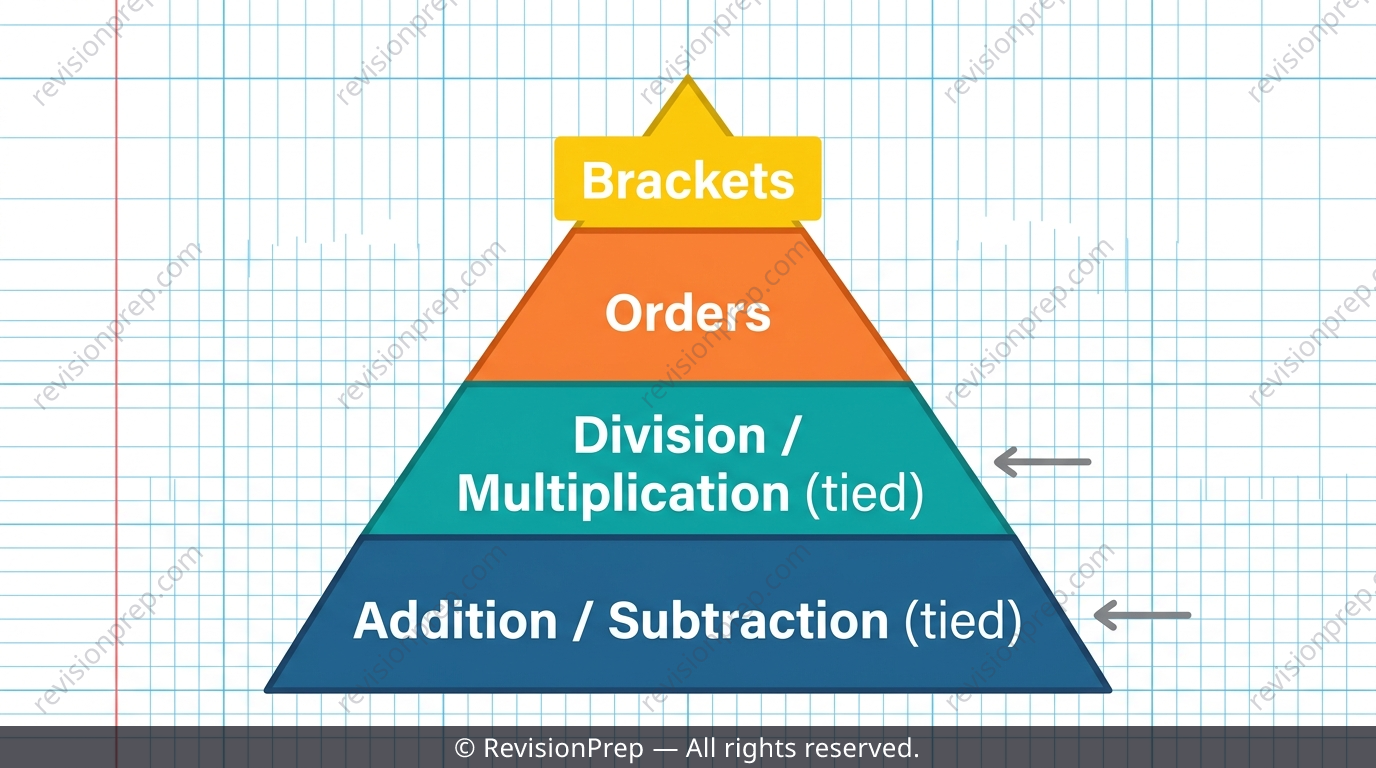
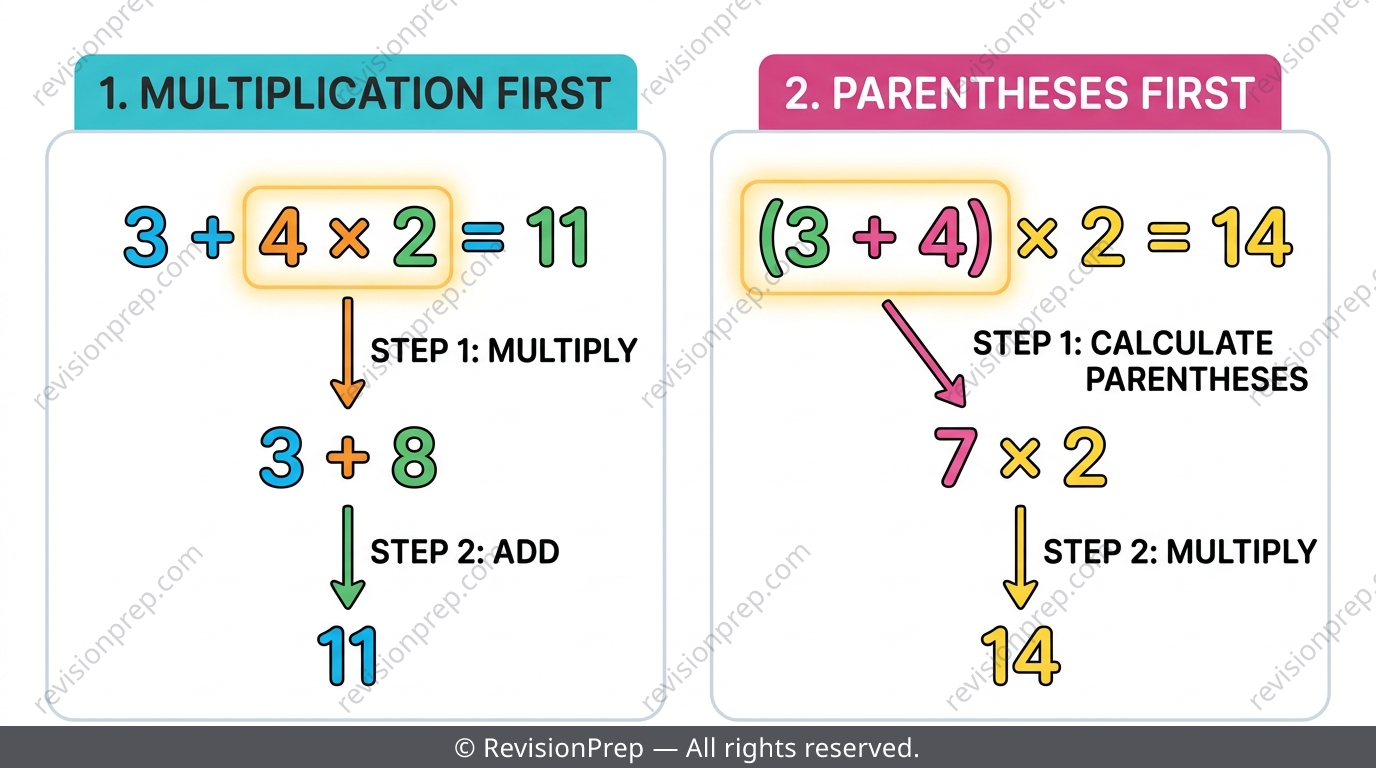
BODMAS and PEMDAS name the exact same four-tier hierarchy: Brackets/Parentheses, then Orders/Exponents, then Division and Multiplication together, then Addition and Subtraction together. The trap most students fall into is treating Division/Multiplication (or Addition/Subtraction) as two separate rules instead of one tied tier read left to right. A fraction bar also acts like an invisible bracket, grouping only the numbers it separates.
| Tier | Operations | Rule |
|---|---|---|
| 1 | Brackets/Parentheses | Innermost first |
| 2 | Orders/Exponents | Powers and roots before anything else |
| 3 | Division/Multiplication | Equal rank — left to right |
| 4 | Addition/Subtraction | Equal rank — left to right |
Exam tip
Explain/describe questions want the named tiers (brackets, orders, division/multiplication, addition/subtraction) in your answer — not just the correct number.
Common mistake
Doing all multiplications before any division: evaluating as instead of the correct left-to-right .
Mini summary
Four tiers, not six rules — Division/Multiplication tie, and so do Addition/Subtraction.
Divisibility and Remainders
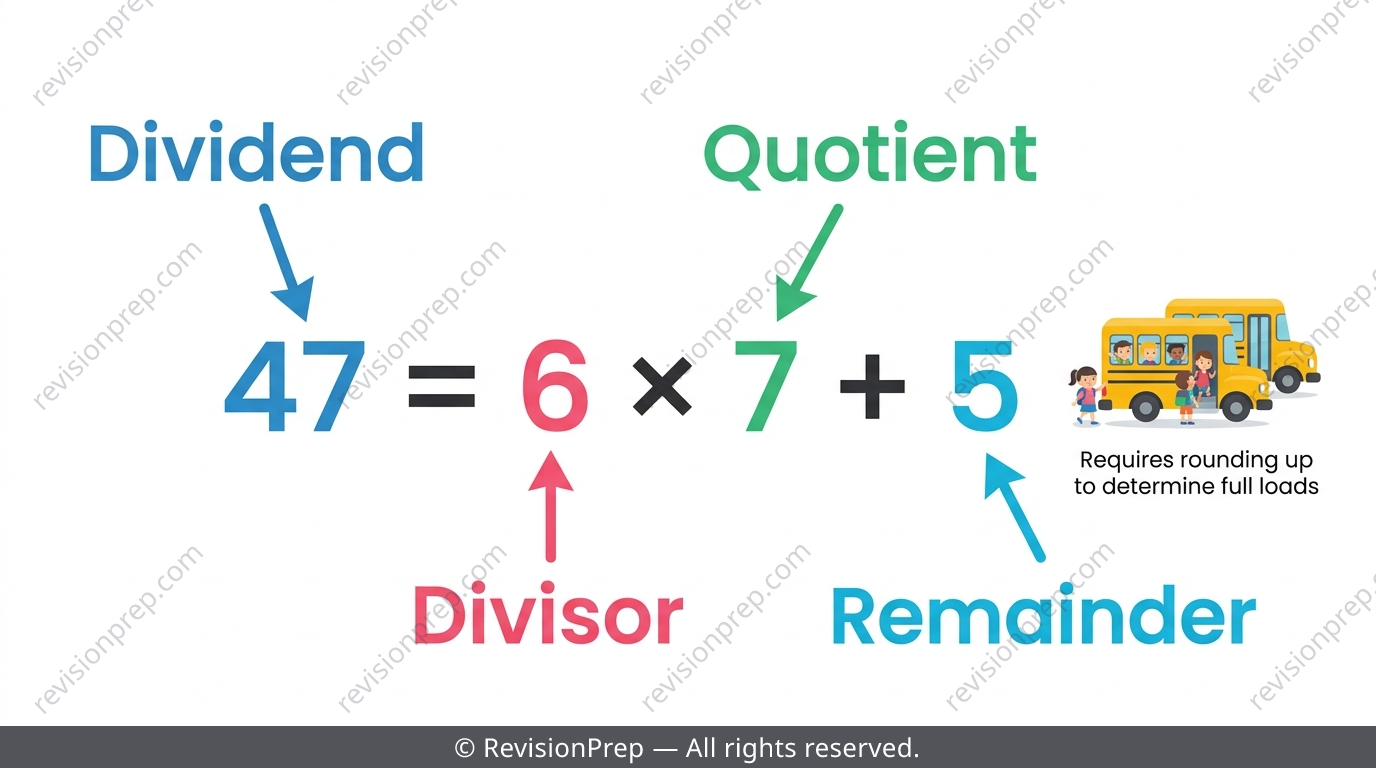
Every whole-number division fits the pattern , where the remainder is always smaller than the divisor . Divisibility rules let you check facts like divisibility by 3 or 9 (digit sum) or by 4 or 8 (last two or three digits) without doing full division. In real-world context questions, a nonzero remainder usually means you must round up, not just report the leftover number.
| Divisible by | Rule |
|---|---|
| 2, 5, 10 | Check the last digit |
| 4 | Check the last two digits |
| 8 | Check the last three digits |
| 3, 9 | Check the digit sum |
Exam tip
If a question asks you to 'verify', write out explicitly with your numbers substituted in.
Common mistake
Checking only the last digit for divisibility by 4 (as if it were the rule for 2) instead of checking the last two digits.
Mini summary
a = bq + r is the backbone of every remainder question — and context often forces rounding up.
Commutative, Associative and Distributive Properties
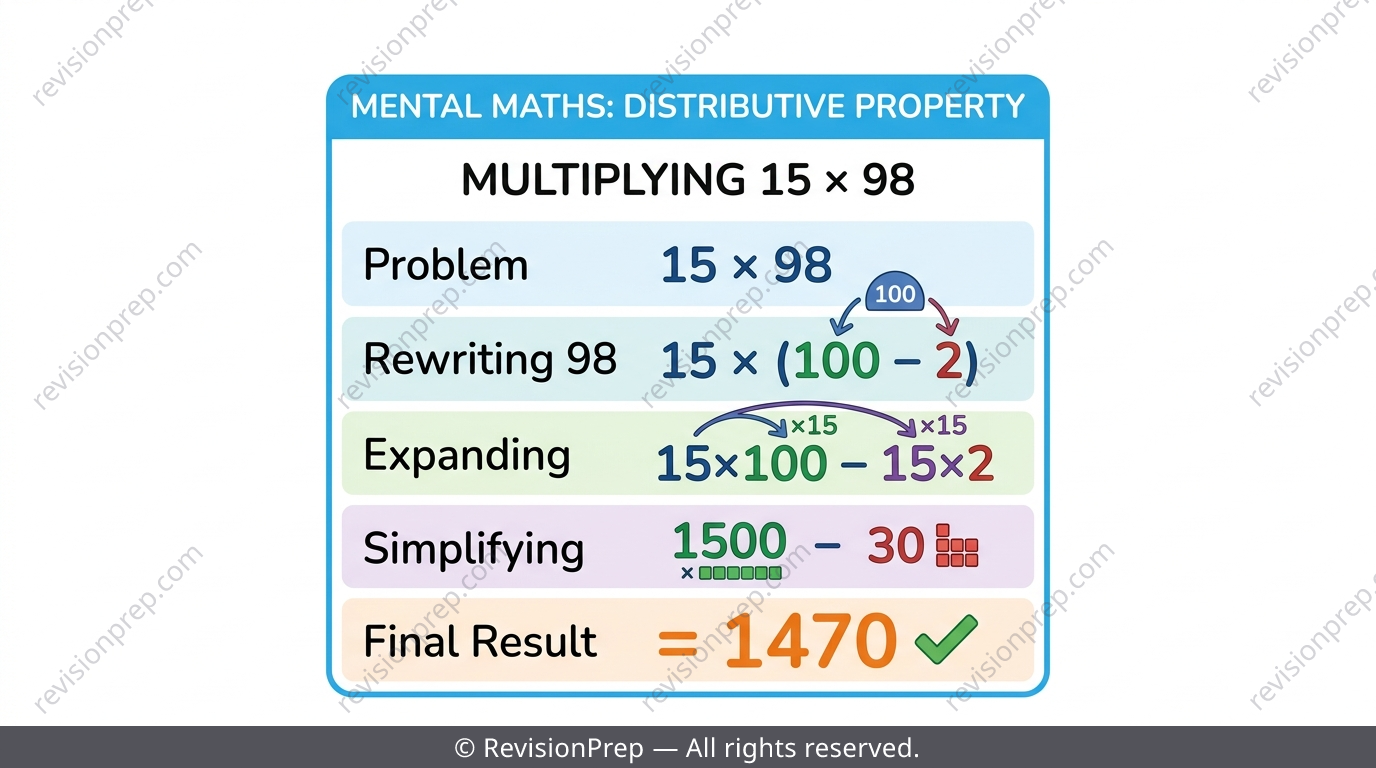
Commutative and associative properties let you reorder or regroup numbers freely for addition and multiplication — but they break down for subtraction and division. The distributive property, , is the single most useful mental-maths shortcut in this chapter, letting you rewrite awkward numbers as nearby round numbers and correct back afterward.
Exam tip
When using the distributive property to round a number up (like 98 → 100), remember to subtract the extra amount back at the end.
Common mistake
Using the distributive shortcut to rewrite as but forgetting to subtract afterward.
Mini summary
Commutative and associative properties only work for + and ×; distributive property is your mental-maths shortcut.
Working with Negative Numbers
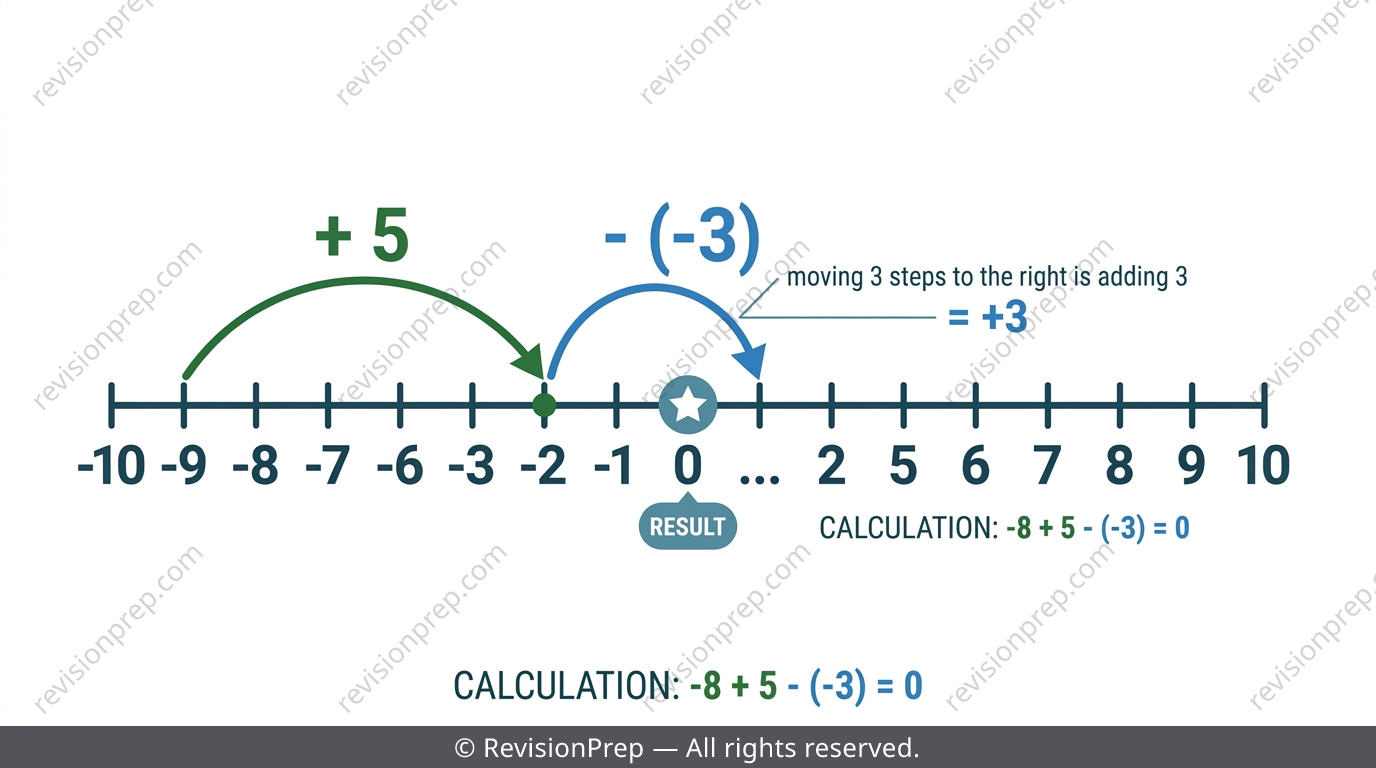
Subtracting a negative number is the same as adding its positive value: . This single sign rule causes the most silent errors in whole-number arithmetic when students misread the double negative. Writing the conversion as its own explicit step before calculating prevents the mistake.
Exam tip
Convert to as a separate written step — don't try to do it mentally.
Common mistake
Reading as instead of , which flips the entire final answer.
Mini summary
Two negatives make a positive — always write this conversion out as its own step.
Applying Number Operations to Word Problems
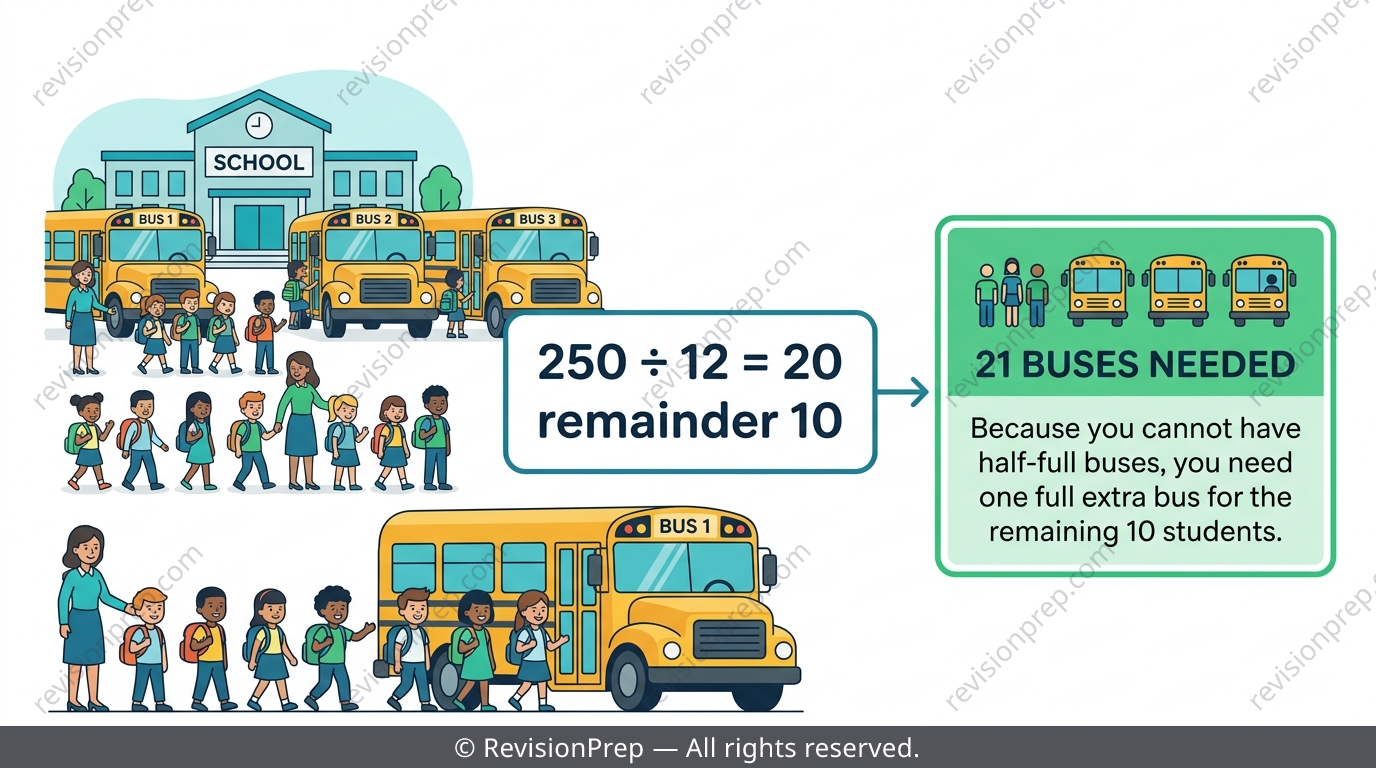
Most marks lost in this topic come from the translation step — turning English into a correct expression before BODMAS is even applied. In context questions, like loading students onto buses, the pure arithmetic remainder isn't the final answer; you almost always need to round up when dealing with whole people, objects or containers.
Exam tip
Write one operation per line and label its tier — markers award a method mark per correctly ordered step.
Common mistake
Stopping at the arithmetic remainder in a context question (e.g. '20 buses, remainder 10') instead of rounding up to 21 buses.
Mini summary
Translate carefully, then apply BODMAS — and always sanity-check remainders against real-world context.
Quick formula sheet
Practice questions
- Evaluate .
- Find the quotient and remainder when 29 is divided by 4.
- Is 342 divisible by 3? Show your check using the digit sum rule.
- Evaluate , showing each step and labelling its tier.
- Use the distributive property to calculate without long multiplication.
- Calculate , showing the sign conversion as a separate step.
- A student evaluates and gets 14. Explain using BODMAS terms why the correct answer is 11.
- A shop has 314 items to pack into boxes of 15. How many boxes are needed, and explain why the remainder forces this answer?
- Explain why the commutative property holds for multiplication but fails for division, using a numerical example.
Frequently asked questions
Is BODMAS the same as PEMDAS?+
Yes — they describe the identical four-tier hierarchy, just with different regional names for brackets/parentheses and orders/exponents.
Do I always do multiplication before division?+
No. Multiplication and division are equal rank — whichever appears first reading left to right is done first.
How do I know if a number is divisible by 4?+
Check the last two digits of the number, not just the final digit — that's the rule for 2, not 4.
Why do I round up when a division question has a remainder?+
In real-world context (like people or buses), a nonzero remainder means an extra whole unit is still needed, so you round up rather than report the leftover.
Why does subtracting a negative number become addition?+
Because — the two negative signs cancel out, so treat this conversion as its own written step to avoid sign errors.
Get the full MYP 2 Number Operations revision notes
Related articles