
Number Concepts & Systems
The IB MYP 2 toolkit strand that makes every later ratio, algebra and measurement question error-free
Quick facts
Number Concepts & Systems is the toolkit strand of IB MYP 2 Mathematics — it isn't new maths so much as your existing number sense made exam-proof. Once you're solid on rational and irrational numbers, rounding, place value, standard form and ordering, the 'silly' errors that creep into ratio, algebra and measurement questions largely disappear. The catch is that almost every exam-style question here uses command terms like 'Show that', 'Explain' or 'Compare', which means a correct final answer with no working typically scores close to zero. This teaser walks through the five ideas that matter most: the exact test for rational numbers, the rounding rule that never changes, how standard form works, how to order tricky numbers including negatives, and why reasoning — not just the answer — is what actually earns marks. For the full worked examples, definitions and practice set, the complete revision notes are linked below.
What you’ll be able to do
Rational vs Irrational Numbers
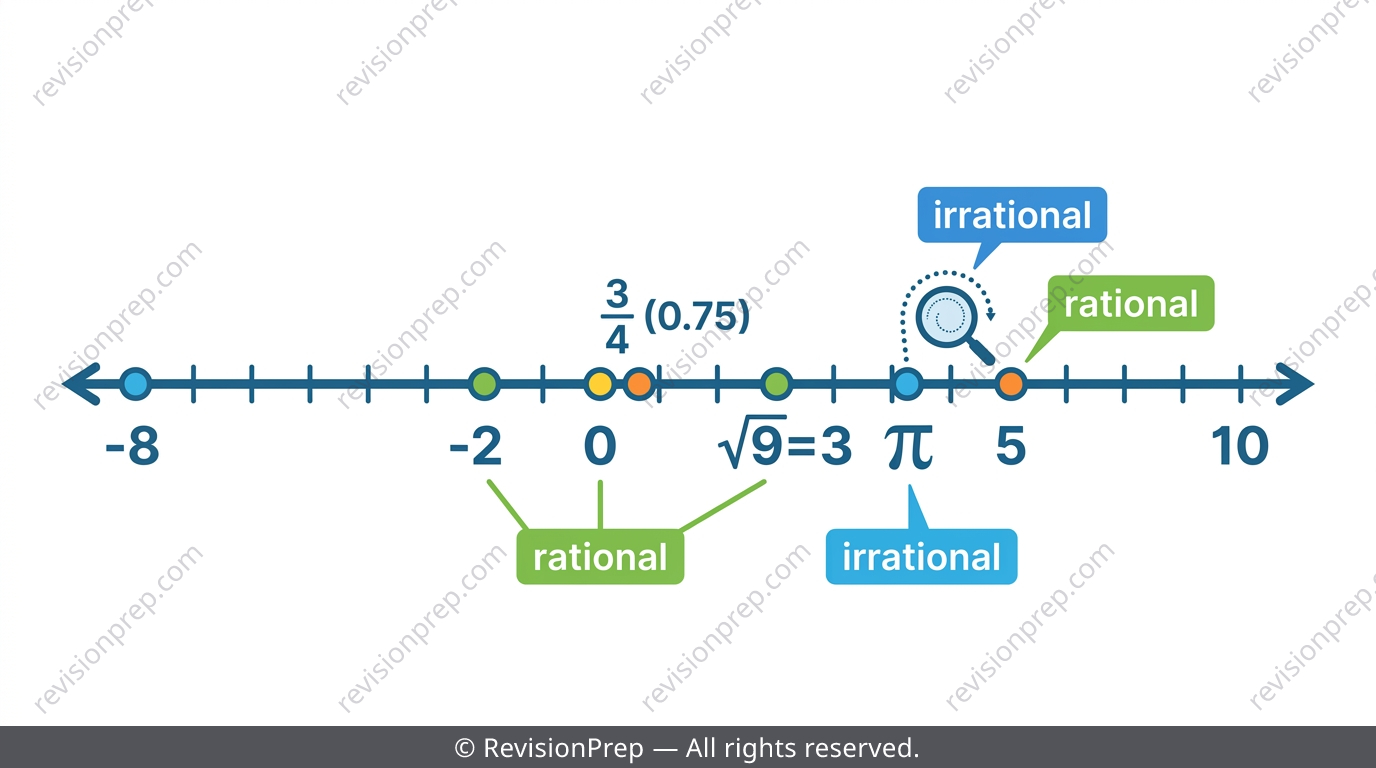
A number is rational the moment it can be written exactly as with integers and — that's the entire test. All integers, every terminating decimal, and every repeating decimal like are rational, while numbers like , , and never terminate or repeat, so they're irrational. Watch out: simplify to whole numbers, so they're rational despite the root symbol.
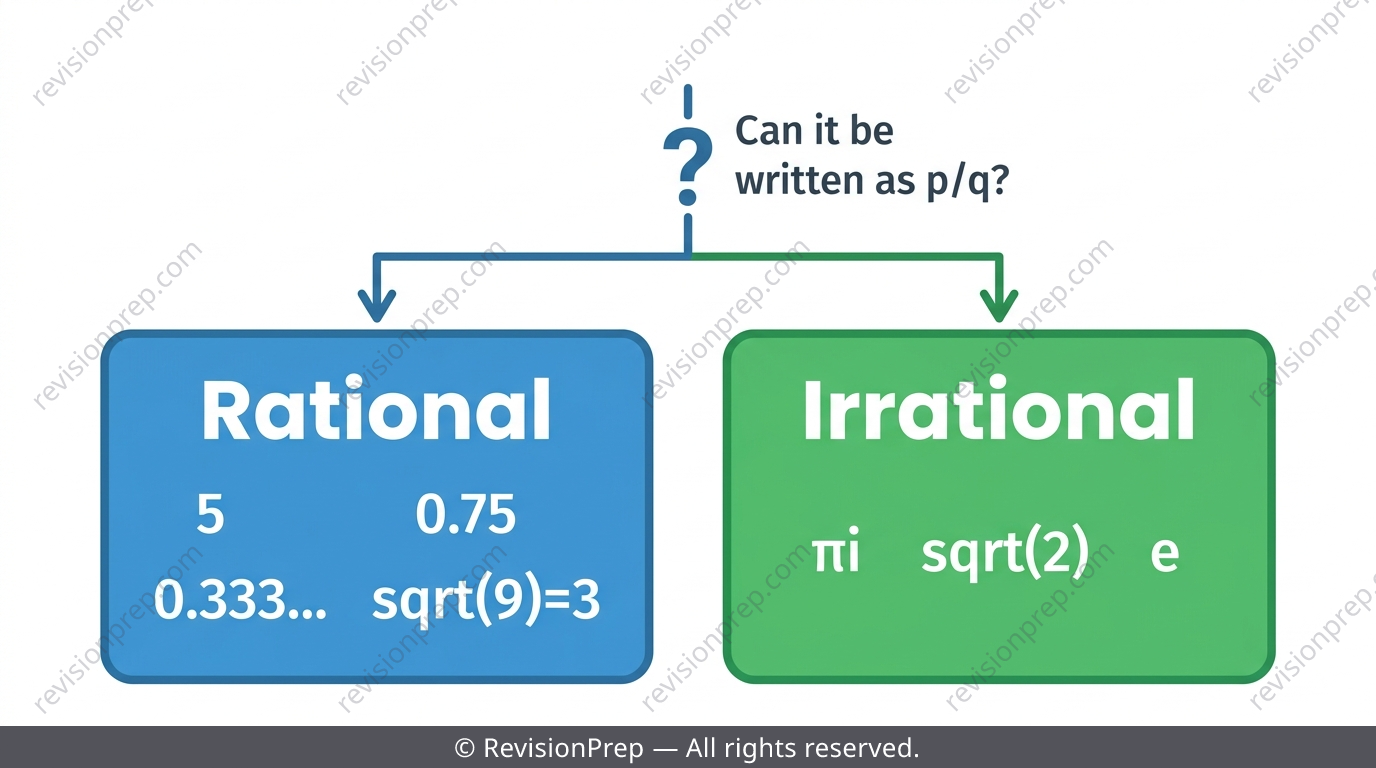
| Number | Rational or Irrational? | Why |
|---|---|---|
| Rational | , an integer | |
| Rational | Terminating decimal, | |
| Rational | Repeats forever, | |
| Rational | Simplifies to | |
| Irrational | Infinite, never repeats |
Exam tip
'Show that is rational' always wants the multiply-and-subtract method written line by line — quoting the answer from memory earns 0 marks even if correct.
Common mistake
Assuming any number written as a fraction, like 22/7, must be exactly rational without checking whether it's the true value or just a rounded approximation of an irrational constant.
Mini summary
Rational = exact fraction of integers (terminates or repeats); irrational = never terminates or repeats.
Rounding, Estimation and Approximation
Decimal places (d.p.) count digits after the decimal point, while significant figures (s.f.) count all meaningful digits starting from the first non-zero digit. The rounding rule is always the same: look at the first digit being removed — 5 or more rounds up, less than 5 rounds down. Estimation means rounding every value to about 1 significant figure BEFORE calculating, just to sanity-check the real answer is in the right ballpark.
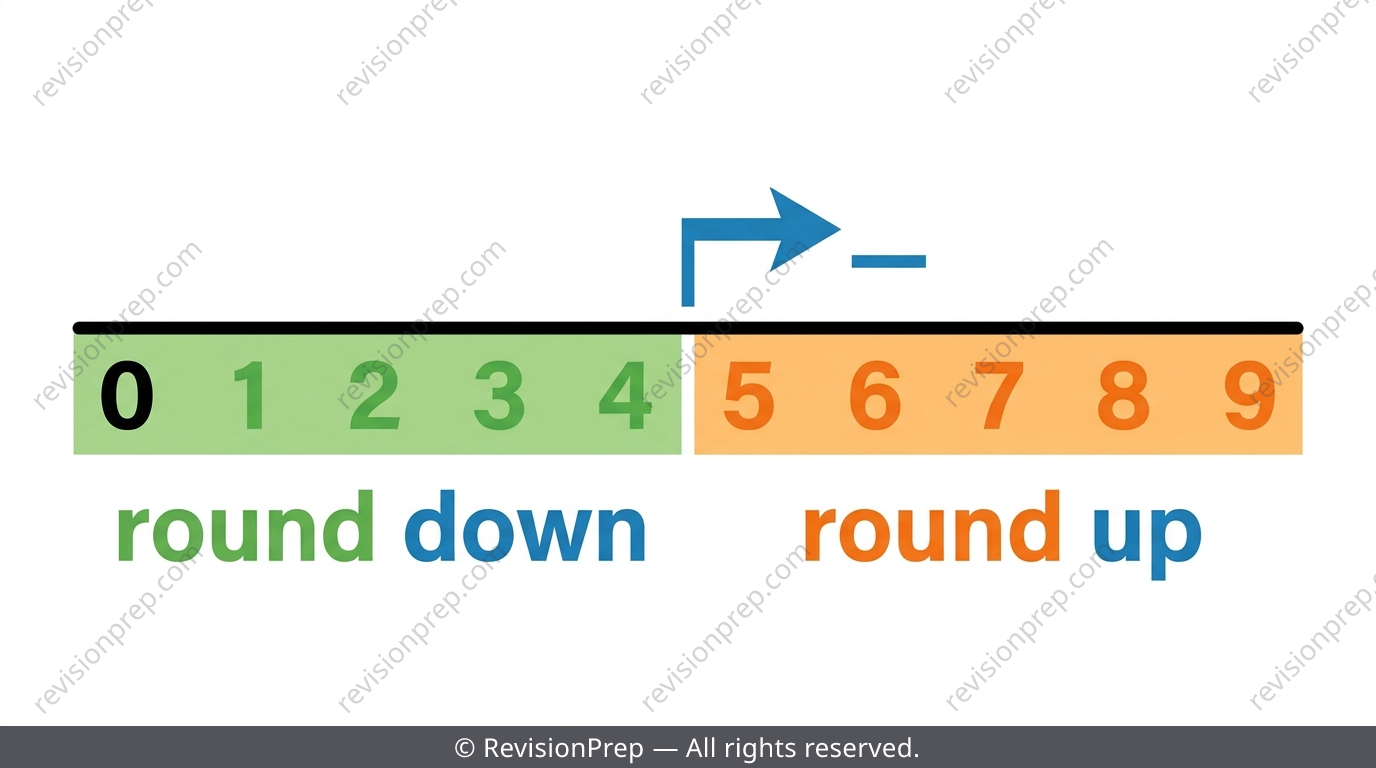
| Task | Rule | Example |
|---|---|---|
| Round to d.p. | Count digits after the decimal point | 3.996 → 4.00 (2 d.p.) |
| Round to s.f. | Start counting from first non-zero digit | 3.996 → 4.00 (3 s.f.) |
| Estimate | Round each value to 1 s.f. first |
Exam tip
Trailing zeros after a decimal point ARE significant — 3.996 rounded to 3 s.f. is '4.00', not '4'. Dropping the .00 loses the precision mark.
Common mistake
Rounding at every intermediate step of a multi-step calculation instead of carrying the full unrounded value through and rounding only the final answer.
Mini summary
Round only once, at the end; estimate by rounding first, calculating second.
Place Value and Standard Form
A digit's value depends entirely on its column position: the '2' in 502 means two hundred, not two. Moving one column left multiplies a digit's value by 10; moving right divides it by 10 — this single rule underlies rounding, ordering and standard form. Standard form writes very large or very small numbers as with , where a positive exponent shifts the decimal point right (bigger number) and a negative exponent shifts it left (smaller number).
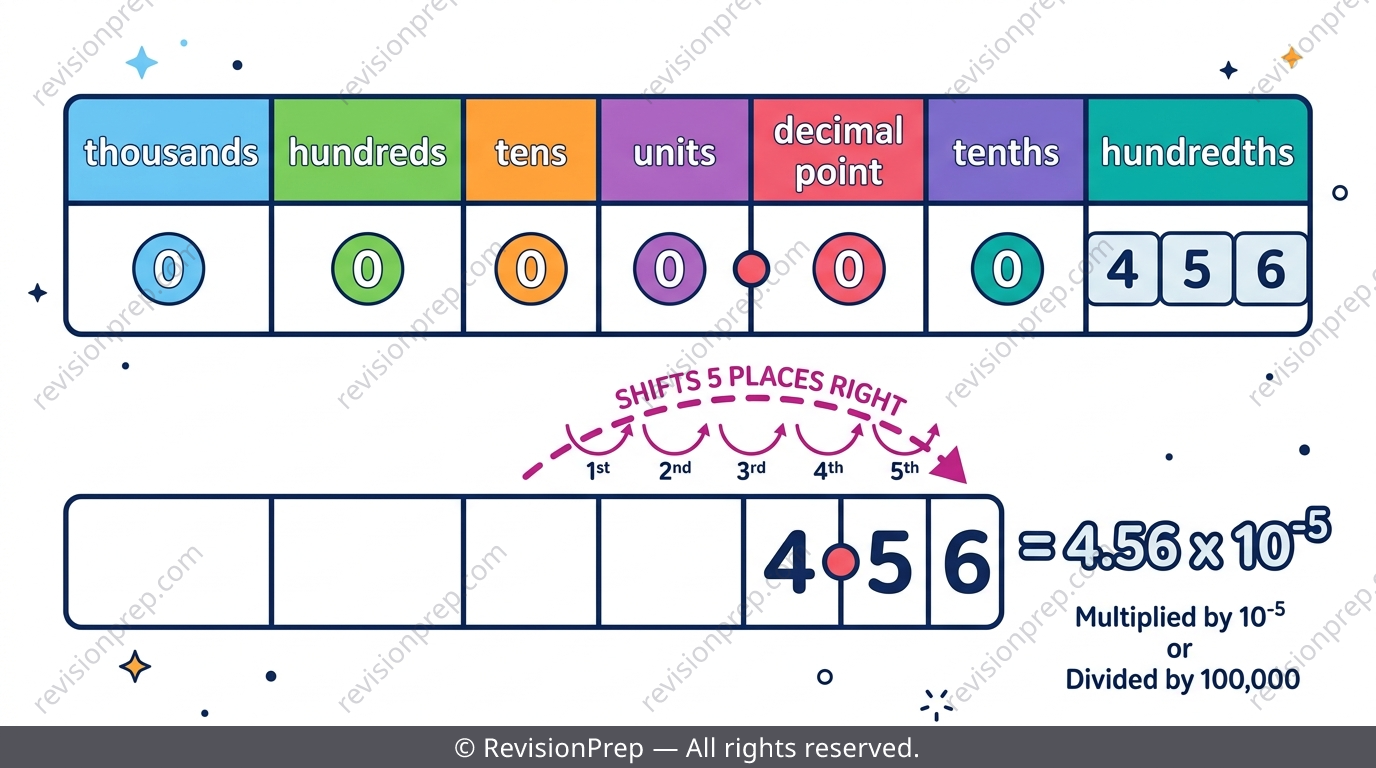
| Number | Standard Form | Exponent sign |
|---|---|---|
| 0.0000456 | Negative — number is small | |
| 45600 | Positive — number is large |
Exam tip
Count how many places the decimal point moves to find n — shift right (original was small) gives a negative n, shift left (original was large) gives a positive n.
Common mistake
Getting the sign of the exponent backwards — this is the #1 error in standard form conversions.
Mini summary
Standard form = , ; sign of n tells you if the original number was big or small.
Comparing and Ordering Numbers
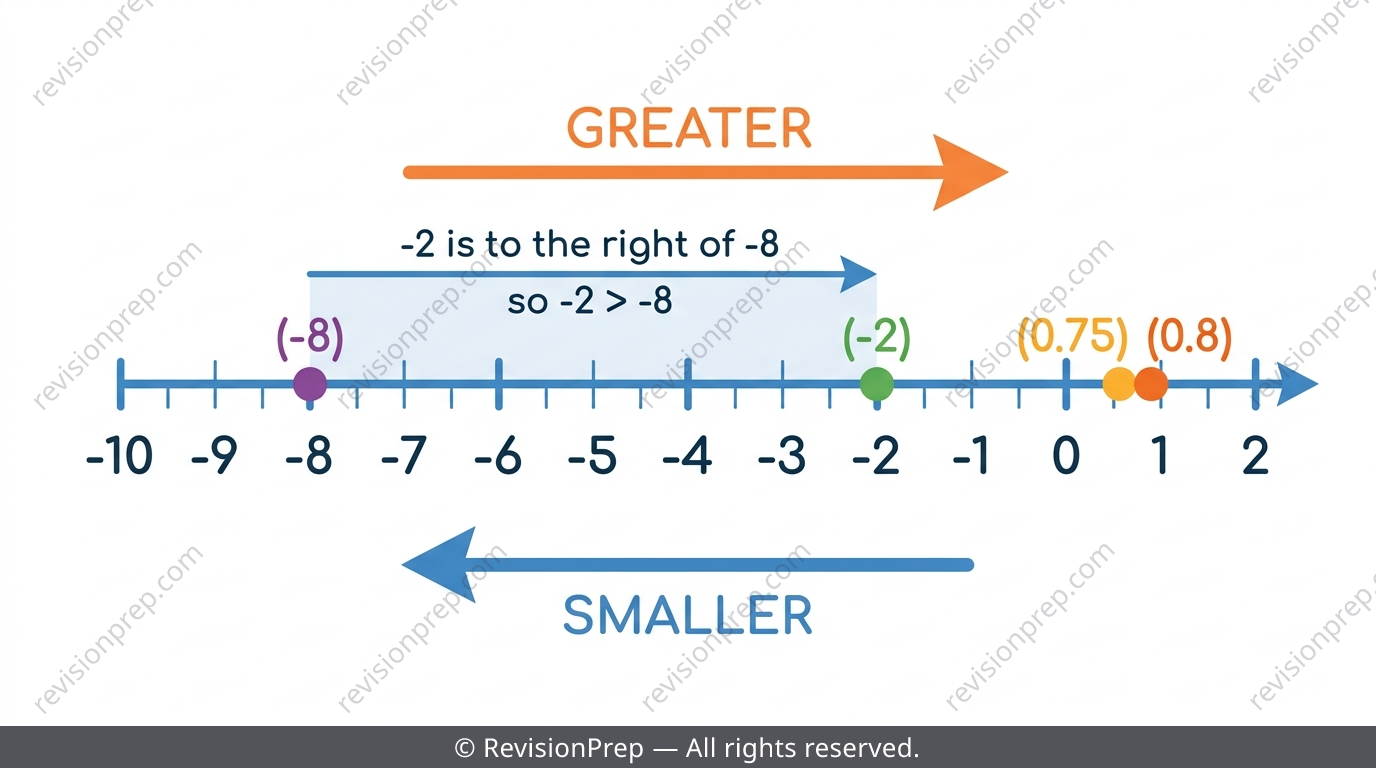
You can't compare and by eye — convert both to the same form first, whether that's a common denominator, decimals, or points on a number line. For negative numbers, the number line decides order: further right always means greater, so even though 8 is bigger than 2 as plain digits. When ordering decimals of different lengths, pad the shorter ones with trailing zeros so every value has the same number of digits to compare fairly.
| Comparison | Common footing | Result |
|---|---|---|
| vs | Convert to decimals: 0.75 vs 0.80 | |
| vs | Position on number line |
Exam tip
Always put values on the same footing before comparing — matching decimal places, common denominators, or a sketched number line for negatives.
Common mistake
Comparing negative numbers by their plain digits instead of their position on the number line, wrongly concluding .
Mini summary
Convert to a common form first; on the number line, further right is always greater.
The Number Line: Why Reasoning Matters
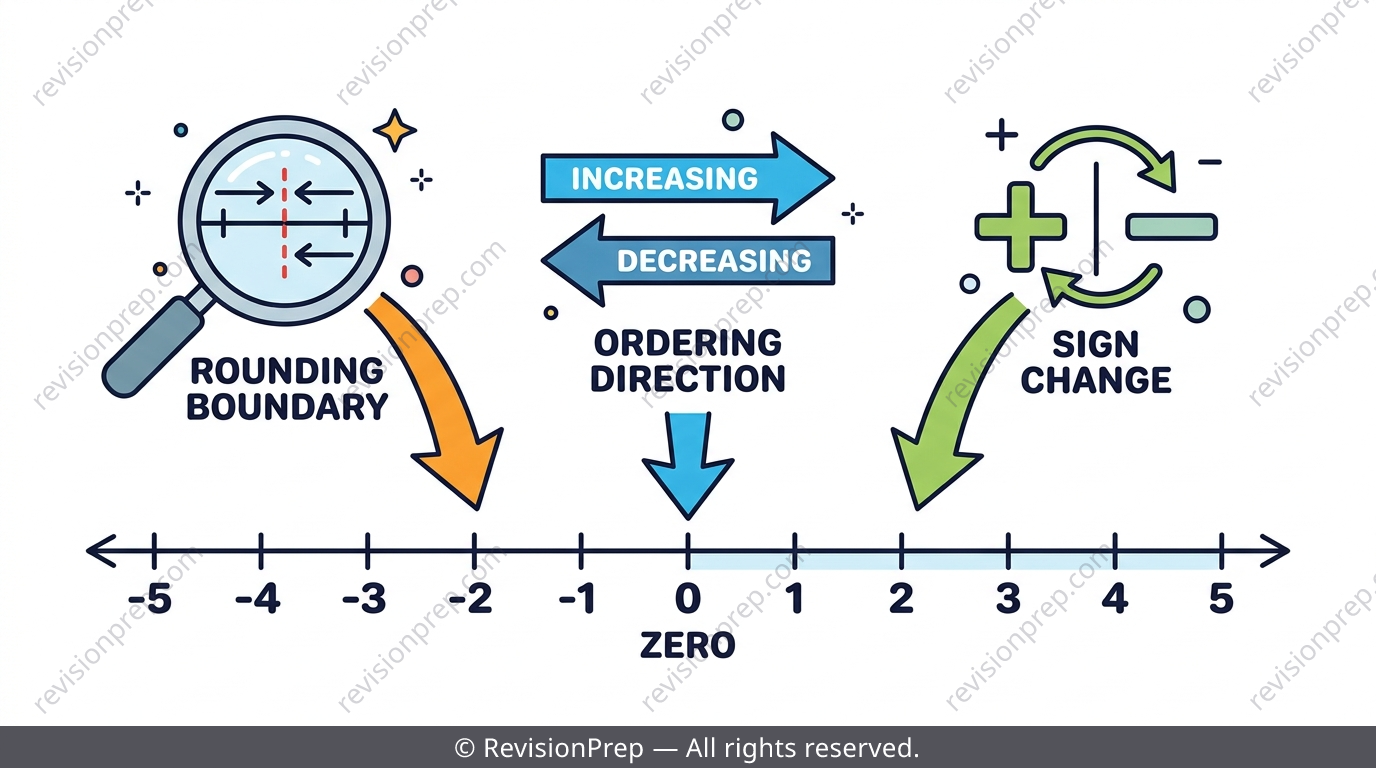
Every rule in this strand — rounding, ordering, sign changes — is really just a statement about a number's exact position on the number line. That's the single idea tying rational/irrational numbers, rounding and ordering together. Because exam questions overwhelmingly use 'Show that', 'Explain' or 'Compare', a correct final answer with no reasoning shown typically scores close to zero.
Exam tip
For 'Show that' questions, always write out the method line by line (like the multiply-and-subtract steps for recurring decimals) — memorised answers without working don't earn the marks.
Common mistake
Writing an approximation with an equals sign, e.g. '' — always use '≈' for approximations, since examiners specifically check for this.
Mini summary
Position on the number line explains every rule; command terms demand shown reasoning, not just answers.
Quick formula sheet
Practice questions
- State whether is rational or irrational, and explain why.
- Round 3.996 to 2 decimal places and to 3 significant figures.
- Write 45 600 in standard form.
- Show that is rational by writing it as a fraction, showing full working.
- Estimate by rounding each value to 1 significant figure, then compare with the exact answer.
- Order the following from smallest to largest: .
- A student claims that a rod measured as 2.71828 m proves is rational. Explain why this reasoning is flawed.
- Write in standard form, then explain why the exponent must be negative.
- Explain, using a number line, why even though 15 > 3 as plain digits.
Frequently asked questions
Is 22/7 exactly equal to π?+
No — 22/7 is a rational number and an approximation of π, but π itself is irrational, so it can never equal 22/7 exactly. Use '≈', never '=', when linking them.
How do I convert a recurring decimal to a fraction?+
Set equal to the decimal, multiply by (where n is the length of the repeating block), subtract the original equation, then solve for x. Always show this working for 'Show that' questions.
What's the difference between decimal places and significant figures?+
Decimal places count digits after the decimal point; significant figures count all meaningful digits starting from the first non-zero digit, including trailing zeros after a decimal point.
Are all square roots irrational?+
No — square roots of perfect squares like or simplify to whole numbers and are rational. Only square roots of non-perfect squares, like , are irrational.
Why is -2 greater than -8?+
Order on the number line depends on position, not the size of the digits: -2 sits further to the right than -8, so it's the greater value even though 8 > 2 as plain numbers.
Why do I lose marks even when my final answer is correct?+
Most questions in this topic use command terms like 'Show that' or 'Explain', which require visible reasoning or working. A correct answer with no method shown typically scores close to zero.
Master Number Concepts & Systems with the full MYP 2 revision notes
Related articles