
Geometry: Measurement & Calculation
Surface area, volume, compound shapes, nets, scale drawings and conversions — one idea applied six ways.
Quick facts
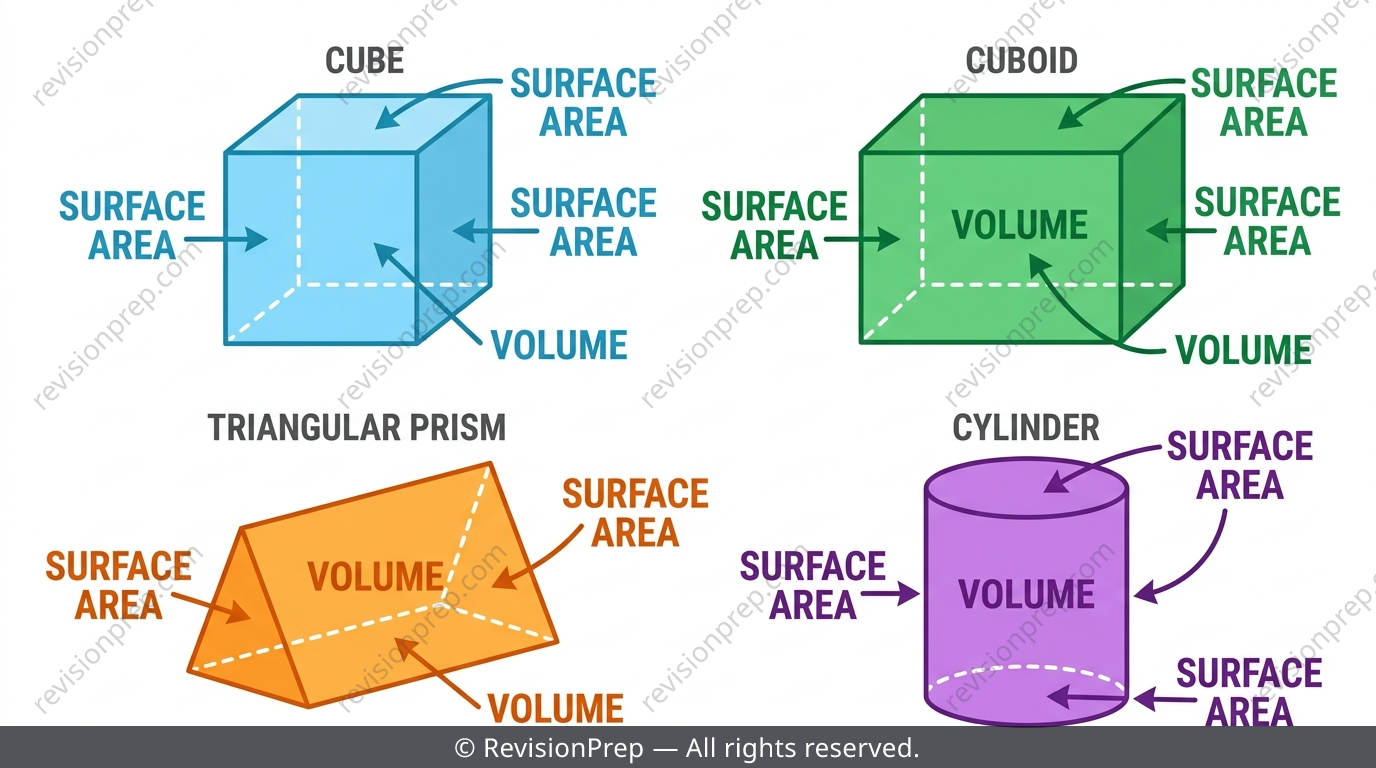
Geometry measurement and calculation in IB MYP 2 sounds like six separate topics, but it's really one idea applied over and over: break a shape or solid into pieces you already know, then add, subtract, or multiply sensibly. Surface area means adding up every flat face; volume means stacking a base area through a height; compound shapes and nets are that same decomposition shown visually. Scale drawings and bearings apply the same logic to ratios instead of solids, and unit conversions apply it to the units themselves — squared for area, cubed for volume. This teaser walks through the five ideas that show up most often in MYP 2 unit tests and Criterion C/D investigations, with the exact traps examiners use to catch rushed working. For the full worked examples, formula derivations, and every common-mistake fix, the complete revision note is linked below.
What you’ll be able to do
Surface Area: Wrapping a Solid With No Gaps
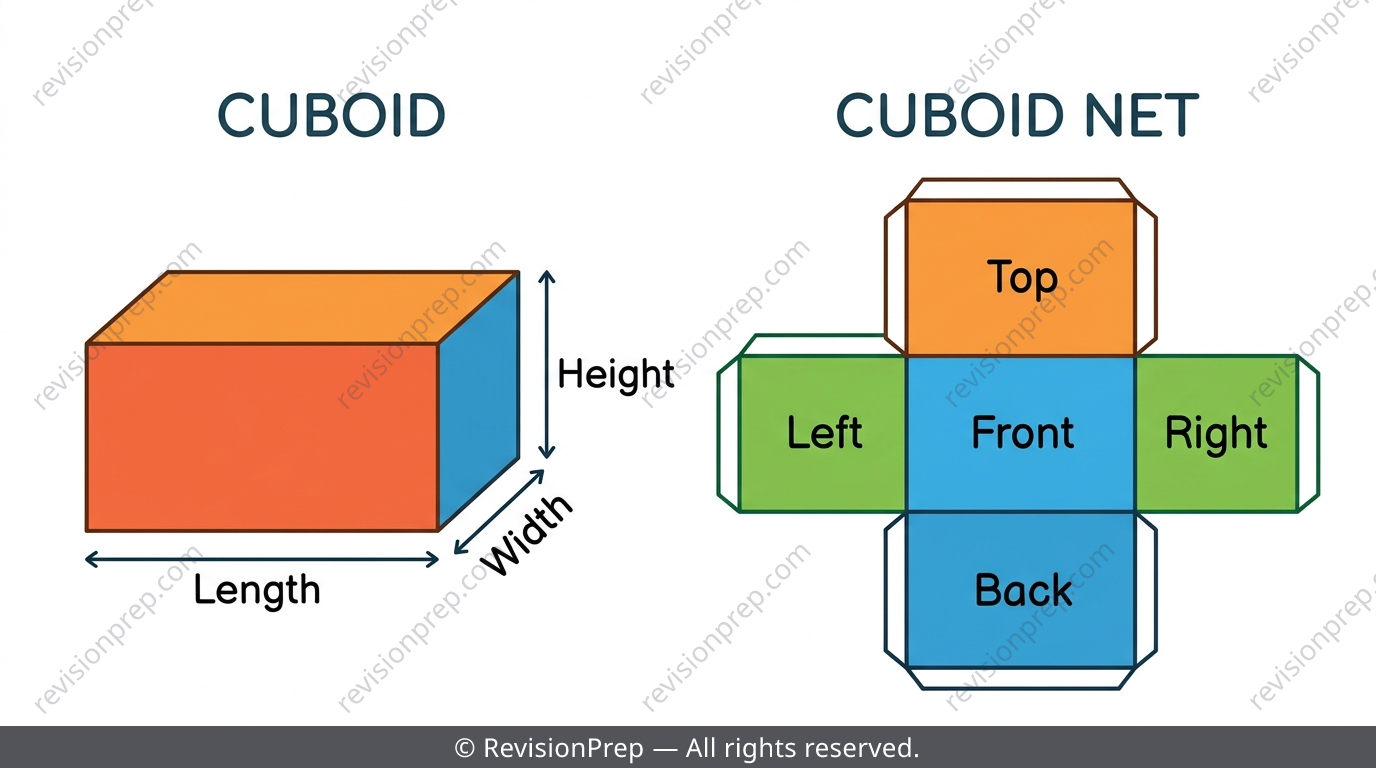
Surface area answers 'how much material would wrap this solid with no overlap and no gaps?' A cuboid has 6 faces in 3 congruent pairs, so you only ever calculate 3 different rectangle areas before doubling the sum. A prism's surface area is two identical end faces plus rectangular side faces that unroll into one long rectangle — width equals the cross-section's perimeter, length equals the prism's length.
| Solid | Formula | Idea |
|---|---|---|
| Cube | SA = 6s² | 6 identical square faces |
| Cuboid | SA = 2(lw + lh + wh) | 3 face-pairs, doubled |
| Prism | SA = 2A_base + P_base × L | 2 ends + unrolled side rectangle |
Exam tip
Write , , as three separate lines before adding and doubling — markers give method marks even if the final arithmetic slips.
Common mistake
Computing and forgetting the outer ×2, or finding just one face instead of all six. Always sanity-check that your final SA is roughly double the sum of the three products.
Mini summary
SA comes from summing three face-pairs and doubling — never adding just three single faces.
Volume: Stack a Base Area Through a Height
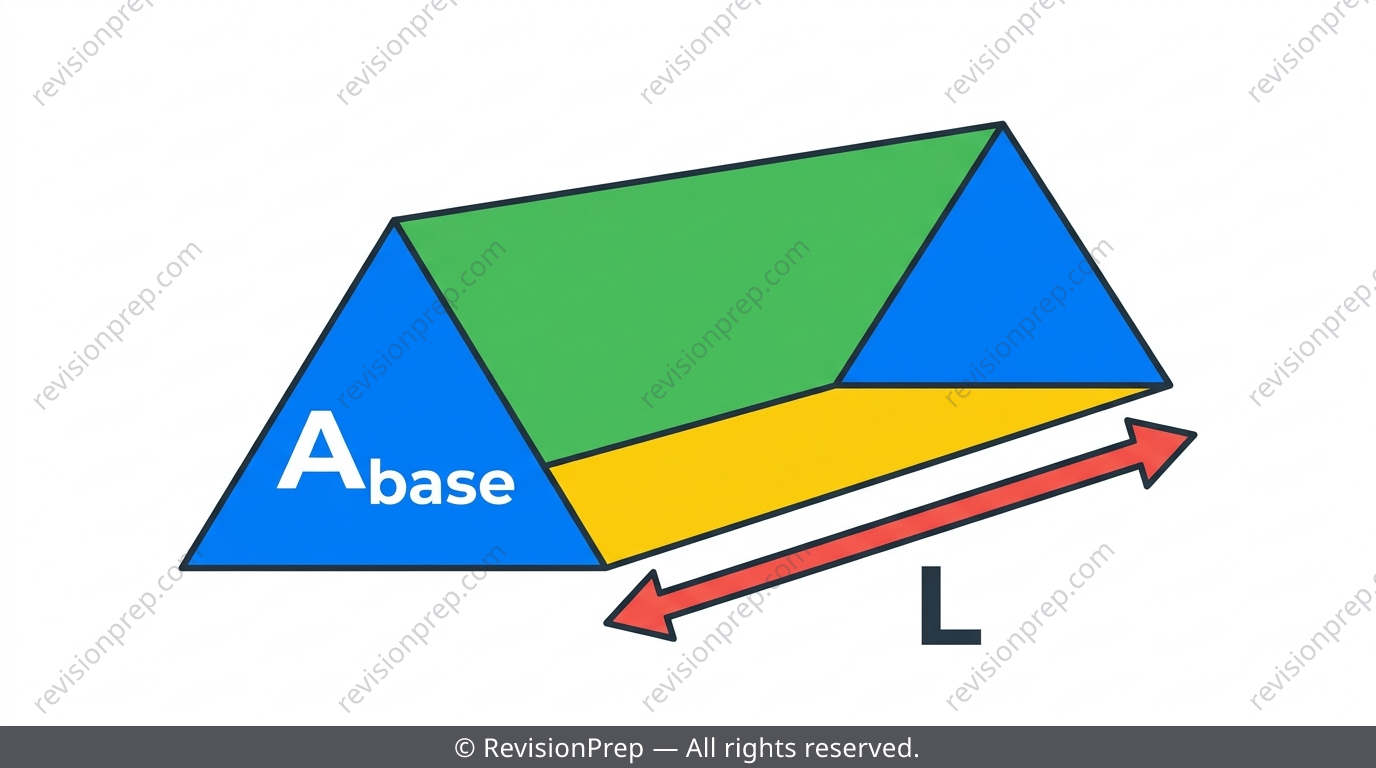
Volume measures the 3D space a solid encloses — think 'how much water would it hold'. Every formula here is the same idea: take the area of a repeating cross-section and multiply by how far it repeats. A cuboid's cross-section is a rectangle repeated through height h, giving ; a cylinder's cross-section is a circle, giving .
Exam tip
Find the cross-sectional area first as its own labelled step (), then multiply by the prism's length on a separate line.
Common mistake
Confusing a triangular prism's length (distance between the two triangular ends) with the triangle's own internal height used inside . Keep these as two clearly separate steps.
Mini summary
covers cuboids, triangular prisms and cylinders — one idea, three shapes.
Compound Shapes and Nets: Build Up, Fold Down
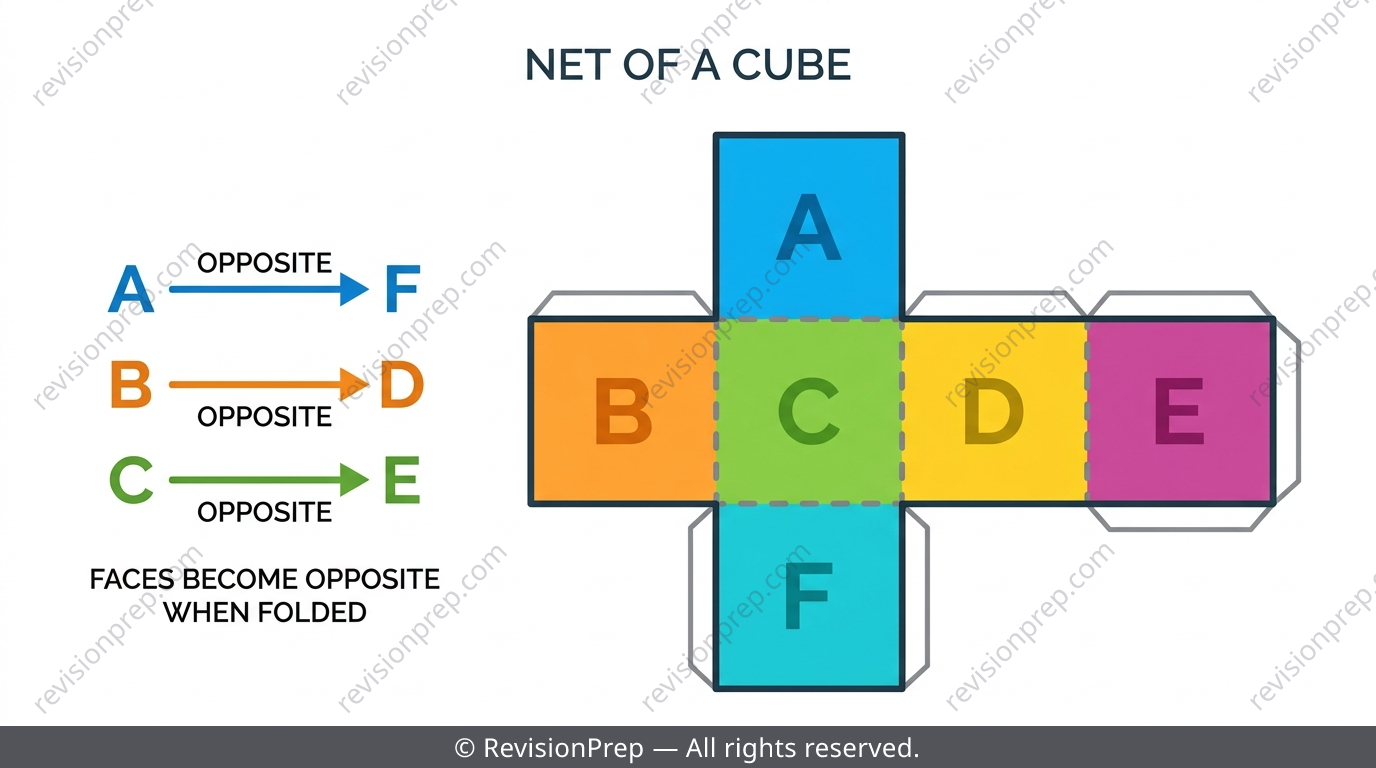
A net is the unfolded 2D version of a 3D solid — every face appears exactly once, and edges that glue together in 3D must match in length. Compound solids are built by joining two or more simple solids face-to-face, and when solids are glued together, both touching faces disappear from the outside since they become internal joints. For 2D compound shapes, split into rectangles or triangles, then add pieces joined side-by-side or subtract a notch that's been removed.
Exam tip
For cube nets, trace the actual folding rule rather than guessing from how far apart letters look on the page: exactly one other face sitting between two faces along a row makes them opposite.
Common mistake
Calculating a compound solid's surface area as simply . You must subtract (area of the joining face) — once for each solid's hidden face — to get the true outer surface area.
Mini summary
Joining two solids face-to-face removes 2× the joining area from the total surface area — it never simply adds.
Scale Drawings, Maps & Bearings
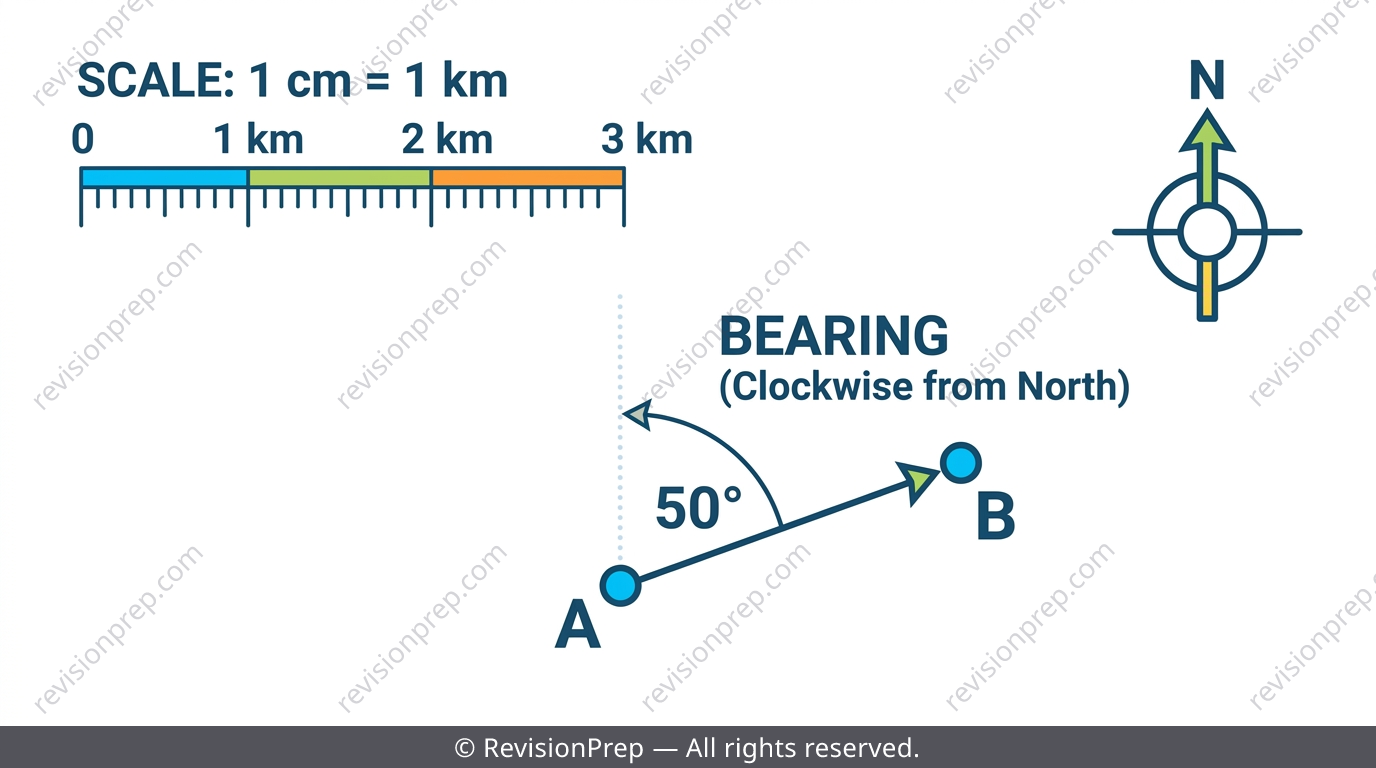
A scale drawing shrinks or enlarges real-world distances using a fixed ratio, so the same geometric reasoning used for shapes now applies to distances on a map. Bearings are geometry applied to navigation: the underlying maths — ratios and angles — is identical to the shapes work, just with a compass direction bolted on. Treat every scale problem as a ratio question first, then convert back to real units carefully.
Exam tip
Always identify whether you're scaling a linear distance (ratio unchanged) before assuming the same ratio applies to an area calculated from that drawing — it won't, without squaring it.
Mini summary
Scale drawings and bearings are the shapes topic in disguise — same maths, applied to ratios and compass directions.
Unit Conversions: Square It, Cube It
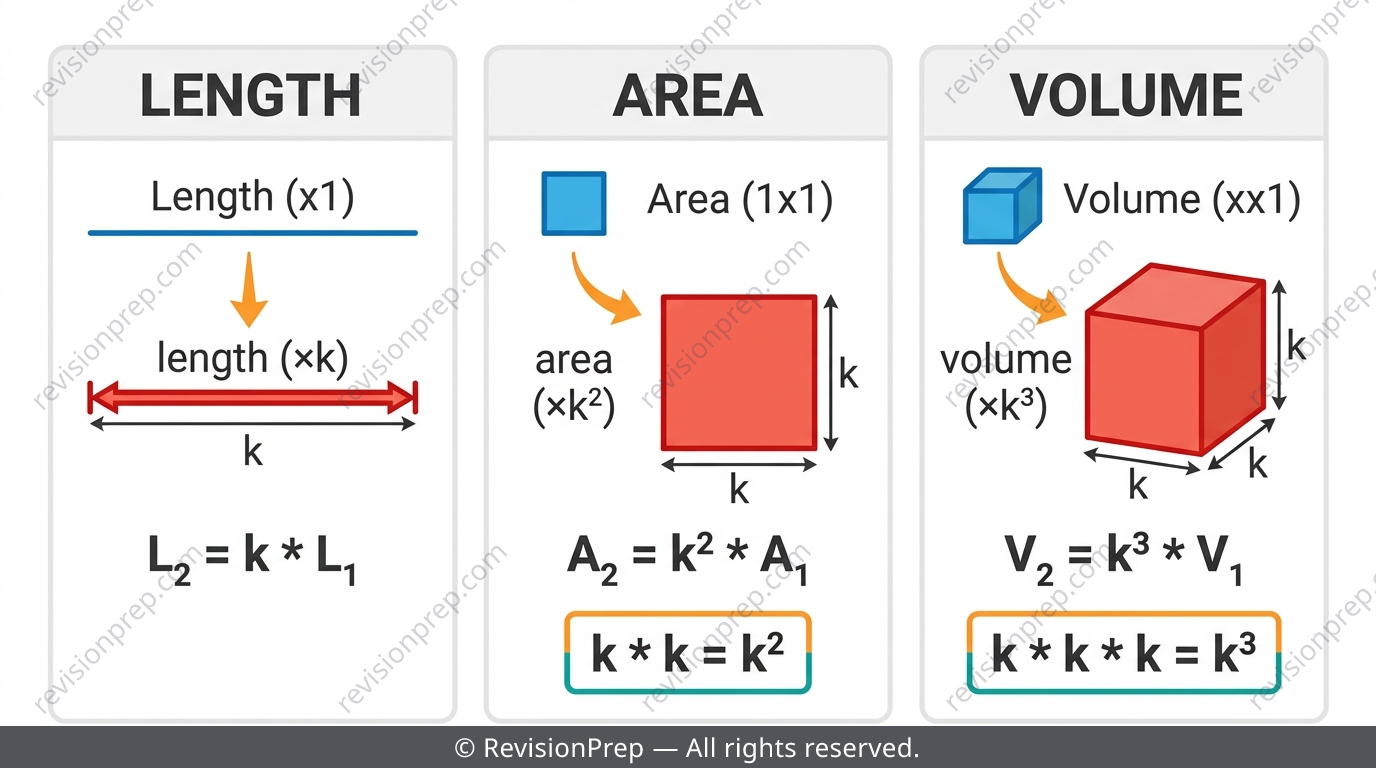
There are three families of quantity: linear (cm, m, km), area (cm², m²), and volume (cm³, m³, litres). The single rule that causes the most lost marks in this entire unit is that every conversion factor must be squared for area and cubed for volume — never applied as a plain linear factor.
Exam tip
Before converting, ask: is this quantity linear, area, or volume? Write the conversion factor, then square or cube it explicitly as its own step.
Common mistake
Multiplying an area or volume by the same linear conversion factor used for length, instead of squaring or cubing it first.
Mini summary
Linear conversions stay as-is; area conversions get squared; volume conversions get cubed — always.
Quick formula sheet
Practice questions
- Calculate the surface area of a cube with side length 5 cm.
- Calculate the volume of a cuboid with l = 6 cm, w = 4 cm, h = 3 cm.
- Convert 3 m² into cm², showing the correct scaling of the conversion factor.
- A triangular prism has a triangular cross-section of area 12 cm² and a length of 10 cm. Calculate its volume.
- Two cubes have side lengths 2 cm and 4 cm. Calculate both surface areas and state the ratio between them.
- A cube net is drawn in a cross shape with faces labelled A–F. Explain which face is opposite face A when folded.
- Two identical cubes of side 4 cm are glued face-to-face. Calculate the surface area of the resulting compound solid.
- A cylinder has radius 3 cm and height 10 cm. If both dimensions are doubled, by what factor does the volume increase? Justify your answer numerically.
- A gift box needs to hold exactly 1000 cm³. Compare the surface areas of a 10×10×10 cm box and a 20×10×5 cm box, and decide which uses less material.
Frequently asked questions
What's the difference between surface area and volume?+
Surface area is the total area of every flat face on a solid (measured in cm² or m²) — how much material wraps it. Volume is the 3D space enclosed inside the solid (measured in cm³ or m³) — how much it can hold.
Why do area conversions get squared and volume conversions get cubed?+
Because area is a two-dimensional quantity and volume is three-dimensional, the linear conversion factor must be applied that many times — squared for area, cubed for volume — otherwise the converted value is wrong.
How do I find the surface area of a compound solid?+
Add the surface areas of the two separate solids, then subtract 2× the area of the face where they're joined, since that face becomes hidden inside the solid on both sides.
How do I know which faces are opposite each other on a cube net?+
Trace the actual folding rule: two faces become opposite only if exactly one other face sits directly between them along a row of the net — don't guess based on how far apart the letters look.
What formula connects the volume of a cuboid, prism and cylinder?+
All three use — take the cross-sectional area (rectangle, triangle, or circle) and multiply by how far it repeats through the solid's length or height.
How are bearings related to this geometry topic?+
Bearings apply the same ratio and angle reasoning used in scale drawings, just with a compass direction added — the underlying maths of measuring and scaling distances is identical.
Master Geometry Measurement for MYP 2 with the Full Revision Notes
Related articles