
Earth and Space Science
Weathering, erosion, the rock cycle, the Solar System and Moon phases — the MYP 2 essentials in one place
Quick facts
IB MYP 2 Earth and Space Science covers a lot of ground in a short space: how rock breaks down and moves, how the pieces cycle into new rock, what's inside our planet, and where Earth sits in the Solar System. Most unit tests and investigations circle back to the same five ideas — so mastering them covers the bulk of the question bank. This teaser walks through weathering vs erosion, the surface area to volume ratio trick examiners love to test, common fair-test traps, the layout of the Solar System, and why the Moon changes shape in the sky. Along the way you'll pick up the exact definitions, the classic mistakes students make on 'identify' and 'compare' questions, and the reasoning behind tricky facts like Venus being hotter than Mercury. For the full worked examples, diagrams and practice sets, the complete revision notes are linked at the end.
What you’ll be able to do
Weathering vs Erosion: the most rewarded distinction in the unit
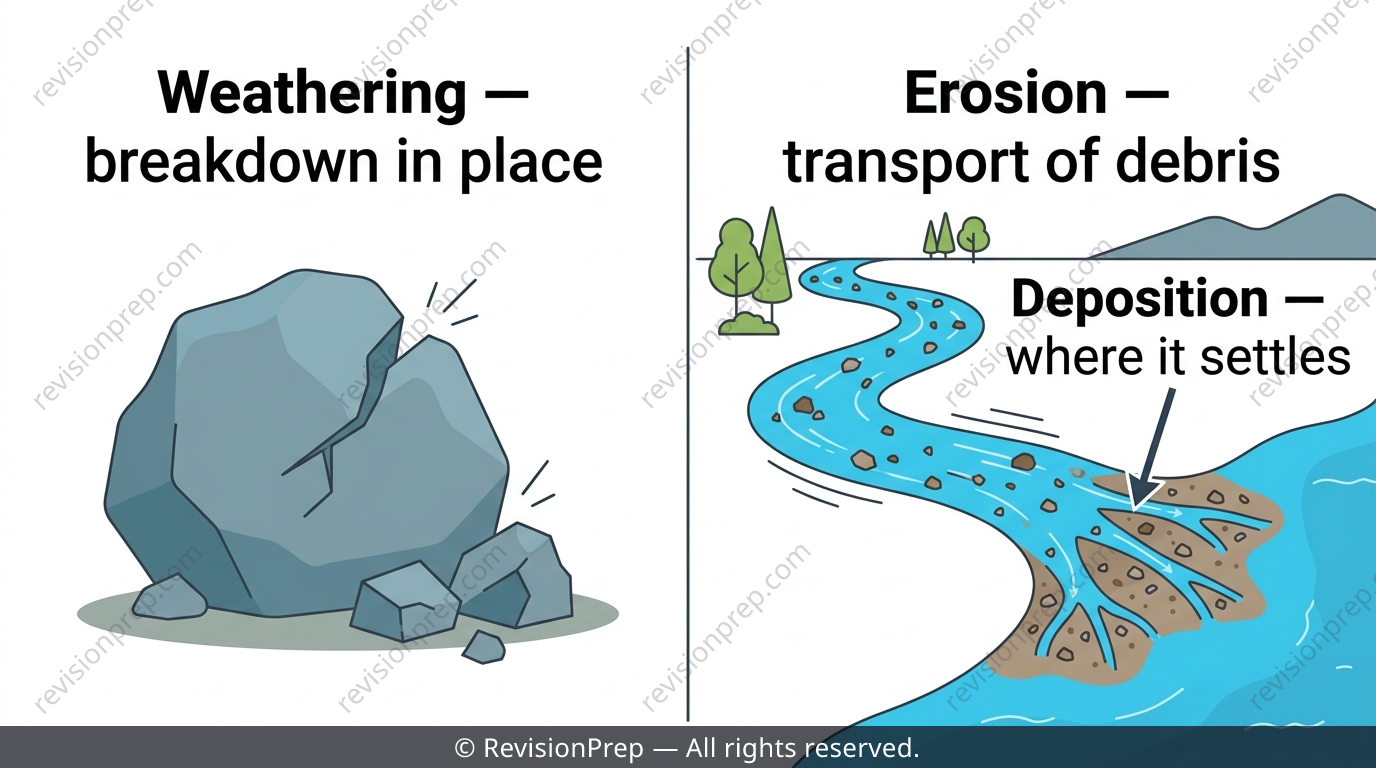
Weathering breaks rock apart exactly where it sits — nothing moves anywhere. Erosion is the transport of that broken material by wind, water, ice or gravity, with deposition marking where it finally lands. There are three weathering mechanisms: physical (pure force, no chemical change), chemical (a reaction alters the minerals), and biological (a living organism does the breaking). A single agent, like a river, can do both jobs at once — dissolving rock chemically while carrying the debris downstream.
Exam tip
In any 'identify' question, state weathering and erosion as two separate, clearly defined processes — never blend them into one sentence.
Common mistake
Calling transport of rock debris 'weathering' just because it started with weathering — transport is always erosion, even if the same agent caused both.
Mini summary
Weathering = breakdown in place; erosion = transport away from that spot.
Surface area to volume ratio: why smaller pieces weather faster
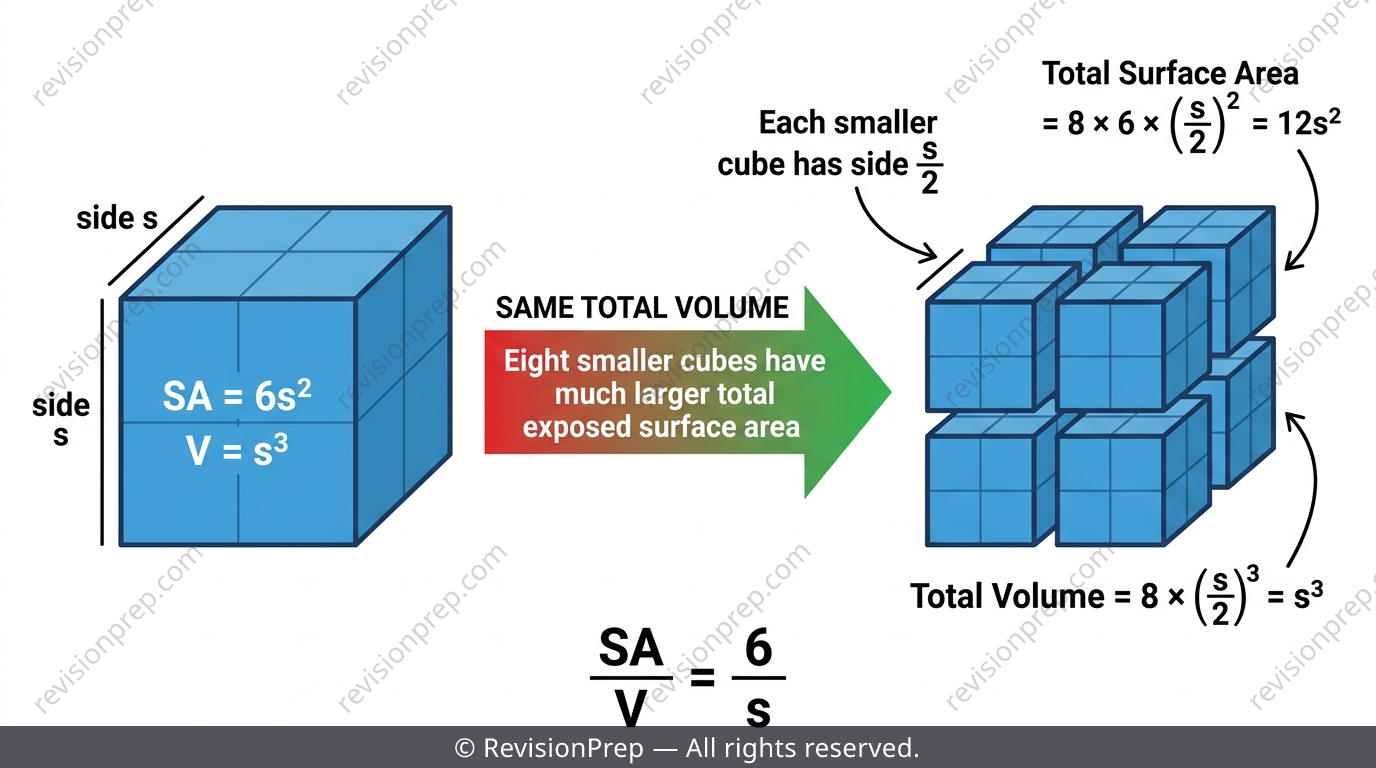
For a cube of side , surface area is and volume is , so the ratio — this gets bigger as gets smaller. More exposed surface means more area for chemical reactions like acid rain to attack, so fragmented rock weathers faster overall, even though the reaction rate per square centimetre stays constant. The classic exam trap is comparing raw mass-loss figures between samples of different sizes and concluding 'smaller pieces weather faster' without doing the SA/V calculation first.
Exam tip
Always normalise mass loss by surface area before comparing samples of different sizes — that's what actually proves the SA/V effect.
Common mistake
Comparing raw mass-loss numbers (e.g. 2.5 g vs 15.0 g) directly and skipping the surface area calculation — this is the single most common wrong answer in this question style.
Mini summary
Smaller fragments have higher SA/V, so total weathering is faster even though the rate per cm² is unchanged.
Fair-testing weathering investigations: getting the IV and DV right
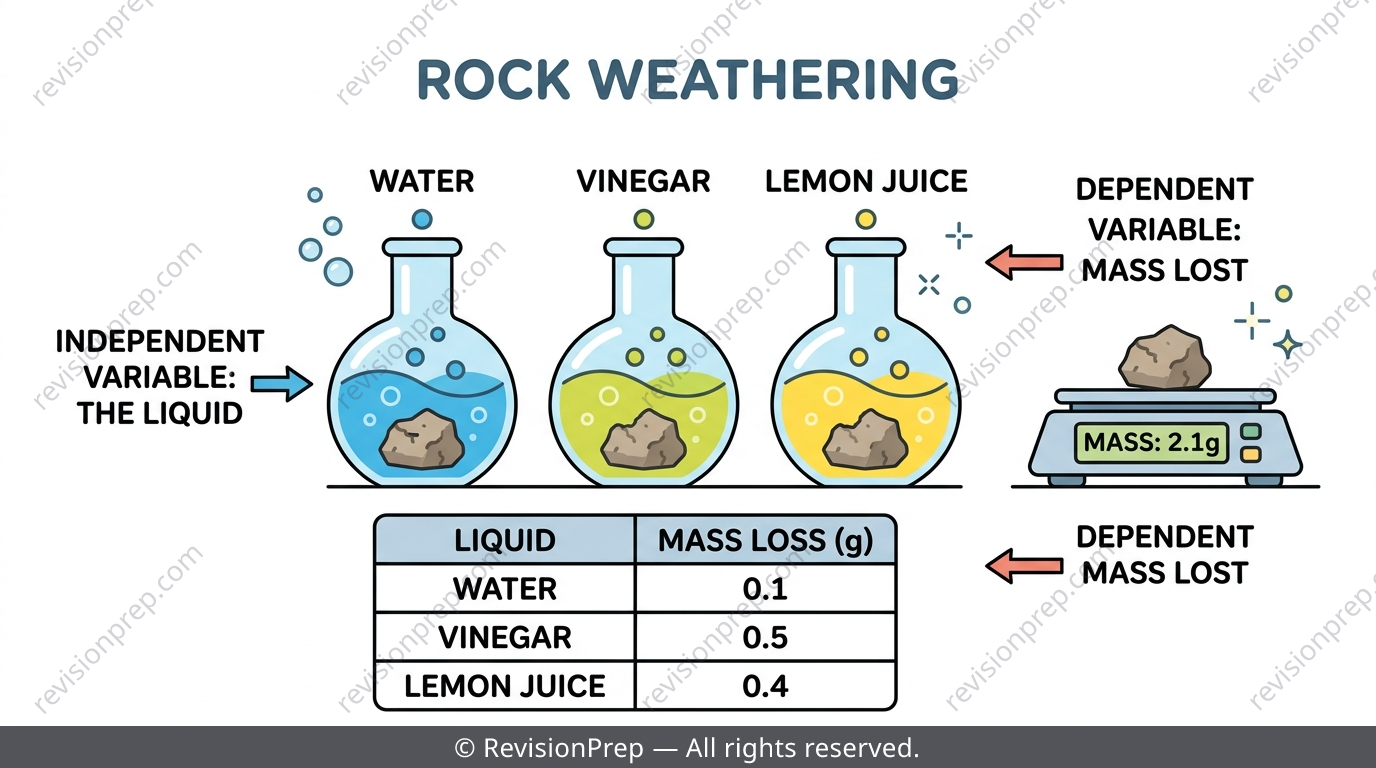
In investigations like identical rocks placed in water, vinegar and lemon juice, the independent variable is the thing you deliberately changed — here, the liquid — not the rocks themselves. The dependent variable is what you measured at the end, usually mass loss. Everything else (rock type, starting mass, temperature, time) must be kept identical as controlled variables, precisely so the only thing affecting mass loss is the liquid being tested.
Exam tip
When comparing two materials in acid rain, write one explicit sentence per material — a mark scheme awards a point per item compared, not one point for a general statement.
Common mistake
Naming 'the rocks' or 'the mass lost' as the independent variable instead of the thing that was actually changed on purpose between set-ups.
Mini summary
IV = what you deliberately changed; DV = what you measured; everything else stays identical.
The Solar System: order, planet types and dwarf planets
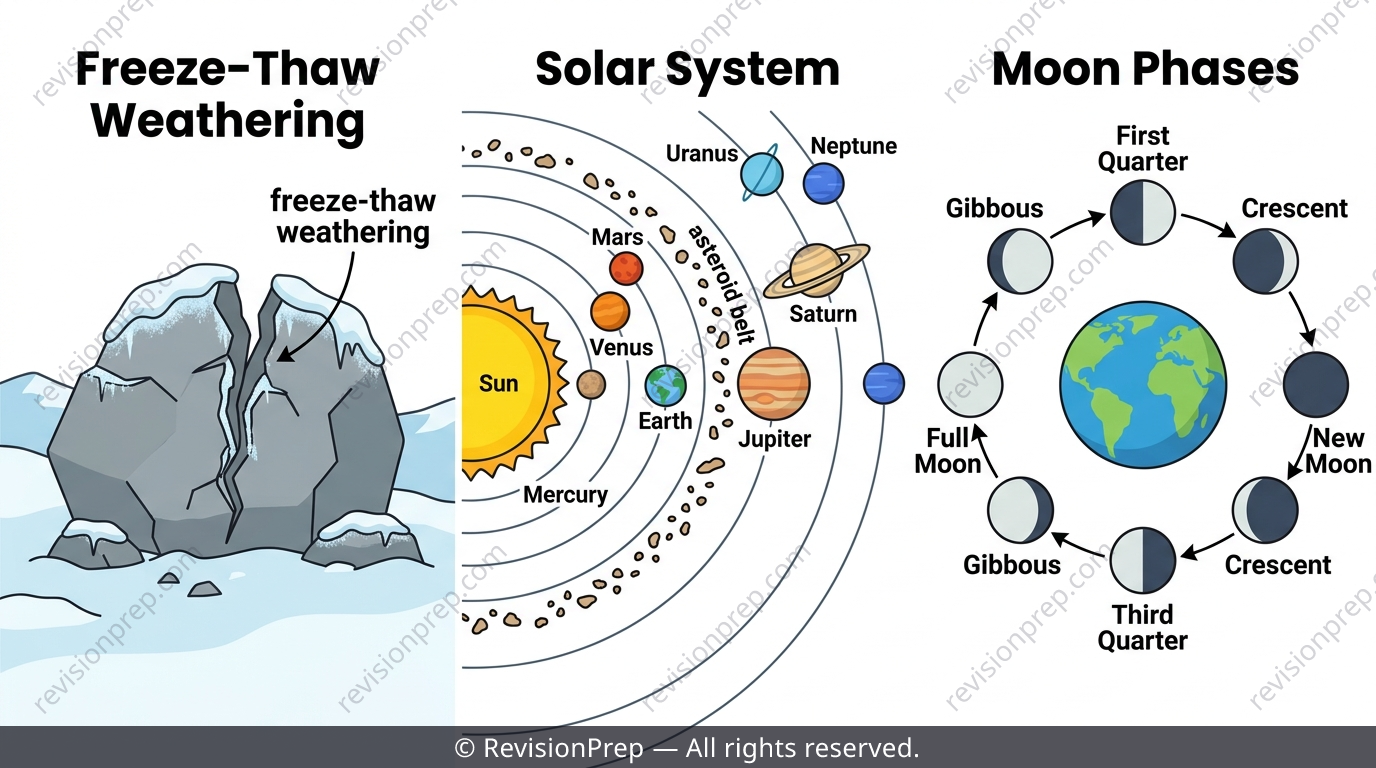
The Sun holds about 99.8% of the Solar System's mass, with everything else — Mercury, Venus, Earth, Mars, the asteroid belt, then Jupiter, Saturn, Uranus, Neptune — orbiting it under gravity. The inner four are terrestrial planets (small, dense, rocky, solid surfaces); the outer four are gas or ice giants (huge, low density, no solid surface, ring systems). Dwarf planets like Pluto are round and orbit the Sun, but haven't cleared other debris from their orbital path — the exact reason Pluto lost full-planet status in 2006.
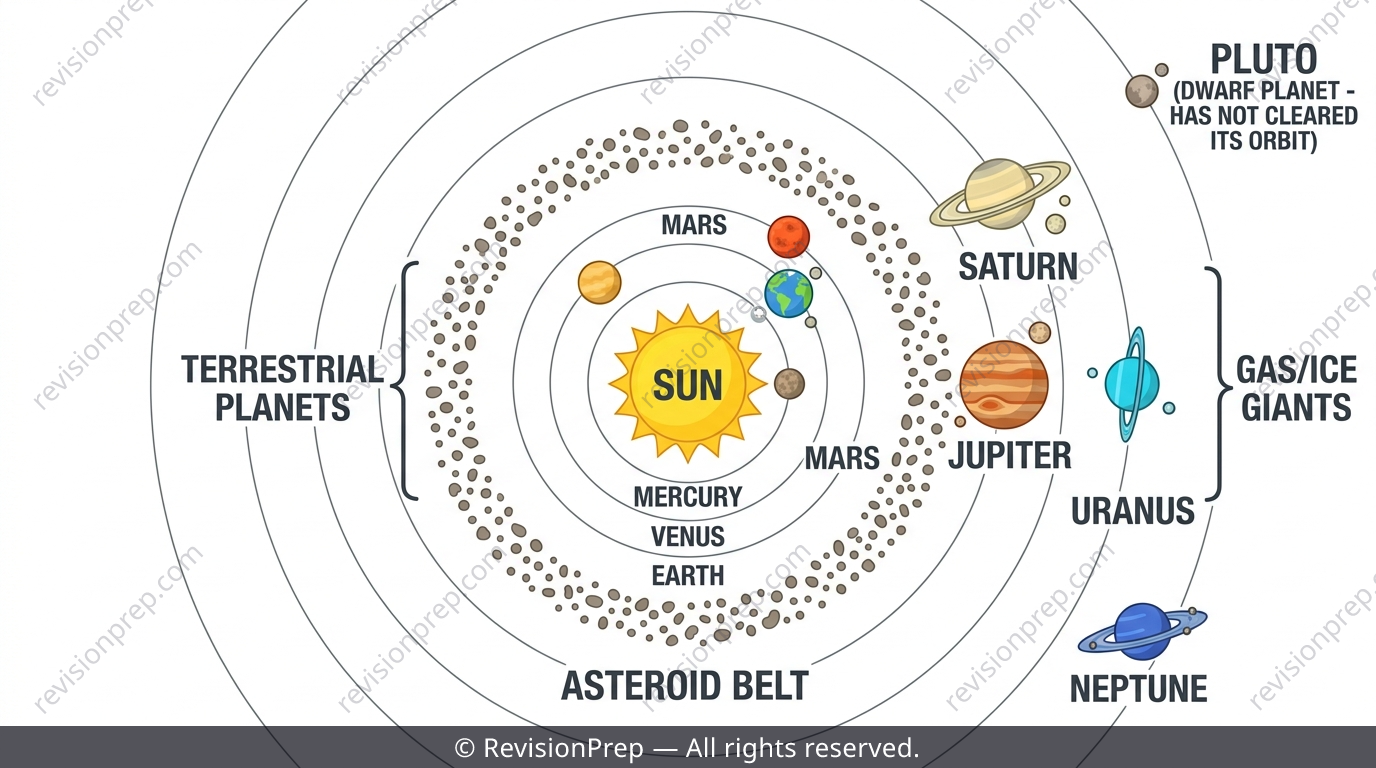
| Feature | Terrestrial planets | Gas/ice giants |
|---|---|---|
| Composition | Rocky, dense | Hydrogen/helium or icy volatiles |
| Surface | Solid surface | No solid surface |
| Size | Small | Large |
| Examples | Mercury, Venus, Earth, Mars | Jupiter, Saturn, Uranus, Neptune |
Exam tip
Distance from the Sun does not equal temperature — Venus's thick CO₂ atmosphere traps heat, making it hotter than Mercury despite being farther away.
Common mistake
Assuming planet order equals temperature order, so Venus (2nd planet) 'should' be cooler than Mercury (1st) — atmosphere can dominate over distance.
Mini summary
Inner four = terrestrial; outer four = gas/ice giants; dwarf planets orbit but haven't cleared their path.
Moon phases and eclipses: why the sky changes shape
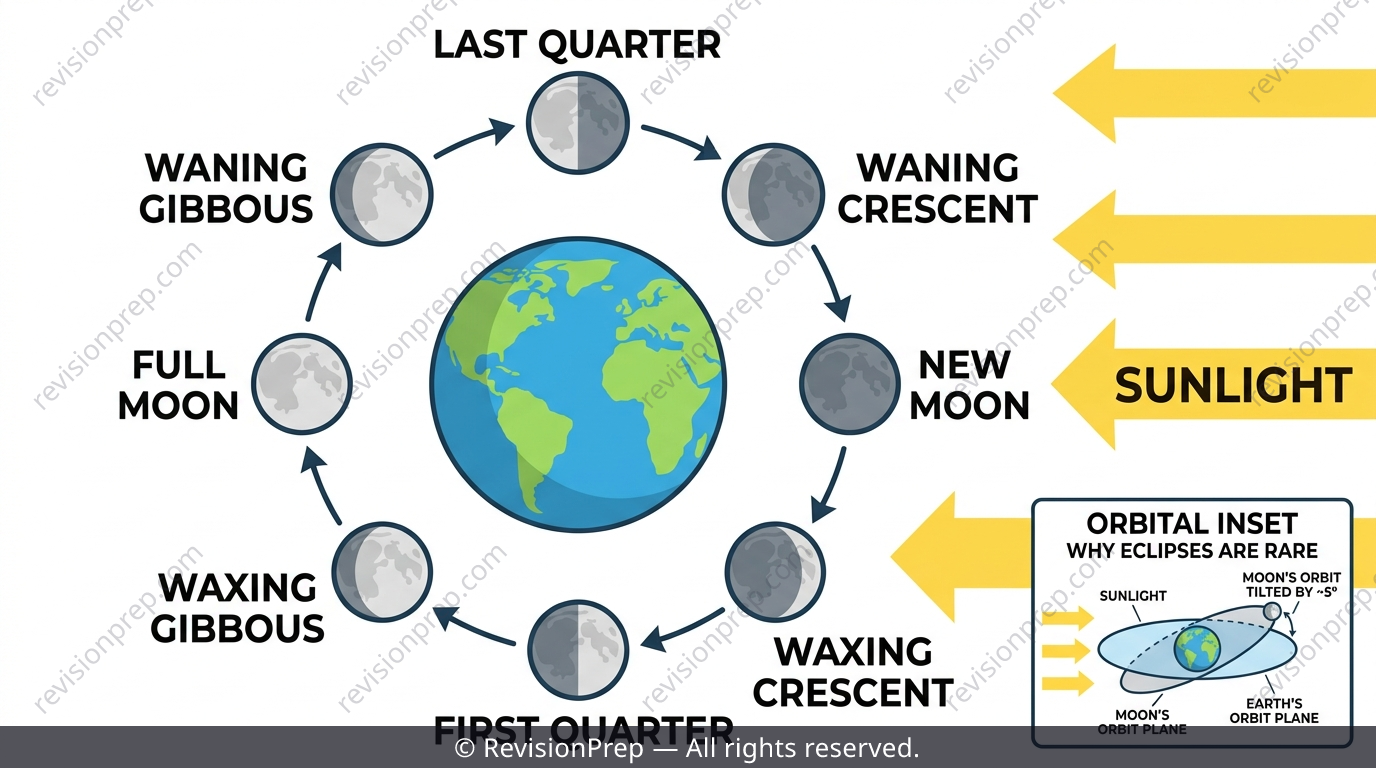
The Moon produces no light of its own — we only ever see the half currently lit by the Sun. As the Moon orbits Earth over about 27.3 days, the fraction of its sunlit half facing us keeps changing, producing the sequence from new Moon through crescent, quarter, gibbous, to full Moon, then back down (waning). Eclipses need a near-perfect straight-line alignment of Sun, Earth and Moon, and because the Moon's orbit is tilted about 5° relative to Earth's orbit, it usually passes above or below that line — which is why eclipses are rare rather than monthly.
Exam tip
Solar eclipses can only happen at new Moon and lunar eclipses only at full Moon — always link the eclipse type to the correct phase in your answer.
Common mistake
Thinking eclipses should happen every month simply because the Moon completes a full cycle of phases each month — the 5° orbital tilt is what actually makes them rare.
Mini summary
Phases come from changing sunlit-side visibility; eclipses need alignment, which the Moon's tilted orbit makes rare.
Quick formula sheet
Practice questions
- Define weathering and erosion in one sentence each.
- Name the three mechanisms of weathering.
- List the eight planets in order from the Sun.
- Explain why a fragmented rock sample loses more total mass than a single large rock of the same starting mass, using the SA/V ratio.
- Identify the independent, dependent and one controlled variable in an investigation testing rock samples in three different acid concentrations.
- Explain why Venus is hotter than Mercury despite being farther from the Sun.
- Two rock samples of different sizes lose different total masses in acid over 10 days. Explain how you would prove the reaction rate per unit surface area is actually the same for both.
- Explain why solar and lunar eclipses do not occur every month, referring to the Moon's orbital plane.
- Compare the weathering of a limestone statue and a granite statue exposed to acid rain, making one explicit point about each material.
Frequently asked questions
What is the main difference between weathering and erosion?+
Weathering breaks rock apart where it sits, with no transport; erosion is the movement of that broken material elsewhere by wind, water, ice or gravity.
Why does smaller rock fragment size increase weathering rate?+
Smaller fragments have a higher surface area to volume ratio (), exposing more surface for reactions, so the total weathering happens faster even though the rate per cm² stays the same.
Why is Venus hotter than Mercury if Mercury is closer to the Sun?+
Venus has a thick CO₂ atmosphere that traps heat through the greenhouse effect, so it retains more heat than Mercury despite receiving less sunlight.
Why isn't Pluto considered a full planet?+
Pluto is round and orbits the Sun, but it hasn't cleared other objects from its orbital neighbourhood, which is why it's classified as a dwarf planet.
Why don't we get an eclipse every month?+
The Moon's orbital plane is tilted about 5° relative to Earth's orbit around the Sun, so it usually passes above or below the exact alignment needed for an eclipse.
How do I identify the independent variable in a weathering investigation?+
Ask what was deliberately changed between the set-ups — that's the independent variable. What you measured at the end (like mass loss) is the dependent variable.
Get the complete MYP 2 Earth and Space Science notes
Related articles