
Ecology and Environment
Master ecosystems, energy pyramids, pollution chains and biodiversity for IB MYP 3 Sciences
Quick facts
IB MYP 3 ecology and environment questions almost always come back to the same pond, forest or desert diagram — and the same three questions: what's there, how does energy move, and what happens when something changes? This teaser walks through the five ideas that unlock most marks: the levels of ecological organisation (population, community, ecosystem, biome), sorting biotic from abiotic components, energy flow through trophic levels and pyramids, tracing pollution chains like bioaccumulation and eutrophication, and the basics of biodiversity and conservation. Get comfortable with these five concepts and you can handle almost any ecosystem stimulus your teacher throws at you, whether it's Criterion A knowledge recall or a Criterion C evaluate task. For full worked examples, mark-scheme-style traps, and every definition in one place, the complete revision notes go much deeper than this quick overview.
What you’ll be able to do
Ecosystems and Biomes: Getting the Levels Right
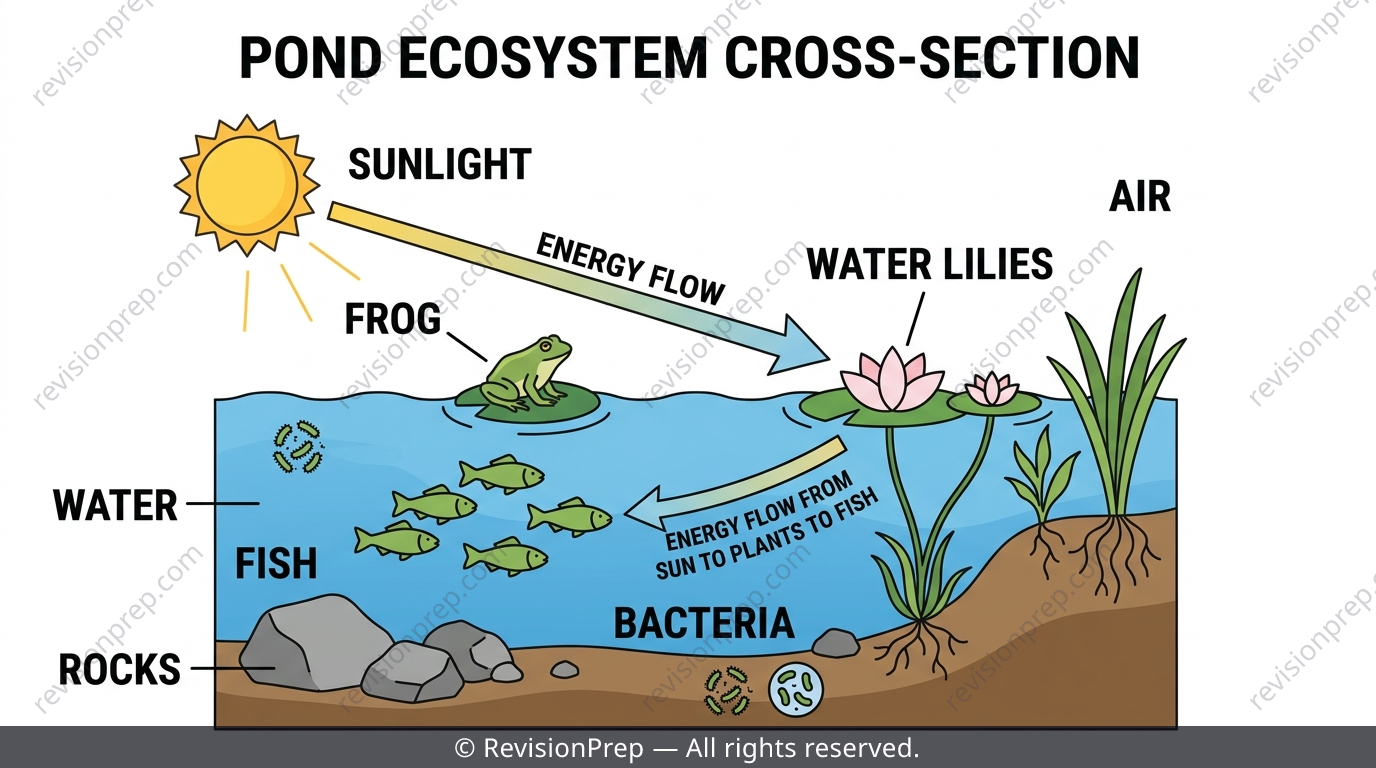
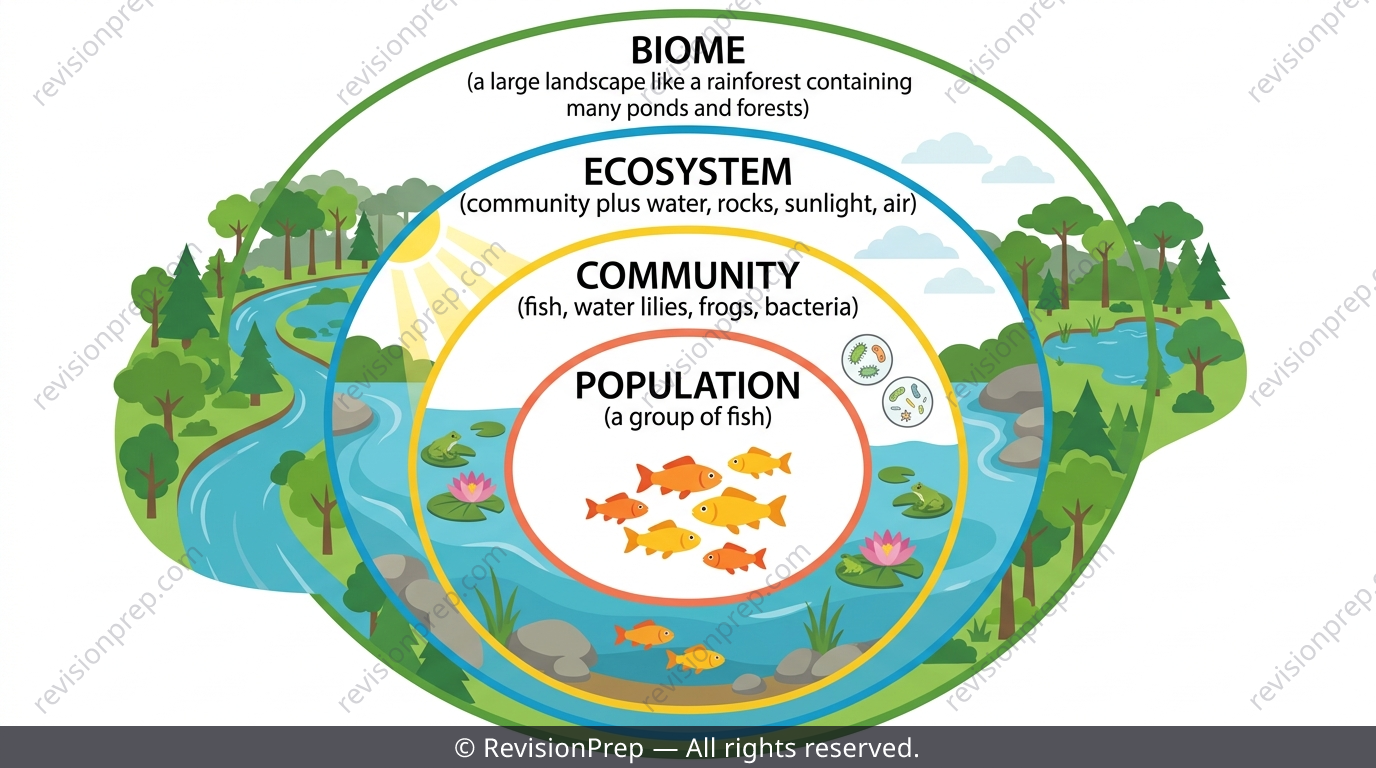
A population is all individuals of one species in an area, like every fish in a pond. A community adds every other interacting species — fish, water lilies, frogs, bacteria — while an ecosystem is that community plus the abiotic environment (water, rocks, sunlight, air) it interacts with. A biome is the zoomed-out version: a huge climate-defined region, like a desert or rainforest, containing many similar ecosystems.
Exam tip
Keep the four levels in strict order — population → community → ecosystem → biome — examiners often ask you to place a scenario at the correct level.
Common mistake
Describing 'the pond ecosystem' by only listing components loses marks; the real marks come from explaining how the biotic and abiotic parts depend on each other.
Mini summary
Ecosystem = community (all species) + the abiotic environment they interact with.
Biotic vs Abiotic: The Sorting Trap
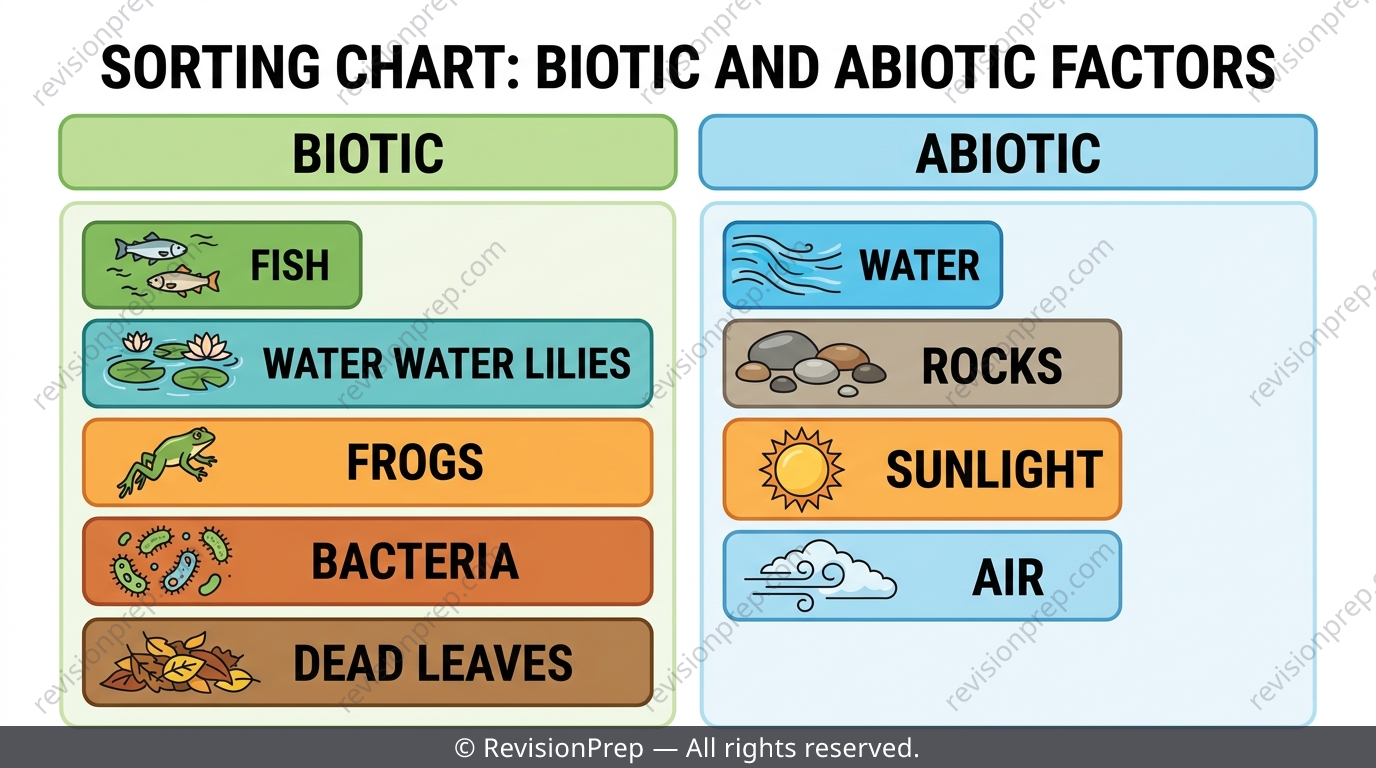
Biotic components are anything ever alive — plants, animals, bacteria, even dead leaves — while abiotic components are non-living physical or chemical factors like water, rocks, air, sunlight and temperature. Exam mark schemes tick off the exact word given in a list, so writing 'plants' when the list says 'lily pads' can cost you the mark. Bacteria and dead matter often get missed but they still count as biotic.
Exam tip
Copy each word from the given list exactly under its heading — don't paraphrase or generalise.
Common mistake
Confusing the independent and dependent variable is a classic trap: the thing you change (e.g. light exposure) is independent, the thing you measure (e.g. number of leaves) is dependent.
Energy Flow and the 10% Rule
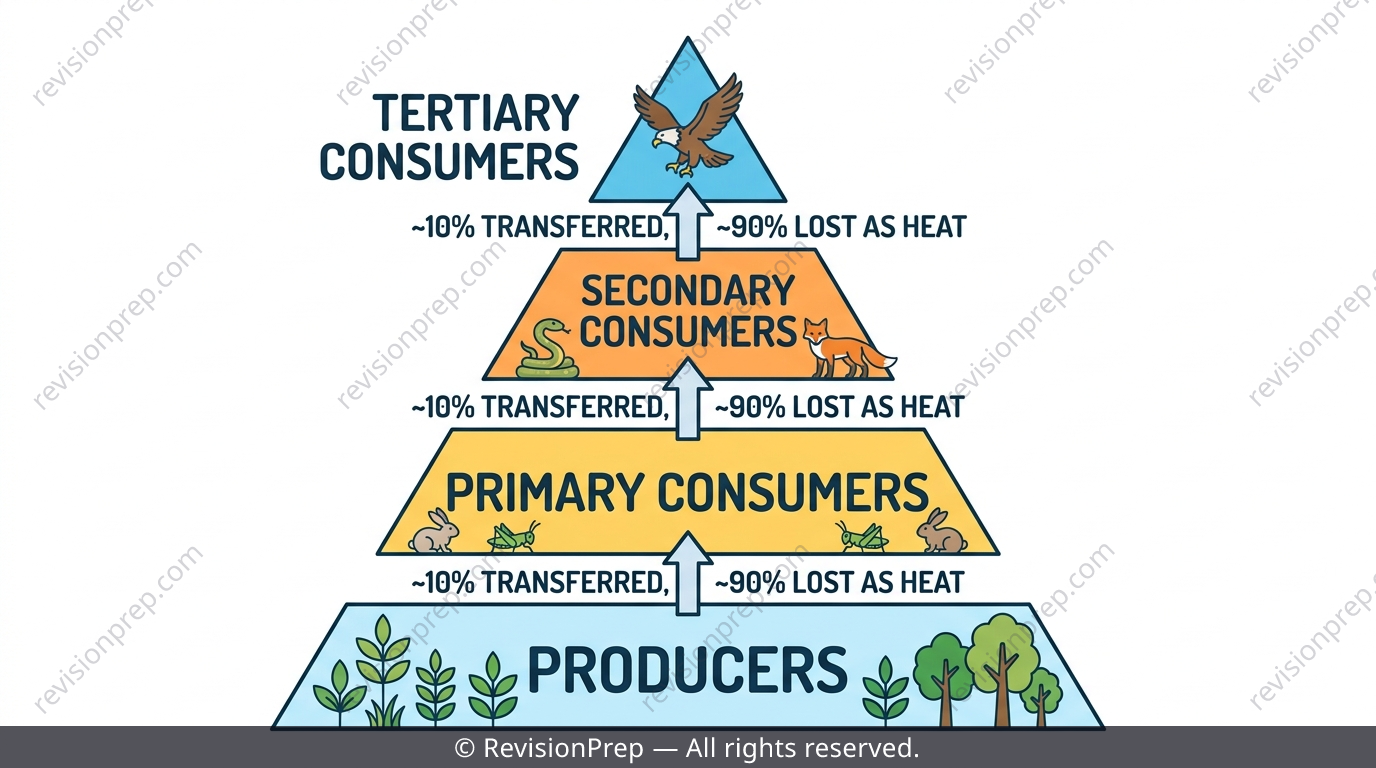
Energy enters as sunlight, gets captured by producers through photosynthesis, then flows one way through primary, secondary and tertiary consumers before being lost as heat — it is never recycled like nutrients are. At each step, only around 10% of the energy transfers to the next trophic level; the other 90% is lost through respiration, movement and undigested waste, which is why food chains rarely stretch beyond four or five levels.
| Trophic level | Role | Example |
|---|---|---|
| 1 | Producer | Plants, algae |
| 2 | Primary consumer | Herbivore eating producers |
| 3 | Secondary consumer | Carnivore eating herbivores |
| 4 | Tertiary consumer | Top predator |
Exam tip
Only the energy pyramid is always upright, because energy loss between levels is unavoidable — number and biomass pyramids can be irregular or even inverted.
Common mistake
Assuming every ecological pyramid narrows smoothly like the energy pyramid; number and biomass pyramids depend on organism size and don't always follow that shape.
Mini summary
Energy flows one way and is mostly lost as heat — around 10% transfers per level.
Pollution Chains: Bioaccumulation, Biomagnification, Eutrophication
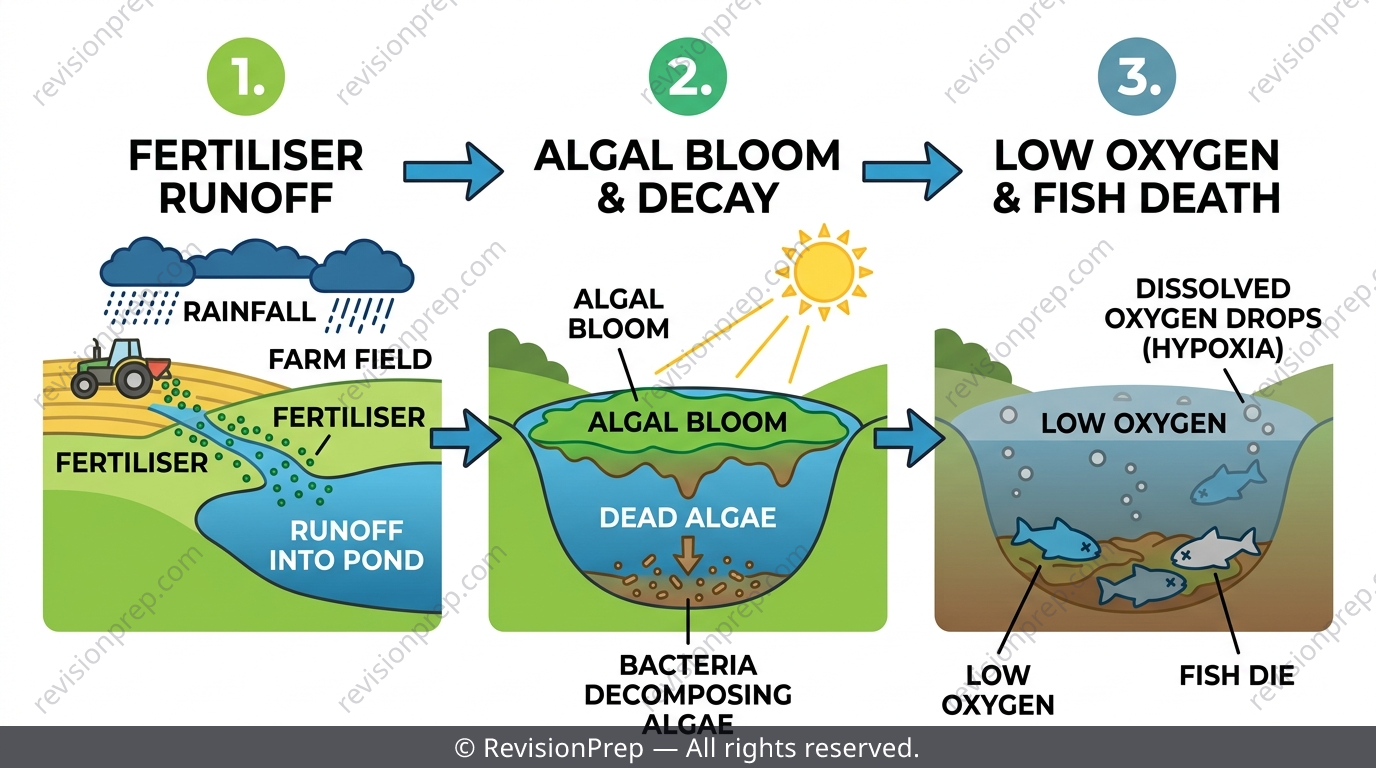
Almost every pollution question wants a chain: a pollutant enters the environment, it changes an abiotic factor (oxygen, temperature, pH, light), and that change harms a biotic population. Bioaccumulation is a toxin building up inside one organism over its lifetime; biomagnification is that toxin's concentration increasing up the food chain as predators eat many contaminated prey, hitting top predators hardest. Eutrophication happens when excess fertiliser nutrients cause algae to overgrow, then die and decompose, using up dissolved oxygen and killing aquatic life.
| Type | Common source | Typical pollutant | Main effect on organisms |
|---|---|---|---|
| Eutrophication | Fertiliser runoff | Nitrates/phosphates | Algal bloom, then oxygen depletion kills aquatic life |
| Thermal pollution | Rising water temperature | Heat energy | Lowers dissolved oxygen, stresses or kills fish |
| Global warming | Burning fossil fuels | CO2, methane | Enhanced greenhouse effect raises global temperatures |
Exam tip
For 'explain' questions on temperature or pollution, name the abiotic mechanism (like falling dissolved oxygen) before mentioning the biotic harm — skipping straight to 'it dies' loses the mechanism mark.
Common mistake
Jumping straight to 'fish will die because it's hot' without mentioning the drop in dissolved oxygen misses the actual mark scheme point.
Biodiversity: Species and Genetic Diversity
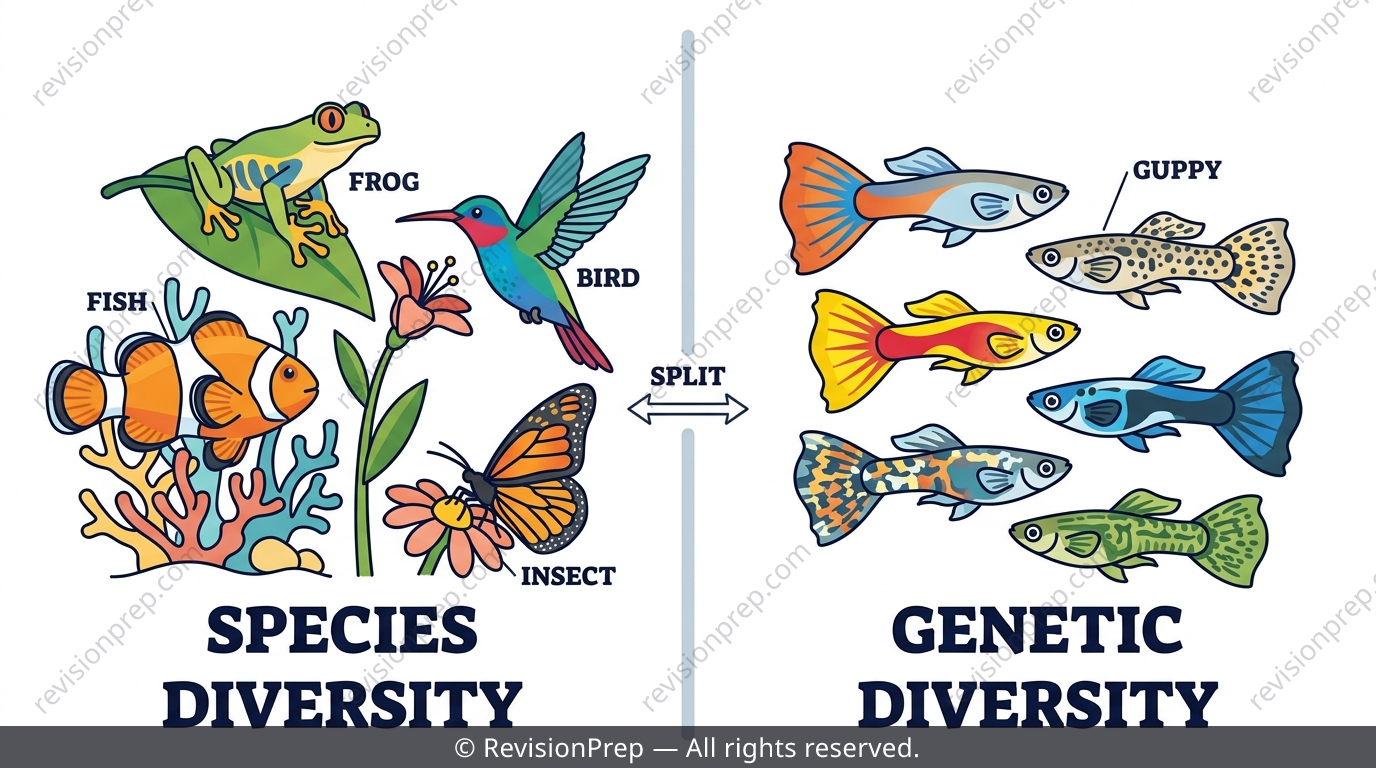
Species diversity is the number and variety of different species living in an area, while genetic diversity is the variety of genes and alleles within a single species. Higher genetic diversity makes a population more likely to survive environmental change, disease, or new predators, because more individuals carry traits that might help them cope. Both types of diversity matter for conservation, since losing either weakens an ecosystem's resilience.
Exam tip
If asked why genetic diversity matters, link it to survival: more genetic variety means a higher chance some individuals have traits suited to a changing environment.
Quick formula sheet
Practice questions
- Define the terms 'community' and 'ecosystem', and explain the difference between them.
- Sort the following into biotic and abiotic: frog, rock, sunlight, bacteria, water lily.
- State which trophic level producers always occupy in an energy pyramid.
- Explain why energy pyramids are always upright but number pyramids are not.
- Describe, using a chain of cause and effect, how excess fertiliser runoff into a pond can kill fish.
- Explain the difference between bioaccumulation and biomagnification, using an example of a toxin in a food chain.
- A pond's water temperature rises significantly. Explain, using the concept of dissolved oxygen, how this could cause the fish population to decline.
- Explain why food chains rarely have more than four or five trophic levels, referring to energy transfer efficiency.
- Evaluate why a decrease in genetic diversity could make a species more vulnerable to a new disease outbreak.
Frequently asked questions
What is the difference between a population, community and ecosystem?+
A population is all individuals of one species in an area; a community is all the different species interacting together; an ecosystem is that community plus the abiotic environment it interacts with.
Why is only about 10% of energy transferred between trophic levels?+
Most energy is lost as heat through respiration, used for movement, or tied up in body parts a consumer doesn't eat, so only roughly 10% is available to the next level.
What's the difference between bioaccumulation and biomagnification?+
Bioaccumulation is a toxin building up inside one organism over its lifetime; biomagnification is that toxin becoming more concentrated at each higher trophic level, harming top predators most.
How does eutrophication kill fish in a pond?+
Excess nutrients cause an algal bloom; when the algae die and decompose, decomposers use up the dissolved oxygen in the water, leaving too little oxygen for fish to survive.
Are energy pyramids always upright?+
Yes — because energy transfer always loses roughly 90% per level. Number and biomass pyramids, however, can be irregular or occasionally inverted depending on organism size.
Why does genetic diversity matter for a species' survival?+
Higher genetic diversity increases the chance that some individuals carry traits suited to surviving a changing environment, disease, or new predators.
Get the Full IB MYP 3 Ecology and Environment Revision Notes
Related articles