
Equations, Inequalities & Formulae
The core algebra skills IB MYP 3 tests in nearly every unit test and eAssessment
Quick facts
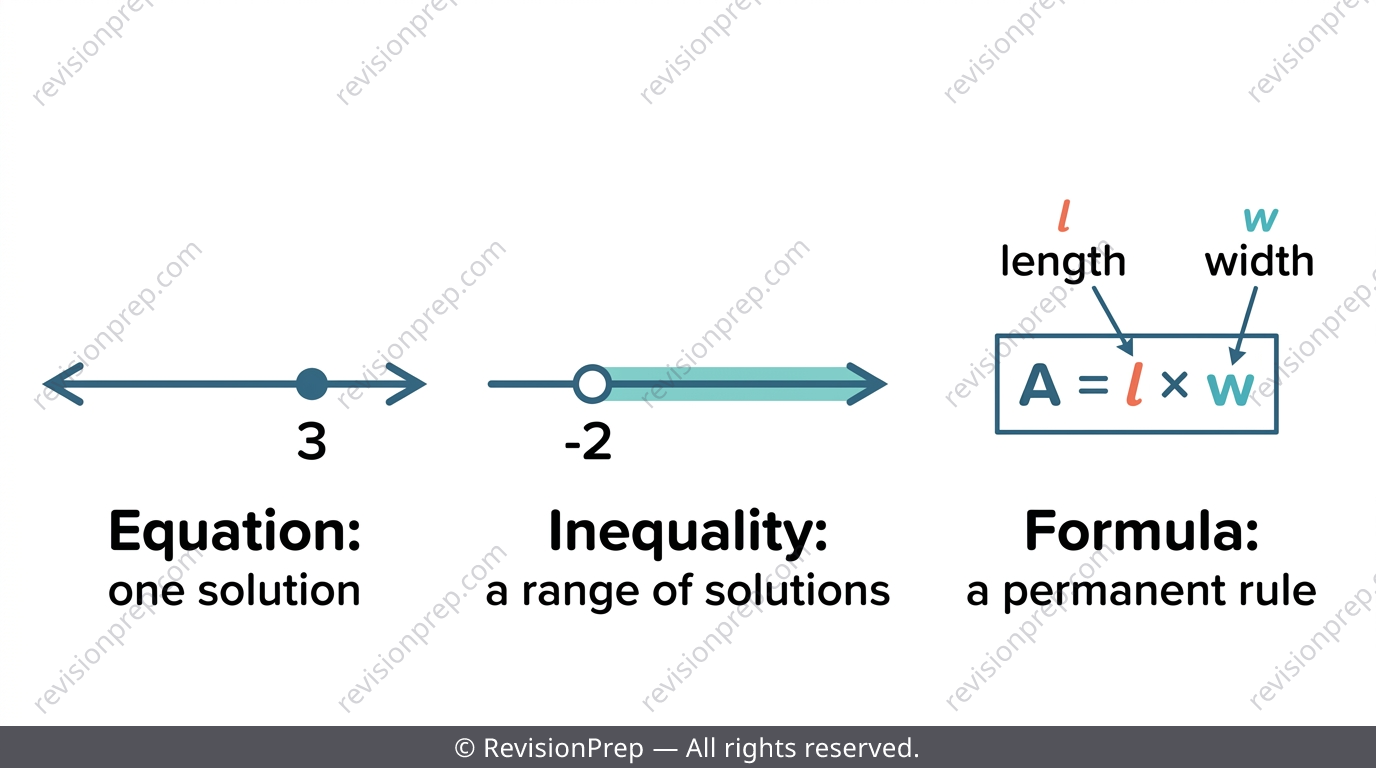
Equations, inequalities, and formulae look similar but ask completely different questions — and IB MYP 3 loves testing whether you can tell them apart. An equation pins down one exact value, an inequality describes a whole range on the number line, and a formula is a permanent rule you substitute into or rearrange, never 'solve.' This is exactly the kind of core algebra content that shows up repeatedly across unit tests and the eAssessment, from solving two-step equations to translating tricky word problems and rearranging formulas like simple interest or temperature conversion. Get comfortable with the balance method, the one extra rule inequalities add, and the 'let x = ...' habit for word problems, and most of this strand becomes routine. This teaser walks through the five ideas that cause the most lost marks, with the full worked examples and practice waiting in the complete revision notes.
What you’ll be able to do
Equations vs Inequalities vs Formulae — Why Mixing Them Up Costs Marks
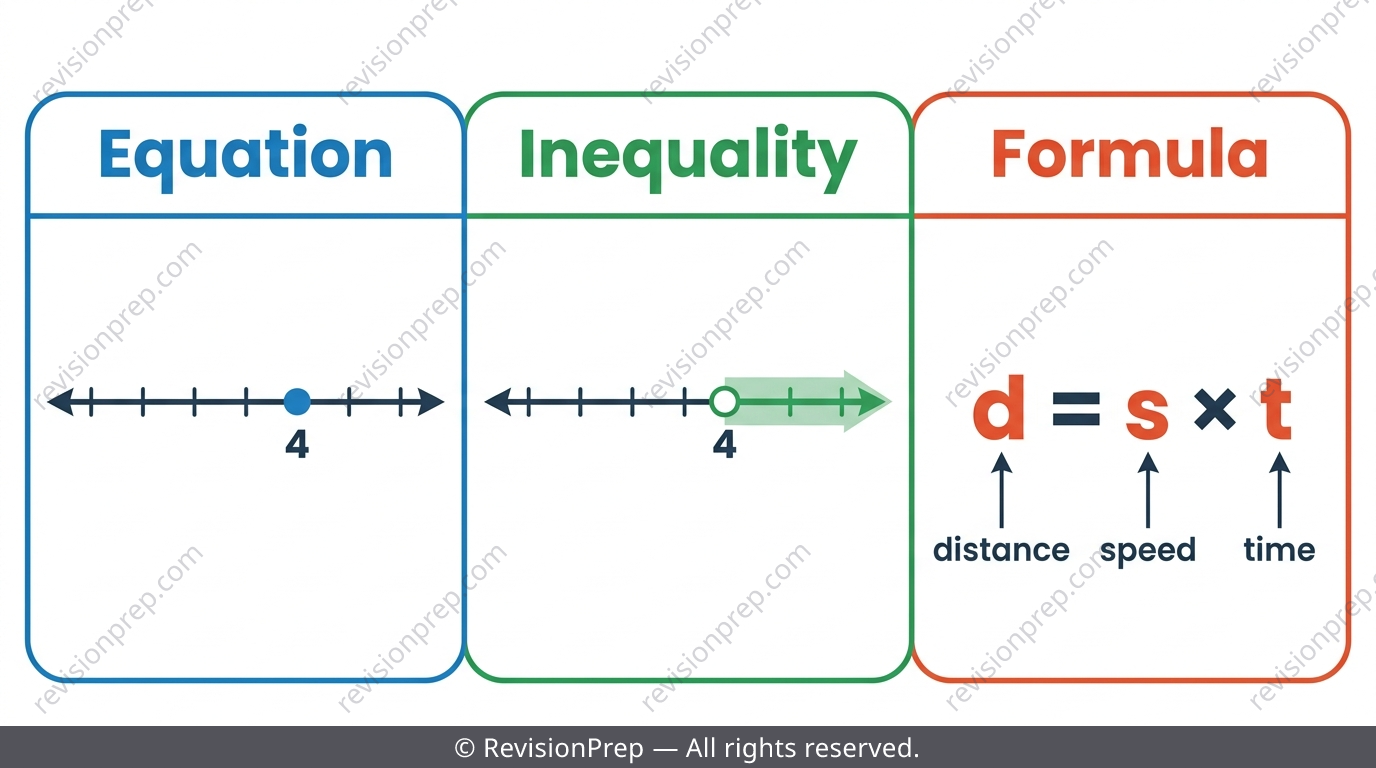
An equation asks for the specific value (or values) of x that make it true — the answer is a point on the number line. An inequality asks for the whole range of values that work, shown as a region. A formula, like or , connects several variables permanently — you substitute numbers in or rearrange for a different subject, but you never 'solve' it the way you solve an equation. All three obey the same balance-method rules, with one extra rule for inequalities.
| Type | What the answer looks like | Example |
|---|---|---|
| Equation | A point on the number line | |
| Inequality | A region on the number line | |
| Formula | A rule linking variables |
Common mistake
Treating a formula as something you 'solve' for x, when it's actually meant to be substituted into or rearranged.
Mini summary
Equations give a point, inequalities give a region, formulae give a rule — know which one the question is testing.
Solving Inequalities and Representing Them on Number Lines
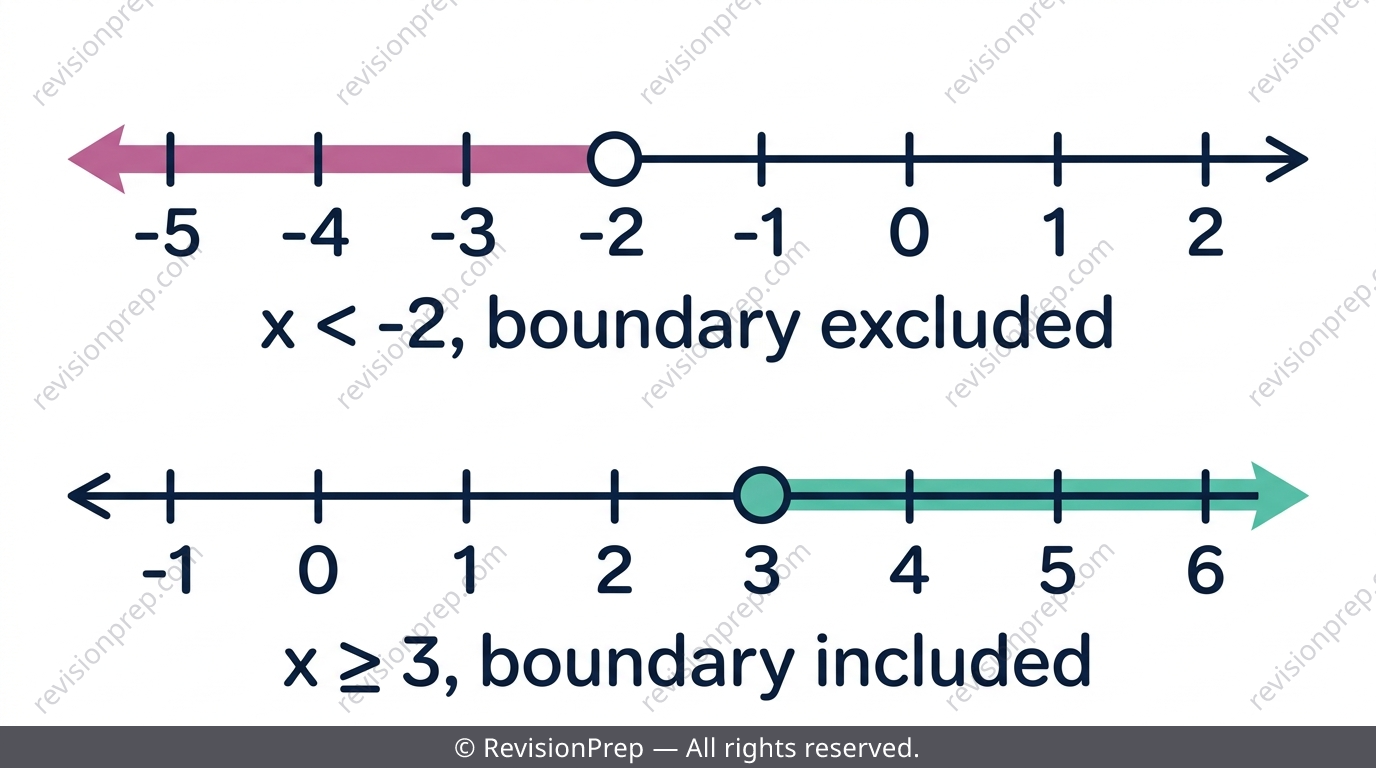
Inequality rules match equation rules exactly, except one: multiplying or dividing both sides by a negative number flips the inequality sign. Use an open circle for strict inequalities () since the boundary value is excluded, and a closed circle for or since the boundary is included. A compound inequality like describes one continuous interval — read it as 'x is at least and less than .'
Exam tip
Always substitute your final answer back into the ORIGINAL inequality, not the simplified line, to catch a missed sign-flip.
Common mistake
Dividing or multiplying by a negative without flipping the sign — e.g. going from to instead of the correct .
Mini summary
Same steps as equations, plus one rule: flip the sign when multiplying or dividing by a negative number.
Turning Word Problems into Equations
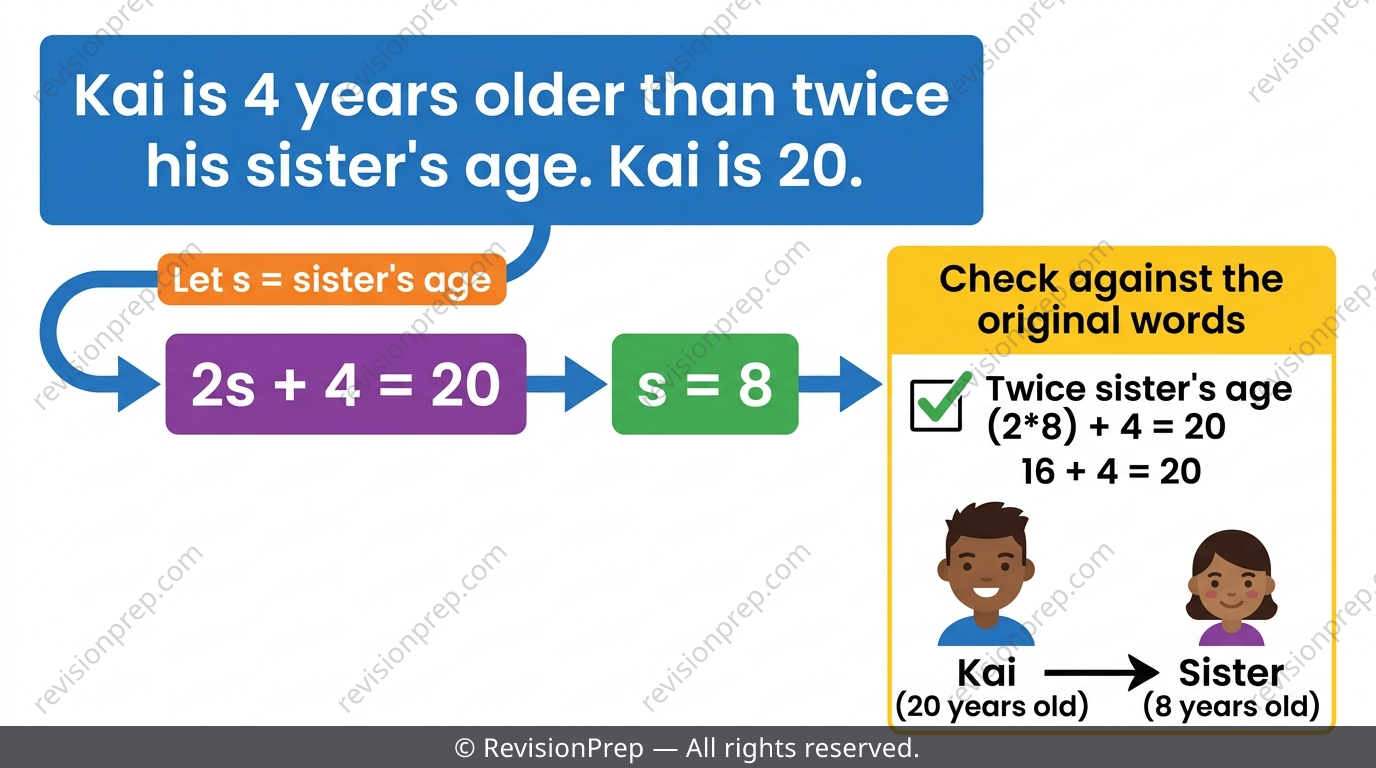
The hardest part of a word problem is deciding what x represents and writing one sentence that becomes one equation — not the algebra itself. Always start with 'Let = ...' before writing any symbols; this earns its own mark and prevents translation errors later. Watch phrases like '5 less than a number,' which means , not — the value named second is the one being subtracted.
Exam tip
Check your final answer against the ORIGINAL words of the problem, not just the equation, and make sure you've answered the actual question asked.
Common mistake
Skipping the 'let x = ...' step, or translating subtraction phrases in the order they're read instead of their true meaning.
Mini summary
Define the unknown first, translate phrase by phrase, then check your answer against the original story.
Formulas: Substitution vs Changing the Subject
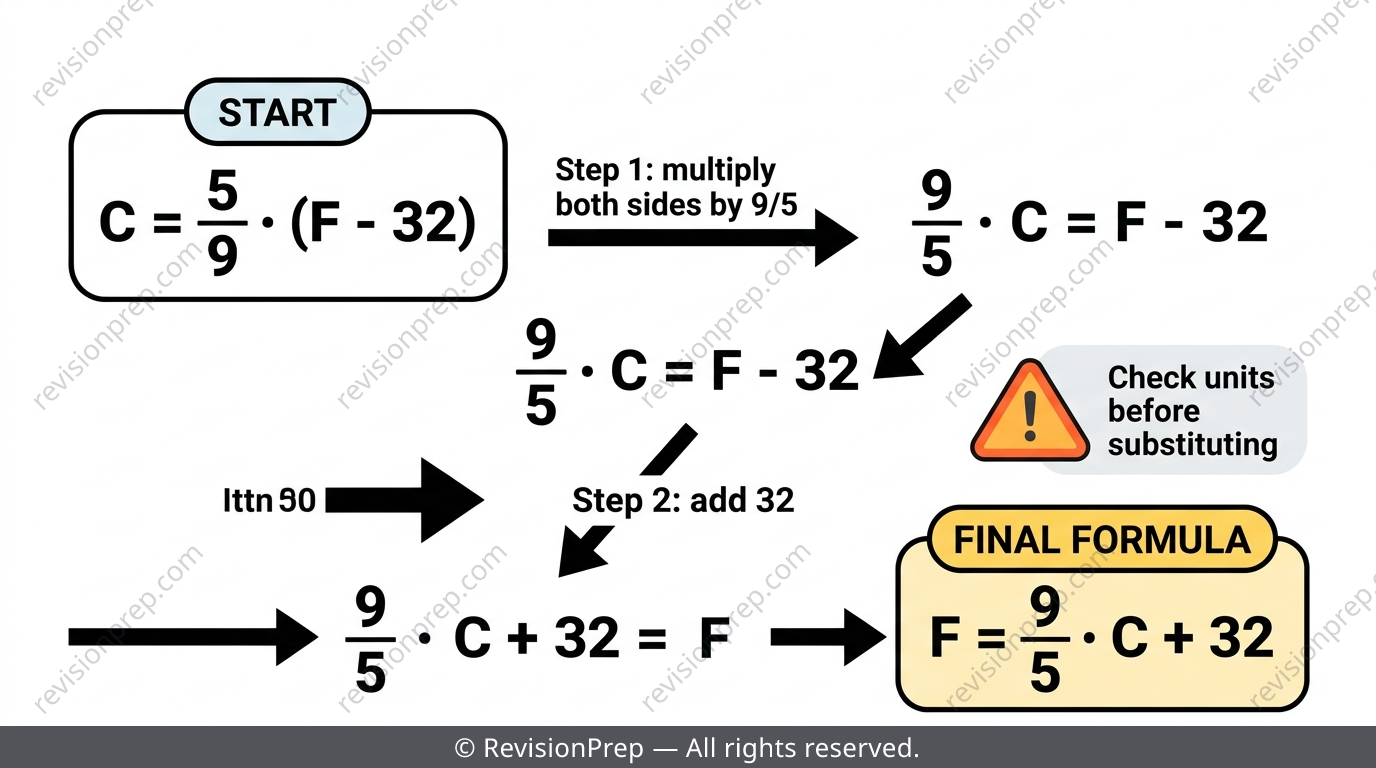
A formula like is a permanent rule: substitution means plugging in known numbers to get a single value, while changing the subject means rearranging so a different letter is isolated, using the exact same balance-method logic as solving an equation. Undo operations in reverse order — for , multiply by before adding 32 to correctly get . Units matter enormously here; mixing km/h with minutes is a top cause of correct algebra but wrong final answers.
| Formula | Meaning |
|---|---|
| Area of a rectangle | |
| Perimeter of a rectangle | |
| Distance = speed × time | |
| Celsius from Fahrenheit | |
| Simple interest |
Exam tip
Once you've rearranged a formula, substitute directly into the NEW rearranged version — don't re-solve from the original formula each time.
Common mistake
Rearranging only part of an expression, like multiplying just one term by instead of the whole bracket.
Mini summary
Substitution gives a number, changing the subject gives a new formula — treat the target letter exactly like x, and check your units.
The Balance Method for One-Step and Two-Step Equations
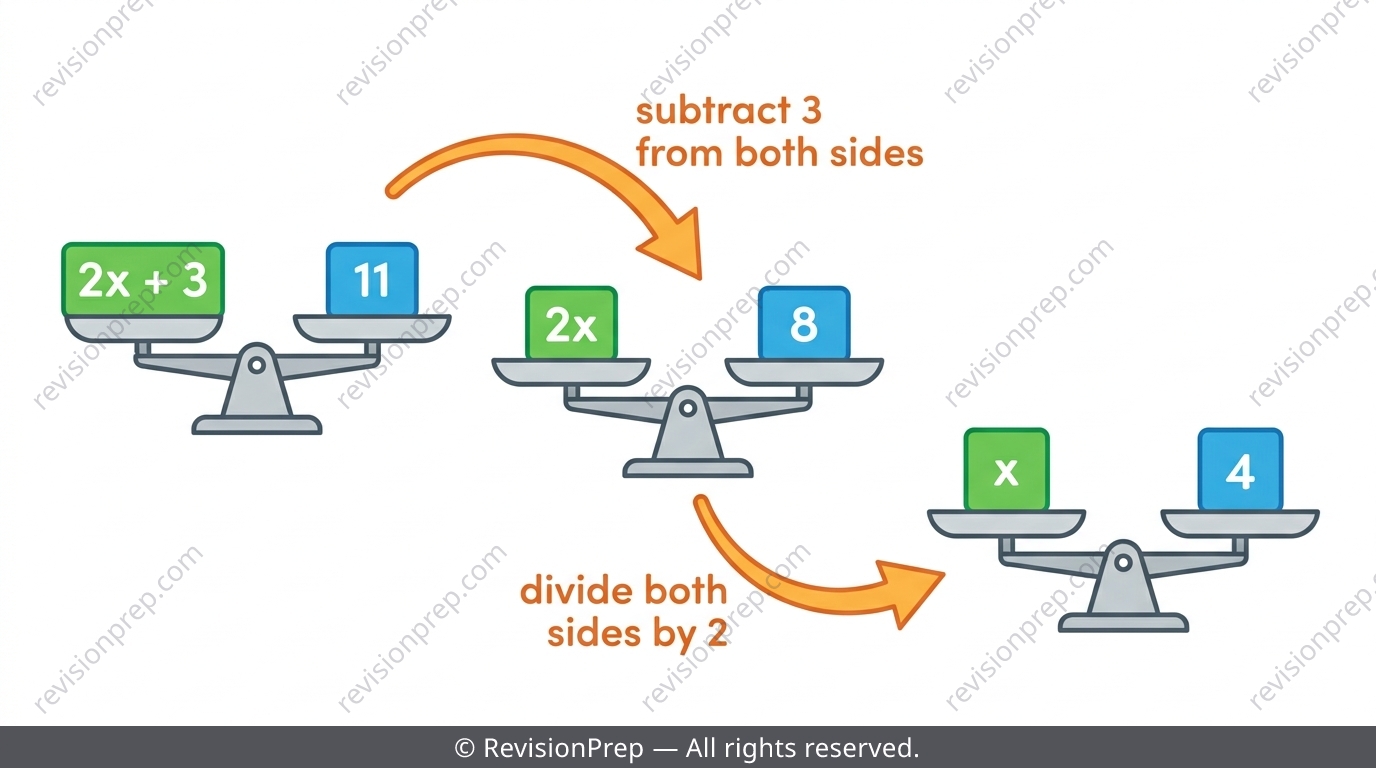
Every equation, inequality, and formula rearrangement in this chapter relies on the same balance method: whatever you do to one side, you must do to the other. For two-step equations, undo addition or subtraction first, then undo multiplication or division, working in the reverse order the equation was built. This single method is the backbone connecting every skill in the unit — master it here and inequalities and formula rearranging both become far easier.
Exam tip
Write out each balance-method step on its own line — mark schemes reward clear method, not just a correct final number.
Mini summary
The balance method — do the same operation to both sides — underlies equations, inequalities, and formula rearranging alike.
Quick formula sheet
Practice questions
- Solve for x: $3x - 4 = 11$.
- Solve and represent on a number line: .
- Substitute into to find the area when and .
- Solve and represent your solution on a number line, naming the type of circle used.
- A number is 6 more than 3 times another number. If the result is 24, let x = the smaller number and find its value.
- Rearrange to make the subject, then find when and .
- Solve the compound inequality and describe the solution set in words.
- Rearrange to make the subject, then find if , , .
- A student solved and got . Identify the error, explain why it occurred, and give the correct solution.
Frequently asked questions
What is the difference between an equation and an inequality?+
An equation gives one exact value (or a few) that make it true, like a single point on the number line. An inequality describes an entire range of values that satisfy it, shown as a shaded region on the number line.
Why does the inequality sign flip when you multiply or divide by a negative number?+
Multiplying or dividing by a negative number reverses the order of numbers on the number line. Test it: is true, but multiplying both sides by gives , which is false — the sign must flip to to stay true.
When do I use an open circle versus a closed circle on a number line?+
Use an open circle for strict inequalities ( or ) because the boundary value is excluded from the solution. Use a closed, filled circle for or because the boundary value is included.
How do I turn a word problem into an equation?+
Read the whole problem first, then explicitly write 'Let = ...' to define your unknown before symbolising anything. Translate each phrase carefully, solve using balance-method steps, and check your answer against the original words.
What's the difference between substituting into a formula and changing its subject?+
Substitution means plugging in known numbers to calculate one value. Changing the subject means rearranging the formula algebraically so a different letter is isolated, using the same balance-method logic as solving any equation.
Why is my formula rearrangement wrong even though my algebra looks right?+
A very common cause is mismatched units (like km/h with minutes) or undoing operations in the wrong order. Always undo operations in the exact reverse order they were applied, and make sure units match before substituting.
Get the Full Equations, Inequalities & Formulae Revision Notes
Related articles