
Patterns, Sequences & Algebraic Thinking
Crack arithmetic and geometric sequences, nth-term rules and real-world patterns for IB MYP 3 Maths
Quick facts
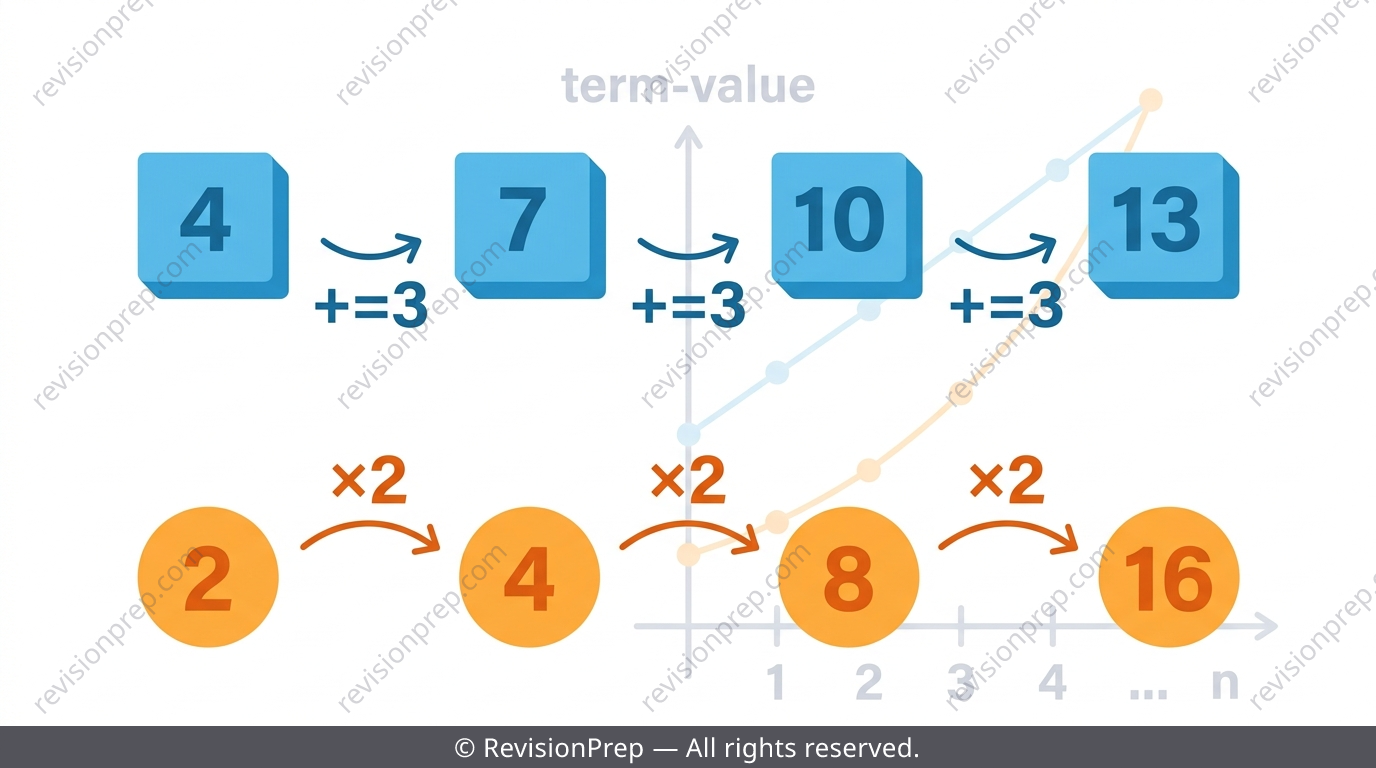
Every number pattern you meet in IB MYP 3 Maths is really one of two behaviours in disguise: adding the same amount each time, or multiplying by the same amount each time. Once you can tell arithmetic sequences and geometric sequences apart, the nth-term formulas practically write themselves — and suddenly 'find term 50' takes seconds instead of a long list. This topic sits at the heart of MYP Criterion B (Investigating Patterns) and Criterion C (Communicating), showing up in dot patterns, seating plans, savings problems and the on-screen eAssessment. This teaser walks through the five ideas that matter most: telling sequence types apart, using the two core formulas, building your own general rule, reading real-life word problems, and generalising patterns algebraically. For the full worked examples, common-mistake breakdowns and practice sets, the complete revision note is linked below.
What you’ll be able to do
Arithmetic vs Geometric Sequences
An arithmetic sequence adds the same fixed number, , every step; a geometric sequence multiplies by the same fixed factor, , every step. Test for arithmetic by subtracting consecutive terms — if the result repeats, that's . Test for geometric by dividing consecutive terms (later ÷ earlier) — if that repeats, that's . Plotted as , arithmetic sequences sit on a straight line, while geometric sequences curve, steepening for growth () or flattening toward zero for decay ().
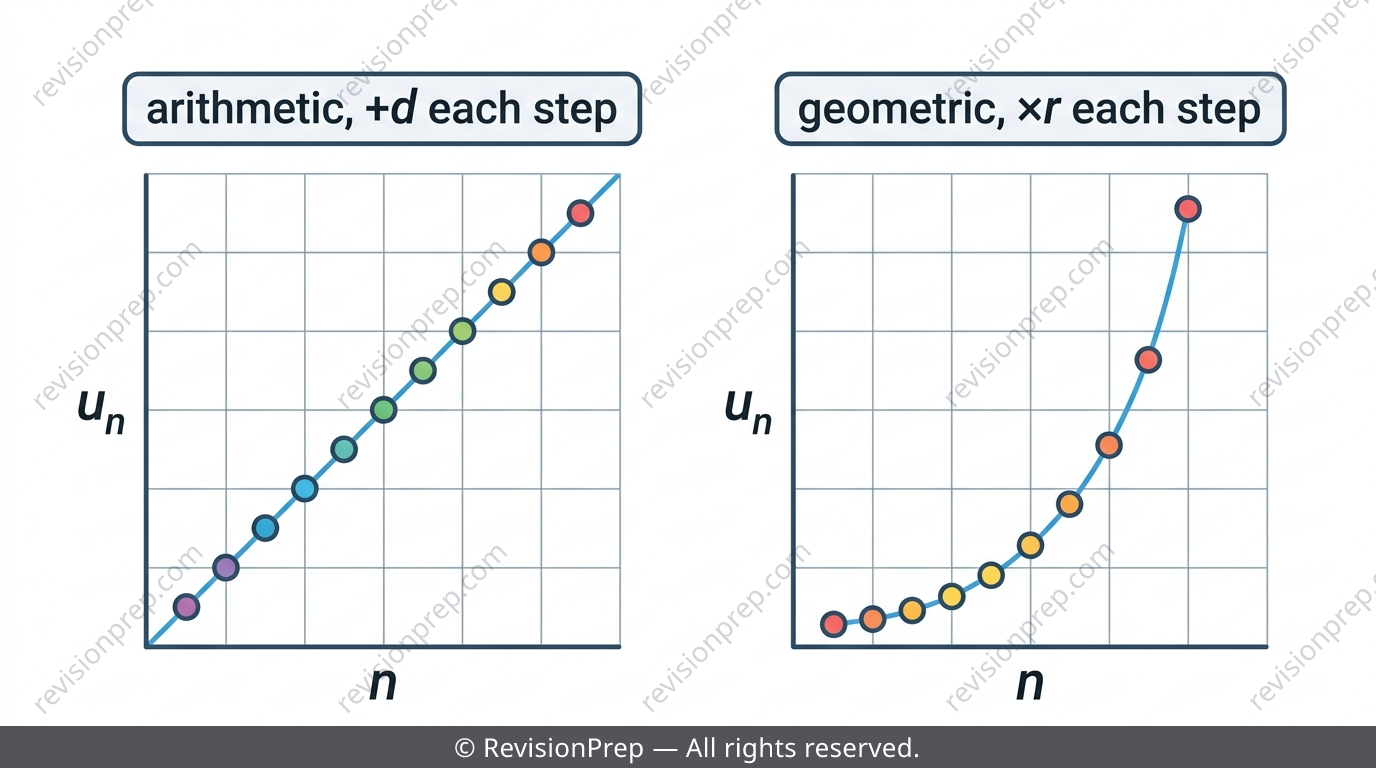
| Feature | Arithmetic sequence | Geometric sequence |
|---|---|---|
| Change per step | Add a fixed | Multiply by a fixed |
| Test | Subtract consecutive terms | Divide consecutive terms |
| Graph shape | Straight line | Curve (growth or decay) |
Exam tip
Always confirm the same difference (or ratio) holds for at least two consecutive pairs before you commit to or .
Common mistake
Subtracting terms in the wrong order, or dividing consecutive terms of an arithmetic sequence looking for a ratio that isn't there.
Mini summary
Add = arithmetic; multiply = geometric — subtract first, divide second, and check twice.
The Two Core nth-Term Formulas
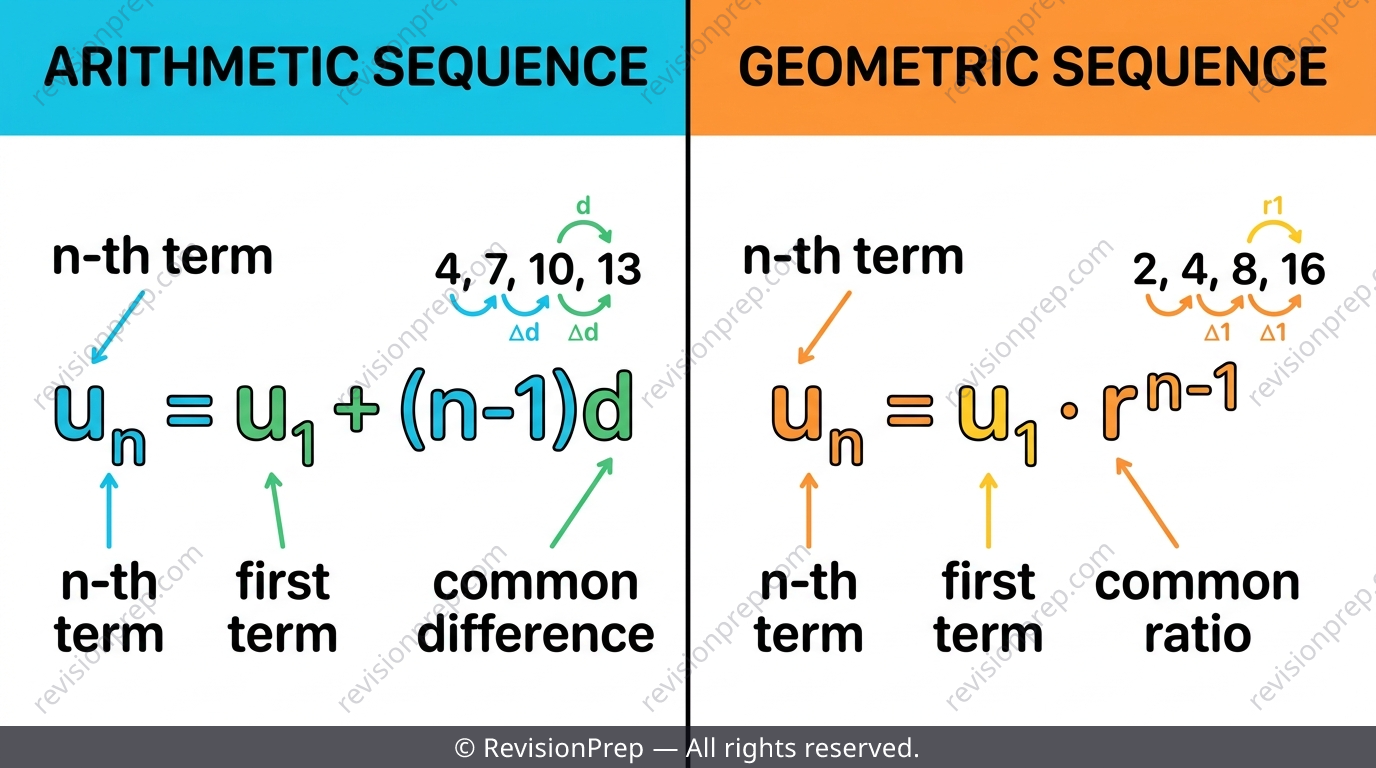
Once you know a sequence's type, one formula lets you jump straight to any term without listing every value in between. For arithmetic sequences use ; for geometric sequences use . If you're only given two terms rather than the first term and the common difference, set up two equations and solve for or by comparing the gap between the term positions, not the term numbers themselves.
Exam tip
'State the formula' is often its own mark — write symbolically before substituting any numbers.
Common mistake
Dividing the difference between two given terms by the term numbers (e.g. 7 or 3) instead of by the number of steps between them (e.g. 4).
Mini summary
for add-patterns; for multiply-patterns.
Building Your Own General Rule
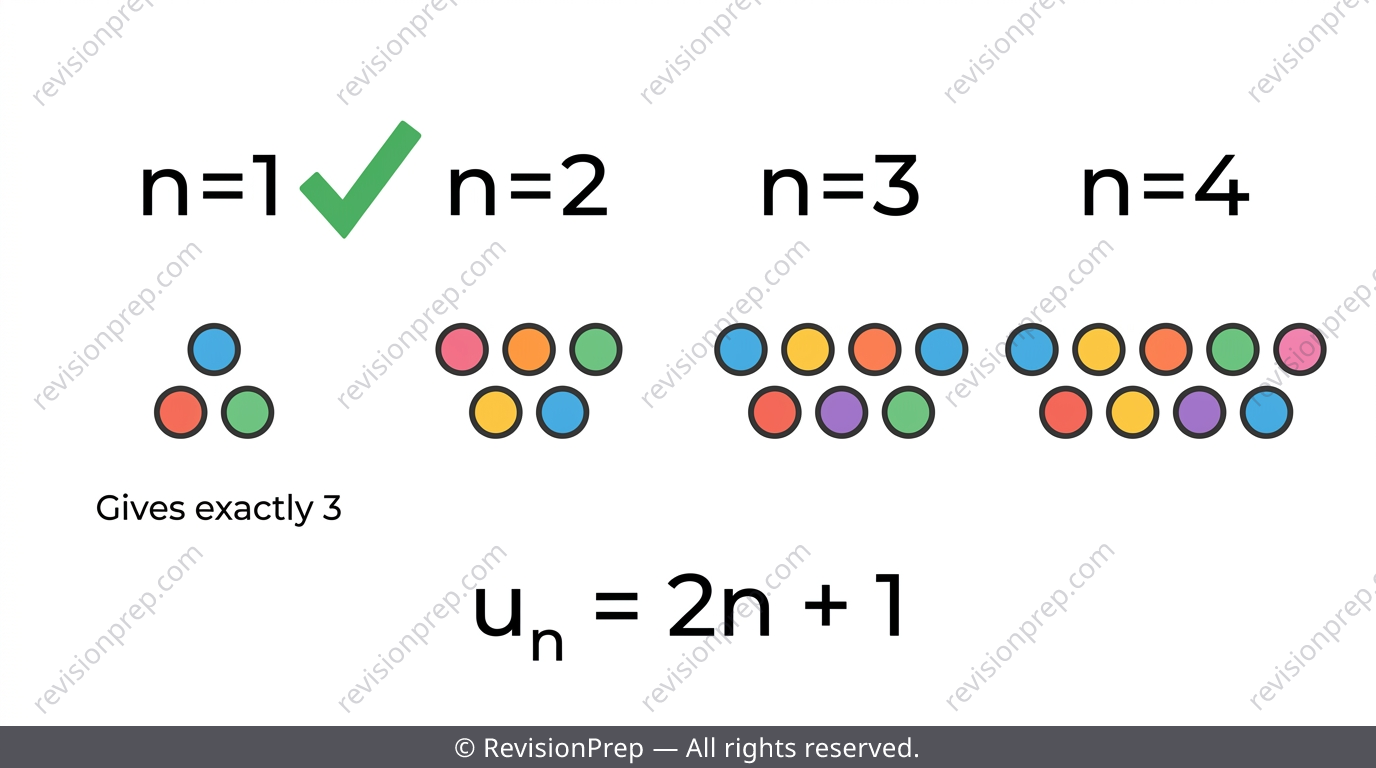
An nth-term rule lets you find any term directly from its position — essential once a question asks for 'term 50'. For a linear pattern, the coefficient of is always the common difference ; the constant term is whatever makes the rule true when . Always double-check your finished rule against a term you did NOT use to build it — that safety check is exactly what examiners look for.
Exam tip
Substitute into your draft rule immediately; if it doesn't exactly match the real first term, adjust the constant using .
Common mistake
Writing the rule as just (e.g. ) with no correction constant, because the coefficient looks right but the starting point was never checked.
Mini summary
Coefficient of = common difference; constant = whatever makes correct — then verify with a second term.
Spotting Patterns in Real-Life Word Problems
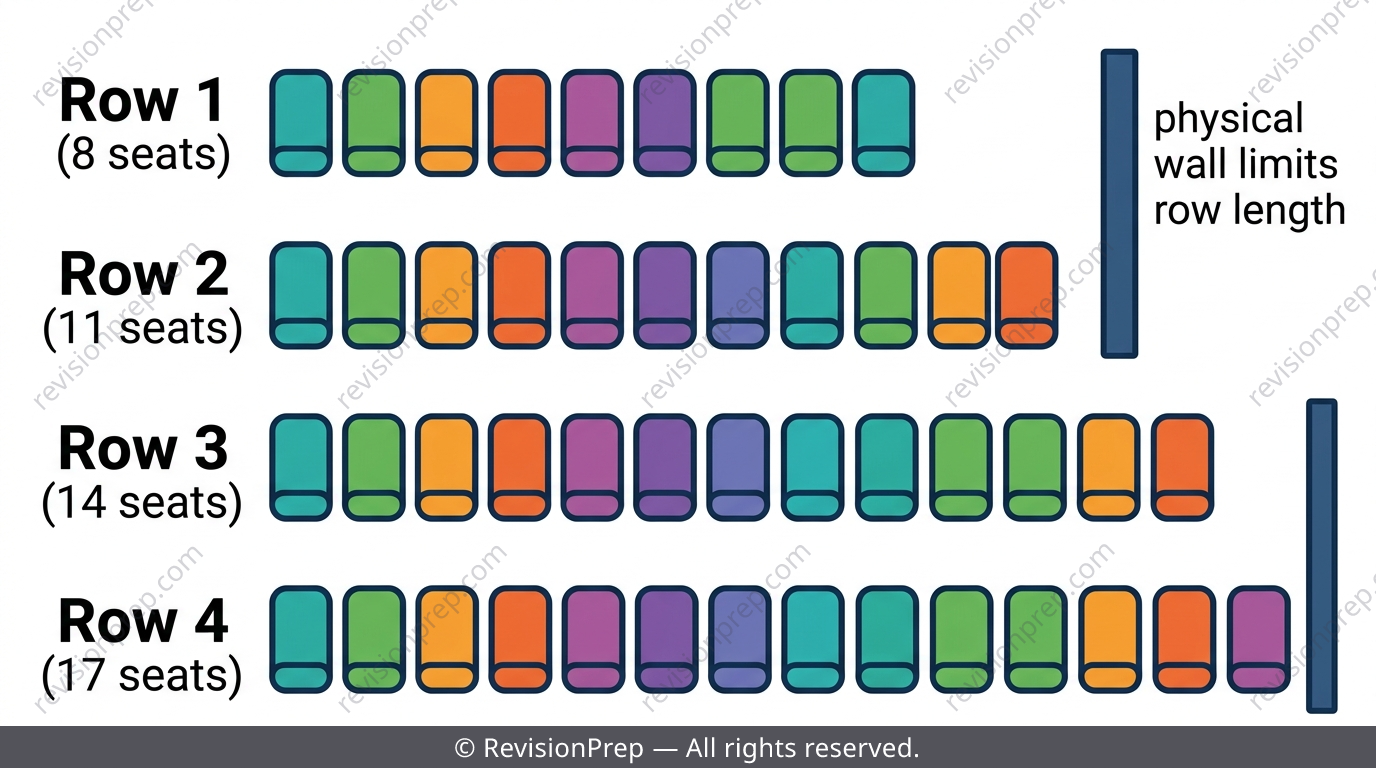
Most 'real-life' exam questions are simply an arithmetic or geometric sequence wearing a costume. Fixed-amount contexts — a flat fee plus a constant add-on, like seat rows or weekly savings — are arithmetic. Fixed-percentage contexts — interest rates, doubling or halving — are geometric. When asked why a model might not hold forever, always name a concrete, context-specific limiting factor, never a vague generalisation.
Exam tip
For 'explain one real-world reason' questions, give ONE strong, specific, named constraint rather than two weak vague ones.
Common mistake
Assuming a real-world pattern continues forever with the exact same difference or ratio, e.g. claiming a theatre has unlimited seats or a bank balance grows without limit.
Mini summary
Flat add-on = arithmetic; fixed percentage = geometric; always name a real limiting factor.
Generalising Patterns Algebraically
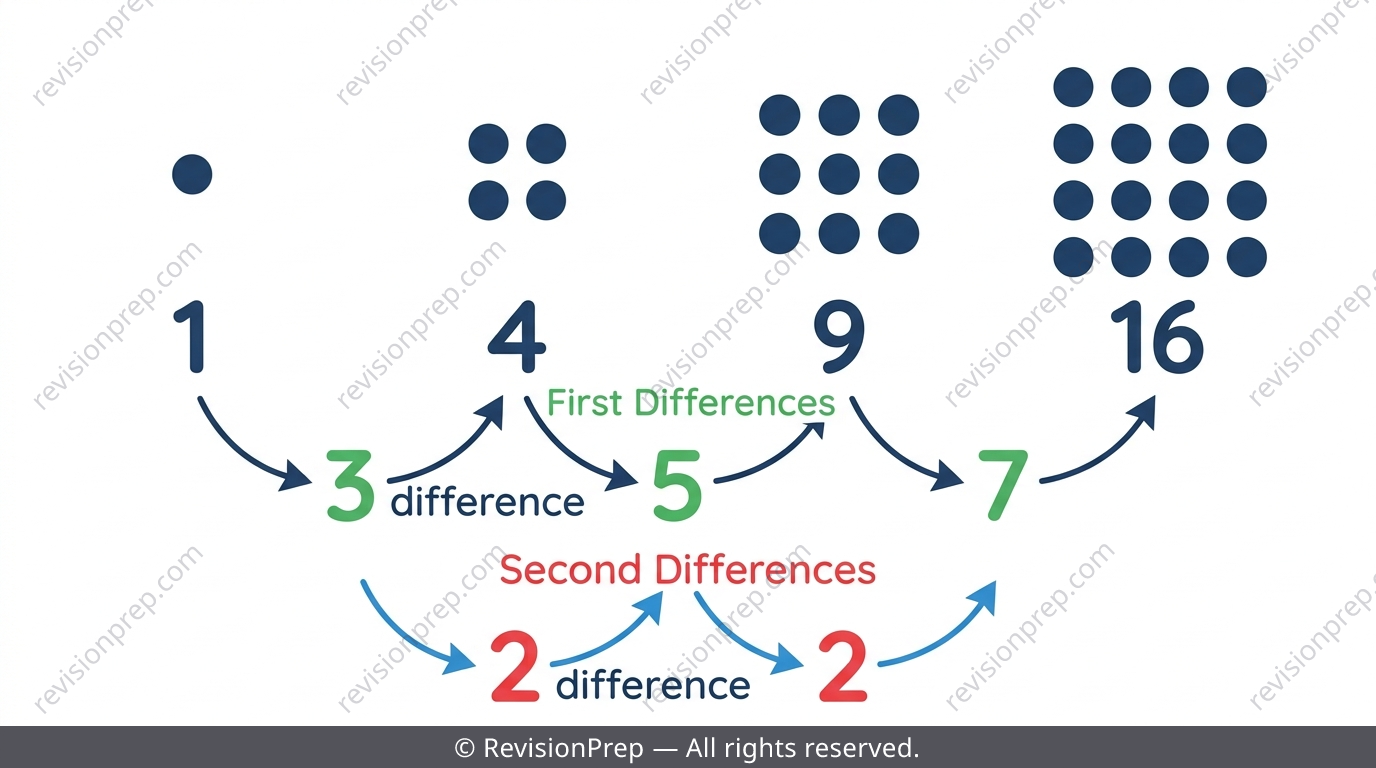
Generalising a pattern means replacing the specific numbers you counted with one algebraic expression in that works for every term at once — the bridge between noticing a pattern and being able to use or prove it. Not every pattern is linear: sequences like squares or triangular numbers don't have a constant first difference, so you need to look at the differences of the differences to spot the underlying structure. Spotting whether a pattern is linear (constant first difference) or needs a second look tells you which type of rule to search for.
Exam tip
If the first differences aren't constant, calculate the second differences before assuming there's no pattern at all.
Common mistake
Giving up on a pattern as 'random' as soon as the first differences aren't equal, instead of checking the differences of the differences.
Mini summary
Constant first difference → linear rule; unequal first differences → check second differences before generalising.
Quick formula sheet
Practice questions
- State whether 5, 9, 13, 17 is arithmetic or geometric and give the common difference or ratio.
- Find the common ratio of the sequence 3, 6, 12, 24.
- Write the nth-term rule for the sequence 2, 5, 8, 11.
- An arithmetic sequence has and . Find the common difference .
- A savings pattern starts at $10 and increases by $4 each week. Predict the saving in week 6 and state the type of sequence.
- Check whether the rule correctly gives the first term of the sequence 4, 7, 10, 13.
- A geometric sequence has and . Find the common ratio .
- A theatre's row pattern is arithmetic with , . Explain one specific reason the model might not hold for row 20 in a real building.
- A sequence of square numbers is 1, 4, 9, 16, 25. Calculate the first and second differences and explain what they show about the pattern.
Frequently asked questions
How do I tell if a sequence is arithmetic or geometric?+
Subtract consecutive terms first — if the result is always the same, it's arithmetic and that value is . If subtracting gives different values, divide consecutive terms instead; a constant result there means it's geometric and that value is .
What's the difference between $u_n = u_1 + (n-1)d$ and $u_n = u_1 \cdot r^{n-1}$?+
The first formula is for arithmetic sequences (adding repeatedly) and the second is for geometric sequences (multiplying by repeatedly). Use whichever matches your test result from subtracting or dividing terms.
Why does my nth-term rule need to be checked at $n=1$?+
Because the coefficient of only gives you the common difference — it doesn't guarantee the starting point is correct. Substituting confirms your constant term actually matches the real first term.
How do I answer 'justify whether the student is correct' questions?+
Calculate the actual value yourself, write it down, and then explicitly compare it in a sentence to the student's claim. A verdict alone, without the written calculation and comparison, usually only earns partial credit.
Is a real-life pattern always exactly arithmetic or geometric?+
Not forever — most real situations only follow the pattern for a while before a specific, named factor in the context (like a wall, a bill, or reduced income) causes it to break down.
What do I do if the first differences of a sequence aren't constant?+
Don't assume there's no pattern — calculate the differences of the differences (second differences). A constant second difference points to patterns like square or triangular numbers rather than a simple linear rule.
Get the Full MYP 3 Patterns & Sequences Notes
Related articles