
Acids, Bases and Salts
Definitions, neutralisation, salt preparation and real-world applications for MYP 5 Chemistry
Quick facts
Acids, bases and salts is one of the most exam-tested topics in MYP 5 Chemistry because it blends theory with hands-on practical skills. You need to know what makes a substance acidic or basic, how neutralisation reactions produce salts, and how to actually prepare and purify those salts in the lab — soluble salts by crystallisation, insoluble salts by precipitation. Examiners also love connecting this topic to real life: fertilisers, antacids, soap-making and industrial cleaning all rely on acid-base chemistry, and evaluation questions expect you to weigh trade-offs, not just state facts. This teaser covers the five ideas worth the most marks — definitions and properties, the four neutralisation reaction families, salt preparation methods, real-world applications, and the data-evaluation skills examiners test again and again. For full worked examples, definitions and practice, the complete revision notes are linked below.
What you’ll be able to do
Acids, Bases, Alkalis and Salts: The Core Definitions
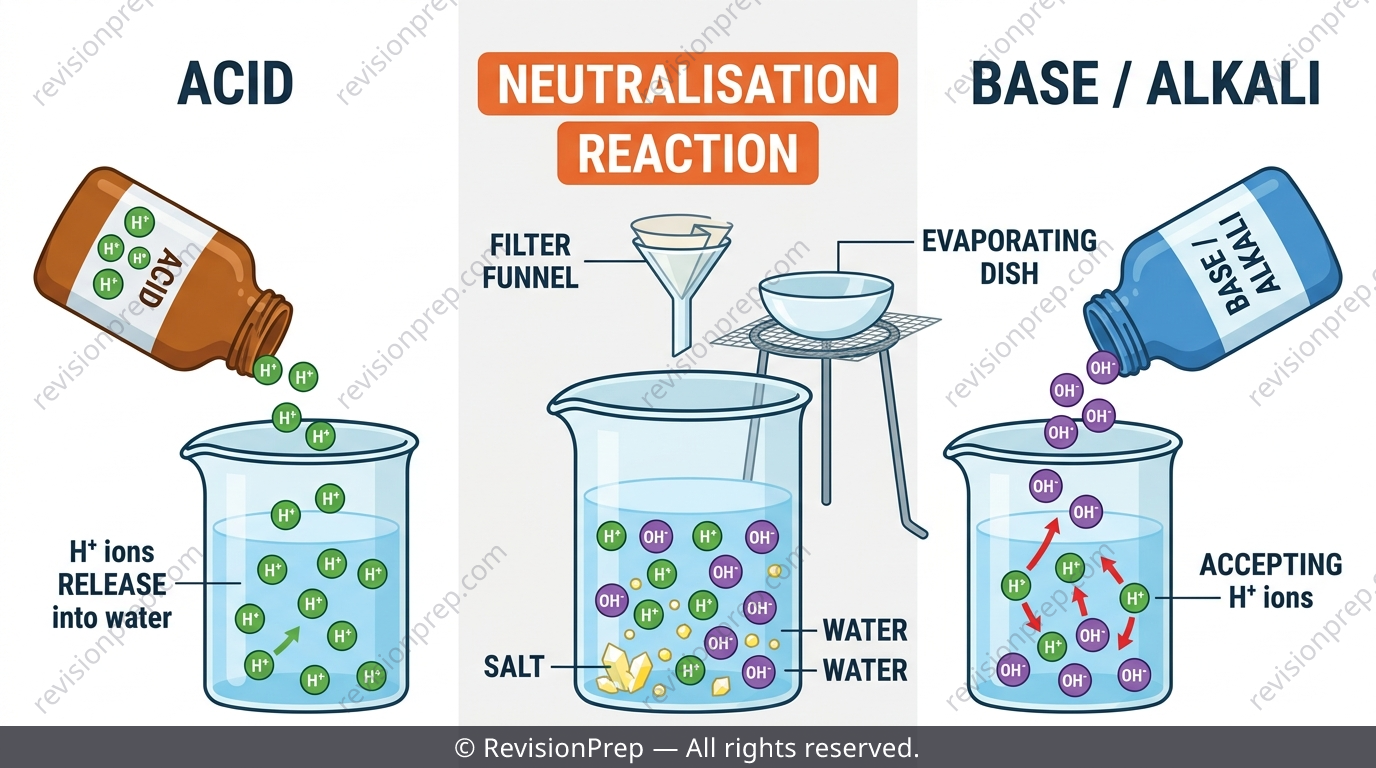
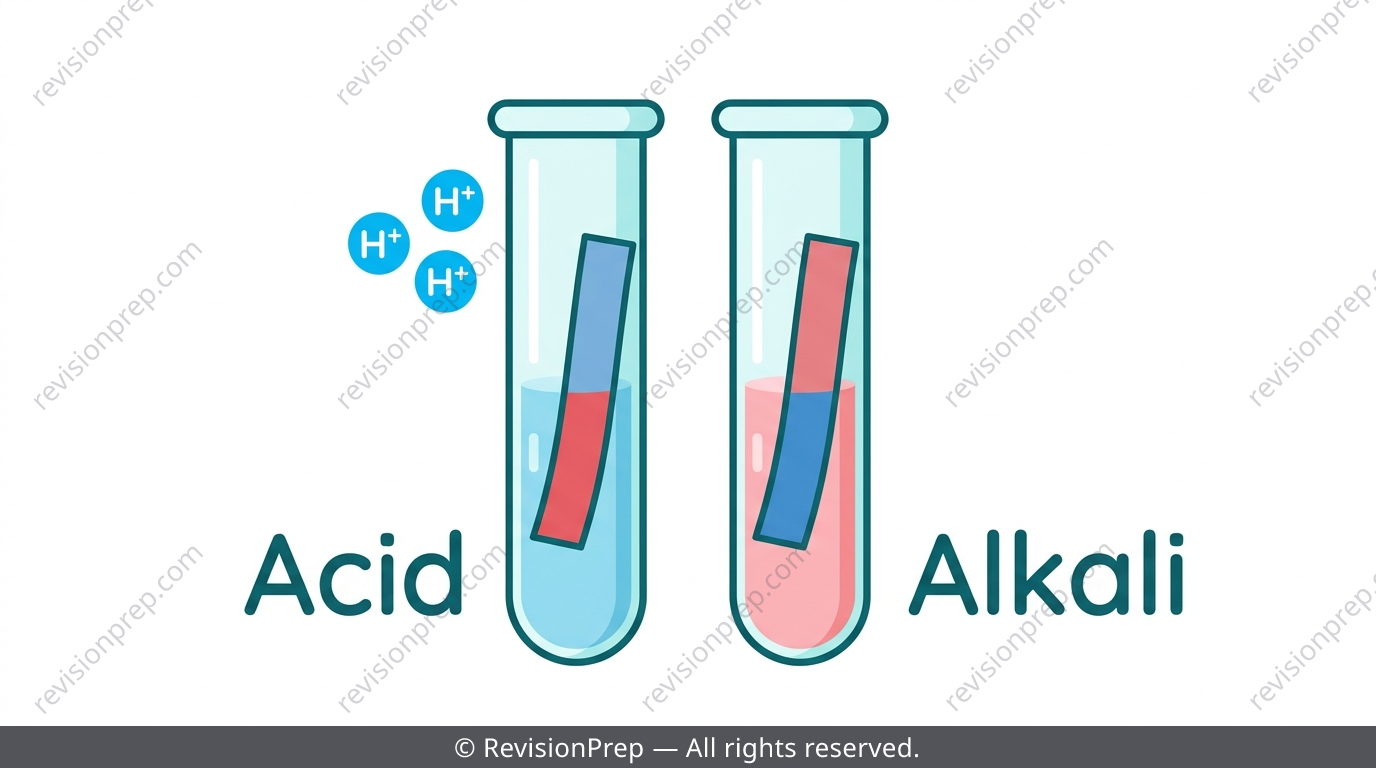
An acid produces hydrogen ions () in water, while a base is anything that can neutralise an acid by accepting . An alkali is simply a base that dissolves in water. A salt is the ionic compound formed when the of an acid is replaced by a metal ion or ammonium ion, and its name always comes from the acid (chloride, sulfate, nitrate) plus the metal used. Acids turn blue litmus red and taste sour; alkalis turn red litmus blue, feel soapy, and taste bitter — but taste and touch are descriptive knowledge only, never real lab tests, since both acids and alkalis are corrosive.
Exam tip
If a question asks you to identify a salt's name, check both parts: the metal/ammonium ion AND the acid-derived ending (chloride, sulfate, nitrate, carbonate).
Mini summary
Acid = releases H+; base = accepts H+; alkali = soluble base; salt = acid's H+ replaced by a metal or ammonium ion.
Neutralisation: The Four Salt-Making Reaction Families
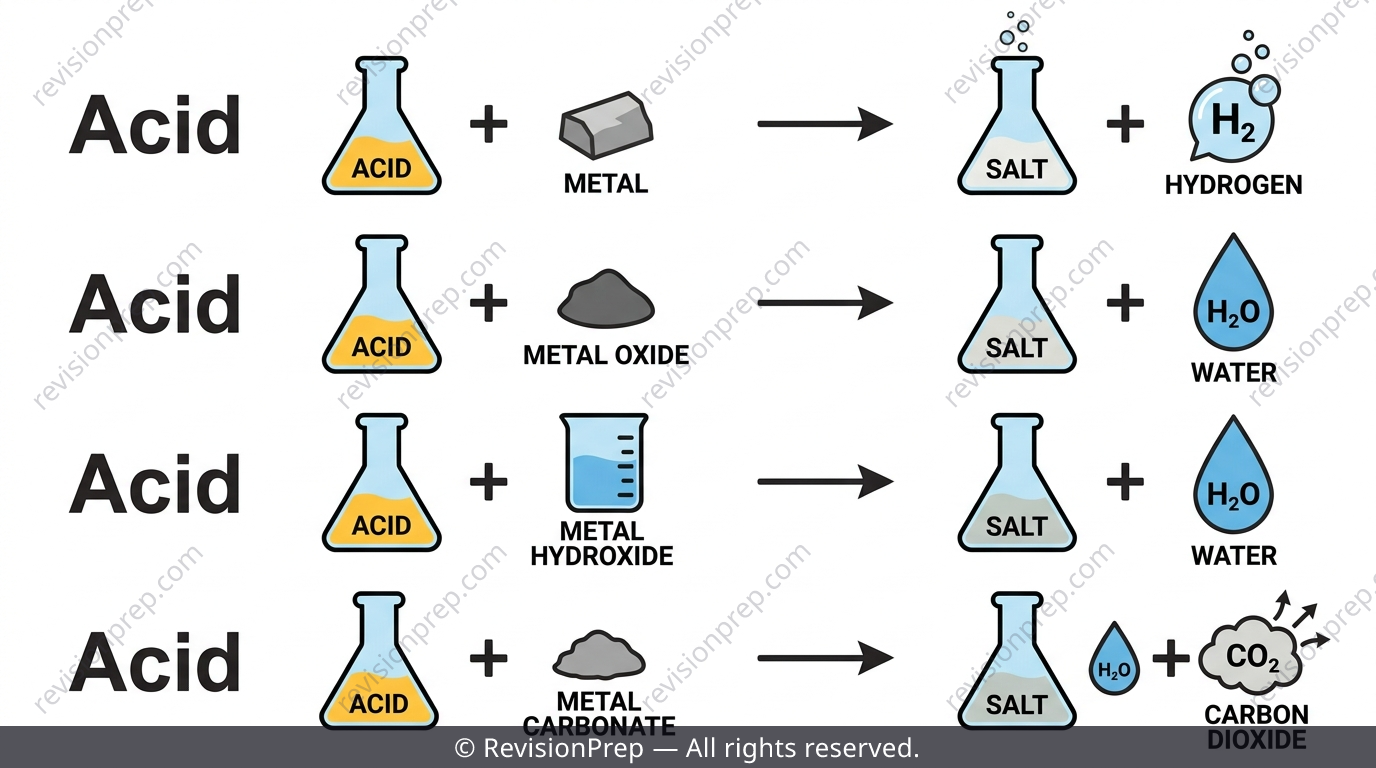
Every neutralisation reaction that produces a salt falls into one of four families: acid + metal, acid + metal oxide, acid + metal hydroxide, or acid + metal carbonate. Only metals more reactive than hydrogen (never copper, silver or gold) react directly with acids to release hydrogen gas; the other three families all produce water, and the carbonate reaction additionally releases carbon dioxide gas. Constructing these equations correctly means getting three things right: correct formulas, correct balancing, and correct state symbols matching the actual stage of the reaction described.
| Reaction Family | Products |
|---|---|
| Acid + Metal | Salt + Hydrogen gas |
| Acid + Metal Oxide | Salt + Water |
| Acid + Metal Hydroxide (alkali) | Salt + Water |
| Acid + Metal Carbonate | Salt + Water + Carbon Dioxide |
Exam tip
A 'construct the equation with state symbols' question splits marks across formulas, balancing, AND state symbols — nailing the balancing alone still loses marks.
Common mistake
Writing the salt's state symbol as (s) in a preparation equation when it's actually still dissolved (aq) at that stage of the reaction.
Mini summary
Four families, one pattern: acid always reacts with a base-type substance to give a salt, plus water and/or hydrogen or carbon dioxide.
Making Salts: Soluble vs Insoluble Methods
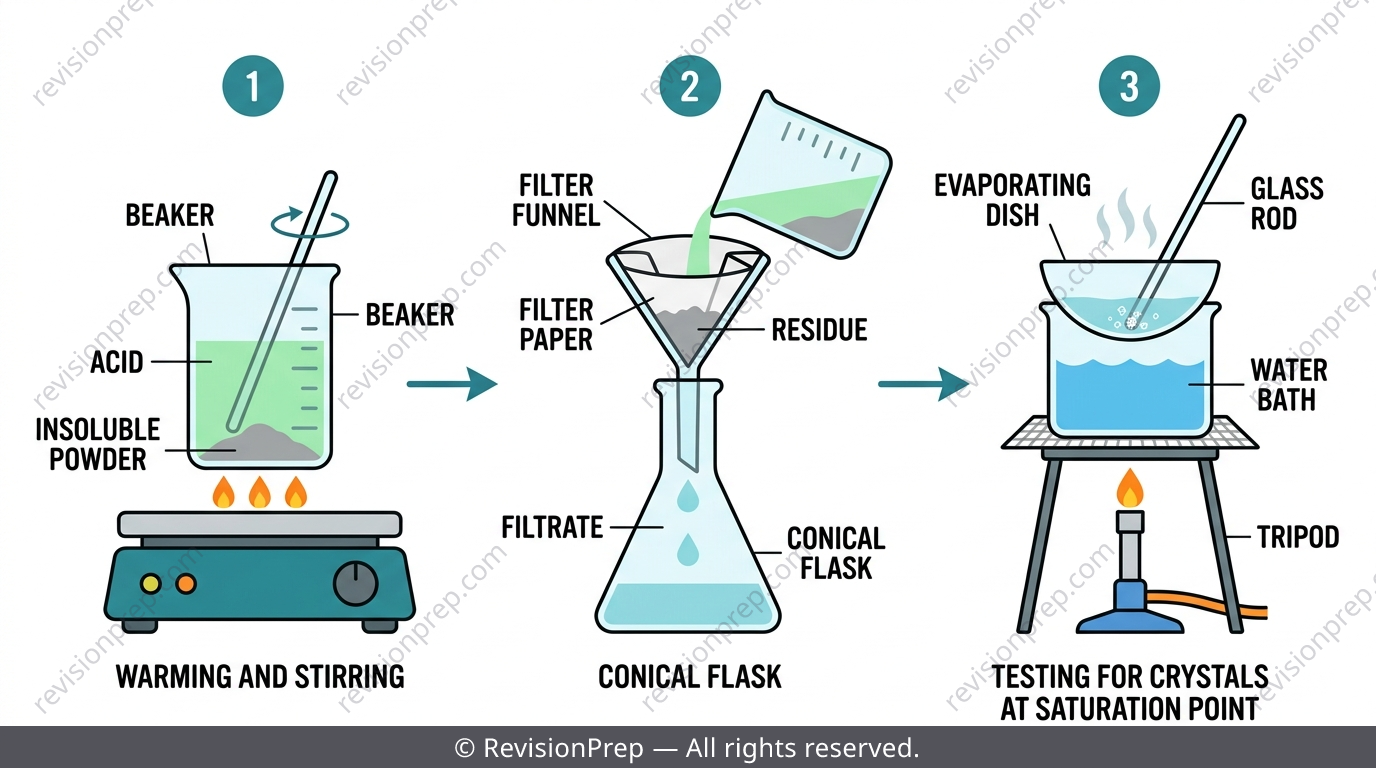
Soluble salts like copper(II) sulfate or sodium chloride are made in solution and then crystallised out, while insoluble salts like lead(II) sulfate form immediately by precipitation and just need filtering. Whenever the base, carbonate or metal is insoluble, use the excess-solid method: add it in excess to the acid so every drop of acid reacts, then filter off the leftover solid. Evaporate the filtrate only to the saturation point — test with a glass rod, and stop heating once crystals form on it, because evaporating fully on the flame ruins crystal shape or decomposes the salt.
Exam tip
Filtration is purely physical: it removes an insoluble solid from a liquid but cannot remove a dissolved acid or salt from the filtrate.
Common mistake
Saying 'excess acid is used' when the correct method actually uses excess insoluble solid — the excess reactant must be the one you can physically remove afterwards.
Mini summary
Insoluble reactant + acid → excess-solid method: warm, add excess, filter, evaporate to saturation, cool, crystallise, dry.
Real-World Applications: Fertilisers, Antacids and Industry
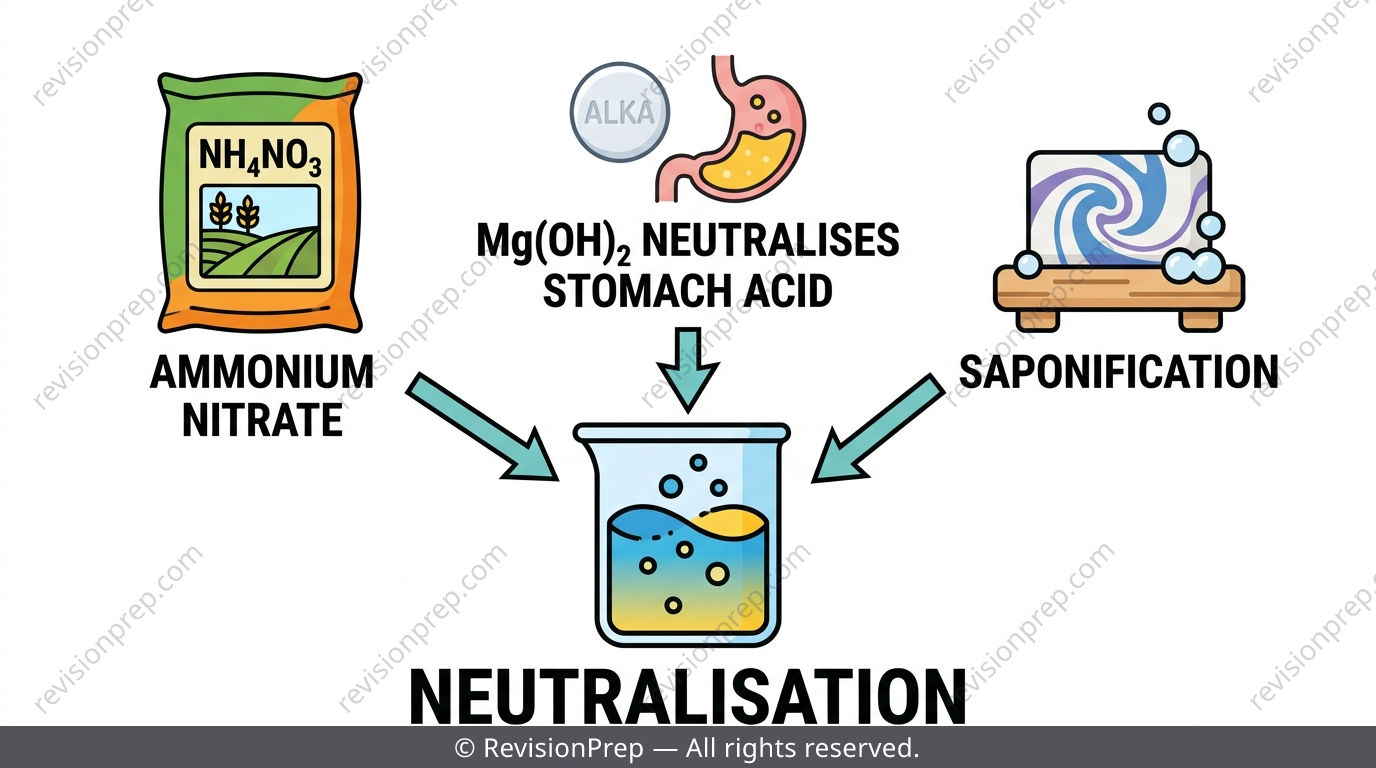
Ammonium nitrate and ammonium sulfate, made by neutralising ammonia with acid, are the most common nitrogen fertilisers and are prepared exactly by the neutralisation methods above. Antacid tablets use weak bases like magnesium hydroxide or calcium carbonate to neutralise excess stomach acid (HCl) and relieve indigestion. Industrially, alkalis break down fats and grease in soap-making and drain cleaners through saponification, while strong acids clean metal surfaces (pickling) before galvanising or painting.
Exam tip
Balancing needs a coefficient of 2 on — always count total N and H atoms rather than trusting the formula 'looking' balanced.
Common mistake
Explaining fertiliser runoff pollution as just 'it kills fish' without the mechanism — full marks need the chain: excess nutrients → algal bloom → decomposition → oxygen depletion.
Mini summary
Fertilisers, antacids and industrial cleaners are all direct real-world applications of acid-base neutralisation.
Evaluating Practical Data: The Skill Examiners Reward Most
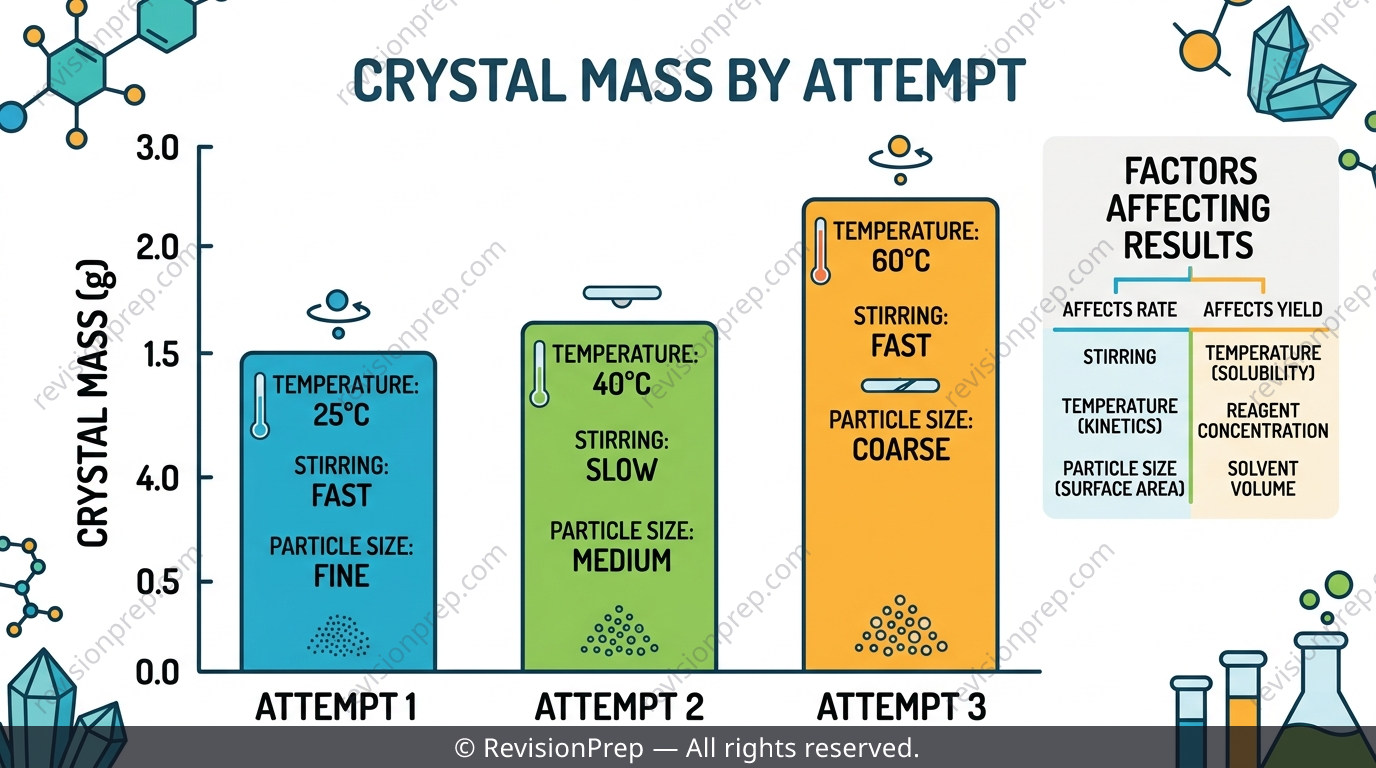
Criterion B and C questions often give crystal-yield data across different conditions and ask which variable mattered most — the key is separating factors that change reaction rate (stirring, particle size) from factors that change the amount of salt actually recovered (temperature, concentration, time). Citing the biggest number without explaining the underlying chemistry (rate vs solubility/yield) earns no reasoning marks. 'Evaluate' questions, like choosing between two solvents for production, always require both sides of the trade-off stated plus a final justified decision — a one-sided answer caps your mark.
Exam tip
For evaluate questions, structure your answer as: advantage of option A, advantage of option B, then a justified final choice.
Common mistake
Writing 'temperature gave the biggest number so it's the answer' with no mechanism linking the data to chemistry.
Mini summary
Separate rate-changing variables from yield-changing variables, and always argue both sides in evaluate-style questions.
Quick formula sheet
Practice questions
- Define the terms acid, base and alkali.
- State the difference between a soluble salt and an insoluble salt.
- Name the products formed when an acid reacts with a metal carbonate.
- Outline the excess-solid method for preparing a salt from an insoluble base and an acid.
- Explain why filtration alone cannot purify a dissolved salt from its solution.
- Explain why antacid tablets containing magnesium hydroxide relieve indigestion.
- Balance the equation NH3(aq) + H2SO4(aq) → (NH4)2SO4(aq) and explain one environmental risk of ammonia escaping during production.
- Given crystal yield data across three attempts with varying temperature and stirring, identify which variable most affected yield and explain the chemistry behind it.
- Evaluate whether water or ethanol should be used as a solvent for producing copper(II) sulfate, considering toxicity, source, energy and purity.
Frequently asked questions
What is the difference between a base and an alkali?+
A base is anything that can neutralise an acid by accepting H+ ions; an alkali is specifically a base that is soluble in water.
Why do we use excess insoluble solid instead of excess acid when preparing a salt?+
Because the excess reactant must be one you can physically remove afterwards by filtration — that's always the solid, since filtration cannot remove dissolved acid.
Why should evaporation stop at the saturation point instead of continuing to dryness?+
Evaporating fully on the flame can spoil the crystal shape or decompose the salt; stopping at saturation and allowing slow cooling produces good crystals.
How are fertilisers connected to acid-base chemistry?+
Fertilisers like ammonium nitrate and ammonium sulfate are soluble salts made by neutralising ammonia with an acid, using the same reaction principles covered in salt preparation.
What's the most common mistake in salt preparation exam questions?+
Writing the salt's state symbol as solid (s) when the equation actually describes the solution stage (aq), and confusing which reactant is in excess.
How do I answer an 'evaluate' question well in this topic?+
State both sides of the trade-off (e.g., two solvents' pros and cons) and finish with a justified final decision — a one-sided answer loses marks.
Master Acids, Bases and Salts with the Full MYP 5 Revision Notes
Related articles