
Chemical Reactions and Bonding
Classify reactions, predict outcomes with the reactivity series, and explain bonding through electron behaviour — the MYP 5 way.
Quick facts
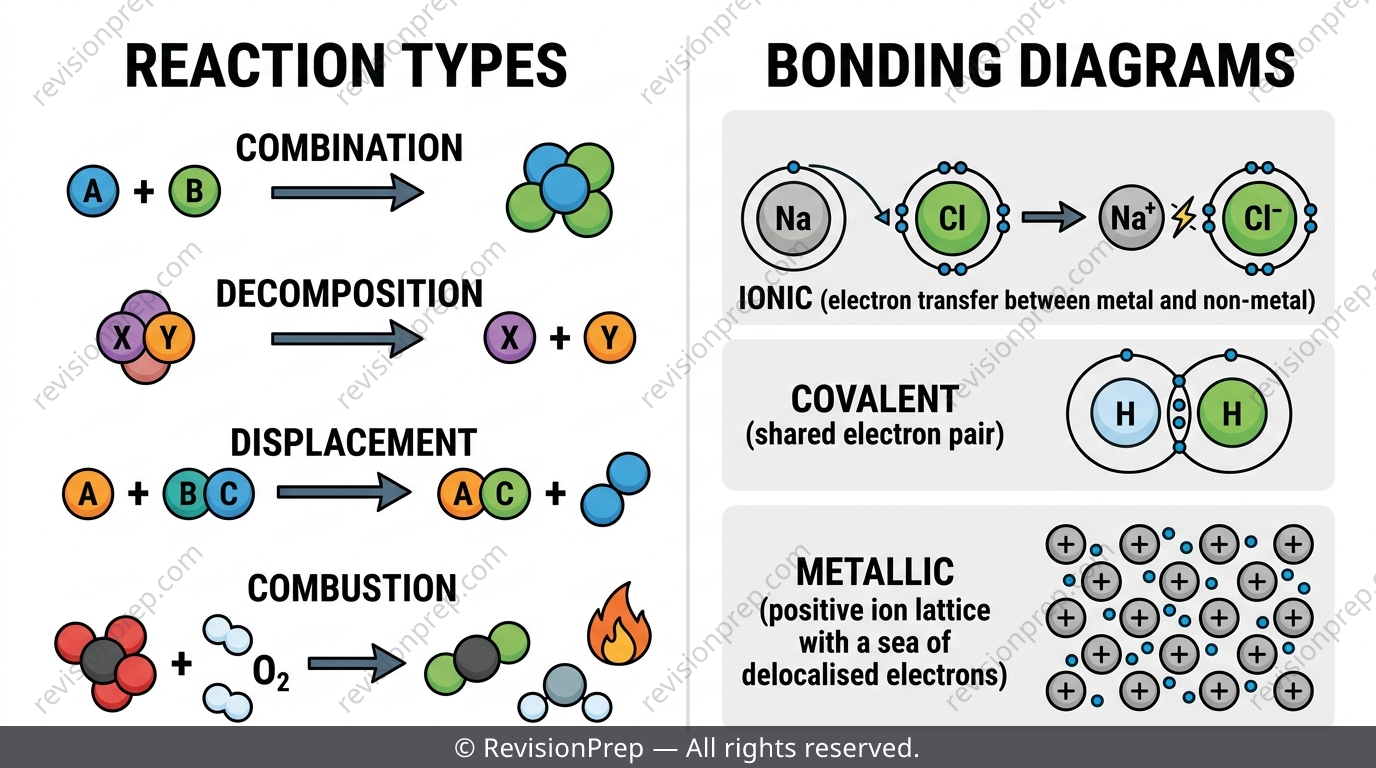
Chemical reactions and bonding is the backbone of MYP 5 Chemistry, and it's built from five ideas that stack on top of each other. You classify reactions by counting reactants and products, predict whether a reaction happens using the reactivity series, and explain the 'why' behind it all with bonding — electron transfer, sharing, or delocalisation. Correct chemical formulas and balanced equations tie everything together, proving that mass is never created or destroyed. Examiners repeatedly test thermal decomposition data, Group 2 carbonate trends, and bonding questions that demand you name electron behaviour, not just say 'strong attraction'. This teaser walks through the five most examined concepts, flags the traps that cost marks in Criterion A and Criterion C tasks, and points you to the full revision note for worked examples, definitions and the complete formula sheet.
What you’ll be able to do
Types of Reactions
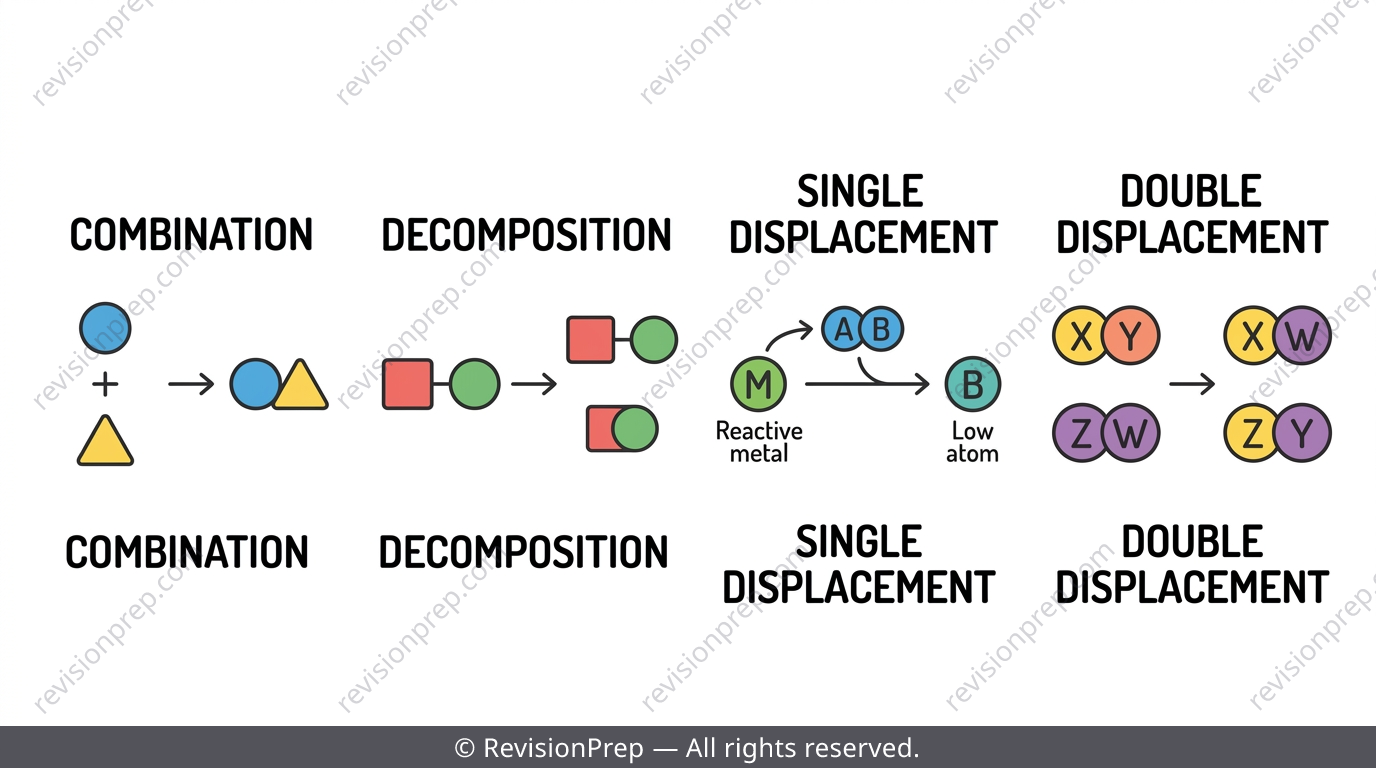
You classify a reaction by counting distinct reactants and products, not by the coefficients in front of them. Combination reactions merge two or more substances into one product, while decomposition breaks one compound into several — usually triggered by heat. Displacement happens when a more reactive element replaces a less reactive one in a compound. Thermal decomposition of compounds like , , and is the single most-tested reaction because it's easy to test with real lab data.
| Reaction type | General form | Key feature |
|---|---|---|
| Combination | A + B → AB | Two or more reactants form one product |
| Decomposition | AB → A + B | One reactant forms two or more products, usually needs heat |
| Single displacement | A + BC → AC + B | A more reactive element replaces a less reactive one |
| Double displacement | AB + CD → AD + CB | Ions swap partners, often forming a precipitate |
Exam tip
When asked to 'deduce the type of reaction', name the type AND quote evidence from the exact equation given — a generic definition alone is marked incomplete.
Common mistake
Counting coefficients as separate substances — has two distinct reactants, not three.
Mini summary
Combination = fewer products than reactants; decomposition = more products than reactants; always justify with the actual equation.
Reactivity Series and Reaction Predictions
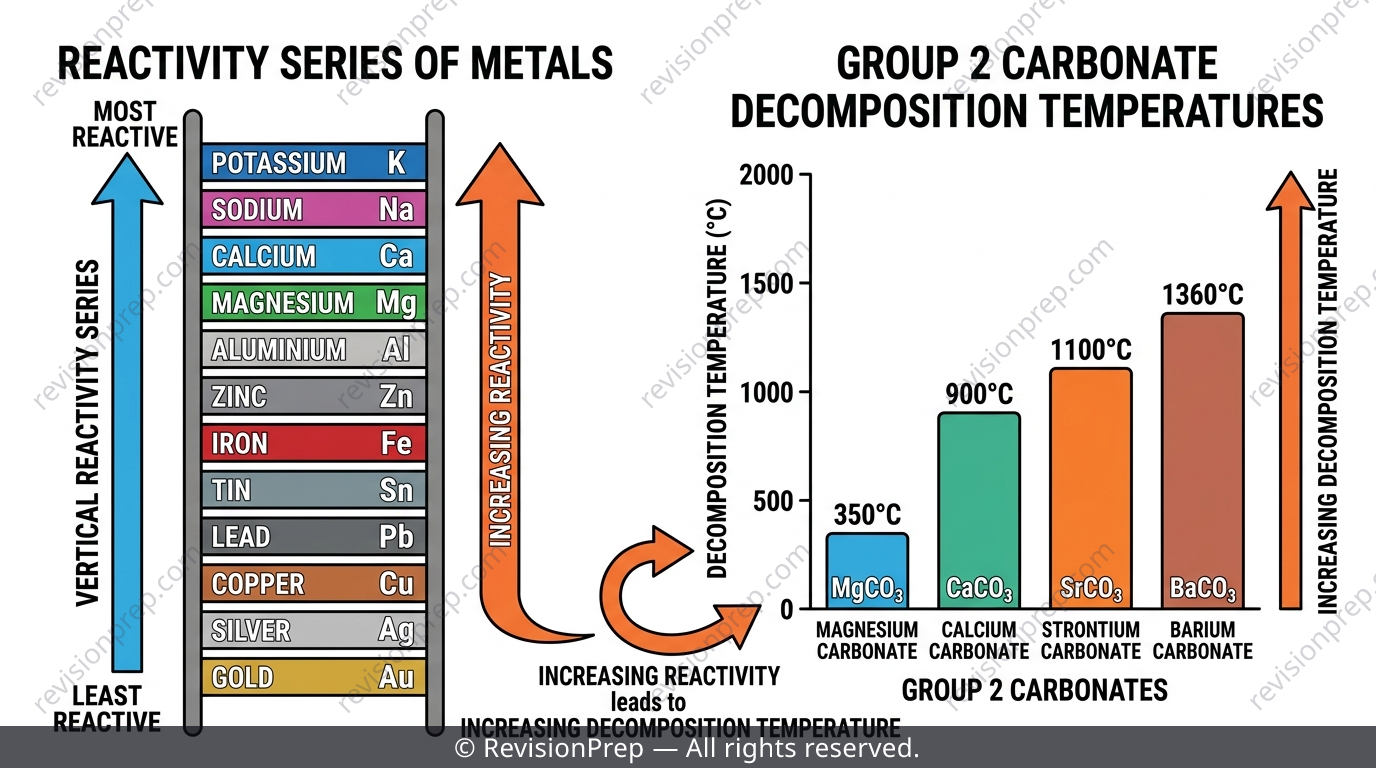
The reactivity series ranks metals by how readily they lose electrons to form ions, letting you predict two exam favourites: whether a displacement reaction actually happens, and how a metal compound behaves when heated. A more reactive metal always displaces a less reactive one from solution — never the reverse. Metals higher in the series form more stable ionic compounds, so their carbonates need higher temperatures to decompose, exactly the trend tested with Group 2 carbonate data.
Exam tip
For a 'deduce' question on decomposition temperature trends, state the mechanism (reactivity/ion stability) — describing the trend alone only earns the 'describe' mark, not the 'deduce' mark.
Common mistake
Assuming two mixed metals will displace each other without checking their relative positions in the series first.
Mini summary
Higher metal displaces lower metal from solution; more reactive metals form more thermally stable compounds.
Ionic, Covalent and Metallic Bonding
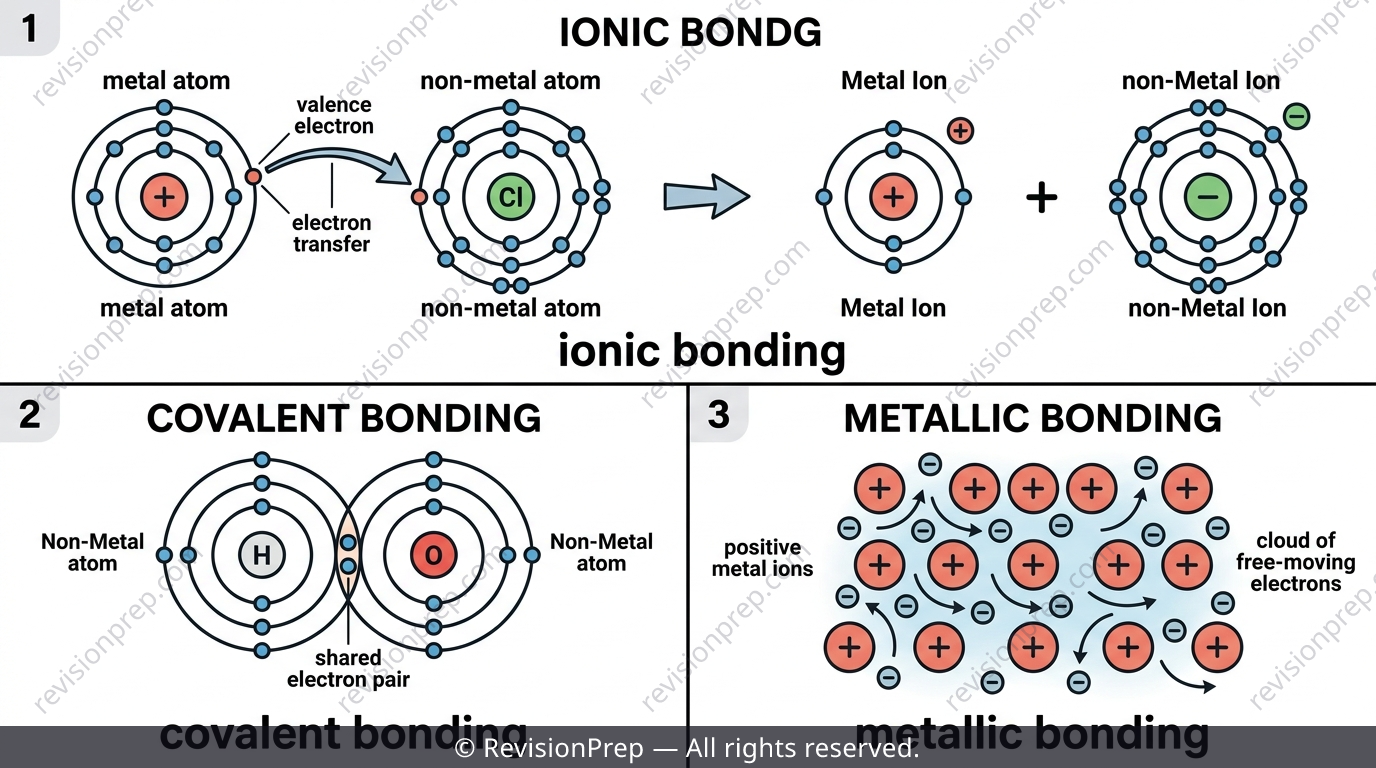
Bonding explains why compounds form and why they behave the way they do — and examiners never accept 'strong attraction' as an answer. Ionic bonding is a complete transfer of electrons from a metal to a non-metal, creating oppositely charged ions held together by electrostatic attraction. Covalent bonding is non-metal atoms sharing electron pairs with no ions formed, while metallic bonding is metal atoms releasing outer electrons into a shared 'sea' of delocalised electrons around a lattice of positive ions.
| Feature | Ionic | Covalent | Metallic |
|---|---|---|---|
| Electron behaviour | Transferred | Shared | Delocalised |
| Particles formed | Oppositely charged ions | Molecules (no ions) | Positive ion lattice + free electrons |
Exam tip
Always name the electron behaviour — transferred, shared, or delocalised. Stating charges alone is not the same as explaining the bond.
Common mistake
Calling an ionic compound like NaCl 'a molecule' — use 'formula unit' or describe the giant ionic lattice instead.
Mini summary
Ionic = electron transfer; covalent = electron sharing; metallic = delocalised electrons — never just 'attraction'.
Chemical Formulas and Equations
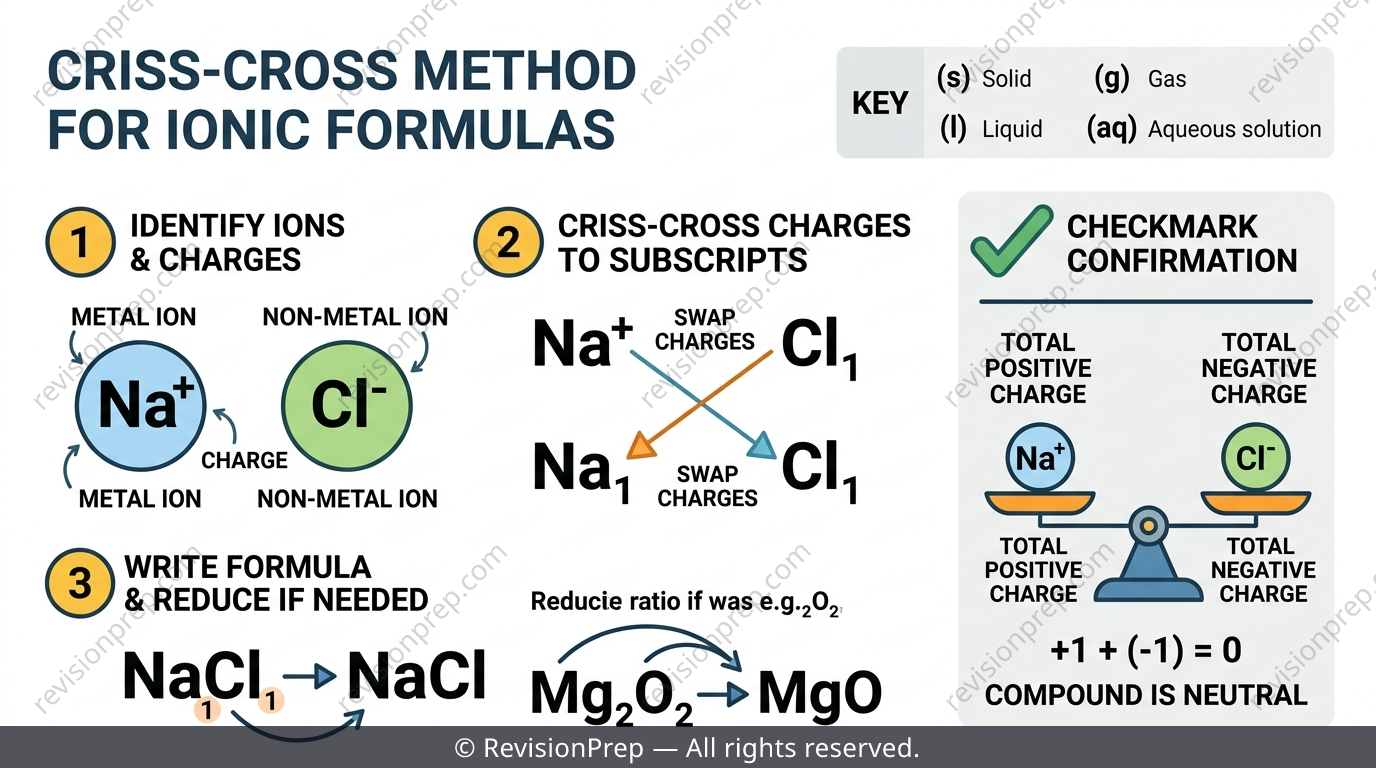
A correct ionic formula comes from balancing charges, not guessing subscripts — the criss-cross method makes the total positive charge equal the total negative charge automatically. State symbols tell the reader the physical state of every substance in the reaction: solid, liquid, gas, aqueous. Getting formulas and state symbols right is essential before you can even attempt to balance an equation correctly.
Exam tip
Double-check state symbols match the reaction conditions described in the question — examiners test these directly.
Mini summary
Balance charges with the criss-cross method; always include correct state symbols.
Balanced Equations and Conservation of Mass
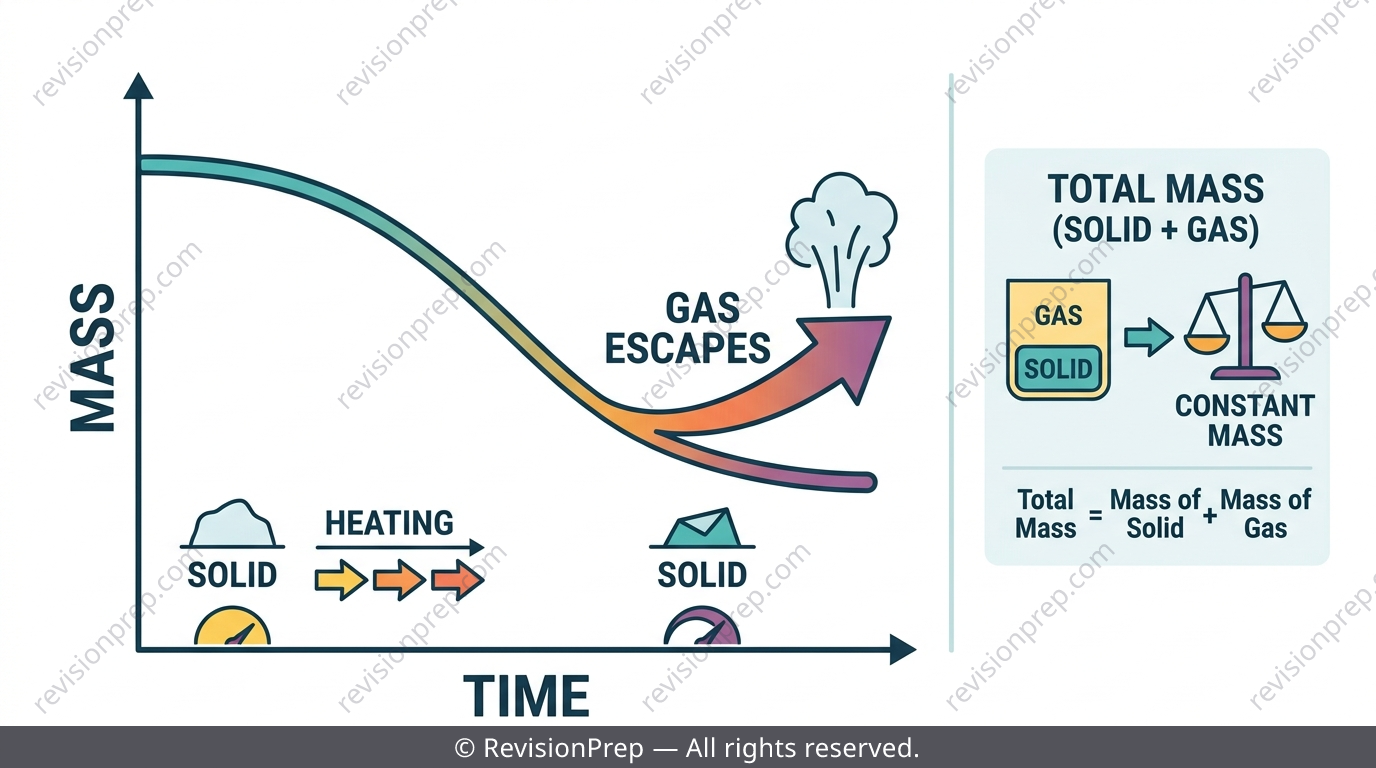
Balancing an equation is how you prove that no atoms are lost or gained during a reaction — the same substances rearrange, they don't disappear. This idea shows up most often in mass-versus-time graphs for thermal decomposition, where a solid appears to lose mass as a gas escapes into the air. If that gas is captured and weighed too, the total mass before and after the reaction stays the same.
Exam tip
In mass-loss graph questions, explain the drop in solid mass by naming the gas escaping — don't just describe the curve shape.
Mini summary
Balanced equations reflect conservation of mass; apparent mass loss in decomposition is due to gas escaping, not mass being destroyed.
Quick formula sheet
Practice questions
- Classify the reaction and explain why.
- State the meaning of the state symbol .
- Name the type of bonding formed between a metal and a non-metal.
- Deduce the products of the thermal decomposition of , using the pattern from , and .
- Explain why sodium chloride should never be called 'a molecule of sodium chloride'.
- Using the reactivity series, predict whether zinc will displace copper from copper sulfate solution and justify your answer.
- Given decomposition temperatures for Group 2 carbonates increasing down the group, explain the trend in terms of reactivity and ion stability.
- A solid loses mass when heated in an open container but the mass stays the same in a sealed container with the gas captured — explain this observation using conservation of mass.
- Explain, in terms of electron behaviour, why metallic bonding allows metals to conduct electricity while covalent compounds generally do not.
Frequently asked questions
What are the four main types of chemical reactions in MYP 5 Chemistry?+
Combination, decomposition, single displacement and double displacement. Combustion is also tested as a special case involving reaction with oxygen.
Why is thermal decomposition tested so often?+
It's easy to test with real lab data — heat a solid, weigh what's left, and identify the gas released — which makes it a favourite for data-response questions.
How do I know if a displacement reaction will happen?+
Check the reactivity series first — only a metal positioned above another can displace it from a solution of its compound.
What's the difference between ionic, covalent and metallic bonding?+
Ionic bonding transfers electrons between a metal and non-metal, covalent bonding shares electron pairs between non-metals, and metallic bonding delocalises electrons around a lattice of positive metal ions.
Why does mass appear to decrease during thermal decomposition?+
A gas escapes into the air as the solid decomposes. If you capture and weigh that gas too, total mass stays the same, proving conservation of mass.
What's the biggest mistake students make with bonding answers?+
Writing 'strong attraction' without naming the electron behaviour — examiners want you to say electrons are transferred, shared, or delocalised.
Master Chemical Reactions and Bonding with the Full MYP 5 Revision Note
Related articles