
Stoichiometry & Mole Concept
Turn tiny, invisible particles into countable, weighable, measurable chemistry — the mole is your bridge.
Quick facts
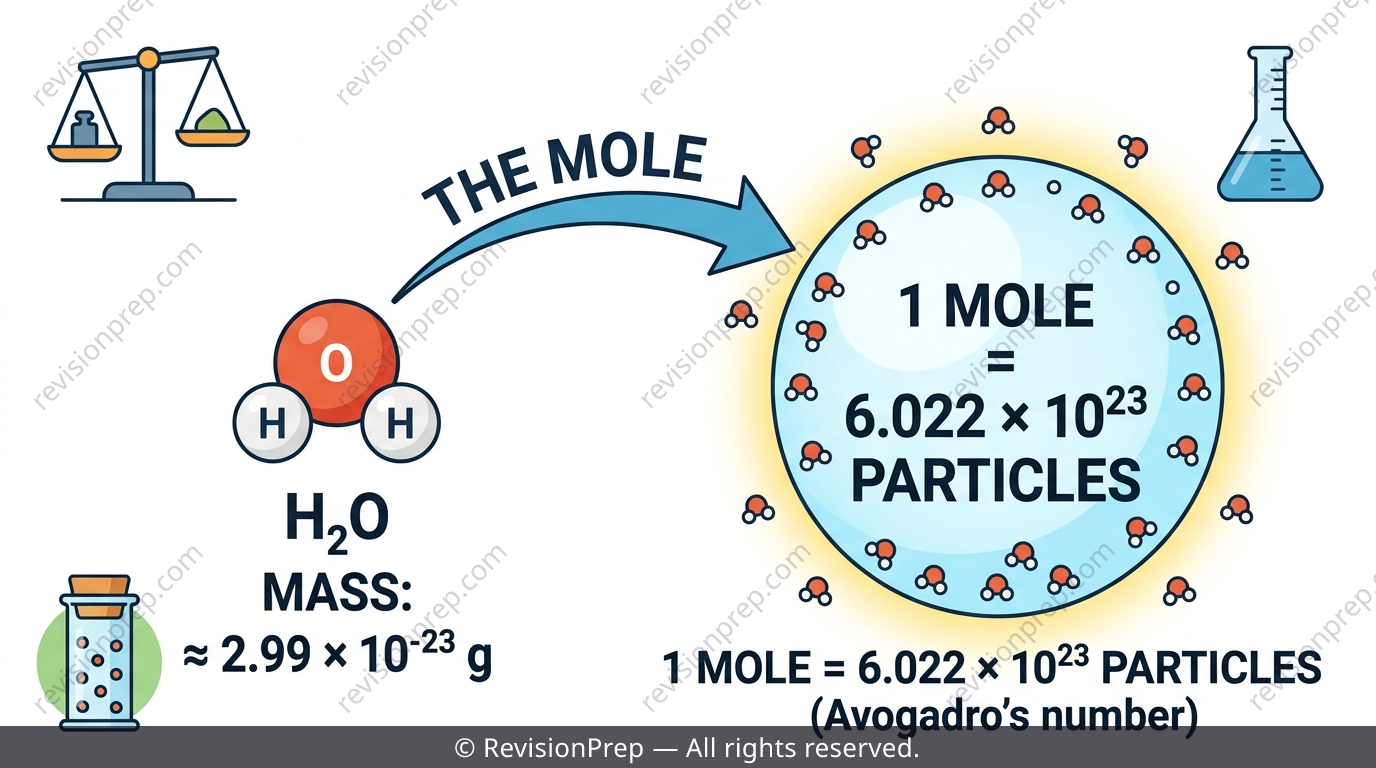
Atoms are far too small to weigh one at a time, so chemists invented a counting unit big enough to matter: the mole. Understanding the mole concept and stoichiometry is essential for IB MYP 5 Chemistry, because almost every calculation question — whether about a lab experiment, an industrial process like the Haber process, or emissions data — is really just converting between mass, moles, particle number, gas volume or concentration. This teaser walks through the five ideas that show up again and again: Avogadro's constant, relative formula mass, the mass-mole-molar mass relationship, molar gas volume, and concentration of solutions. Get these five locked down and the rest of the topic becomes rearranging one of a handful of formulas. For the full worked examples, common-mistake breakdowns, and complete formula sheet, follow the link to the full RevisionPrep notes for MYP 5 Chemistry.
What you’ll be able to do
The Mole and Avogadro's Constant
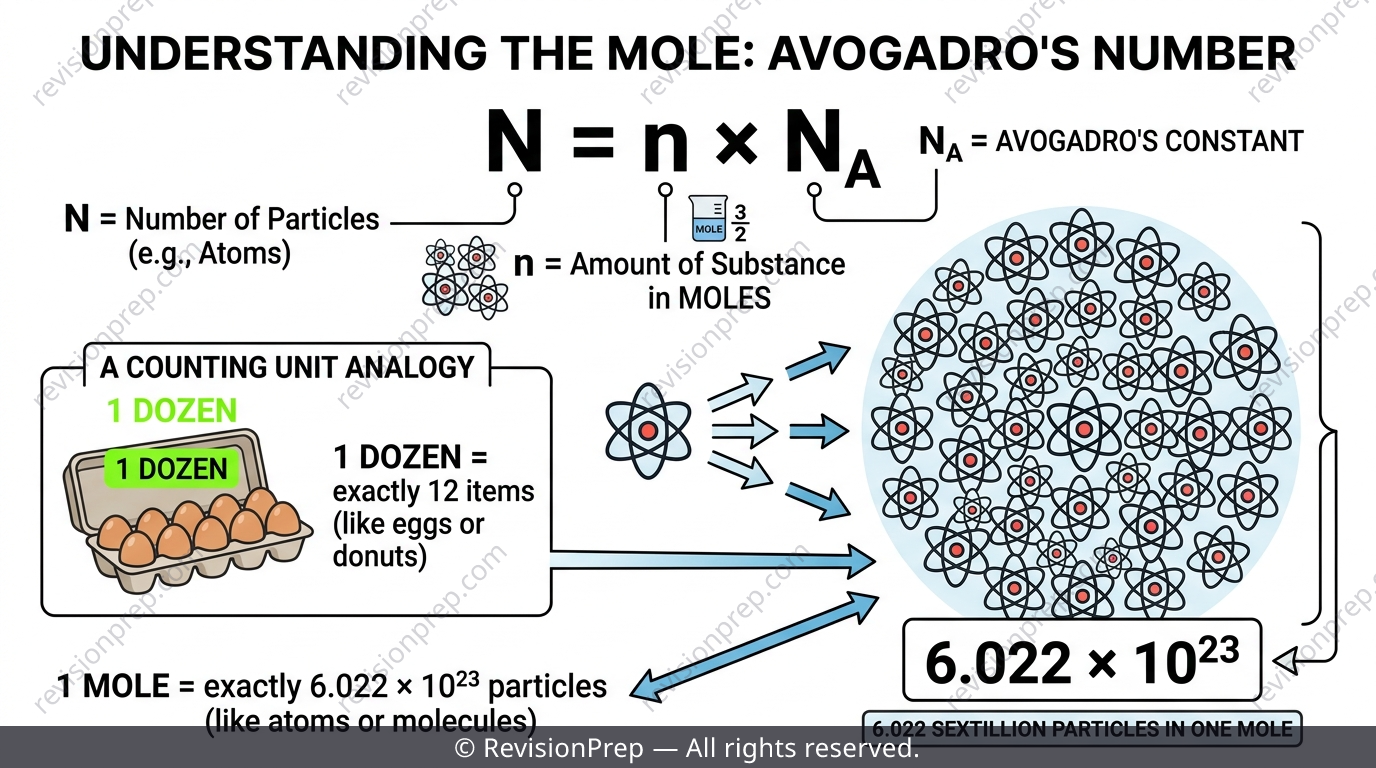
A mole is simply a counting unit — like a dozen, but scaled up to particles, a number chosen so that one mole of atoms has a mass in grams numerically equal to its relative atomic mass. This fixed number is Avogadro's constant, , and because it's defined per mole, it carries the unit — it is not dimensionless. Always specify which particle you mean: 1 mol of molecules is very different from 1 mol of H atoms.
Exam tip
'State the value of ' requires the unit written explicitly — the number alone often scores zero.
Common mistake
Assuming a heavier sample automatically contains more particles, or writing 'the sample has 2 moles' when the question actually gives grams — label every number with its unit (g, mol, or particles) before calculating.
Mini summary
One mole of any substance always contains particles — but always state which particle.
Calculating Relative Formula Mass (Mr)
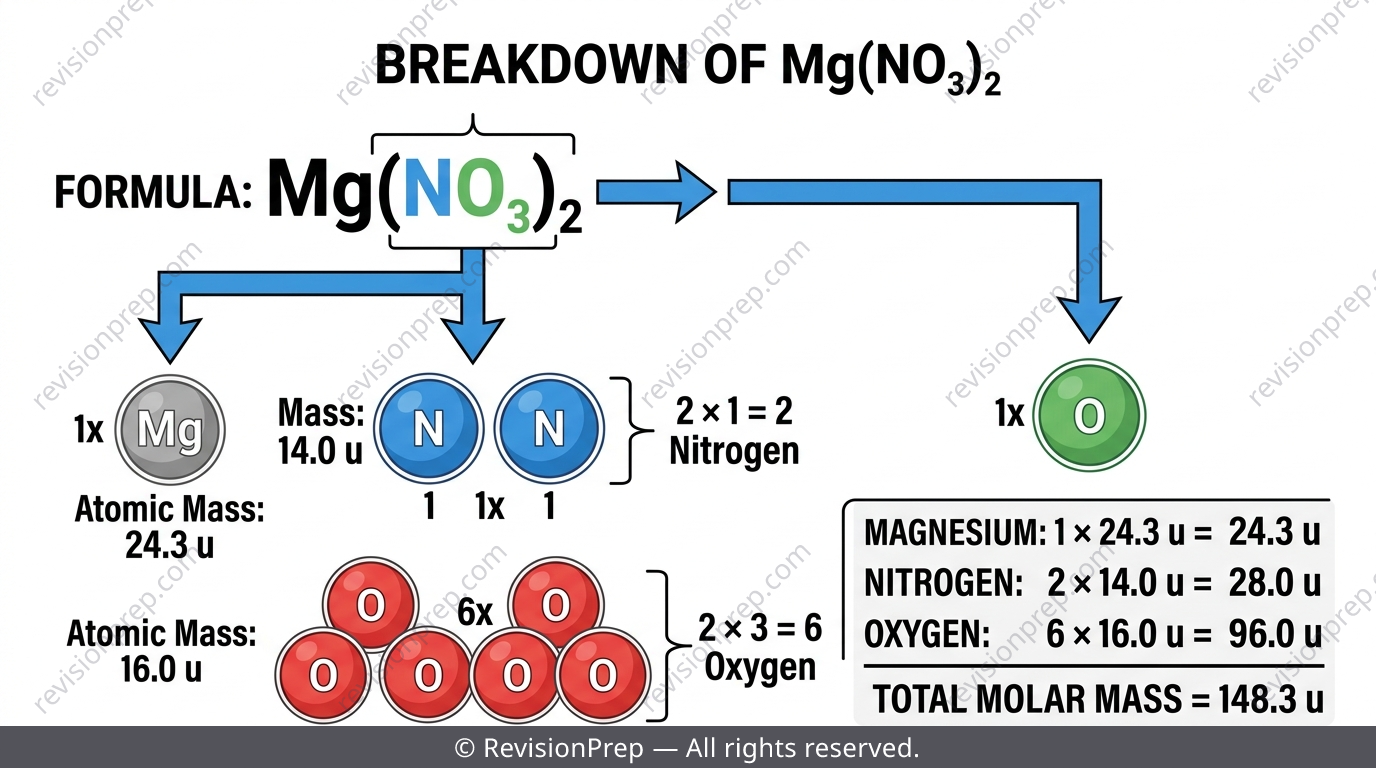
Relative atomic mass () is a weighted average based on isotope abundance, while relative formula mass () is simply the sum of every atom's in the formula. Neither has units — they're ratios, which is why molar mass in is the version you actually use in calculations. Brackets multiply everything inside by the subscript outside: means 1 Ca + 2 O + 2 H, not 1 Ca + 1 O + 1 H.
Exam tip
Write a full atom-count checklist line before adding anything up — expand every bracketed group first.
Common mistake
Treating a bracketed group like as 2 N + 3 O instead of 2 N + 6 O — forgetting the bracket applies to every atom inside it.
Mini summary
= sum of all atomic masses, with subscripts and bracket multipliers expanded carefully.
Linking Moles, Mass and Molar Mass
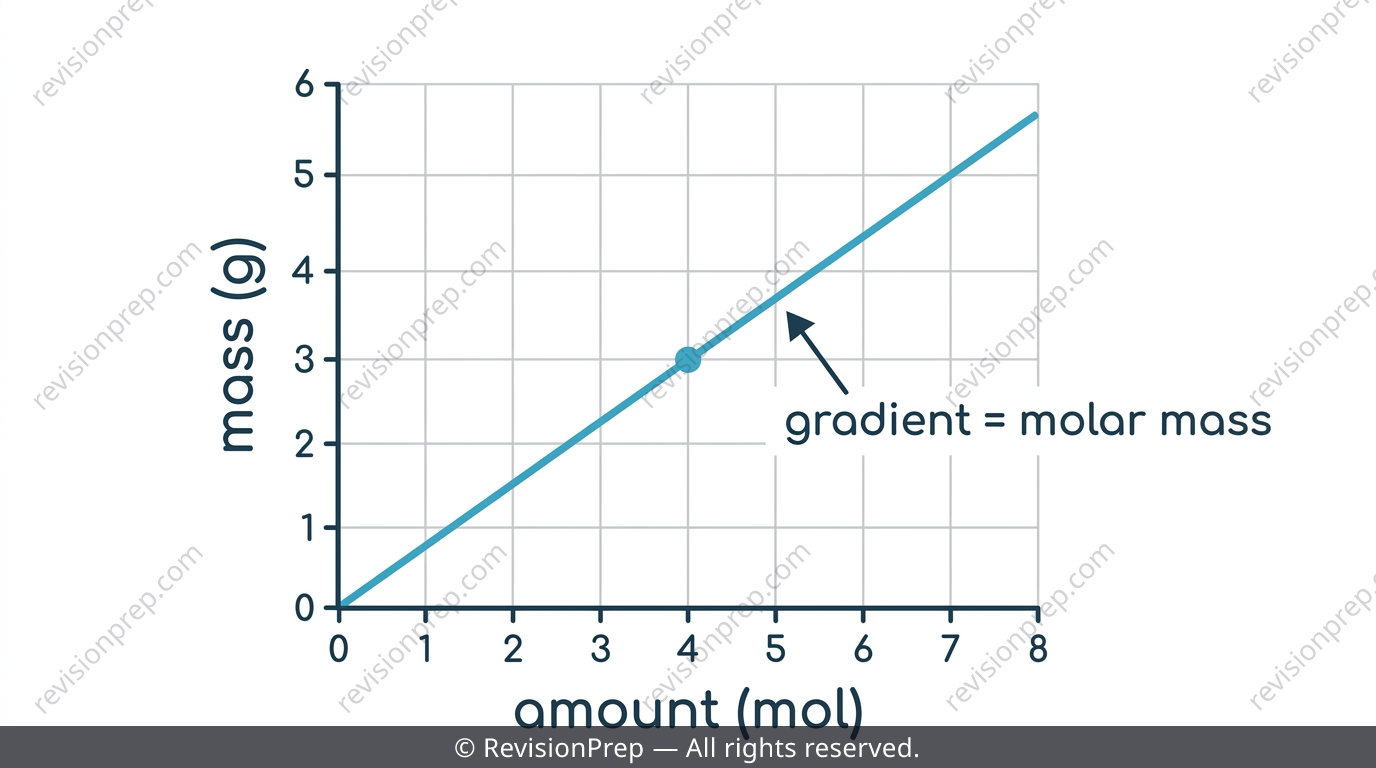
Molar mass () is the mass of exactly one mole of a substance, in — numerically equal to but now carrying a unit and connecting to a real balance reading. Mass, moles and molar mass are locked together by , which you rearrange depending on what's given. A balance reading in grams is never automatically '1 mole' of anything — it only equals 1 mole if that mass happens to equal the molar mass.
| Quantity given | Formula to use | Typical unit of given quantity |
|---|---|---|
| Mass | n = m/M | g |
| Number of particles | n = N/N_A | particles |
| Gas volume at RTP | n = V/Vm | dm³ |
| Concentration and volume | n = c × V | mol dm⁻³ and dm³ |
Exam tip
On a mass-vs-moles graph, the gradient IS the molar mass — always read it from a clean gridline point.
Common mistake
Assuming a balance reading equal to the value automatically means exactly one mole, without checking purity or explaining why molar mass makes this true.
Mini summary
is the single most-used equation in this chapter — rearrange it, don't re-derive it.
Gas Volume at RTP: n = V/Vm
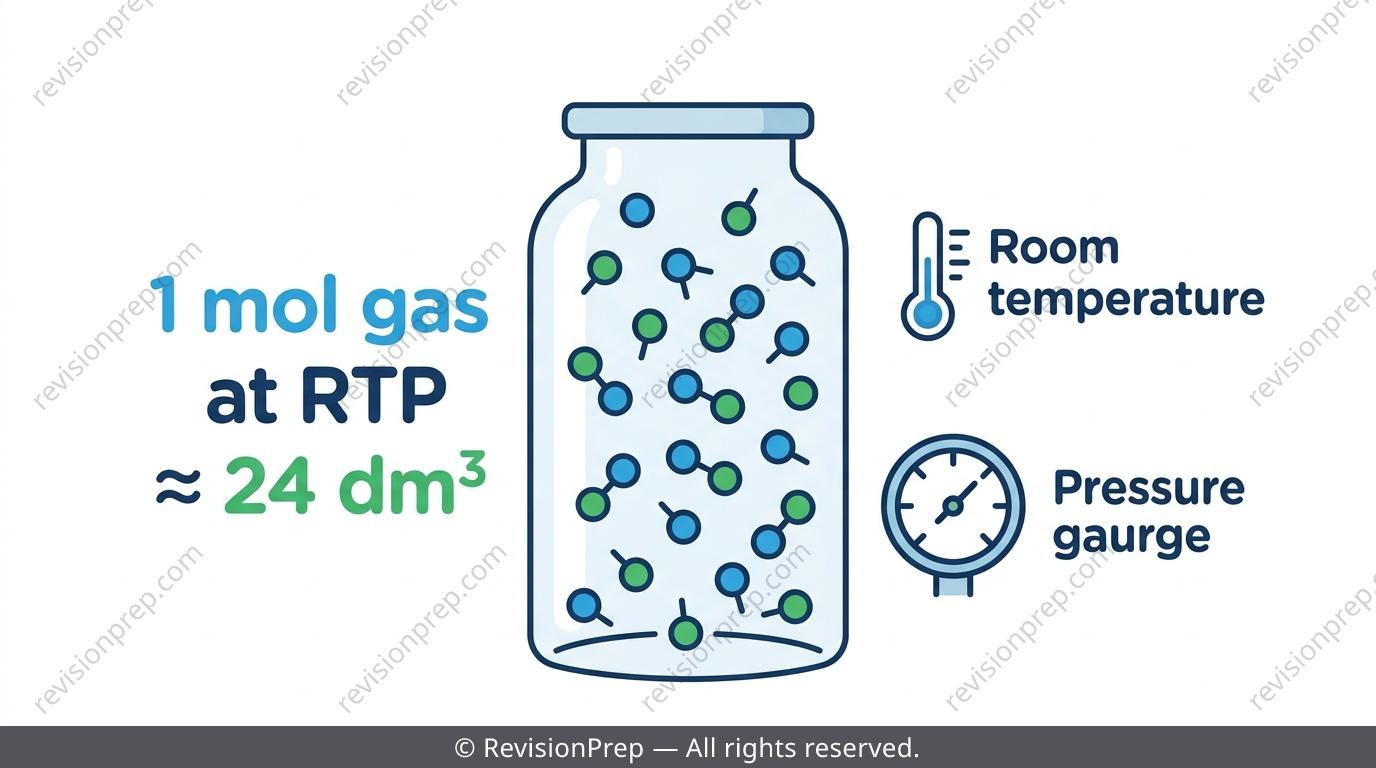
The mole idea extends neatly to gases: at room temperature and pressure (RTP), one mole of any gas occupies approximately , regardless of what the gas is. This gives a fourth route into moles alongside mass, particle number and concentration — useful whenever a question hands you a gas volume instead of a mass.
Exam tip
Check the units before substituting — gas volumes are often given in and need converting to first, just like in concentration calculations.
Common mistake
Forgetting that the approximation only applies at RTP, and applying it without checking the conditions stated in the question.
Mini summary
At RTP, 1 mole of any gas ≈ — use when a gas volume is given.
Concentration, Dilution and Solutions
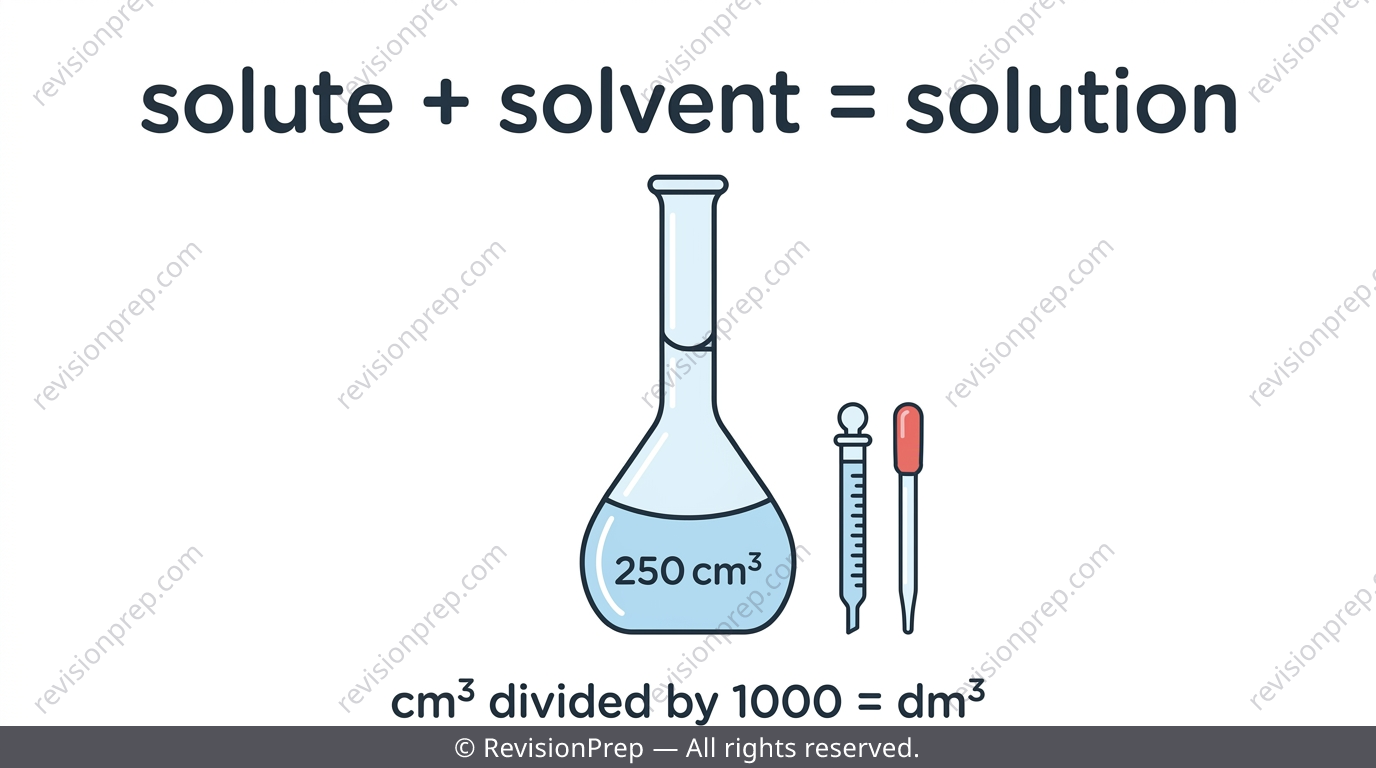
Concentration tells you how crowded a solution is with solute particles: moles of solute per litre (dm³) of the whole solution, not per litre of solvent added. Lab equipment is graduated in , but needs — divide by 1000 before doing anything else. When diluting, moles of solute stay constant, giving .
Exam tip
'Calculate the concentration' expects the final unit stated explicitly, not just a bare number.
Common mistake
Plugging a volume in straight into without converting to first — this gives an answer 1000 times too big.
Mini summary
needs volume in of the whole solution — always write '÷1000' as a working line for values.
Quick formula sheet
Practice questions
- State the value of Avogadro's constant, including its unit.
- Calculate the number of particles in 2.0 mol of a substance.
- State the unit used for concentration of a solution.
- Calculate the relative formula mass of given : Ca = 40.1, O = 16.0, H = 1.0.
- A sample of NaCl has a mass of 11.7 g. Calculate the amount, in moles, present ( NaCl = 58.5).
- Calculate the volume, in dm³, occupied by 0.75 mol of a gas at RTP.
- Calculate the mass of NaOH needed to prepare 250 cm³ of a 0.100 mol dm⁻³ solution ( NaOH = 40.0).
- A digital balance reads 63.55 g for a pure copper sample. Deduce whether this equals exactly one mole of Cu atoms, explaining your reasoning.
- Using , calculate the volume of water needed to dilute 50 cm³ of a 2.00 mol dm⁻³ solution to 0.500 mol dm⁻³.
Frequently asked questions
What is the difference between Ar and Mr?+
is the relative atomic mass of a single element (a weighted average of its isotopes), while is the relative formula mass — the sum of all the values in a compound's formula, with brackets expanded.
Why does Avogadro's constant have units of mol⁻¹?+
Because it's defined per mole: it tells you how many particles are in exactly one mole. Counting requires a defined reference amount, and that reference is the mole, which is why carries the unit rather than being dimensionless.
How do I convert cm³ to dm³ in concentration calculations?+
Divide the volume in cm³ by 1000 to get dm³, and do this before substituting into — skipping this step is the most common reason for answers being exactly 1000 times too large or small.
Does one mole of any gas always occupy the same volume?+
Only at the same temperature and pressure. At room temperature and pressure (RTP), one mole of any gas occupies approximately , but this value changes if conditions change.
Why isn't a balance reading automatically equal to one mole?+
A mass reading equals one mole only if that specific mass happens to match the substance's molar mass exactly — you still need to check this using rather than assuming it.
What's the most common mistake in mole calculations?+
Forgetting to expand brackets when calculating , and forgetting to convert cm³ to dm³ before using concentration or gas volume formulas — both are simple unit-tracking errors that cost easy marks.
Get the Full IB MYP 5 Stoichiometry & Mole Concept Notes
Related articles