
Rates of Reaction and Energy Changes
Energy profiles, collision theory and exam-ready temperature data skills for IB MYP 5 Chemistry
Quick facts
Every question in this IB MYP 5 Chemistry unit really boils down to two things: does the surroundings get hotter or colder, and what makes the reaction speed up or slow down? Rates of reaction and energy changes ties these together using bond breaking, bond forming, energy profile diagrams and collision theory. You'll need to confidently label exothermic and endothermic reactions with real temperature evidence, calculate ΔE using energy profiles, and explain rate changes using activation energy and effective collisions. These are exactly the skills MYP Criterion A and C data-response questions test, especially graph literacy and justifying conclusions with numbers, not just words. This teaser walks through the five ideas examiners return to again and again, so you know exactly what the full revision notes and practice questions will sharpen further.
What you’ll be able to do
Exothermic vs Endothermic Reactions
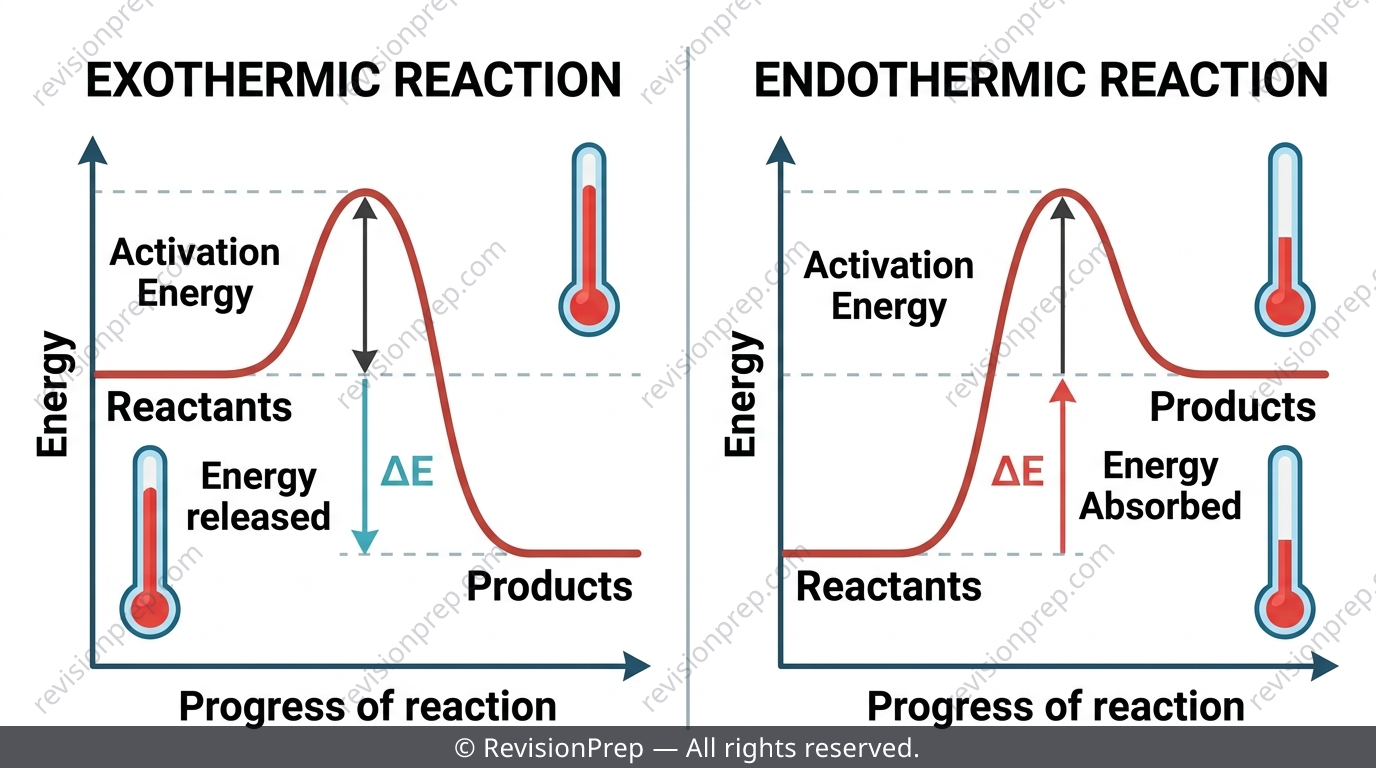
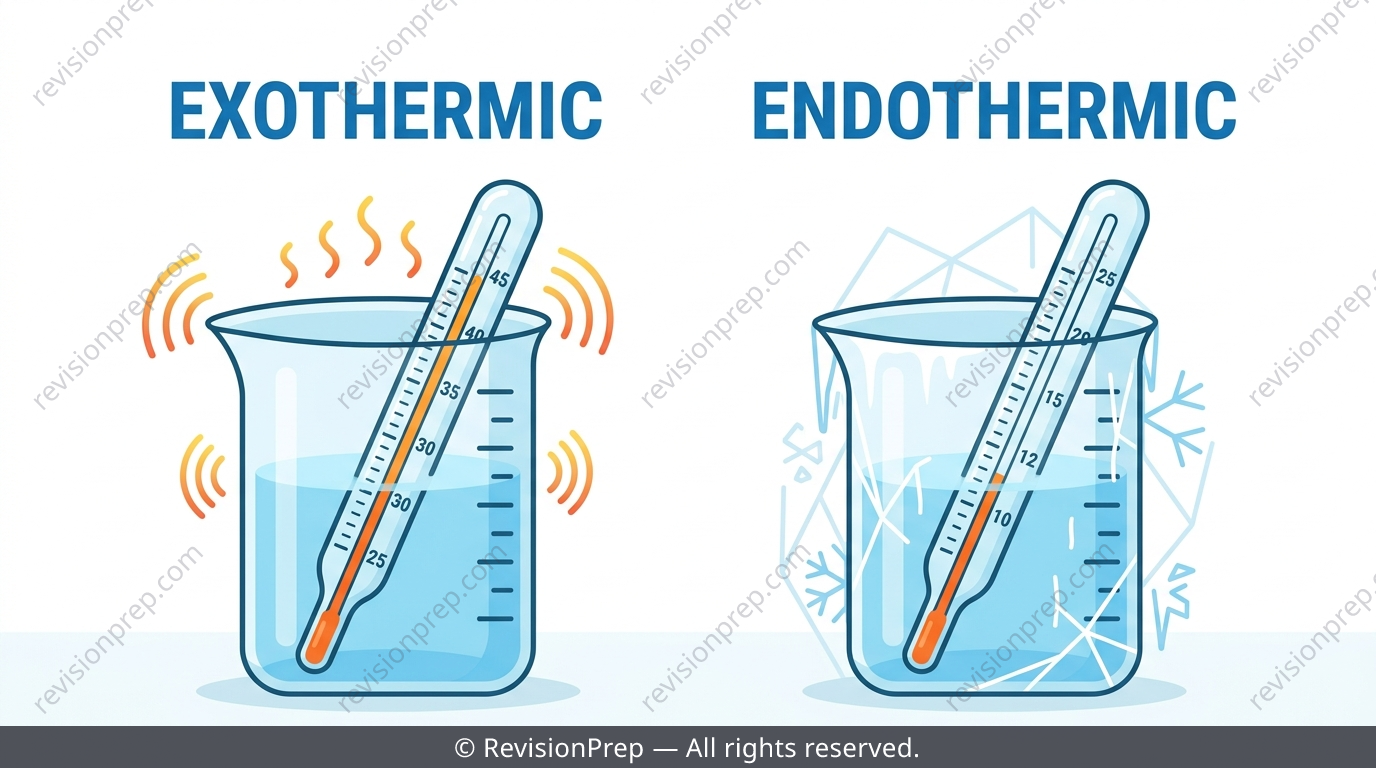
Energy is never created or destroyed — it just moves between the reacting chemicals and the surroundings, and the thermometer tells you which way. Exothermic reactions release energy into the surroundings, so temperature rises (combustion, neutralisation, rusting). Endothermic reactions absorb energy from the surroundings, so temperature falls (thermal decomposition, dissolving NH4Cl). The size of the temperature change matters too — a bigger swing means more energy moved.
| Exothermic | Endothermic |
|---|---|
| Energy released to surroundings | Energy absorbed from surroundings |
| Surroundings get warmer | Surroundings get colder |
| Combustion, neutralisation, rusting | Thermal decomposition, dissolving NH4Cl |
Exam tip
Justify questions are usually worth 2 marks per case: one for the correct label, one for quoting the actual ΔT value from the data.
Common mistake
Concluding a reaction is exothermic just because something 'visibly happened' (fizzing, colour change) with no temperature evidence at all.
Mini summary
Exothermic warms the surroundings; endothermic cools it — always back this up with a real temperature difference.
Energy Profiles: Calculating ΔE
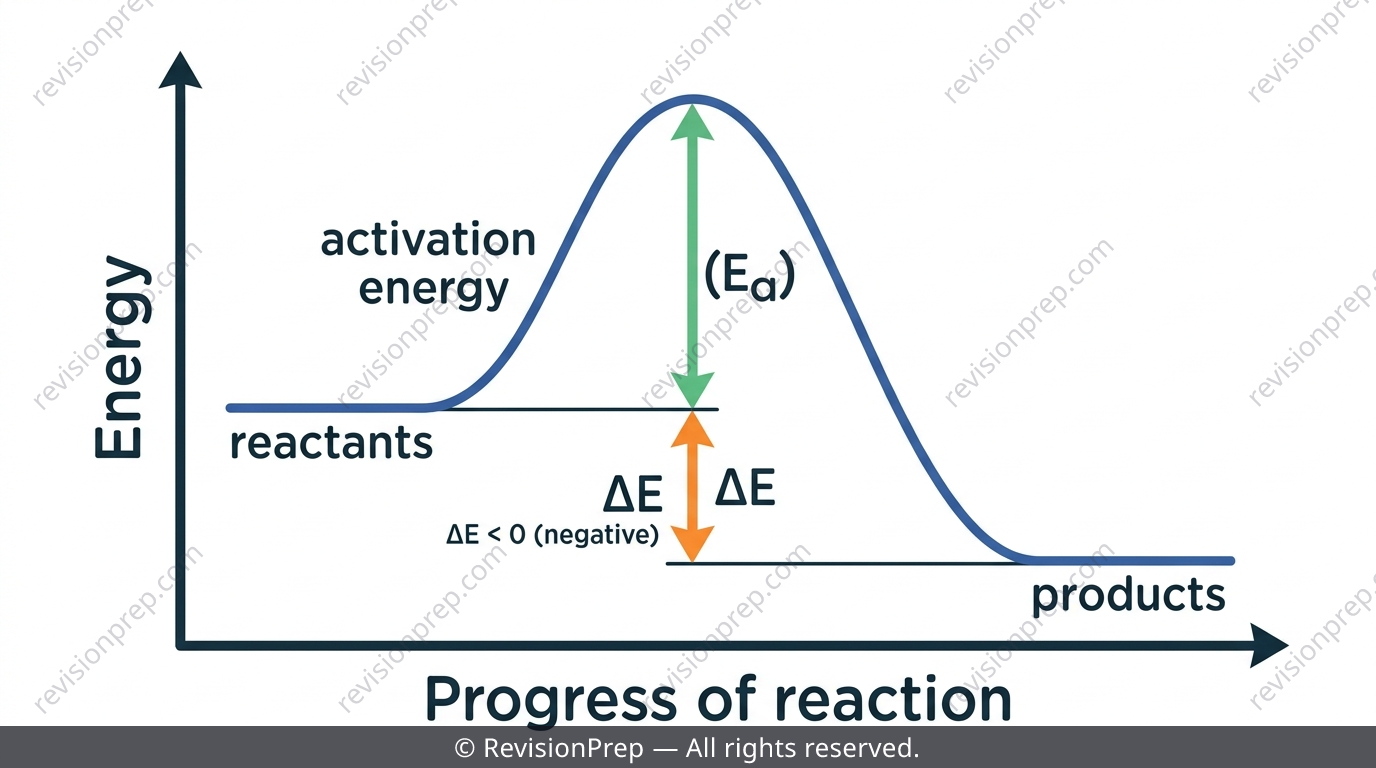
An energy profile plots energy against reaction progress, showing three key heights: reactants, the peak (transition state), and products. The overall energy change is calculated as — get the subtraction order wrong and the whole conclusion flips. A positive ΔE means endothermic; a negative ΔE means exothermic.
Exam tip
Always subtract in the order products minus reactants — never reactants minus products.
Common mistake
Writing ΔE = E(reactants) − E(products), which reverses the sign and flips endothermic/exothermic conclusions.
Mini summary
ΔE = products minus reactants; the sign directly tells you endothermic (+) or exothermic (−).
Bond Breaking and Bond Forming
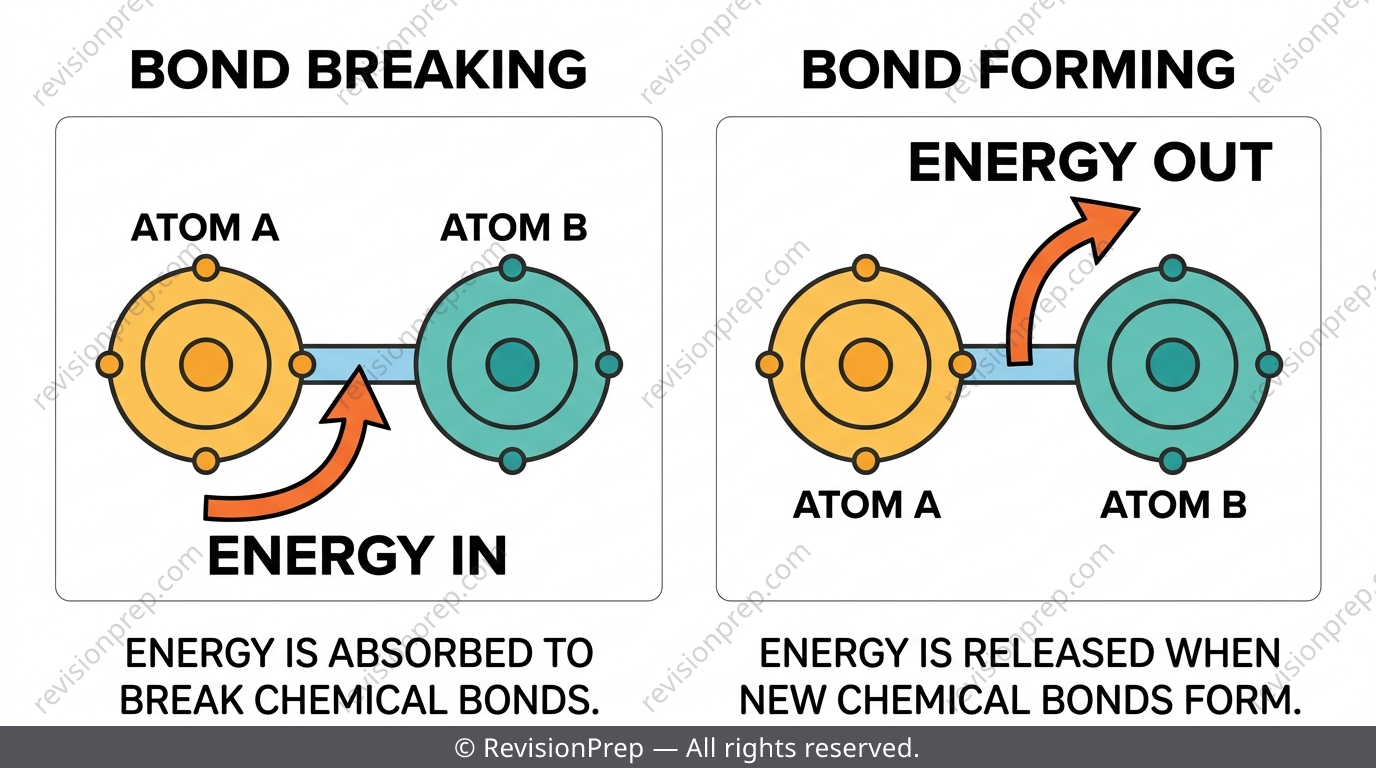
Bond breaking always needs energy in, and bond forming always releases energy out — these two facts never change. The overall reaction's energy change depends on which process 'wins': if more energy is released forming new bonds than was absorbed breaking old ones, the reaction is exothermic overall, and vice versa. Activation energy is the hump's height above the reactants — the barrier every particle must clear, regardless of whether the reaction ends up exothermic or endothermic.
Exam tip
Don't assume a high activation energy means an endothermic reaction — Ea and ΔE are independent quantities.
Common mistake
Assuming a reaction with a large activation energy hump must be endothermic overall — the hump height and the final ΔE are unrelated.
Mini summary
Bond breaking costs energy, bond forming releases it; the overall sign depends on which effect is bigger.
Collision Theory: Effective Collisions
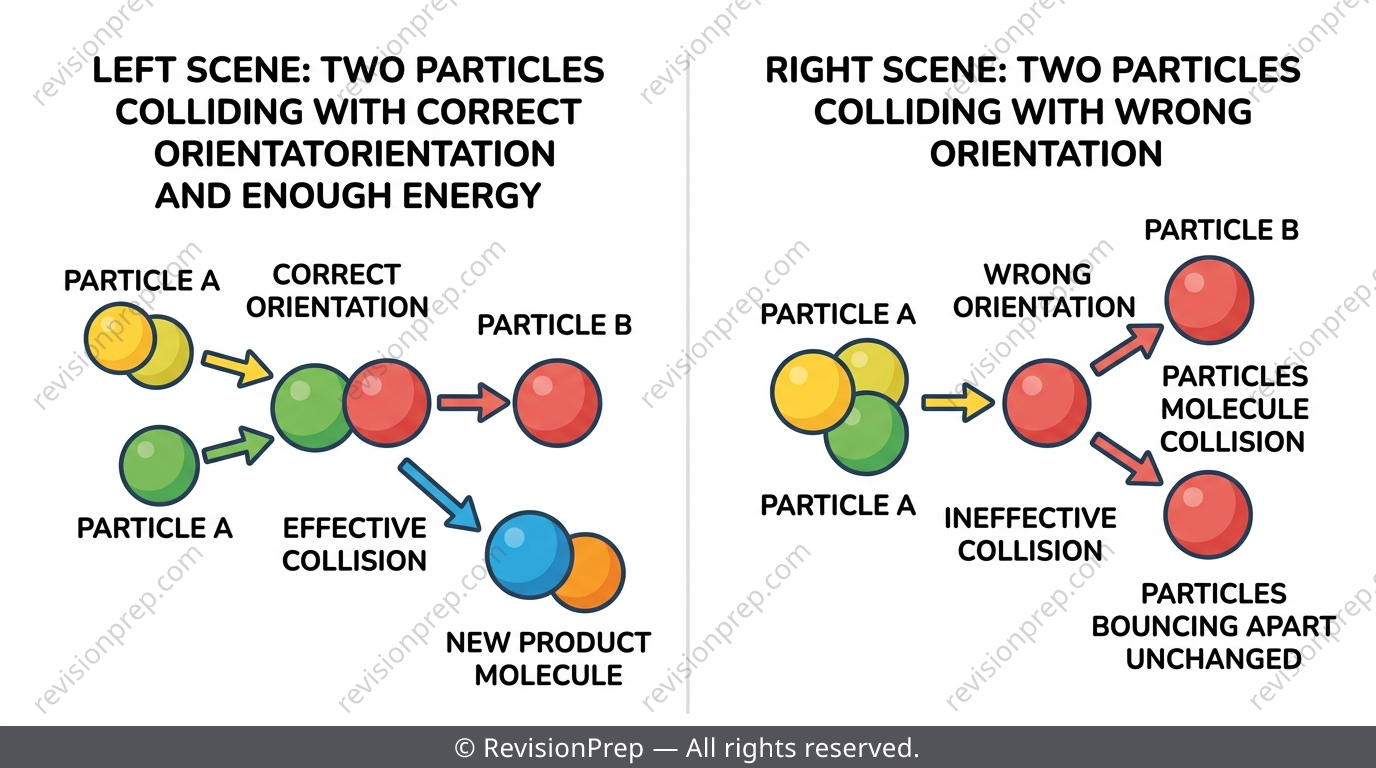
Particles collide constantly, but almost none of those collisions actually cause a reaction. For a collision to be effective, particles need energy at least equal to the activation energy AND the correct orientation. Fail either condition and the particles just bounce apart unchanged, with no bonds breaking or forming.
Exam tip
When explaining rate changes, always mention both conditions — energy and orientation — not just one.
Common mistake
Explaining faster rate only in terms of 'more collisions' while forgetting that more particles also have enough energy to react.
Mini summary
An effective collision needs enough energy AND the right orientation — miss either and nothing happens.
Why Temperature Speeds Up Reactions
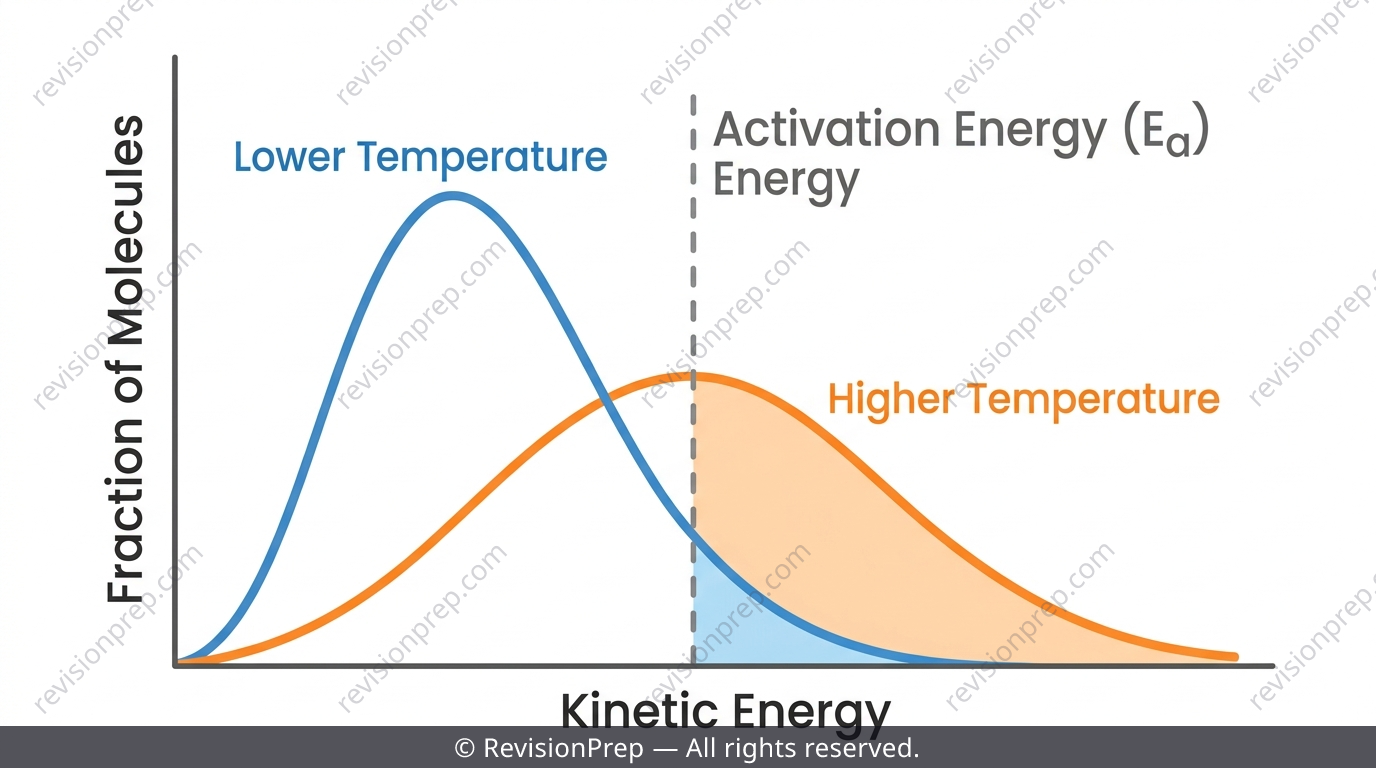
Raising temperature does two things at once: particles move faster so they collide more often, AND a greater proportion of them now have enough energy to clear the activation energy barrier when they do collide. Both effects add together, which is why rate rises sharply with temperature rather than just slightly. This is the reasoning examiners expect in full explanations, not just 'particles move faster'.
Exam tip
Mention both effects of temperature — more frequent collisions AND more particles with sufficient energy — for full marks.
Common mistake
Only stating that particles 'move faster and collide more' without mentioning that more particles also have enough energy to react.
Mini summary
Temperature increases rate through two combined effects: more frequent collisions and more energetic collisions.
Quick formula sheet
Practice questions
- State whether dissolving is generally endothermic or exothermic for most ionic solids.
- Define collision theory in one sentence.
- Write the formula used to calculate the overall energy change, ΔE, of a reaction.
- A reaction has E(reactants) = 60 kJ mol⁻¹ and E(products) = 40 kJ mol⁻¹. Calculate ΔE and state whether it is exothermic or endothermic.
- Explain why raising the temperature of a reaction mixture increases the rate of reaction, referring to collision theory.
- A student records a temperature rise from 21°C to 33°C when two solutions are mixed. State the type of reaction and identify the ΔT they should quote as evidence.
- Given E(reactants) = 70 kJ mol⁻¹, E(products) = 55 kJ mol⁻¹ and Ea(forward) = 130 kJ mol⁻¹, calculate ΔE and the reverse activation energy.
- Explain why a high activation energy does not necessarily mean a reaction is endothermic overall, using the concepts of bond breaking and bond forming.
- A reaction mixture's temperature rises to a peak then falls steadily afterwards. Explain which value should be used as evidence for the reaction being exothermic, and why the final reading would be misleading.
Frequently asked questions
What is the difference between exothermic and endothermic reactions?+
Exothermic reactions release energy to the surroundings so temperature rises; endothermic reactions absorb energy from the surroundings so temperature falls. Always back this up with the actual temperature change from your data.
How do I calculate ΔE from an energy profile?+
Use ΔE = E(products) − E(reactants). A negative ΔE means exothermic, a positive ΔE means endothermic. Getting the subtraction order backwards is the most common mistake.
What is activation energy?+
Activation energy is the minimum energy particles need when they collide for a reaction to occur — shown as the height of the hump above the reactants on an energy profile.
Why does increasing temperature speed up a reaction?+
Higher temperature makes particles move faster (more frequent collisions) and gives a greater proportion of particles enough energy to clear the activation energy barrier. Both effects combine to increase rate sharply.
What counts as an effective collision?+
A collision is effective only if the particles have energy at least equal to the activation energy AND collide with the correct orientation. If either condition fails, no reaction occurs.
Why is a high activation energy not the same as an endothermic reaction?+
Activation energy measures the barrier height above reactants, while ΔE compares reactants to products. A reaction can have a high activation energy but still be exothermic overall if bond forming releases more energy than bond breaking absorbed.
Get the full IB MYP 5 Chemistry notes on Rates of Reaction and Energy Changes
Related articles