
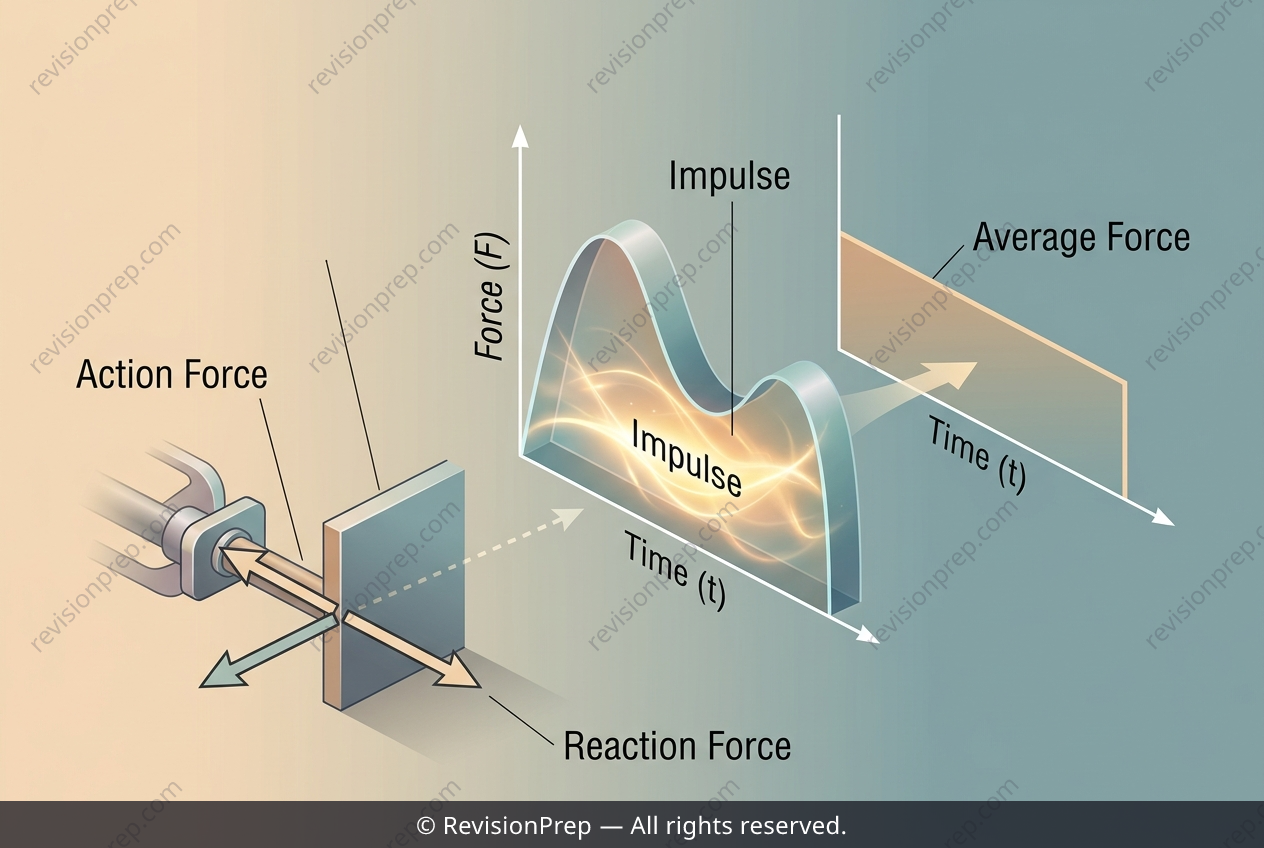
Physics: How Force Over Time Determines Impulse
Newton's Third Law describes how forces always arise in pairs: when one object pushes another, the second pushes back with equal magnitude and opposite direction, at every instant. These action–reaction forces act on different objects simultaneously, which is why a hand pressing a wall feels resistance rather than passing straight through it. When a force changes over time, its effect is captured by impulse — the area under a force–time graph, J = FΔt for constant force, or the area beneath the curve when force varies. Dividing total impulse by total time gives the average force, F̄ = J/Δt, a single steady value representing the same overall push. This matters because real forces rarely stay constant: a triangular profile peaking briefly delivers far less impulse than its peak suggests, and Newton's Third Law ensures the wall pushes back with that same average force.
Start practising IB questions today
150,000+ IB-styled questions, criteria-mapped and instantly accessible.