
Waves, Sound and Light
The IB MYP 5 Physics essentials: EM spectrum, wave properties, sound and refraction in one fast revision teaser.
Quick facts
Waves carry energy without carrying matter — and in IB MYP 5 Physics, sound and light are the two waves examiners return to again and again. Sound is mechanical and needs a medium; light is electromagnetic and races through a vacuum at . Nearly every question in this unit tests one of three things: whether you can apply correctly, whether you can place a wave in the EM spectrum and justify its energy and hazards, or whether you can track a ray of light across a boundary using the normal, not the surface. This teaser pulls out the five ideas worth the most marks — EM spectrum order and hazards, communication technology choices, transverse vs longitudinal waves, sound's medium-dependence, and refraction fundamentals — so you can revise smart before diving into the full RevisionPrep notes for worked examples and mock exam-style questions.
What you’ll be able to do
1. The Electromagnetic Spectrum and Its Uses
All EM waves travel at in a vacuum, so frequency and wavelength are always inversely related — as one goes up, the other goes down proportionally. From lowest to highest frequency the order is radio, microwave, infrared, visible, ultraviolet, X-ray, gamma, and photon energy rises with frequency according to . Gamma rays carry the most energy per photon of any EM wave; radio waves carry the least. UV, X-ray and gamma are ionizing — energetic enough to strip electrons from atoms — which is exactly why X-rays image bone (dense tissue absorbs them strongly) but need shielding and dose limits.
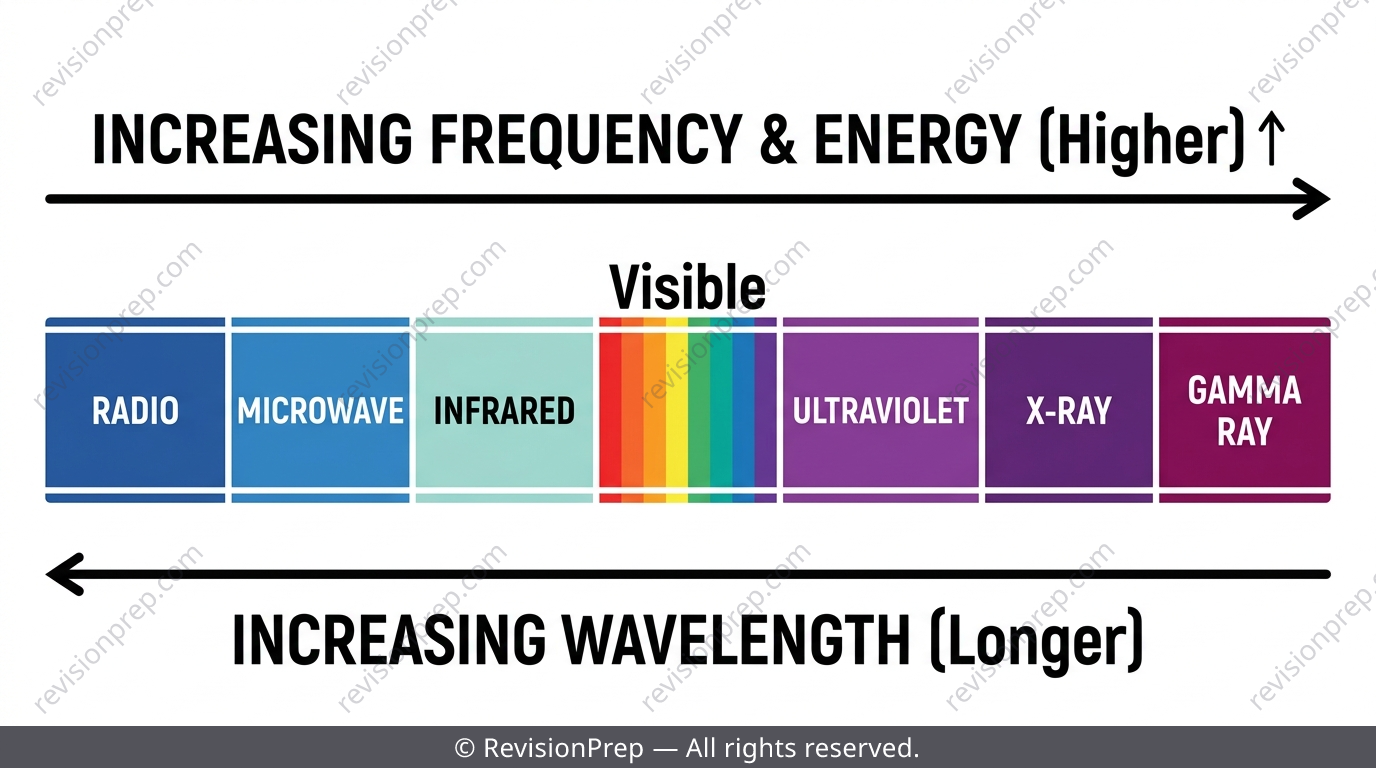
| Wave type | Relative frequency | Ionizing? | Typical use |
|---|---|---|---|
| Radio | Lowest | No | Broadcasting, emergency radios |
| Microwave | Low | No | Satellite links, phone masts |
| Infrared | Medium | No | Optical fibre signals |
| Visible | Medium | No | Human sight |
| Ultraviolet | High | Yes | Sterilisation (with hazard) |
| X-ray | Very high | Yes | Bone imaging |
| Gamma | Highest | Yes | Cancer treatment, sterilisation |
Exam tip
Never just name gamma rays as most dangerous — say 'gamma rays have the highest frequency, so by they carry the most energy per photon.' The link earns the justify mark, the name alone doesn't.
Common mistake
Saying wavelength and frequency both increase or both decrease together. They don't — one full sentence fixes this every time: as frequency increases, wavelength decreases, because their product must stay equal to .
Mini summary
EM spectrum order, inverse f–λ relationship, and E=hf driving the ionizing/non-ionizing hazard split are the three facts worth the most marks here.
2. Light and Radio Waves in Communication
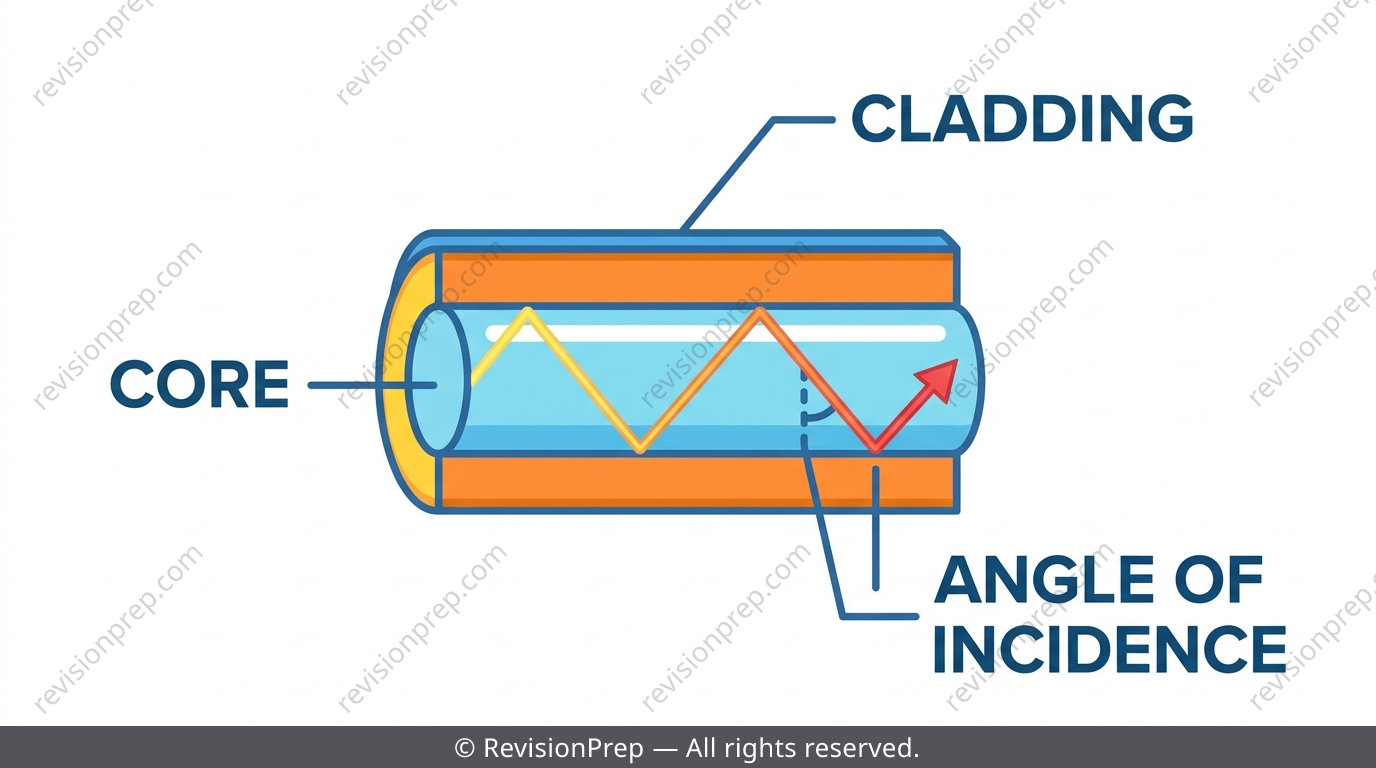
Choosing the right EM wave for a technology always comes down to matching a wave property to the job. Radio waves have long wavelengths that diffract around buildings and hills, which is perfect for broadcast and emergency radios — but thick, extended barriers like tunnels and mountains still block them because too little of the wave can diffract through such dense obstacles. Optical fibres send infrared light pulses along a glass core using total internal reflection, forming the backbone of broadband and phone networks, while microwaves' short wavelength gives a narrow, directional beam ideal for satellite and mobile links.
Exam tip
For 'why does the signal fail' questions, always name diffraction first as the property that usually helps radio waves bend around obstacles, then explain why the obstacle's scale defeats it.
Common mistake
Explaining tunnel signal loss with only 'radio waves travel in straight lines' — that ignores diffraction entirely and won't earn full marks.
Mini summary
Radio = diffraction for broadcast; optical fibre = total internal reflection for lossless data; microwave = directional beam for satellites.
3. Wave Properties: Transverse vs Longitudinal
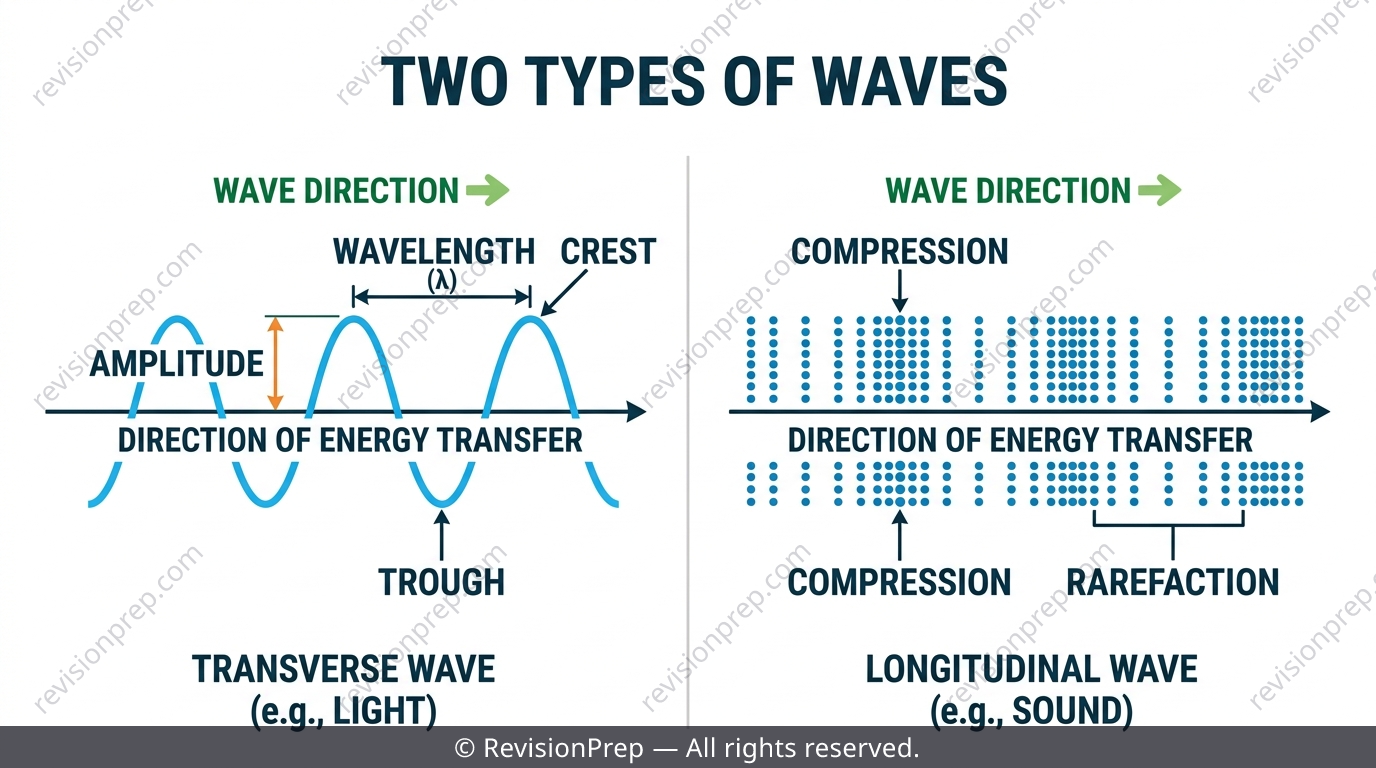
Every wave, mechanical or electromagnetic, is described by amplitude, wavelength, frequency, period and speed, linked by and . Transverse waves oscillate perpendicular to the direction of travel (light, water, waves on a string); longitudinal waves oscillate parallel to travel, creating compressions and rarefactions (sound is the standard example). Amplitude relates to the energy a wave carries, while wavelength and frequency together fix its speed — keep these two roles separate.
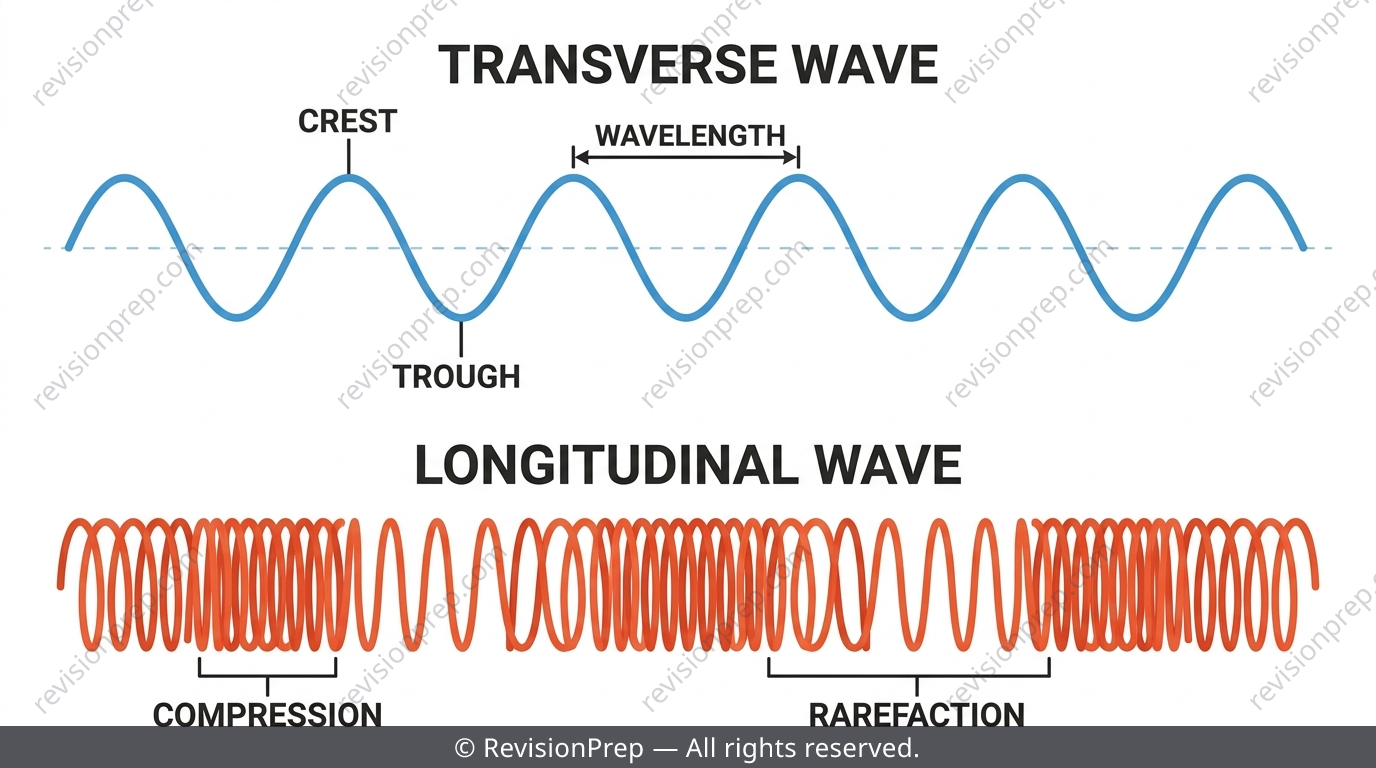
| Feature | Transverse | Longitudinal |
|---|---|---|
| Oscillation direction | Perpendicular to travel | Parallel to travel |
| Example | Light, water waves | Sound |
| Pattern | Crests and troughs | Compressions and rarefactions |
Exam tip
applies to every wave you'll be examined on — mechanical or EM. If a question gives you two of the three variables, this formula almost always gets you the third.
Common mistake
Mixing up amplitude and wavelength as if they both control speed — amplitude relates to energy carried, not speed.
Mini summary
Know the definitions, know and cold, and be able to sort any example into transverse or longitudinal instantly.
4. Sound Waves: Mechanical and Medium-Dependent
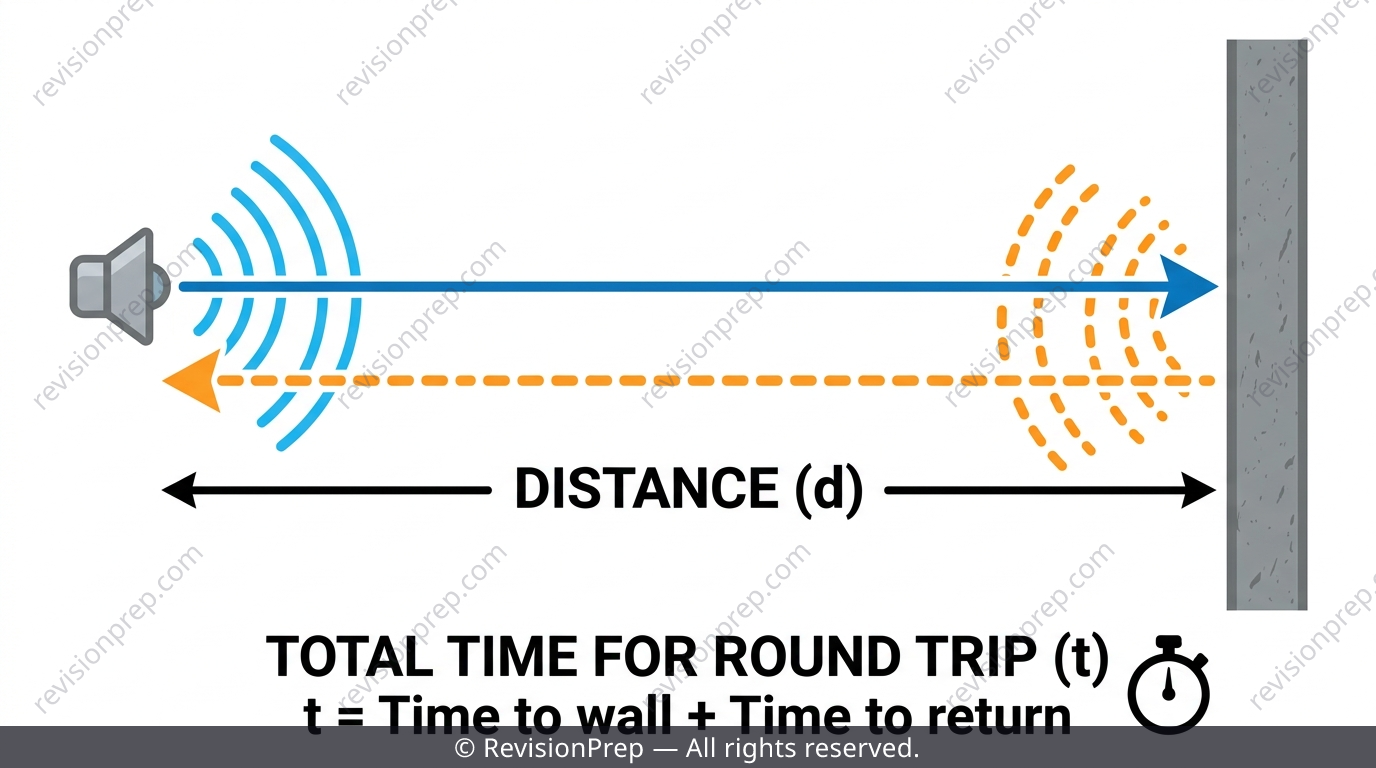
Sound is the classic longitudinal wave, travelling as compressions and rarefactions through a medium — unlike light, sound cannot travel through a vacuum because it needs particles to pass the disturbance along. This medium-dependence is central to exam questions: sound's speed changes depending on whether it travels through a solid, liquid or gas. Echo-timing questions build directly on this idea, using the time for a reflected sound pulse to return to calculate distance or speed.
Exam tip
If a question mentions an echo, immediately think 'distance the sound travels is there and back' — don't forget to account for the return trip when working out distance or time.
Common mistake
Treating sound like light and assuming it can travel through empty space — always state that sound needs a medium.
Mini summary
Sound = longitudinal + mechanical + medium-dependent speed + echo timing is the four-part combo examiners test most.
5. Reflection, Refraction and the Critical Angle
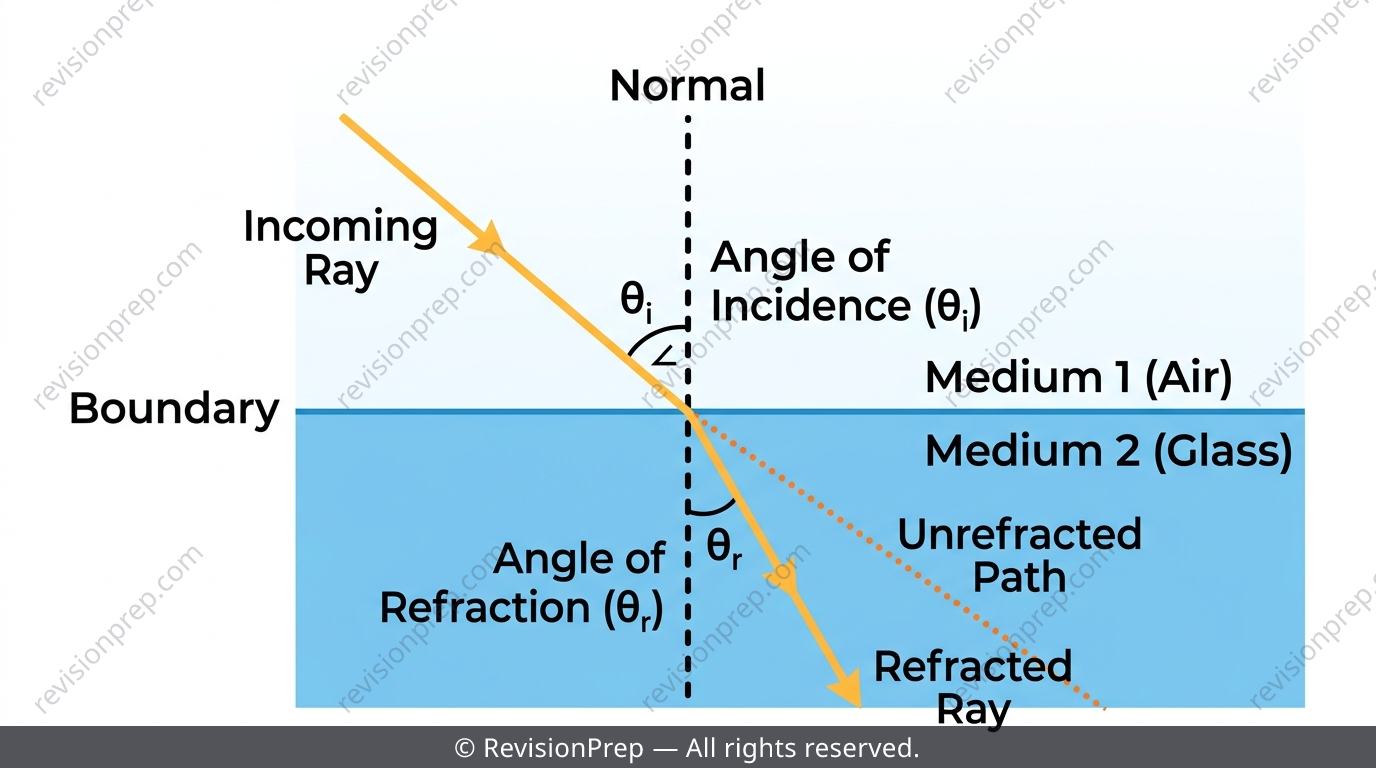
Ray diagrams and refraction questions are marked strictly on measuring angles from the normal — the imaginary line perpendicular to the boundary — never from the surface itself. Total internal reflection happens when light travels from a denser medium toward a less dense one and hits the boundary above a critical angle, calculated with , where is the refractive index of the denser medium. This is exactly the principle that keeps light trapped inside an optical fibre core.
Exam tip
Always draw and label the normal as a dashed line before marking any angle — examiners deduct marks for angles measured from the surface, even if the final numerical answer is correct.
Common mistake
Measuring the angle of incidence or refraction from the boundary surface instead of the normal — this loses marks even when the calculation itself is right.
Mini summary
Normal first, then angle; critical angle formula links straight back to why optical fibres work.
Quick formula sheet
Practice questions
- State the correct order of the EM spectrum from lowest to highest frequency.
- Define wavelength and amplitude in your own words.
- Classify sound and light as either transverse or longitudinal waves.
- A wave has a frequency of 50 Hz and a wavelength of 4 m. Calculate its speed.
- Explain why X-rays are useful for imaging bones but require dose limits for patients.
- Explain why microwaves are used for satellite communication instead of radio waves.
- A glass optical fibre core has a refractive index of 1.52. Calculate the critical angle and explain what happens to light hitting the boundary at exactly this angle.
- A rescue team's radio works fine outdoors but fails inside a long tunnel. Using wave properties, explain this observation fully.
- Given four EM waves and three known photon energies calculated from , deduce the missing energy for a wave of known frequency and justify the overall trend shown by the data.
Frequently asked questions
What's the main difference between sound and light waves?+
Sound is a mechanical, longitudinal wave that needs a medium (solid, liquid or gas) to travel. Light is a transverse, electromagnetic wave that can travel through a vacuum at .
Why does frequency increase as wavelength decreases across the EM spectrum?+
All EM waves travel at the same fixed speed in a vacuum, and since , if one of or goes up, the other must go down proportionally to keep the product constant.
Why are gamma rays more dangerous than radio waves?+
Gamma rays have the highest frequency of any EM wave, and by this means they carry the most energy per photon — enough to ionise atoms and damage tissue, unlike low-energy radio waves.
How do optical fibres keep light signals from escaping?+
Light travels along the glass core and reflects at the core-cladding boundary using total internal reflection, which only happens when the ray hits the boundary at an angle greater than the critical angle.
Why do radio signals fail inside long tunnels if they can diffract around obstacles?+
Diffraction lets radio waves bend around smaller obstacles, but a long tunnel is such a thick, extended barrier that too little of the wave can diffract through or around it, so the signal is blocked.
Where can I find full worked examples and mock exam-style questions on this topic?+
The complete RevisionPrep notes for MYP 5 Physics include full worked examples, detailed EM spectrum tables, and original mock exam-style questions covering every concept in this teaser.
Get the Full MYP 5 Physics Notes on Waves, Sound and Light
Related articles