
Fields: The IB DP Physics Guide to Flux, Induction & Charged Particle Motion
Gravitational, electric and magnetic fields share more maths than you'd think — until magnetism breaks the rules.
Quick facts
Every IB Physics field question — gravitational, electric or magnetic — is really asking the same three things: what's the source, is the field radial or uniform, and does the force actually do work? Gravitational and electric fields obey identical inverse-square maths, differing only in the constant out front and whether attraction can flip to repulsion. Magnetism plays by different rules entirely: the force on a moving charge is always perpendicular to velocity, so it steers particles without ever speeding them up. At HL, this quirk unlocks two exam-heavy subtopics — motion in electromagnetic fields and electromagnetic induction — covering Faraday's law, Lenz's law, transformers, and circular motion in a magnetic field. This teaser walks through the five ideas examiners return to again and again, with the traps that catch out rushed answers. Full worked examples and derivations live in the complete RevisionPrep notes.
What you’ll be able to do
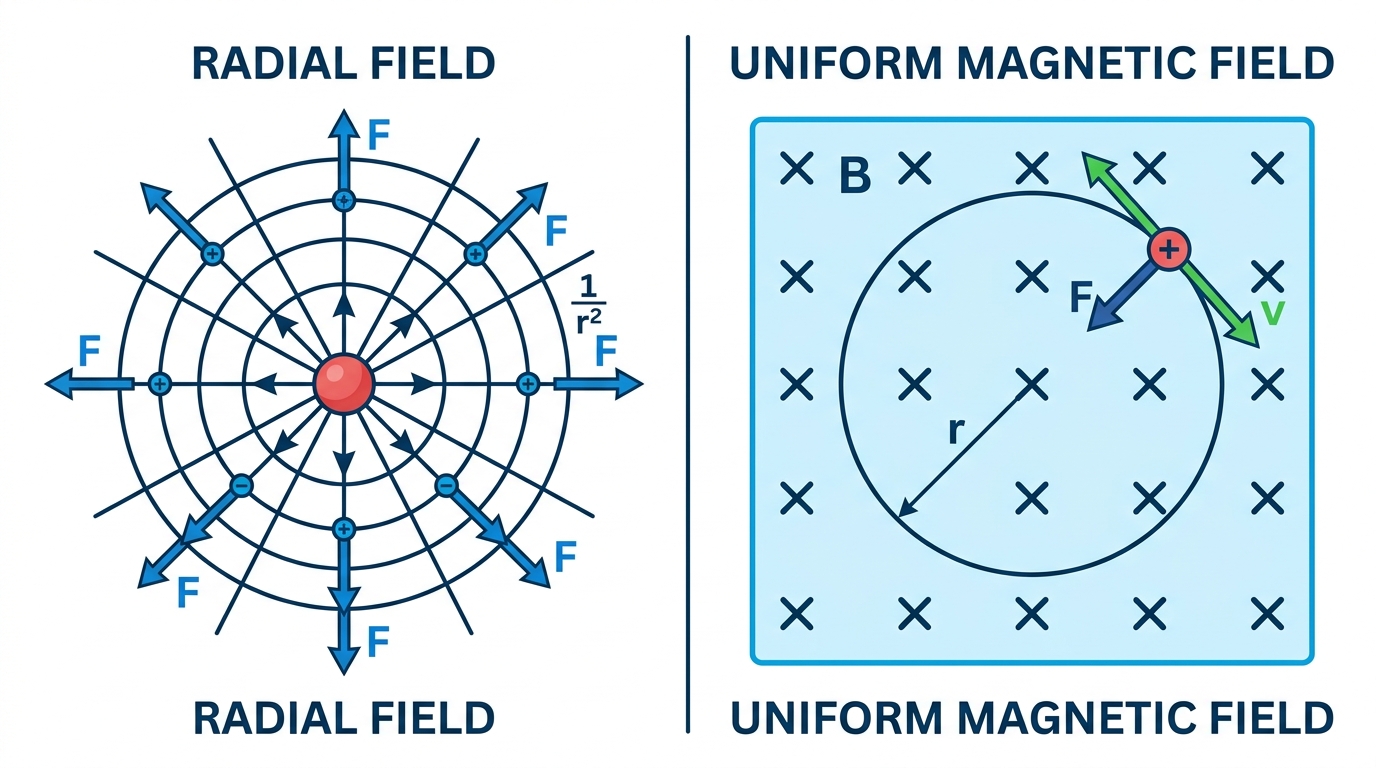
Gravitational, Electric & Magnetic Fields: What's Shared, What's Different
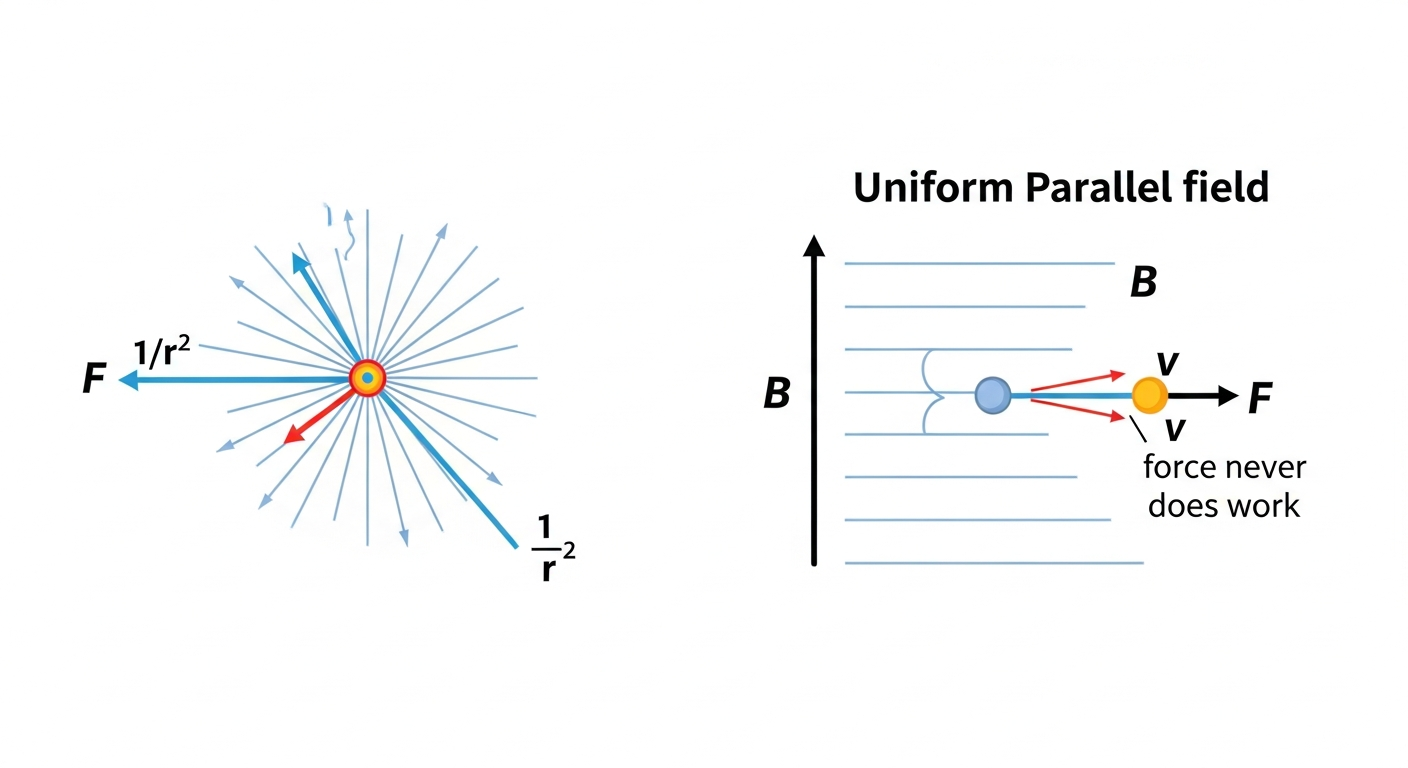
Gravitational and electric fields are mathematical twins: both are inverse-square, , both have a scalar potential, and both give a potential energy that depends only on separation. The only differences are the constant of proportionality and the fact that electric force can repel while gravity never does. Magnetism breaks the pattern completely — the force on a moving charge is always perpendicular to its velocity, so it can bend a path but never do work on it.
Exam tip
Before reaching for any formula, decide: is this field radial (inverse-square) or uniform? That single decision tells you which equations are even relevant.
Mini summary
Gravity and electricity share inverse-square maths; magnetism is uniquely direction-only, never speed-changing.
Magnetic Flux and Faraday's Law (HL)
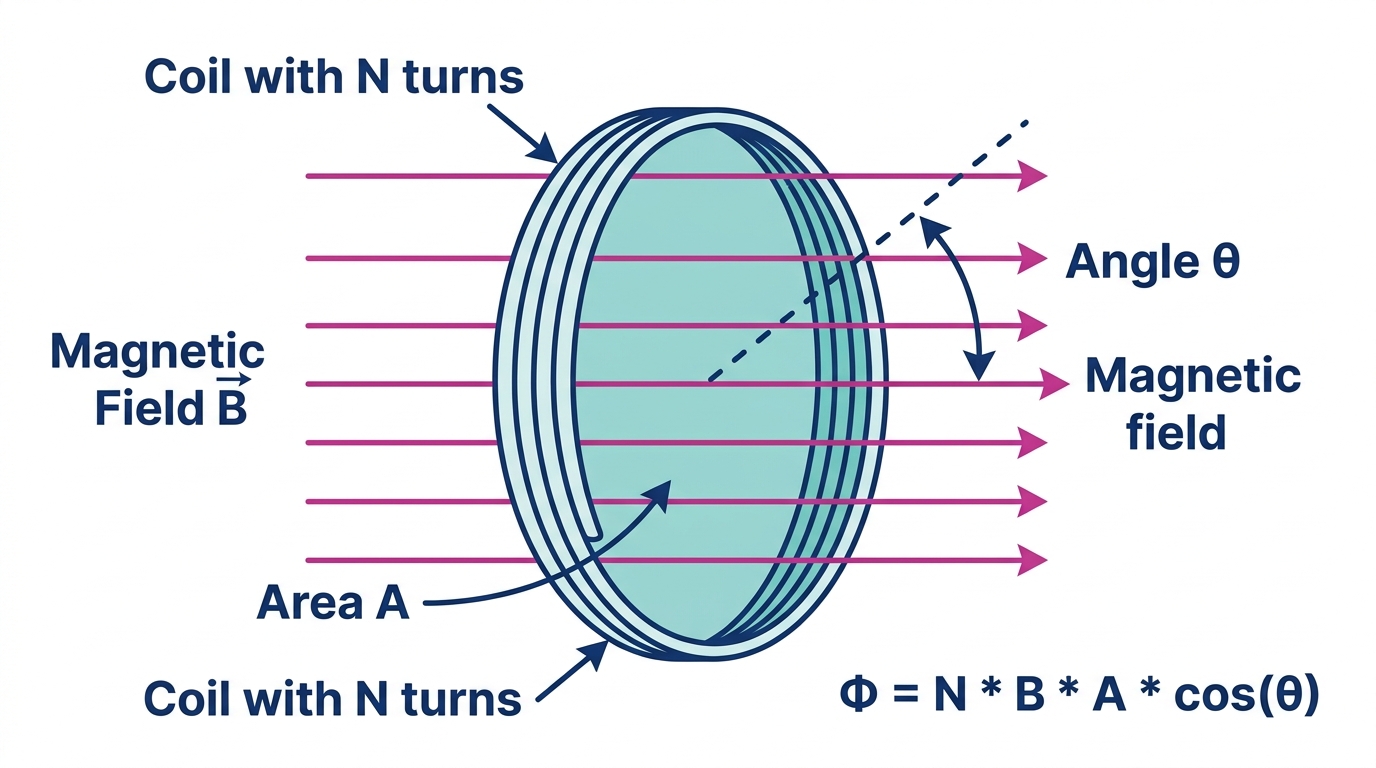
Everything in induction starts from — the component of perpendicular to a coil's area, times that area. Flux changes because changes (transformers, MRI), changes (a rod sliding on rails), or changes (a rotating coil, the generator case). Faraday's law then gives the size of the induced emf as — always check whether the coil has multiple turns before you finish the calculation.
| Scenario | What's changing | Formula / approach |
|---|---|---|
| Field switched off or ramped | Use , differentiate | |
| Rod sliding on rails | Motional emf | |
| Rotating coil (generator) | , differentiate |
Exam tip
MCQ distractors love to drop the (number of turns) from Faraday's law — that gives the emf in one loop, not across the whole coil.
Common mistake
Forgetting to multiply by when a coil has multiple turns, giving an emf that's a factor of too small.
Mini summary
Identify whether B, A or θ is varying, then apply — never skip the turns count.
Lenz's Law and Ideal Transformers (HL)
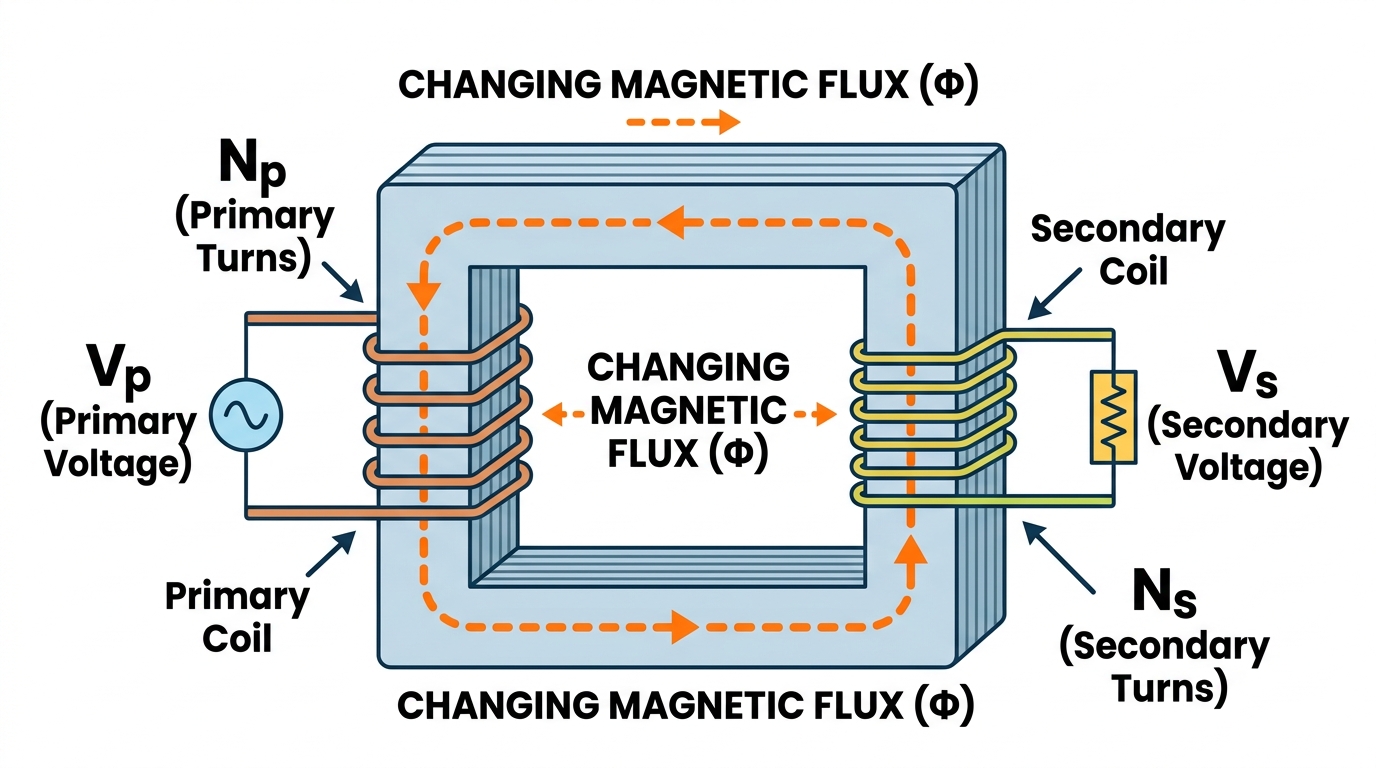
Lenz's law fixes the direction: induced current always opposes the change in flux that created it, guaranteeing energy conservation. A transformer is just two coils sharing one changing flux through an iron core — no wires connect primary to secondary, only magnetic coupling. Power is conserved in an ideal transformer: , alongside .
Exam tip
Decide step-up or step-down from the given voltages first, then eliminate any turns-ratio option that inverts that direction — before you even plug in numbers.
Common mistake
Inverting the turns ratio, or forgetting to square when using to find power dissipated in the secondary.
Mini summary
Lenz's law = direction; transformers conserve power, not turns — low-voltage side always carries the higher current and thicker wire.
Motional EMF and Induced Electric Fields (HL)
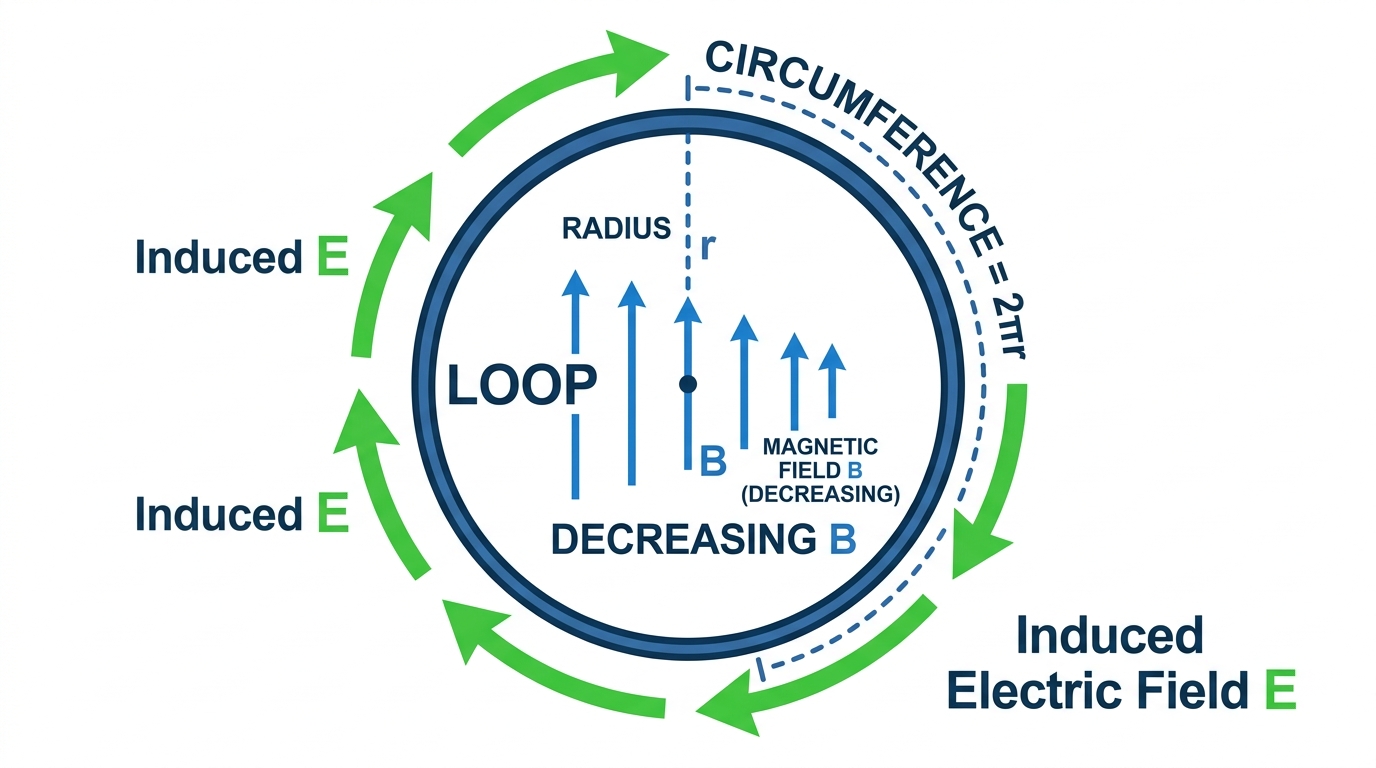
A straight conductor of length sweeping through field at speed (all mutually perpendicular) generates . Less obviously, a changing flux also induces a genuine electric field in the surrounding space, not just an emf in a wire: around a symmetric circular path enclosing that flux, .
Exam tip
In symmetric-loop problems (like an MRI field decreasing to zero), always divide by the full path length , not just .
Common mistake
Dividing the flux rate by the radius instead of , which inflates the induced electric field by a factor of .
Mini summary
A changing B-field creates a real E-field in space — use the full circumference when solving for it.
Lorentz Force, Circular Motion & Velocity Selectors (HL)
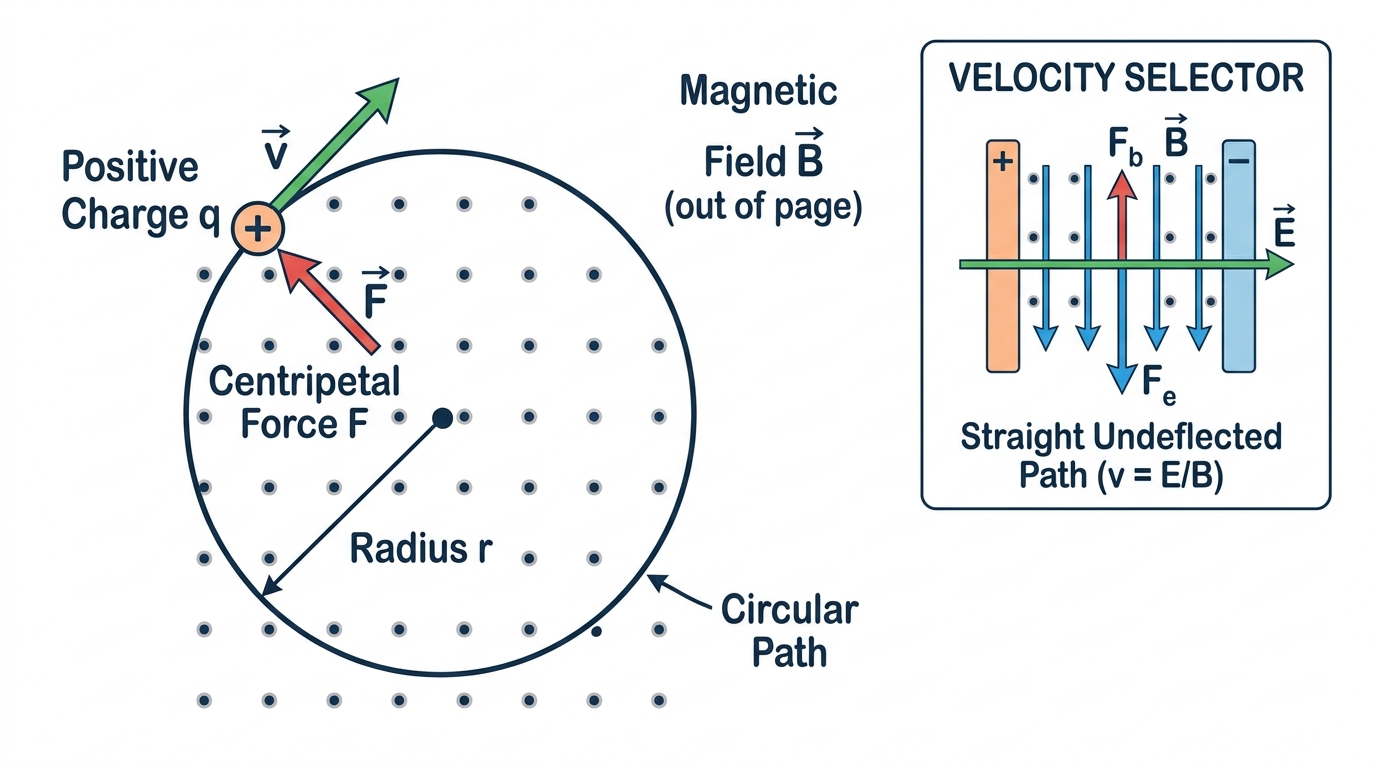
The total force on a moving charge is . A charge entering a uniform field perpendicular to moves in a circle with , and the period contains no at all — every particle of the same charge-to-mass ratio takes the same time per revolution, the whole basis of a cyclotron. A velocity selector balances the two forces so only particles at pass through undeflected.
Exam tip
'Derive' questions want the algebra from a named principle (force balance, ) shown line by line — jumping straight to the final formula loses marks even with the right answer.
Common mistake
Assuming the magnetic force changes a charged particle's speed — it's always perpendicular to , so it does zero work; only an electric (or other non-magnetic) force can change kinetic energy.
Mini summary
scales with speed but does not — that independence is the entire principle behind the cyclotron.
Quick formula sheet
Practice questions
- State Lenz's law and explain what it guarantees about energy conservation.
- Write down the equation for magnetic flux and identify each symbol.
- A charge moves through a region of uniform magnetic field perpendicular to its velocity. Describe the shape of its path and explain why its speed stays constant.
- A coil of 150 turns experiences a flux change of Wb over 0.50 s. Calculate the average induced emf.
- An ideal transformer has 400 primary turns and 100 secondary turns, connected to a 230 V rms supply. Find the secondary voltage and state whether this is a step-up or step-down transformer.
- A proton moves at perpendicular to a 0.30 T magnetic field. Calculate the radius of its circular path.
- Derive the expression for the period of a charged particle's circular motion, starting from the force balance between magnetic force and centripetal force.
- A circular loop of radius 0.10 m sits perpendicular to a magnetic field that decreases uniformly from 2.0 T to 0 T in 0.40 s. Determine the magnitude of the induced electric field at the loop's edge.
- Explain, using the transformer power conservation equation, why the low-voltage side of a step-down transformer must be wound with thicker wire than the high-voltage side.
Frequently asked questions
Is induction on the SL or HL IB Physics syllabus?+
Induction (flux, Faraday's law, Lenz's law, transformers, generators) is entirely HL-only — SL students are never examined on it.
Why can't a magnetic field change a charged particle's speed?+
The magnetic force is always perpendicular to velocity, so it does zero work. Only an electric field (or another force with a component along velocity) can change kinetic energy.
What's the difference between Faraday's law and Lenz's law?+
Faraday's law gives the magnitude of induced emf (); Lenz's law gives its direction, ensuring the induced current always opposes the flux change that caused it.
Why does the period of circular motion in a magnetic field not depend on speed?+
Because has no term — a faster particle traces a proportionally larger circle, so it still takes the same time per revolution. This is the basis of the cyclotron.
How do I know which side of a transformer has thicker wire?+
Power is conserved (), so the low-voltage side carries higher current and needs lower resistance, meaning thicker wire — regardless of which side has more turns.
What is a velocity selector used for?+
It uses balanced electric and magnetic forces () so that only charged particles travelling at exactly pass through undeflected, regardless of their charge or mass.
Get the Full IB DP Physics Fields Revision Notes
Related articles