
Nuclear and Quantum Physics
The photon connects decaying nuclei to glowing atoms — master both halves of IB Theme E.
Quick facts
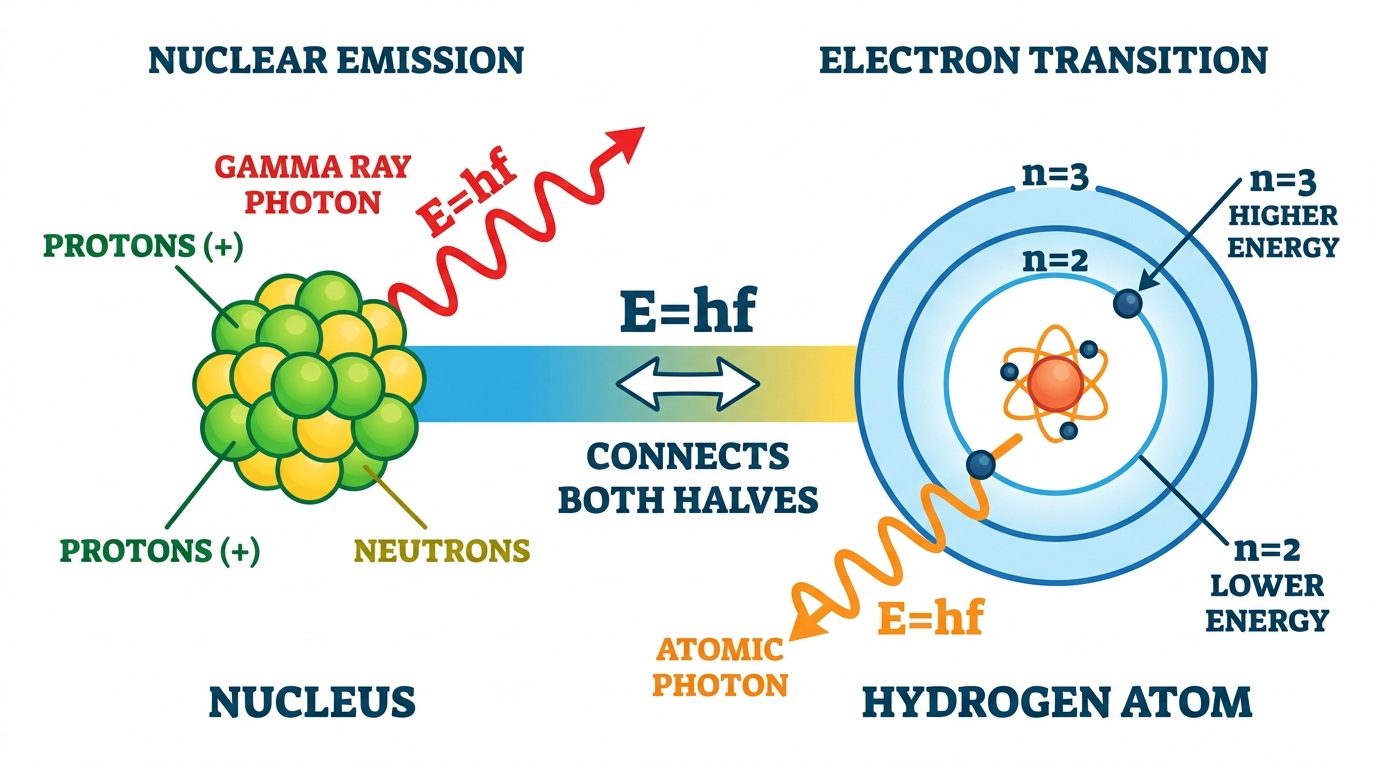
IB DP Physics Theme E asks two big questions: what holds a nucleus together, and why does energy come in fixed packets? Nuclear and quantum physics might look like two separate topics, but they share one equation — — which explains both a gamma ray leaving an unstable nucleus and a spectral line from a hydrogen atom. Exam marks in this topic come from a small set of repeatable skills: reading and balancing nuclear equations, using nuclide notation correctly, linking energy-level jumps to photon wavelengths, and moving fluently between number of nuclei, activity, half-life and decay constant. This teaser walks through the five ideas that carry the most marks — atomic structure and Rutherford scattering, photons and energy levels, the three types of radioactive decay, and the exponential maths of half-life — with the exact traps examiners see every year. The full RevisionPrep notes go deeper into each worked example and formula.
What you’ll be able to do
Structure of the Atom & Nuclide Notation
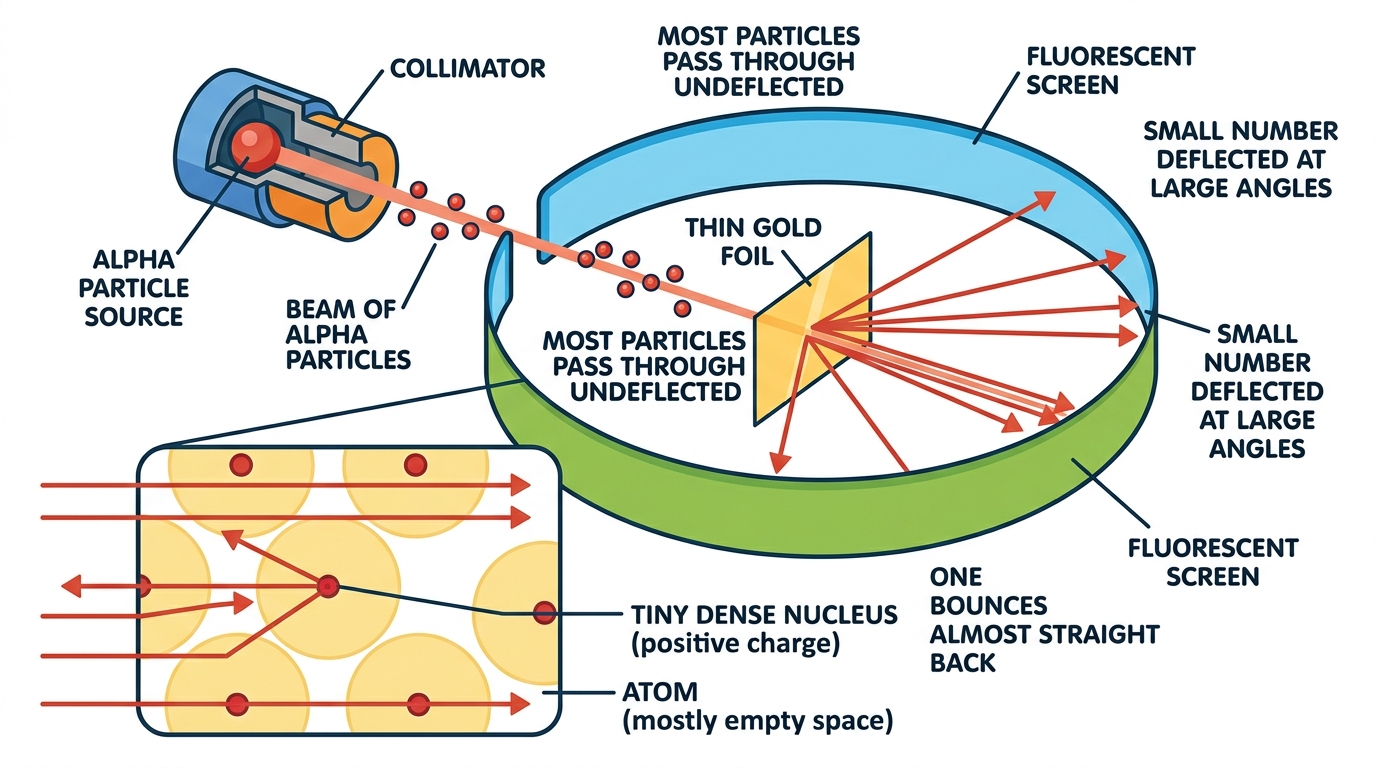
An atom is almost entirely empty space: a tiny, dense, positive nucleus (about across) sits at the centre while electrons occupy a volume about times bigger. Nucleons are protons () and neutrons (no charge), each roughly 1 u, while the electron's mass is negligible for nuclear calculations. The nuclide symbol packs it all in: is nucleons, is protons, and gives neutrons — isotopes share but differ in .
Exam tip
If asked what Rutherford scattering shows, examiners want the link stated fully: 'a few alphas deflect by more than 90°, therefore the positive charge and most of the mass are concentrated in a tiny volume.' The observation alone earns nothing without that conclusion.
Atomic Spectra, Energy Levels & Photons
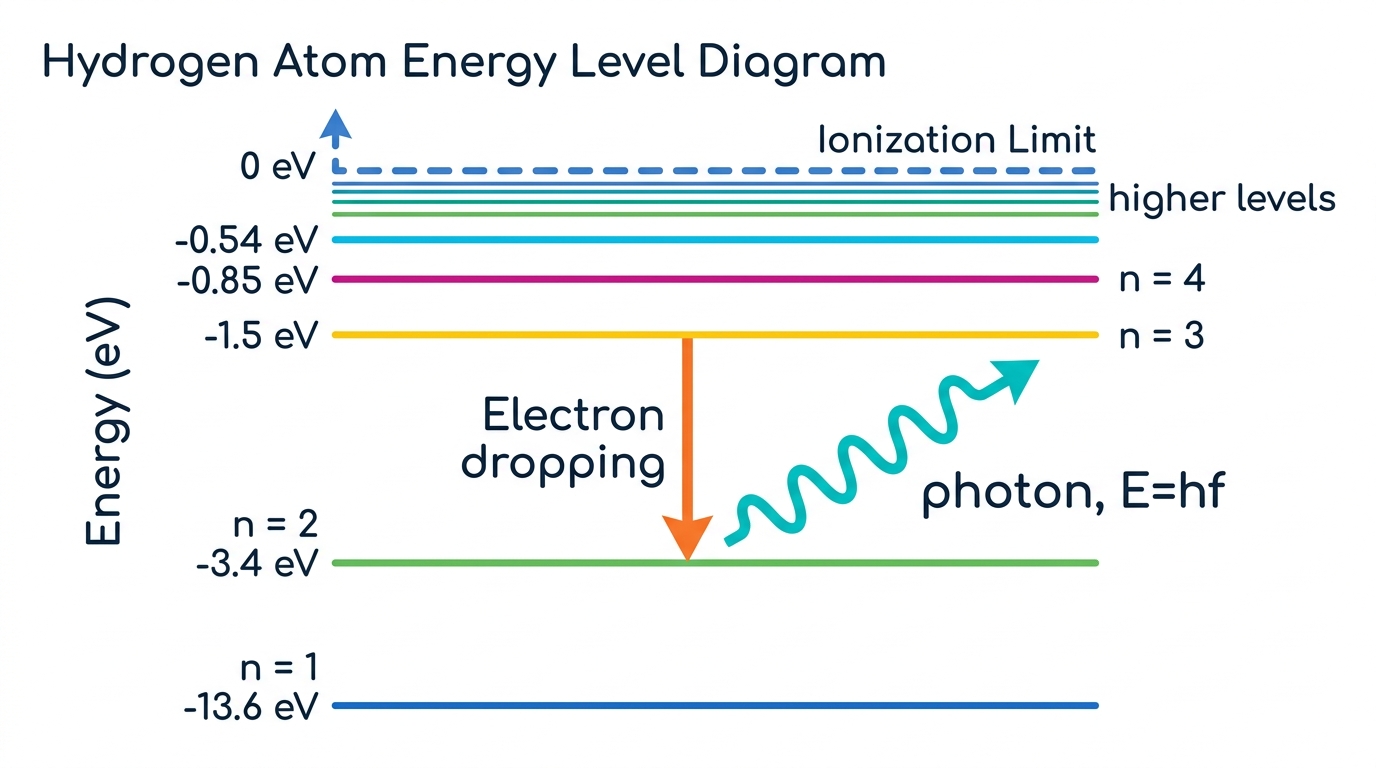
Electrons in an atom only occupy discrete, negative energy levels. Absorbing or emitting a photon means jumping exactly the energy gap between two levels — nothing in between is allowed. That's why spectra show sharp lines rather than a smooth blur: only specific photon energies, and therefore specific frequencies and wavelengths, are possible.
Common mistake
Leaving the energy gap in eV and plugging it straight into . Always convert to joules first, or use the shortcut to sanity-check your answer.
Radioactive Decay: Alpha, Beta & Gamma
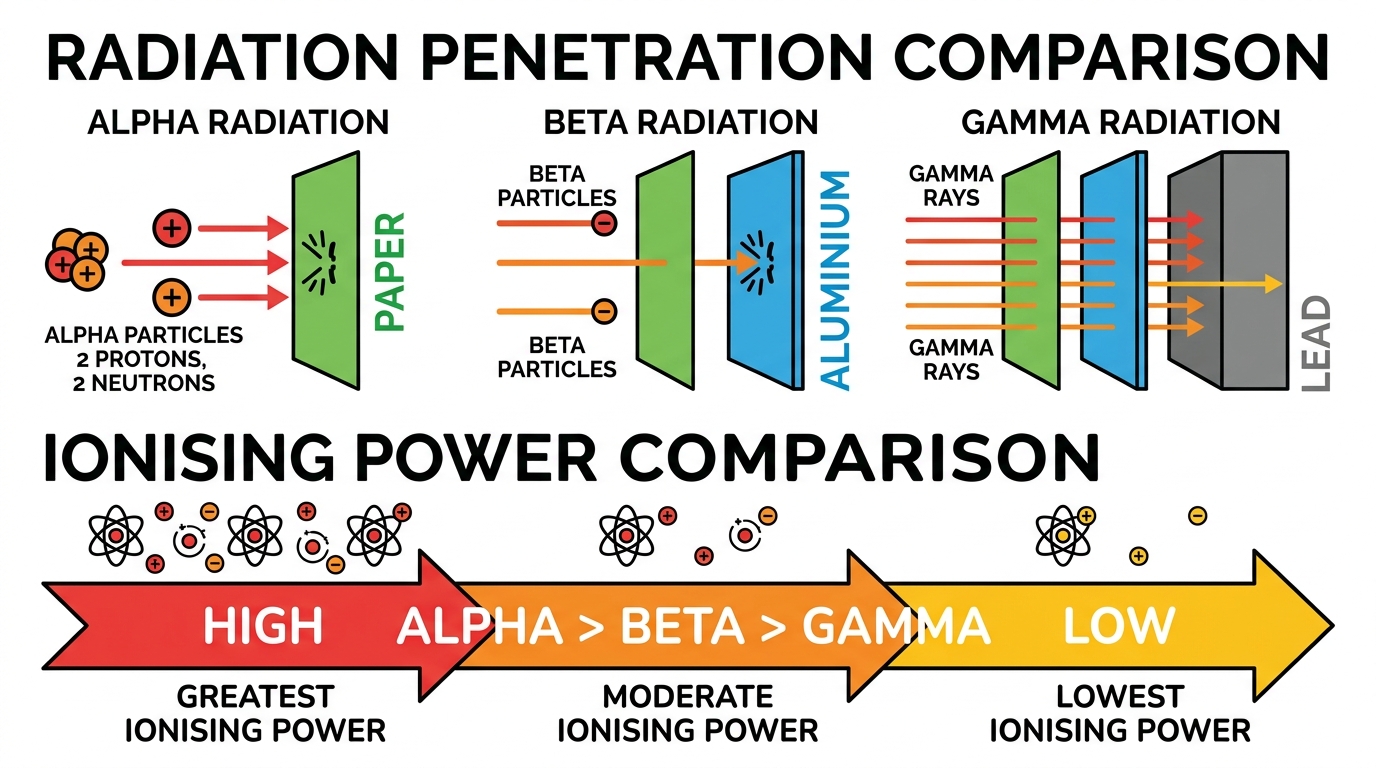
Unstable nuclei decay spontaneously (nothing external changes the rate) and randomly (you can't predict which nucleus decays when). Too many neutrons drives beta-minus decay, too many protons drives beta-plus, an overly large nucleus emits alpha, and any leftover excited state emits gamma. Beta particles are emitted with a continuous range of energies because a third particle, the neutrino, carries away the rest of the energy and momentum.
| Decay type | Emitted | Change to nucleus |
|---|---|---|
| Alpha | Helium nucleus | , |
| Beta-minus | Electron + antineutrino | same, |
| Beta-plus | Positron + neutrino | same, |
| Gamma | High-energy photon | No change to or |
Exam tip
For 'explain why beta particles have a range of energies', the mark is specifically for naming the (anti)neutrino as the particle sharing the released energy — 'energy is lost to surroundings' scores zero.
Half-Life, Decay Constant & Activity
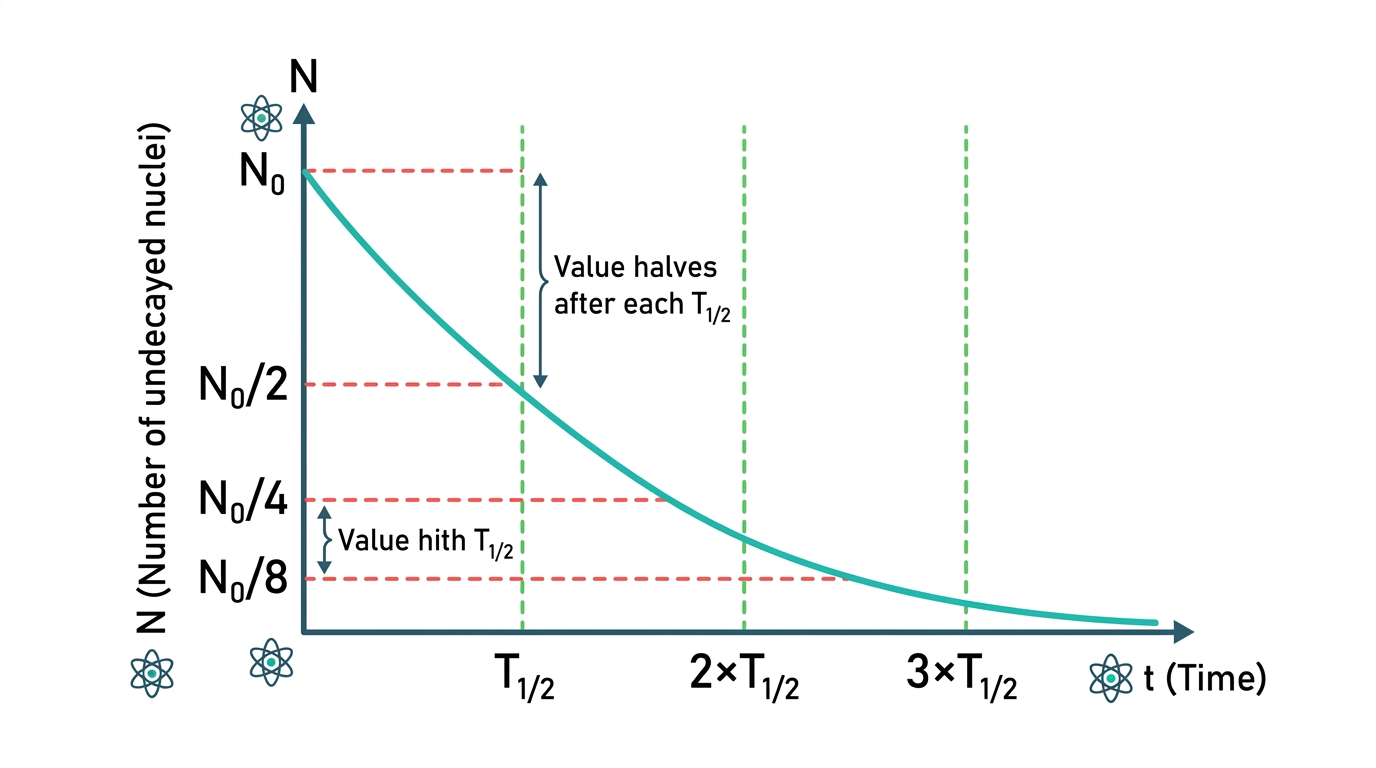
Because individual decays are random, a large sample is described statistically using the decay constant , the fixed probability of decay per second for each nucleus. Activity is the number of decays per second in becquerel, and both and fall exponentially, halving every half-life . After half-lives, the fraction remaining is .
Common mistake
Switching to per-second units while leaving in days. If you convert one, convert both — or keep everything in the same time unit throughout the calculation.
Why This Topic Is Really One Idea
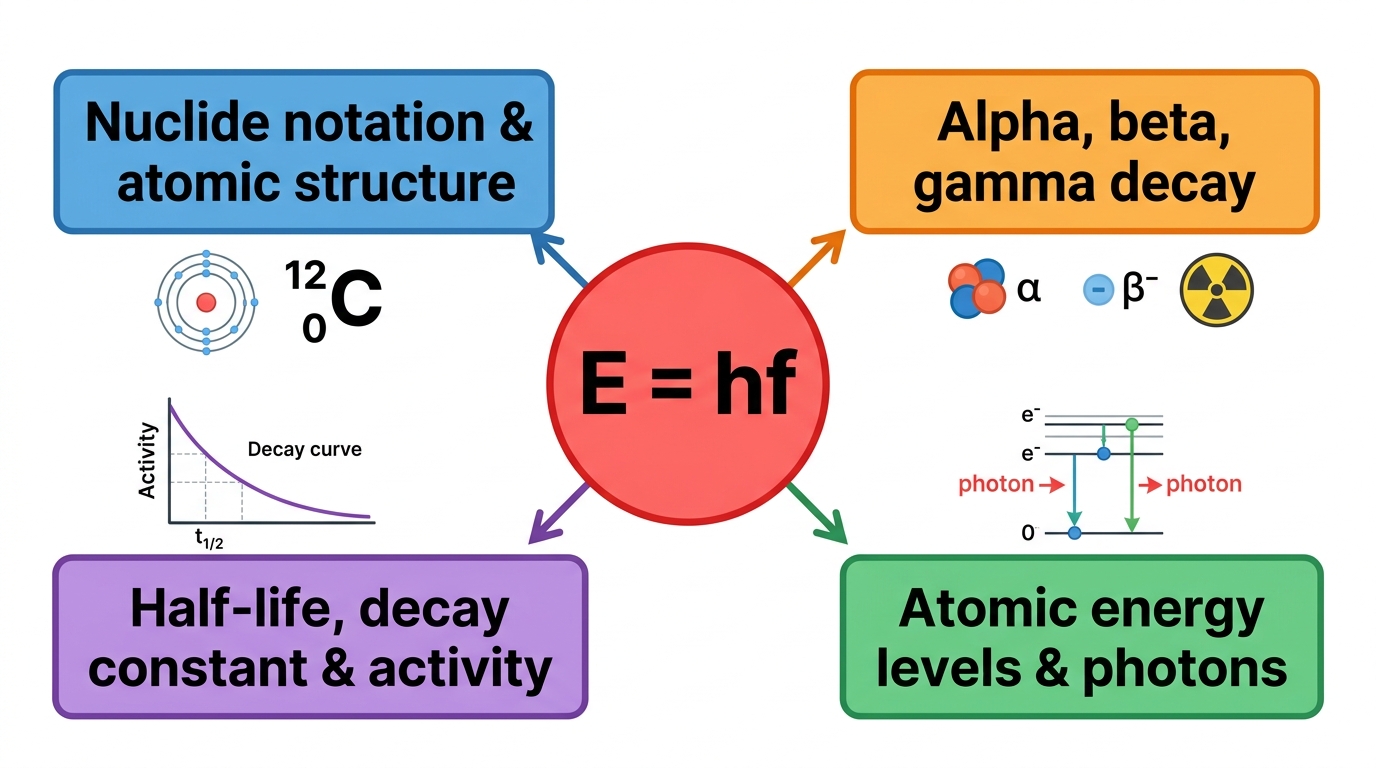
Nuclear equations, energy levels and half-life calculations are usually tested as separate skills, but they all trace back to conservation and quantisation: energy is conserved exactly, charge and nucleon number are conserved exactly, and both nuclei and atoms only release energy in fixed packets via . Seeing this connection makes the topic far less like a list of formulas to memorise.
Mini summary
Nuclear decay and atomic spectra both work through fixed, quantised energy release — the same ties every calculation together.
Quick formula sheet
Practice questions
- Write down the nuclide symbol for an isotope with 6 protons and 8 neutrons, and state its mass number.
- State the two key words examiners want when describing radioactive decay, and explain what each means.
- Using , state what happens to activity if the number of undecayed nuclei halves and stays constant.
- An electron falls from an energy level at to one at . Calculate the photon wavelength emitted.
- Write the full balanced equation for the beta-minus decay of , showing the daughter nuclide and identifying all emitted particles.
- A sample has a half-life of 5.0 days. What fraction of the original activity remains after 15 days?
- Explain, using conservation of energy and momentum, why beta particles are emitted with a continuous range of energies while alpha particles are not.
- An alpha particle with kinetic energy 5.5 MeV is fired head-on at a nucleus with . Estimate the distance of closest approach and comment on what this tells you about the nuclear radius.
- A radioactive sample has an initial activity of and a half-life of 12 days. Find the decay constant in and the activity after 30 days.
Frequently asked questions
What is the nuclide notation $^{A}_{Z}\text{X}$ used for in IB Physics?+
It compactly shows (nucleon/mass number), (proton/atomic number) and element symbol X. The neutron number is found from , and isotopes are nuclei with the same but different .
Why do atomic spectra consist of discrete lines rather than a continuous spread of colours?+
Electrons can only occupy fixed, discrete energy levels. A photon is only absorbed or emitted if its energy exactly matches the gap between two levels, so only specific frequencies (and wavelengths) ever appear.
What's the difference between alpha, beta and gamma decay?+
Alpha emits a helium nucleus, reducing by 4 and by 2. Beta-minus turns a neutron into a proton, increasing by 1 while stays the same. Gamma is a photon released as the nucleus de-excites, with no change to or .
Why do beta particles have a range of energies but alpha and gamma don't?+
Beta decay releases a third particle, the (anti)neutrino, which shares the available energy unpredictably with the beta particle, producing a continuous energy spectrum. Alpha and gamma emissions involve only two products, so energy conservation fixes a single sharp energy.
How are half-life and decay constant related?+
They're linked by : a shorter half-life means a larger decay constant, meaning each nucleus is more likely to decay per second.
What does the Rutherford gold foil experiment actually prove?+
Most alpha particles pass straight through the foil, showing atoms are mostly empty space, while a small fraction deflect at large angles, showing that a tiny, dense, positively charged nucleus concentrates most of the atom's mass and charge.
Get the Full Nuclear and Quantum Physics Revision Notes
Related articles