
Interaction and Interdependence: IB Biology's Big-Picture Theme
Enzymes, immunity, ecology and respiration all tested through the same lens of mechanism and control
Quick facts
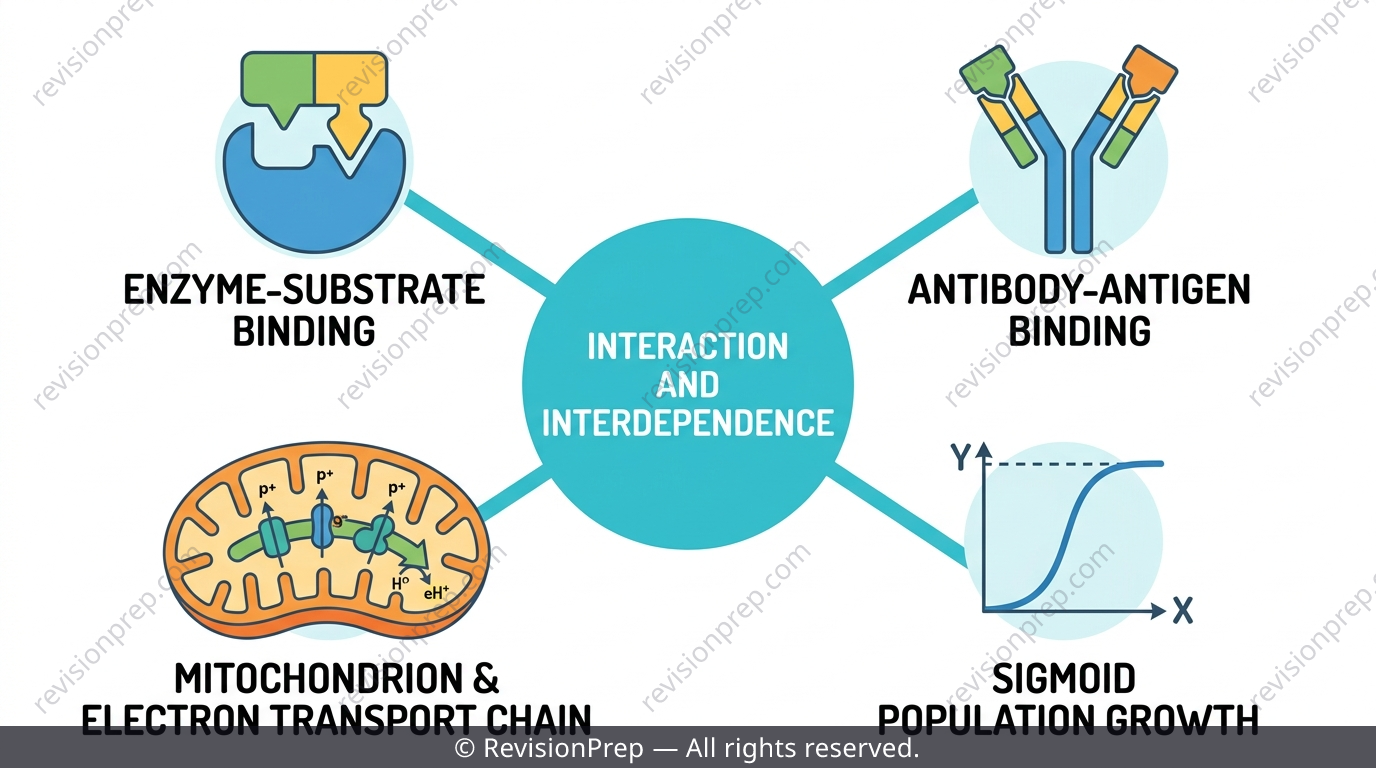
IB Biology's Interaction and Interdependence theme links four topics that look unrelated at first glance: enzymes and metabolism, defence against disease, populations and communities, and cell respiration. What connects them is a single exam-favourite question — what controls the rate and direction of a transfer? At the molecular scale that's enzyme kinetics; at the organism scale it's a specific immune response; at the ecosystem scale it's population growth hitting a limit. Examiners reward mechanism over description, so command terms like determine, compare and explain show up constantly. This revision guide breaks down the five most exam-critical ideas — Michaelis-Menten kinetics, enzyme inhibitors, specific vs innate immunity, the sigmoid population growth curve, and aerobic vs anaerobic respiration — with the common mistakes IB students actually make. For the full depth, worked examples and complete formula derivations, head to the full RevisionPrep notes.
What you’ll be able to do
Enzymes and Metabolism: Catalysis, Anabolism, Catabolism
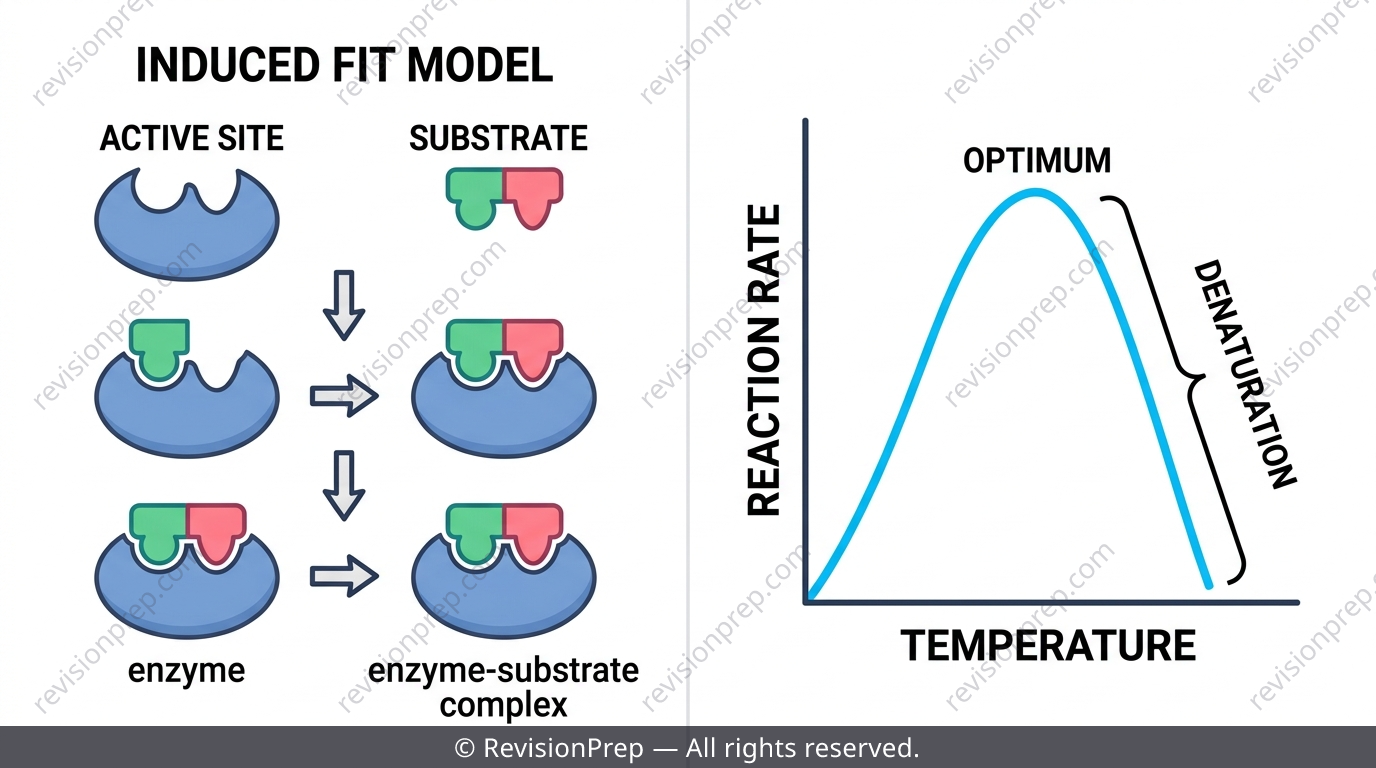
Metabolism is the sum of all cellular reactions, split into catabolism (breaking bonds, releasing energy, like respiration) and anabolism (forming bonds, consuming energy, like protein synthesis). Every step is enzyme-catalysed: the active site binds substrate via induced fit, lowering activation energy so reactions proceed far faster. Rate rises with temperature up to an optimum, then collapses as heat denatures the enzyme's tertiary structure; pH shifts disrupt the same bonds holding the active site's shape.
Common mistake
Calling glycogen synthesis catabolism because 'many small units are combined', or calling gluconeogenesis catabolic because ATP is used. Judge by direction of bond change: anabolic = subunits joined + energy consumed; catabolic = molecule broken down + energy released.
Mini summary
Anabolism builds and costs energy; catabolism breaks down and releases energy — never judge by molecule size alone.
Michaelis-Menten Kinetics and Inhibitors
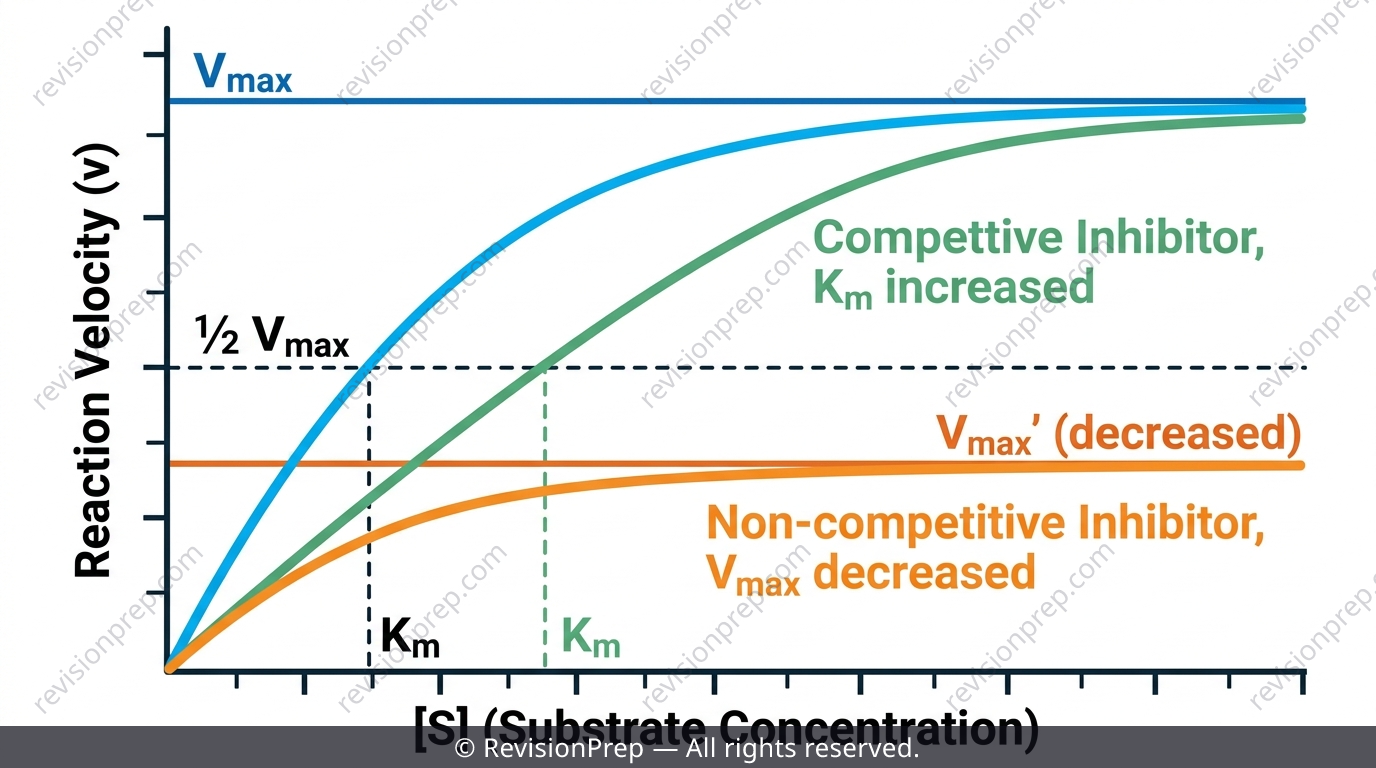
The Michaelis-Menten equation links reaction velocity to substrate concentration through (substrate concentration at half-maximal rate) and (the saturated rate). The single most-tested numerical fact: when . Competitive inhibitors raise but leave unchanged, since more substrate can still outcompete the inhibitor; non-competitive inhibitors lower while stays the same, because they block the active site regardless of substrate concentration.
| Inhibitor type | Effect on Km | Effect on Vmax |
|---|---|---|
| Competitive | Increases | Unchanged |
| Non-competitive | Unchanged | Decreases |
Exam tip
Translate inhibitor wording into 'Km up / Vmax same' or 'Km same / Vmax down' before checking answer options. Phrases like 'requires more substrate to reach half-max velocity' always mean Km increased.
Common mistake
Assuming rate and substrate concentration scale proportionally — the Michaelis-Menten curve saturates and never doubles once past the steep initial region.
Defence Against Disease: Innate vs Specific Immunity
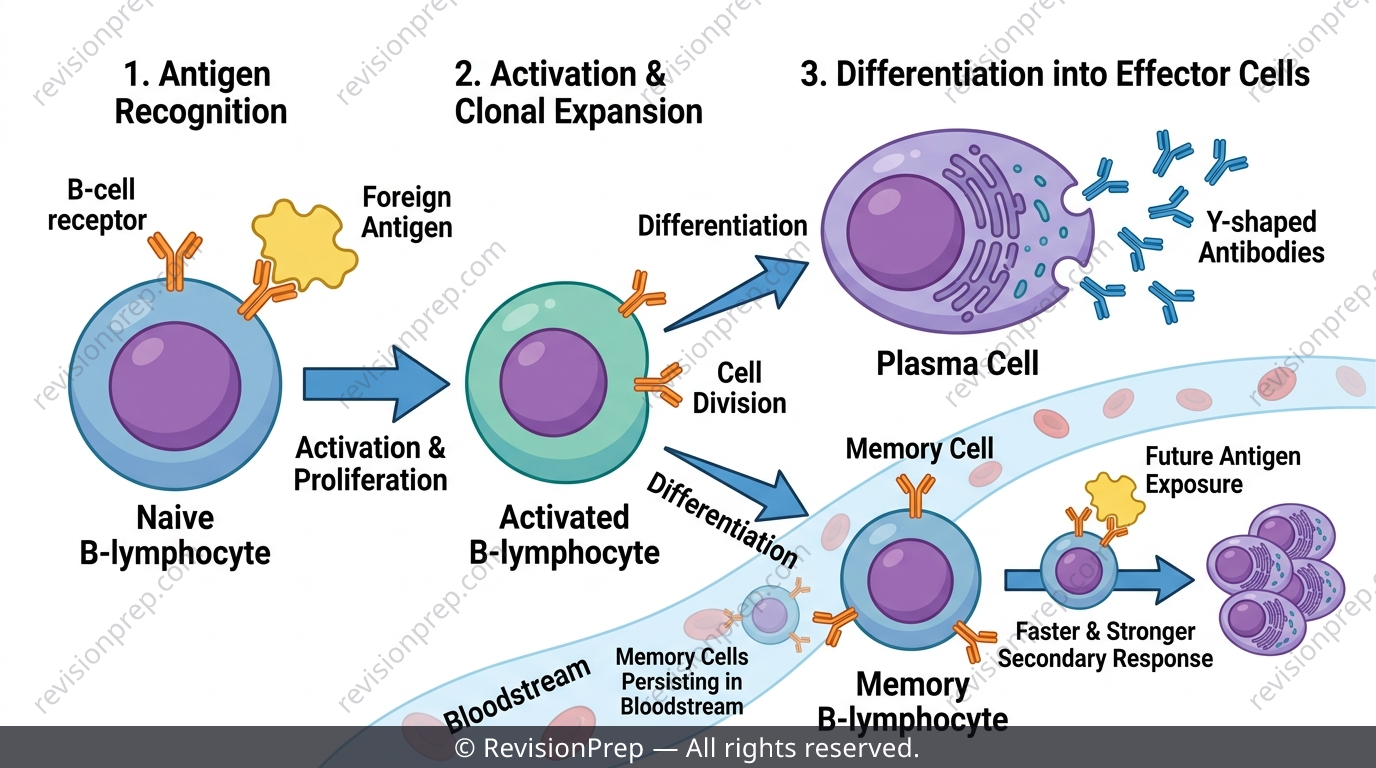
First-line defences like skin and mucous membranes stop most pathogens before infection; if breached, innate responses such as phagocytosis and inflammation act fast but non-specifically. Specific immunity is slower but targeted: B-lymphocytes recognise antigens and differentiate into plasma cells that secrete antibodies, and memory cells that enable a faster, stronger secondary response. Antibiotics disrupt bacterial cell walls or ribosomes, structures viruses simply don't have, which is why they can't treat colds, flu or HIV.
Common mistake
Saying antibiotics can treat viral infections, or that antibiotic resistance makes the person resistant. Resistance evolves in the bacterial population through natural selection, not in the human host.
Mini summary
Innate = fast and non-specific; specific = slower but targeted, with memory cells giving lasting protection — this is exactly how vaccination works.
Populations and Communities: The Sigmoid Growth Curve
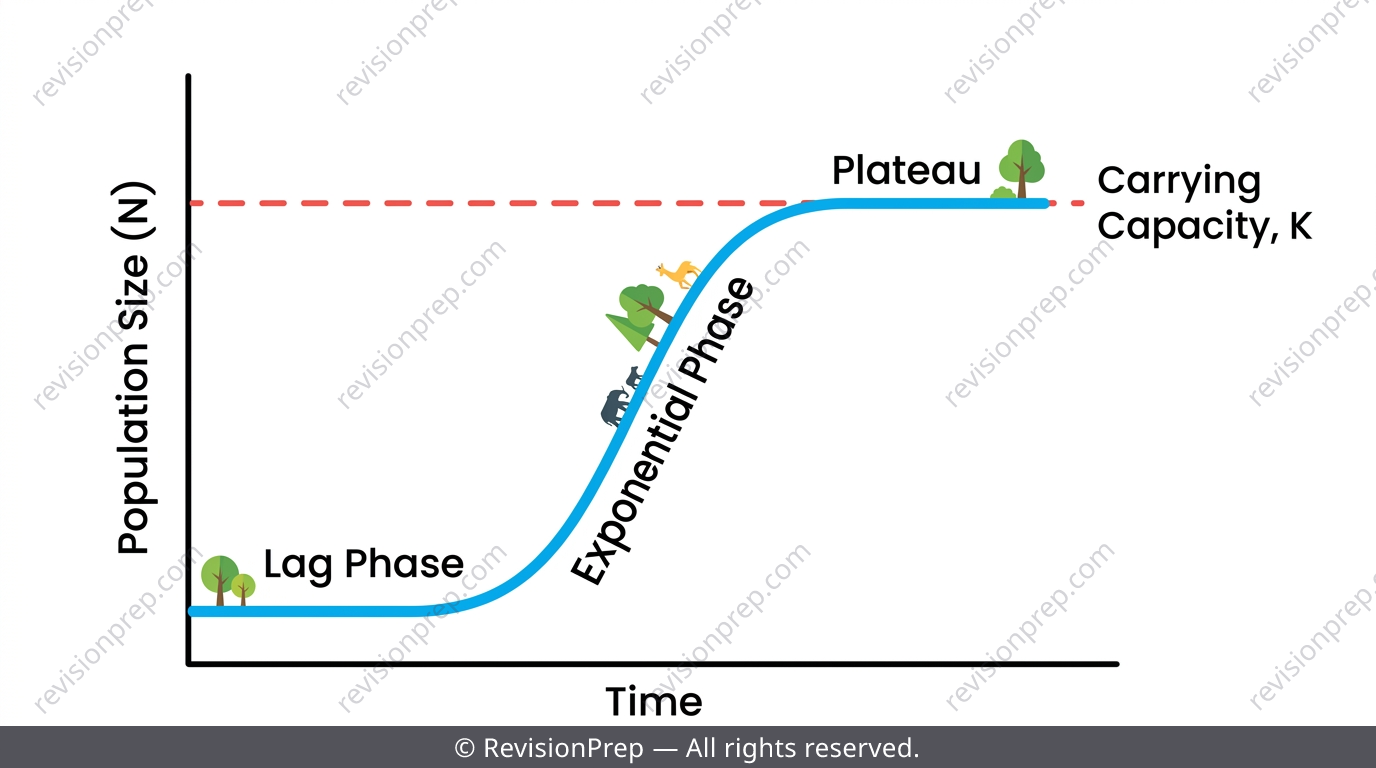
A population grows in a new environment along a sigmoid curve: a slow lag phase, a rapid exponential phase, then a plateau at the carrying capacity (K) — the maximum population a habitat's resources can sustain. Density-dependent factors like food, disease and predation intensify as numbers rise, slowing growth as it approaches K. Growth rate is the gradient of the curve, not its height, so it peaks mid-exponential phase and falls to near zero at K even though population size (N) is greatest there.
Exam tip
Don't confuse the highest point on the N-vs-time curve with the highest growth rate — growth rate is steepest mid-exponential, not at K.
Common mistake
Treating K as a fixed number for a species regardless of habitat. K is set by the resources of that specific habitat and shifts if conditions change, e.g. drought lowers K.
Cell Respiration: Aerobic vs Anaerobic Pathways
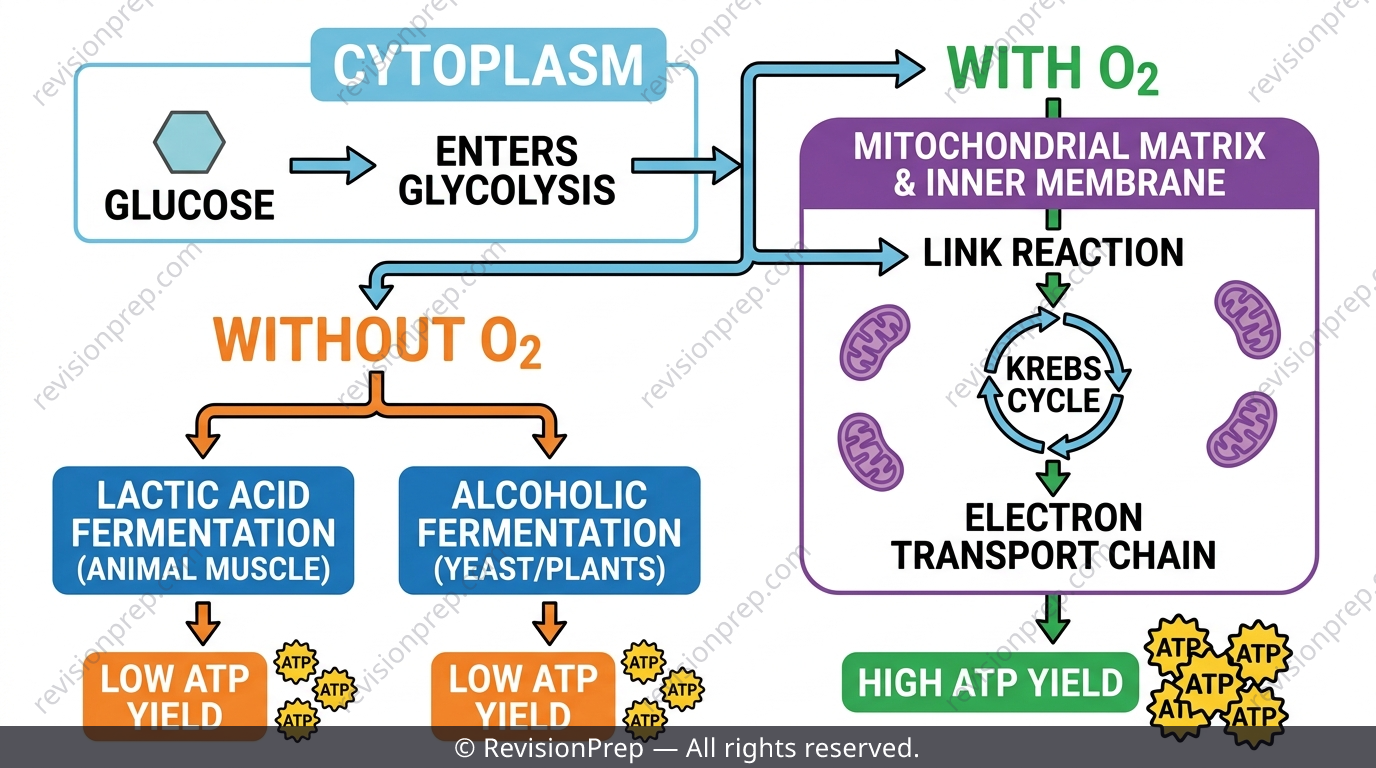
Cell respiration releases chemical energy from organic molecules to make ATP. Aerobic respiration proceeds through glycolysis in the cytoplasm, the link reaction and Krebs cycle in the mitochondrial matrix, and oxidative phosphorylation on the inner mitochondrial membrane, where oxygen is the final electron acceptor and most ATP is produced. When oxygen is unavailable, anaerobic pathways regenerate NAD+ so glycolysis can continue — lactic acid fermentation in animal muscle, or alcoholic fermentation (ethanol + CO2) in yeast and plants — but yield far less ATP per glucose, making anaerobic respiration a stopgap rather than an efficient alternative.
| Pathway | Location | O2 required? | End product |
|---|---|---|---|
| Aerobic respiration | Cytoplasm + mitochondria | Yes | CO2 + H2O, high ATP yield |
| Lactic acid fermentation | Cytoplasm (muscle) | No | Lactate, low ATP yield |
| Alcoholic fermentation | Cytoplasm (yeast/plants) | No | Ethanol + CO2, low ATP yield |
Common mistake
Forgetting that anaerobic pathways exist purely to regenerate NAD+ for glycolysis to continue, not as an efficient energy source in their own right.
Quick formula sheet
Practice questions
- Define Km and explain what a low Km value tells you about enzyme-substrate affinity.
- State one difference between innate and specific immune responses.
- Name the three phases of the sigmoid population growth curve.
- An enzyme's Km is 1.0 mM. At what substrate concentration is the reaction rate equal to half of Vmax?
- Explain why vaccination provides longer-lasting protection than passive immunity.
- Explain why the population growth rate is close to zero at carrying capacity even though N is at its maximum there.
- A competitive inhibitor is added to an enzyme reaction. Predict and justify the resulting changes to Km and Vmax on a Michaelis-Menten graph.
- A student claims doubling [S] from 2Km to 4Km should roughly double the reaction rate. Evaluate this claim using the shape of the Michaelis-Menten curve.
- Compare the ATP yield and end products of aerobic respiration with lactic acid fermentation, and explain why anaerobic respiration cannot sustain long-term energy needs.
Frequently asked questions
What is the difference between Km and Vmax?+
Km is the substrate concentration at which the reaction rate is half of Vmax (a low Km means high enzyme-substrate affinity), while Vmax is the maximum rate reached when all active sites are saturated with substrate.
How do competitive and non-competitive inhibitors differ?+
Competitive inhibitors compete with substrate for the active site, raising Km but leaving Vmax unchanged. Non-competitive inhibitors bind elsewhere, lowering Vmax while Km stays the same.
Why can't antibiotics treat viral infections?+
Antibiotics work by disrupting bacterial structures like cell walls or ribosomes, which viruses don't have, so they have no target to act on in a viral infection.
What is carrying capacity in ecology?+
Carrying capacity (K) is the maximum population size a habitat can sustain given its available resources; it's set by that specific habitat and can shift if conditions like food or water availability change.
Why is anaerobic respiration less efficient than aerobic respiration?+
Anaerobic pathways only regenerate NAD+ to keep glycolysis running and yield far less ATP per glucose molecule than the full aerobic pathway through the Krebs cycle and electron transport chain.
How does HIV lead to AIDS-related deaths?+
HIV specifically destroys helper T-cells, which coordinate the specific immune response, so AIDS patients typically die from opportunistic infections rather than from HIV itself.
Get the full Interaction and Interdependence revision notes
Related articles