
Chemical Reactions and the Periodic Table
Metals, non-metals, the periodic table's logic, and how to spot a real chemical change — MYP 1 foundations explained.
Quick facts
Chemical Reactions and the Periodic Table is the unit every later MYP chemistry topic builds on, and it shows up constantly in Criterion A and C data-based tasks. You'll be handed a table of densities, melting points or costs and asked to identify, describe or compare — not recite a definition. This teaser walks through the five ideas that matter most: how metals and non-metals differ physically, how the periodic table's groups and periods predict behaviour, why some metals rust while others stay shiny for centuries, how to spot genuine chemical change, and the exam-table trap that costs the most marks. Master these five and you're set up for every future MYP chemistry unit, from bonding to acids and bases. For the full breakdown, worked examples and complete property tables, the linked revision notes go much deeper than this overview.
What you’ll be able to do
Metals vs Non-Metals: The Properties That Matter
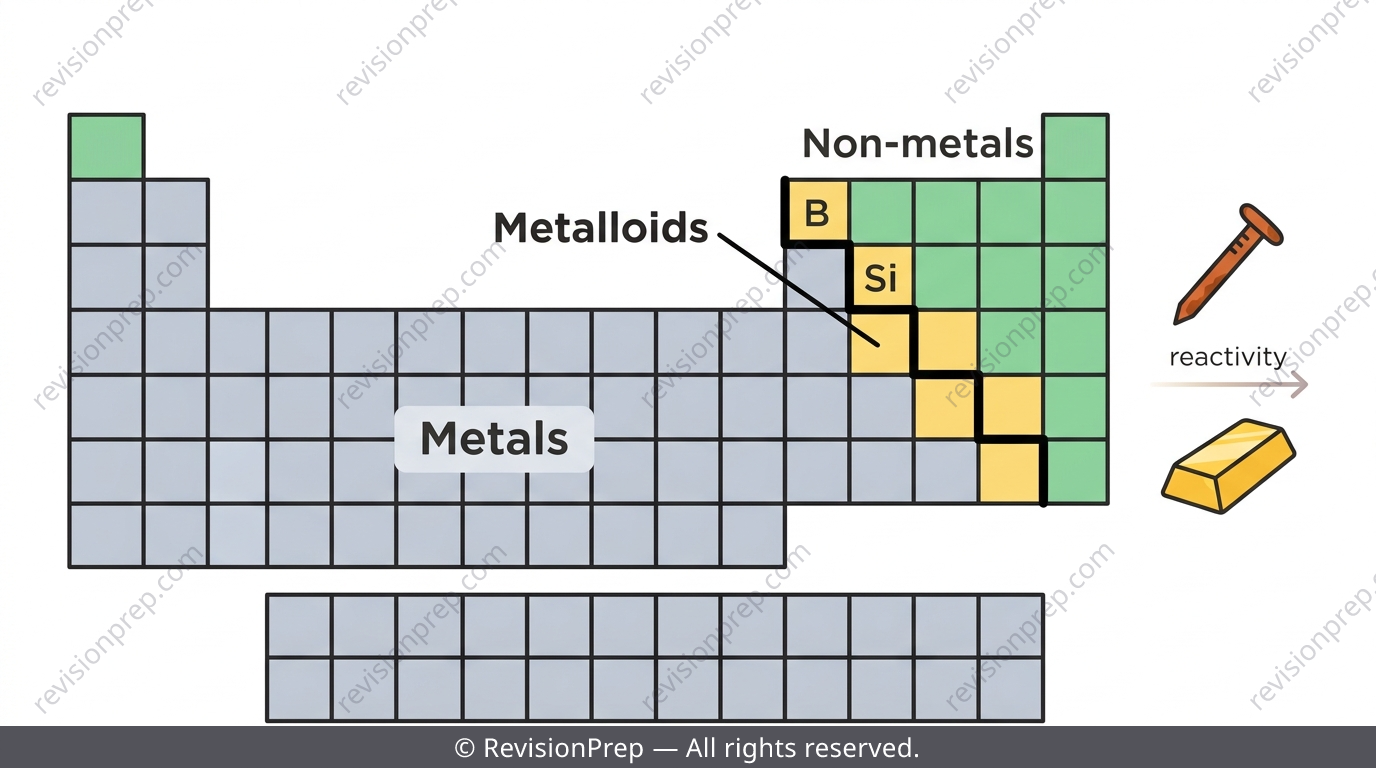
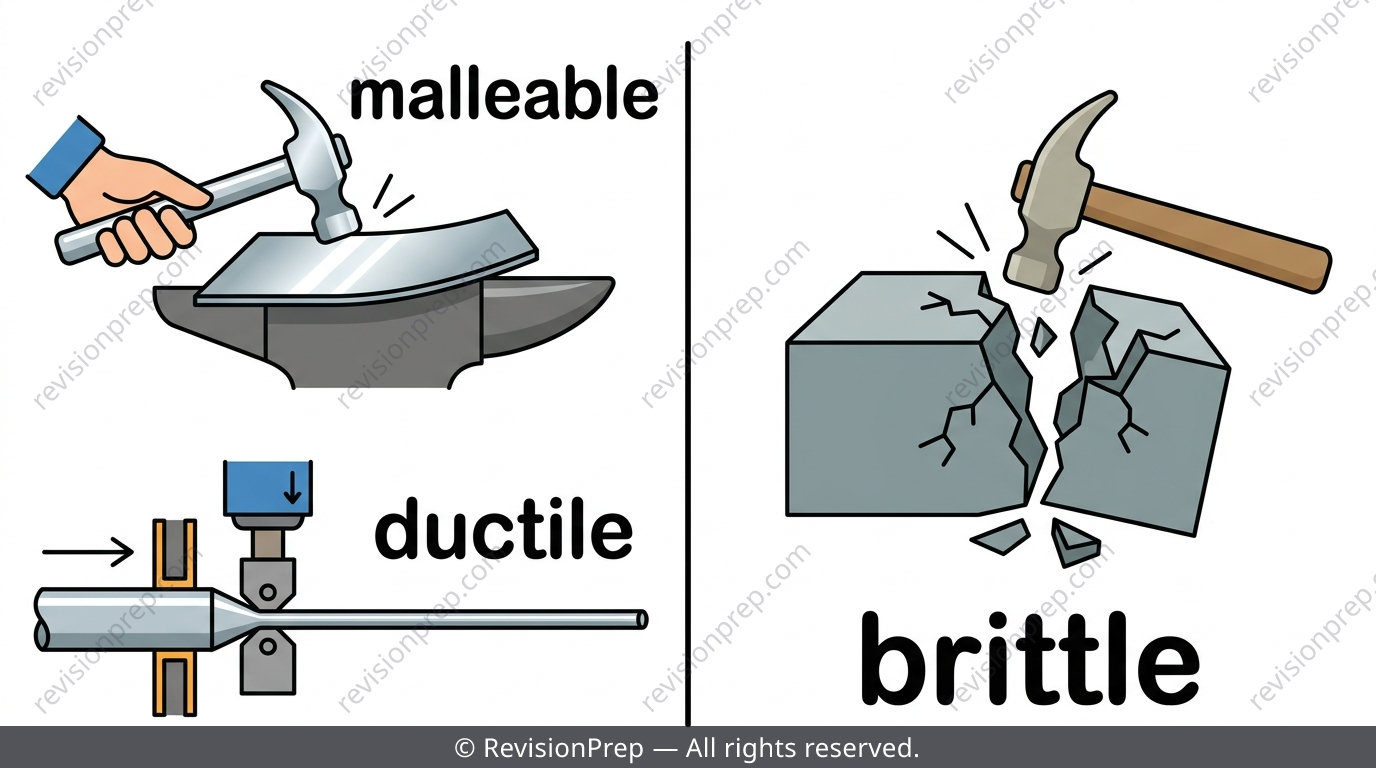
About three-quarters of all elements are metals, and they share a predictable set of physical properties: malleable, ductile, lustrous, sonorous, and good conductors of heat and electricity, usually with high density and high melting point. Non-metals tend to be dull, brittle, poor conductors, and generally lower density — though exceptions like carbon (melting at 3550°C) exist. Exam questions reward the exact word: 'strong' or 'good' isn't a property, but 'malleable' or 'ductile' is.
| Property | Metals | Non-metals |
|---|---|---|
| Malleability | Malleable (bends into sheets) | Brittle (shatters) |
| Appearance | Lustrous when cut | Usually dull |
| Conductivity | Good conductors | Usually poor conductors |
| Density/melting point | Generally high | Generally lower (with exceptions) |
Exam tip
For 'identify' [1 mark], just name the property. For 'describe' [2 marks], name it AND link it to the specific job — leaving out the 'because...' caps you at half marks even with the right property named.
Common mistake
Confusing malleable with ductile, or answering a 'suitability' question with a reactivity fact (e.g. 'aluminium doesn't rust') when the mark scheme is looking for a physical property like low density.
Mini summary
Metals: malleable, ductile, lustrous, sonorous, conductive, dense. Non-metals: dull, brittle, poor conductors — but always check exceptions before generalising.
The Periodic Table: Groups, Periods and Zones
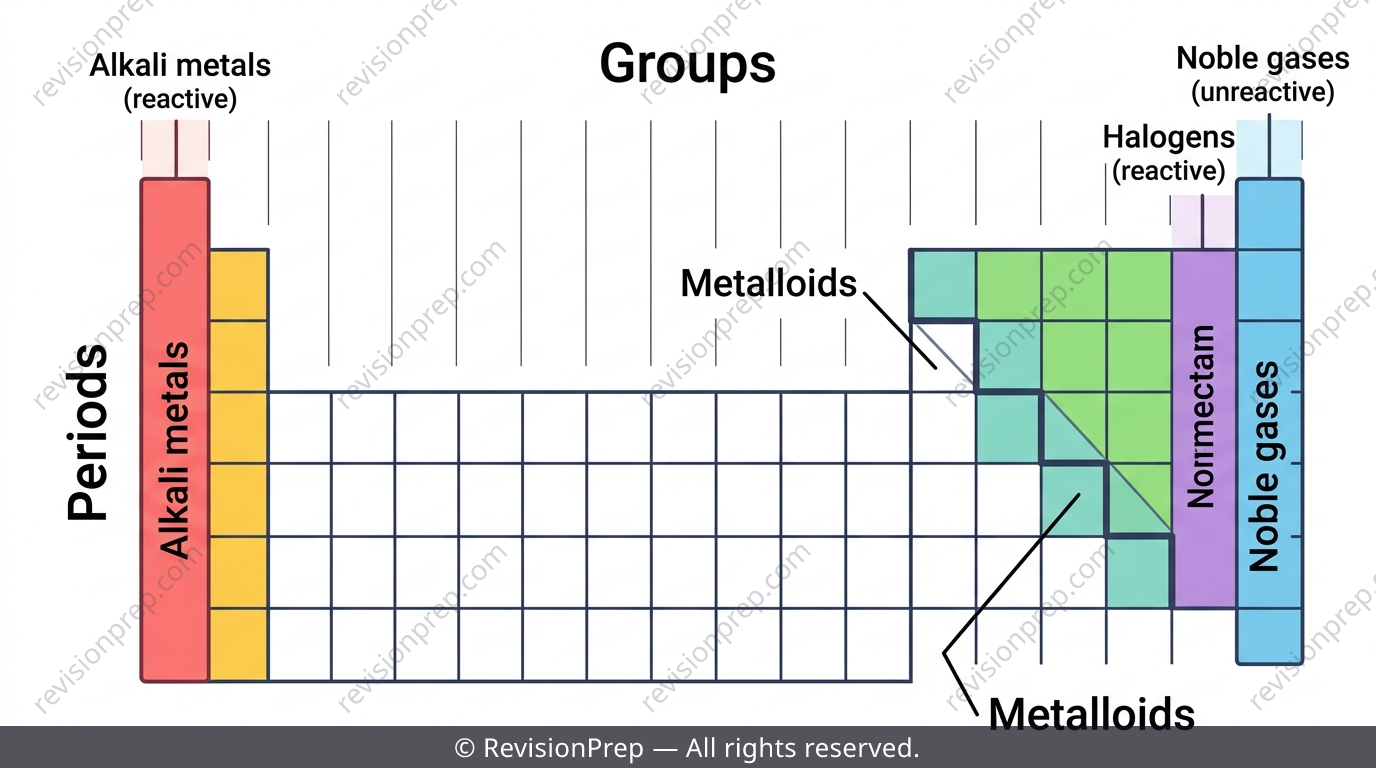
The periodic table is arranged by increasing atomic number so elements with similar properties line up in the same vertical group — because they share the same number of valence electrons. Horizontal periods show a gradual shift from metallic (left) to non-metallic (right). A thin diagonal staircase of metalloids like silicon and boron sits between the metal and non-metal blocks, showing properties of both.
Exam tip
If asked to 'name the group', give the chemical family name (alkali metals, halogens, noble gases) rather than just the number, when the question calls for it.
Common mistake
Swapping groups and periods. Remember: groups stand tall and vertical (same GROUP, same properties); periods are short horizontal rows, like a full stop at the end of a line.
Mini summary
Groups (columns) = similar properties via shared valence electrons. Periods (rows) = gradual metal-to-non-metal shift. Metalloid staircase separates the two blocks.
Reactivity: Why Some Metals Rust and Others Don't
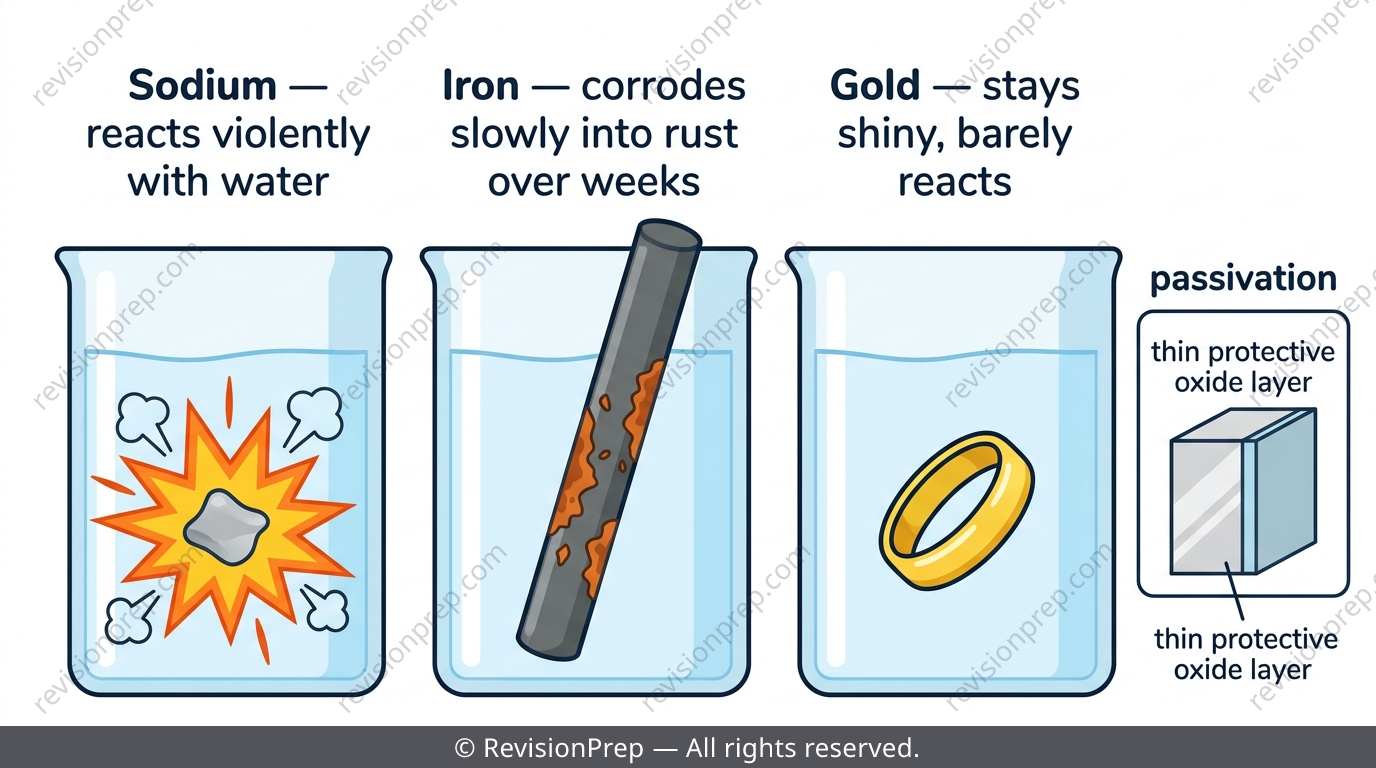
Reactivity is how readily an element reacts with oxygen, water or acid — sodium and potassium react violently, iron and zinc corrode slowly, and gold or platinum barely react at all. Oxidation is a reaction with oxygen to form an oxide; corrosion is the gradual damage this causes, and rust is specifically iron's hydrated iron(III) oxide. Aluminium is a special case: it reacts almost instantly with oxygen to form a paper-thin oxide layer that seals the surface, so it doesn't visibly rust even though it IS reacting — this is called passivation.
Exam tip
If a question asks why a metal 'doesn't rust', check whether it's genuinely unreactive (like gold) or protected by passivation (like aluminium) — these are different explanations and mark schemes distinguish them.
Common mistake
Assuming aluminium simply 'doesn't react' with oxygen — it does react, just so fast and thinly that the oxide layer protects it from further damage.
Mini summary
Reactive metals corrode fast; passivated metals (aluminium) react once and then stop; unreactive metals (gold, platinum) barely react at all.
Spotting a Real Chemical Change
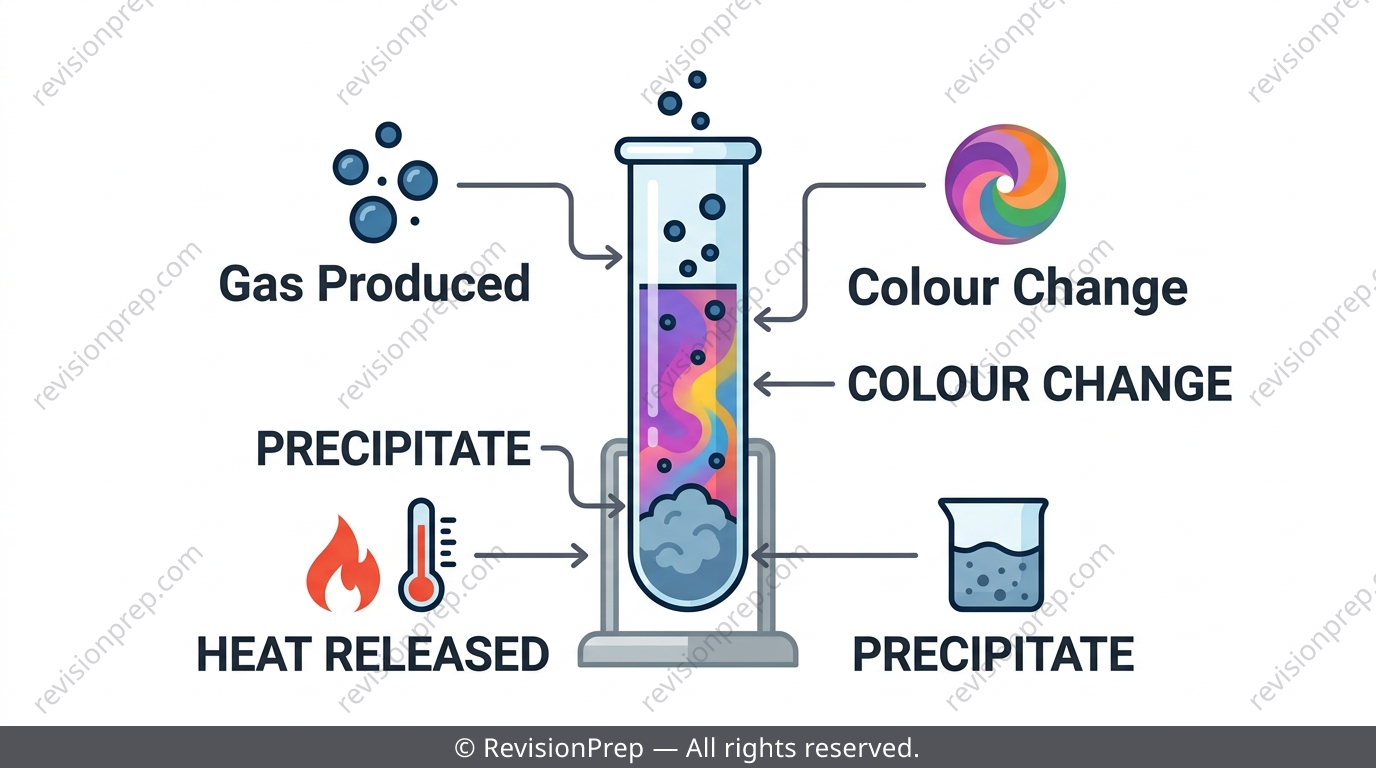
Chemical changes are identified by evidence: gas produced, colour change, a precipitate forming, or heat given off or absorbed. The hard test that separates chemical from physical change is reversibility — can you get the original substance back using simple physical means (like evaporating water from a solution)? If not, a new substance has formed and the change is chemical.
Mini summary
Look for gas, colour change, precipitate or heat as evidence — then ask 'can I physically reverse this?' to confirm it's chemical.
Reading Data Tables Without Overgeneralizing
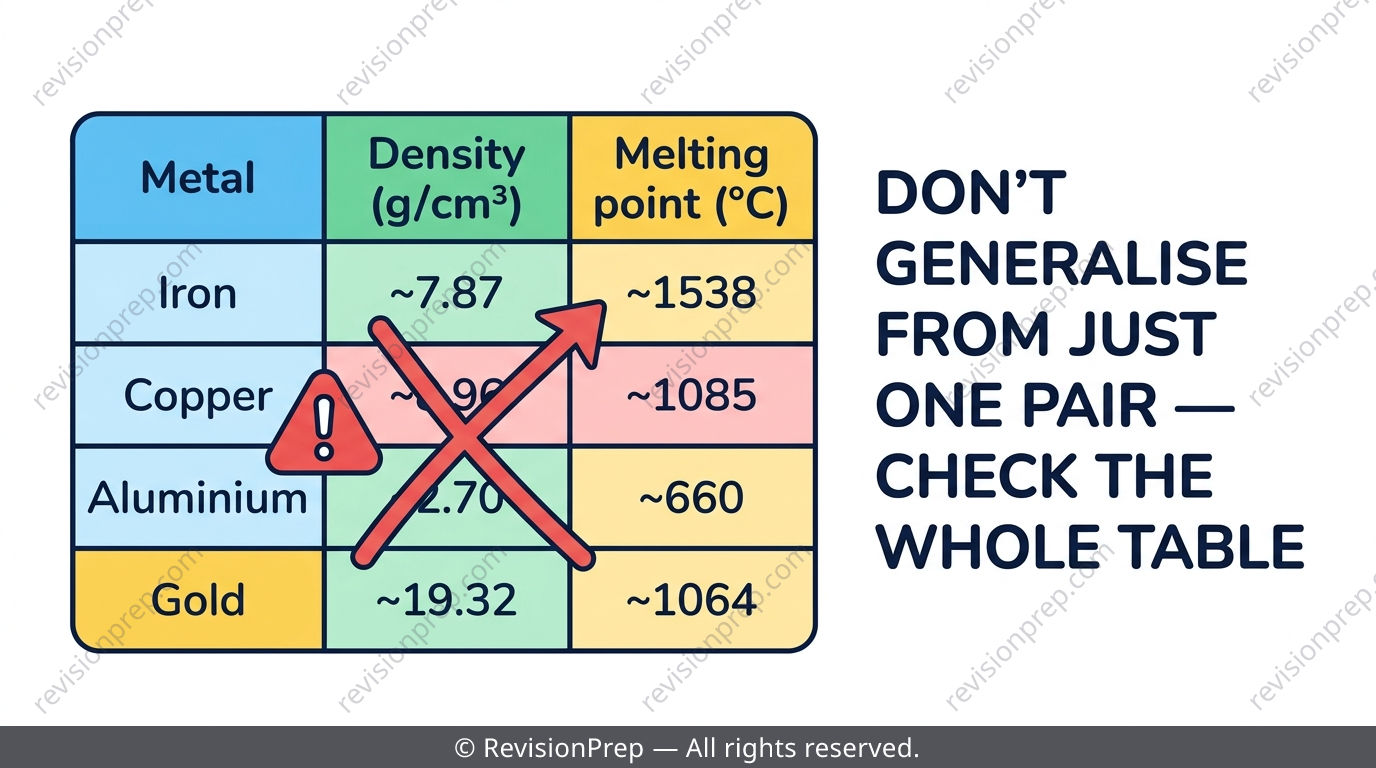
MYP chemistry questions almost always hand you a table of real values — melting points, densities, costs — and the biggest trap is spotting a trend in one convenient pair and writing it as a universal rule. Carbon melting at 3550°C instantly breaks any claim that 'metals always have higher melting points than non-metals.' Always check a claimed trend against the whole table, not just the two values that happen to agree with you.
Exam tip
When asked to 'describe what the data shows,' scan every row before writing your answer, and phrase your claim tied to the specific substances given rather than as a universal law.
Common mistake
Generalising a trend (like 'density down = melting point down') from one lucky pair of metals instead of checking it holds across the entire table.
Mini summary
Never write a general law from partial data — tie every claim to the specific substances in the table you were given.
Quick formula sheet
Practice questions
- Name three physical properties typical of metals.
- What is the difference between a group and a period in the periodic table?
- Give one piece of evidence that suggests a chemical reaction has occurred.
- Explain why gold jewellery stays shiny while an iron nail rusts in the same environment.
- Using the metalloid staircase, explain why silicon has properties of both metals and non-metals.
- Describe why aluminium does not visibly rust even though it reacts with oxygen.
- A data table shows carbon melting at 3550°C while several metals melt below 1500°C. Explain why this means you cannot claim 'metals always have higher melting points than non-metals.'
- Compare iron and sulfur as materials for a cooking pot using melting point data, and justify your choice.
- Explain why picking only one pair of values from a table to support a density–melting point trend is a weak argument, and describe what a stronger answer would check instead.
Frequently asked questions
What's the easiest way to remember groups vs periods?+
Groups are vertical columns that stand tall — same GROUP, same properties. Periods are short horizontal rows, like a full stop at the end of a line.
Why doesn't aluminium rust like iron does?+
Aluminium reacts with oxygen almost instantly, forming a thin oxide layer that seals the surface and stops further reaction — this is called passivation. It IS reacting, just not visibly corroding like iron.
Are metalloids metals or non-metals?+
Neither exactly — metalloids like silicon and boron sit on the diagonal staircase between the metal and non-metal blocks and show a mix of properties from both.
How do I know if a change is chemical, not just physical?+
Look for evidence like gas, colour change, a precipitate, or heat given off. The definitive test is whether you can get the original substance back using simple physical means — if not, it's a chemical change.
Why is it wrong to say 'metals always have higher melting points than non-metals'?+
Carbon, a non-metal, melts at 3550°C — higher than most metals. Always check a claimed trend against the whole data table, not just a convenient pair of values.
What's the difference between 'identify' and 'describe' in exam questions?+
'Identify' means simply name the property for the mark. 'Describe' means name the property AND explain the specific consequence — skipping the 'because' caps your marks even if the property is correct.
Get the complete MYP 1 Chemical Reactions and Periodic Table notes
Related articles