
Geometry – Coordinates and Transformations
The Cartesian plane, ordered pairs, quadrants and reflections explained the way MYP 1 examiners actually test them
Quick facts
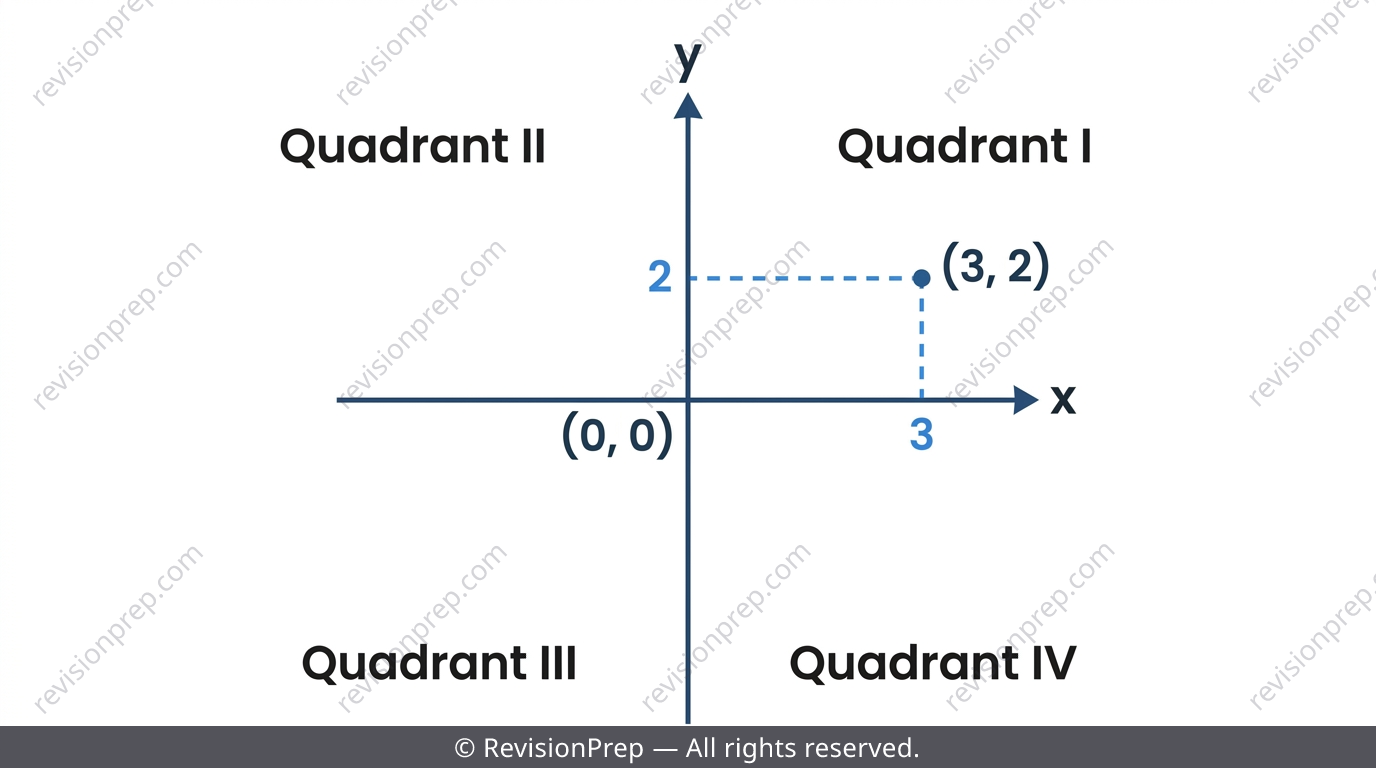
Every later coordinate geometry topic in MYP maths — graphing lines, transformations, even GPS-style problem solving — depends on one foundational idea: the Cartesian plane. It's simply two number lines placed at right angles, letting you describe any position with two numbers instead of a vague description. This teaser covers the five things you must have automatic before a unit test: the x-axis and y-axis, why order matters in an ordered pair, how the four quadrants get their sign patterns, and the two most commonly tested transformations — reflecting a point across the x-axis or y-axis. These ideas sound simple, but MYP examiners specifically target the order-swap error and the reflection mix-up, so getting the details precise now saves marks for years. The full revision notes go deeper with worked traps, a quadrant sign-pattern table and a grid-map comparison.
What you’ll be able to do
The Cartesian Plane: Axes and Origin
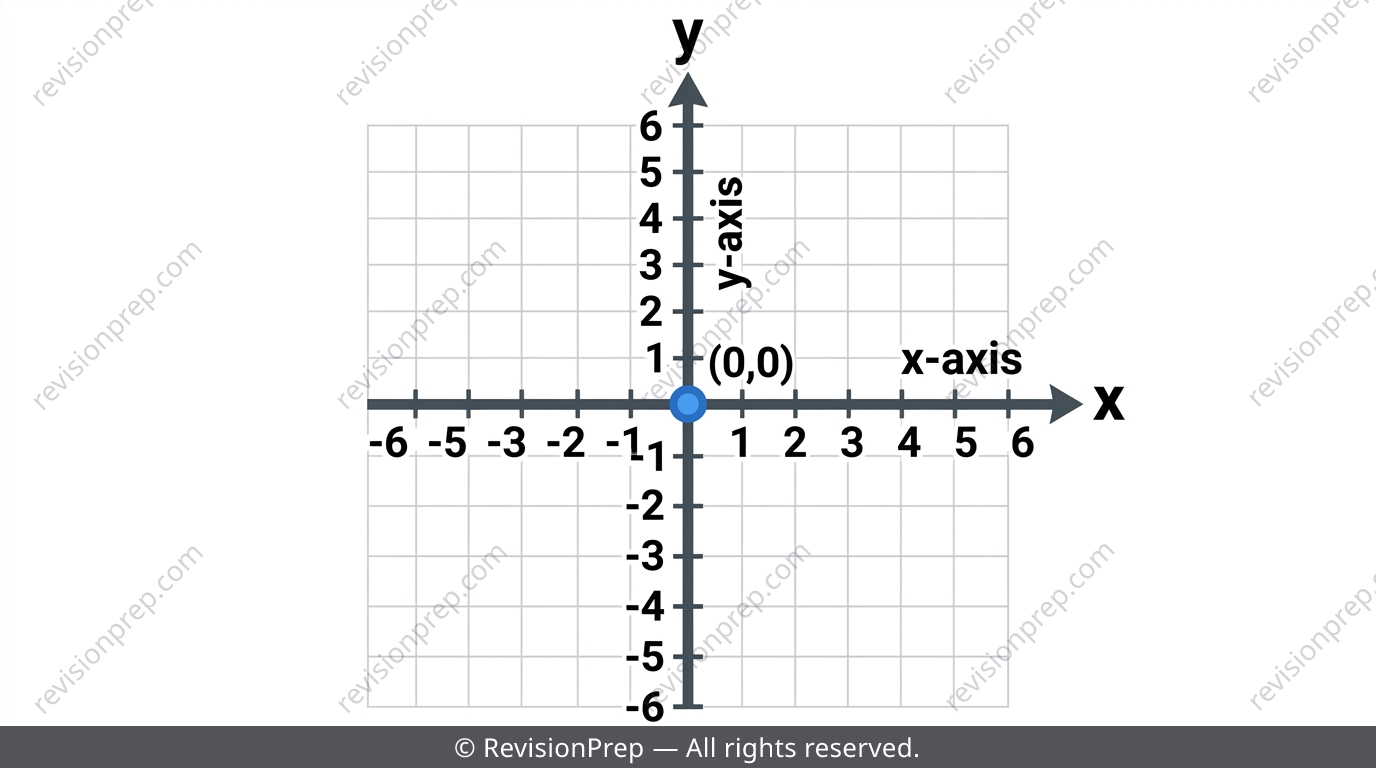
The Cartesian plane is built from two perpendicular number lines: the horizontal -axis and the vertical -axis. They cross at one fixed point, the origin — it isn't just 'the middle of the picture', it's a mathematically defined location wherever the plane is drawn. Positive means right, negative means left; positive means up, negative means down.
Exam tip
Always align a point with the gridline itself, not the nearest number label, when reading off coordinates — a slight misalignment shifts your whole answer by one unit.
Ordered Pairs: Why Order Matters
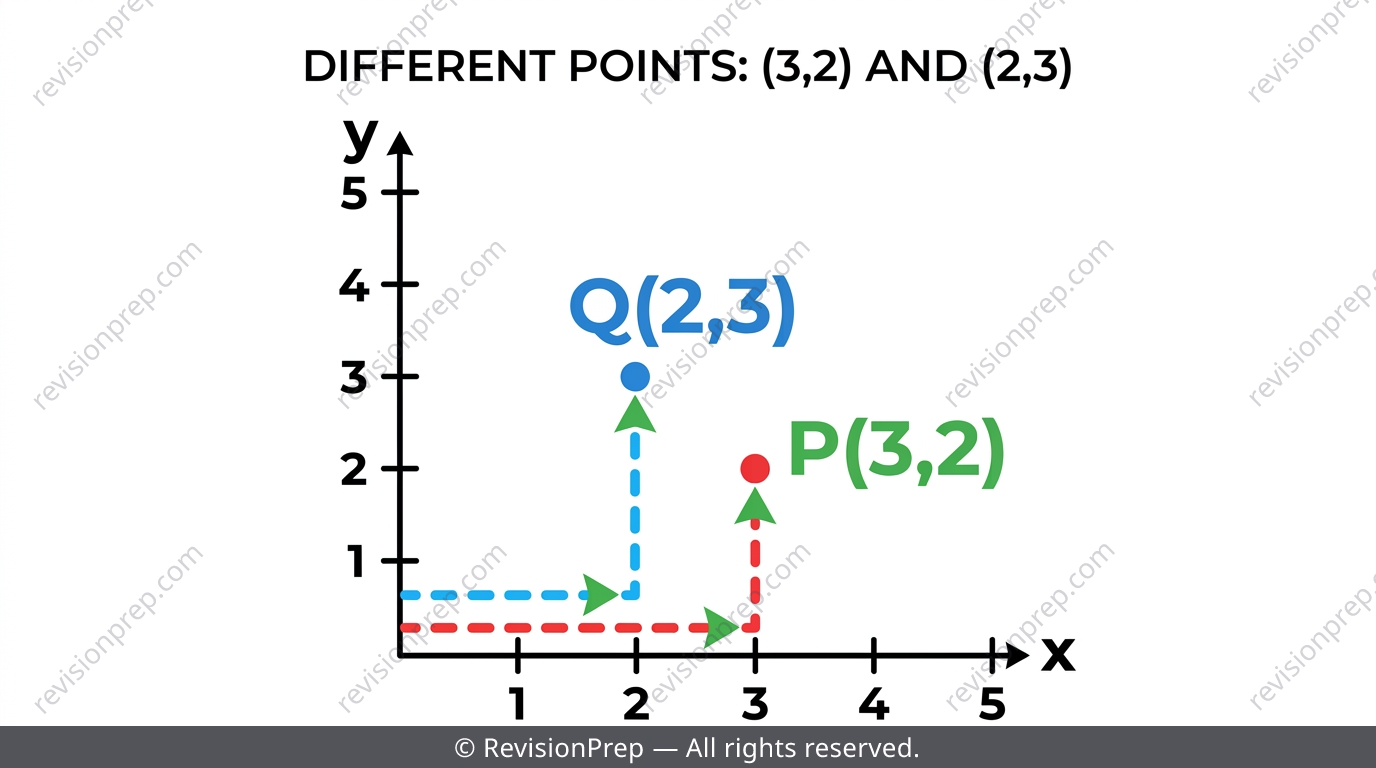
An ordered pair fixes exactly one point: the first number is always the horizontal movement, the second is always vertical. means '3 units along, then 2 units up' — never the reverse. Swapping the order gives a completely different point, even though both numbers are 'technically' present.
Exam tip
Say it out loud as 'along, then up' — never 'up, then along' — to lock in the correct order every time.
Common mistake
Writing the y-value first or describing the vertical movement before the horizontal one — e.g. calling 'up 2, right 3' and then writing .
Quadrants and Sign Patterns
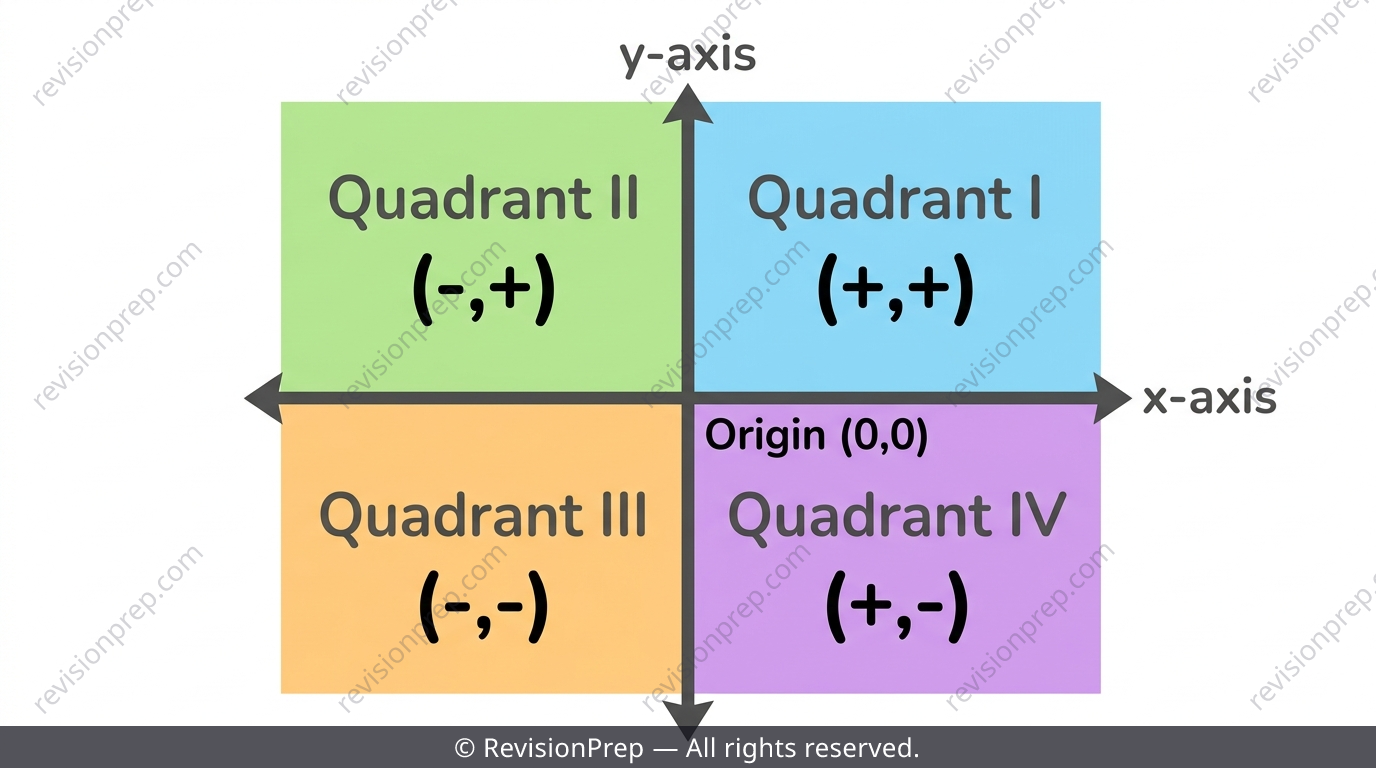
The two axes divide the plane into four quadrants, numbered I to IV going anticlockwise starting from the top-right, where both and are positive. Each quadrant has a fixed sign pattern for its coordinates, which lets you name a point's quadrant instantly just from its signs. A point sitting exactly on an axis, like or , is not inside any quadrant and is not the origin.
| Quadrant | x-sign | y-sign | Example point |
|---|---|---|---|
| I | (3, 2) | ||
| II | (-3, 2) | ||
| III | (-3, -2) | ||
| IV | (3, -2) |
Mini summary
Quadrants run I–IV anticlockwise from the top-right; points on an axis belong to neither.
Reflecting Points Across the Axes
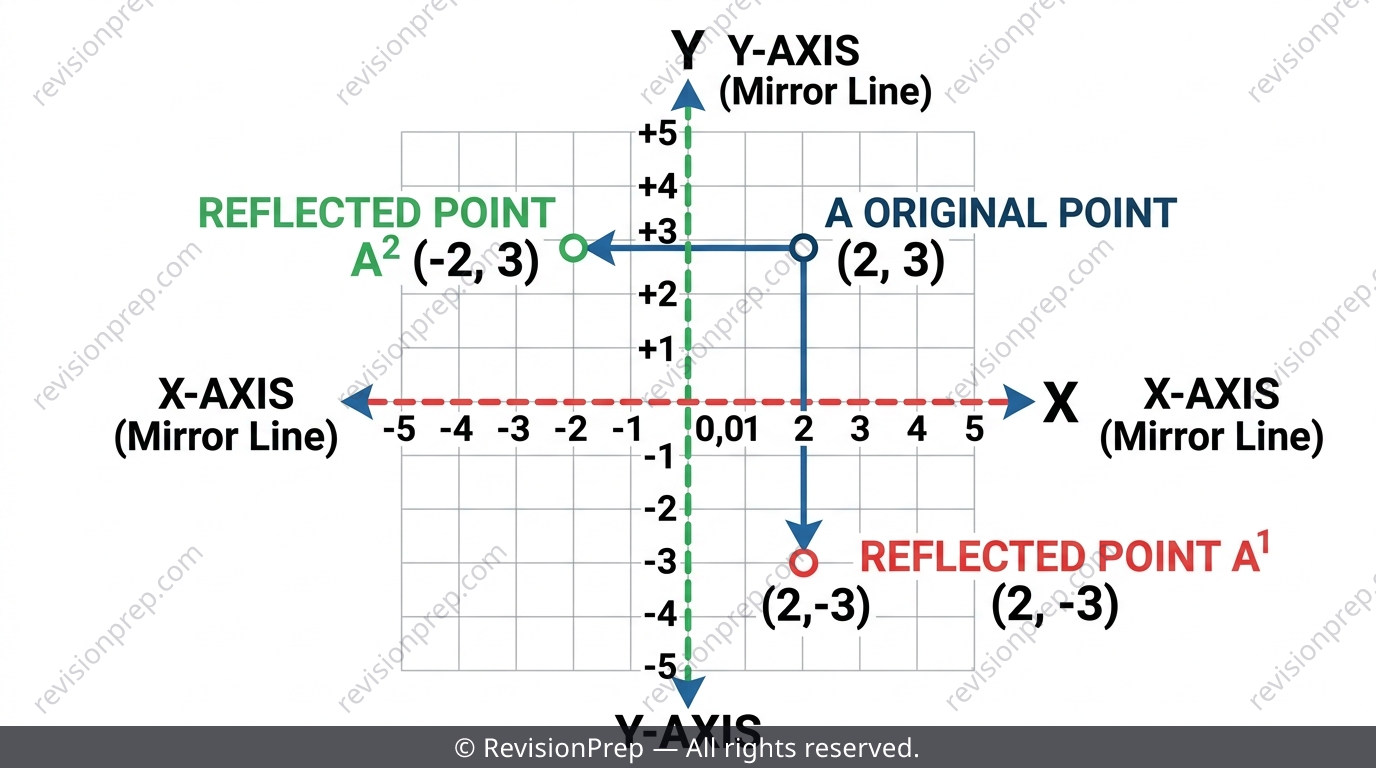
Reflecting a point across the -axis flips only the -coordinate's sign: . Reflecting across the -axis flips only the -coordinate's sign: . It's tempting to flip both coordinates, but each rule changes exactly one sign, matching the axis you're reflecting across.
Common mistake
Flipping the x-coordinate when reflecting across the x-axis (or vice versa for the y-axis) — that rule belongs to the other mirror line entirely, and mixing them up usually costs both marks.
Describing Coordinates Precisely
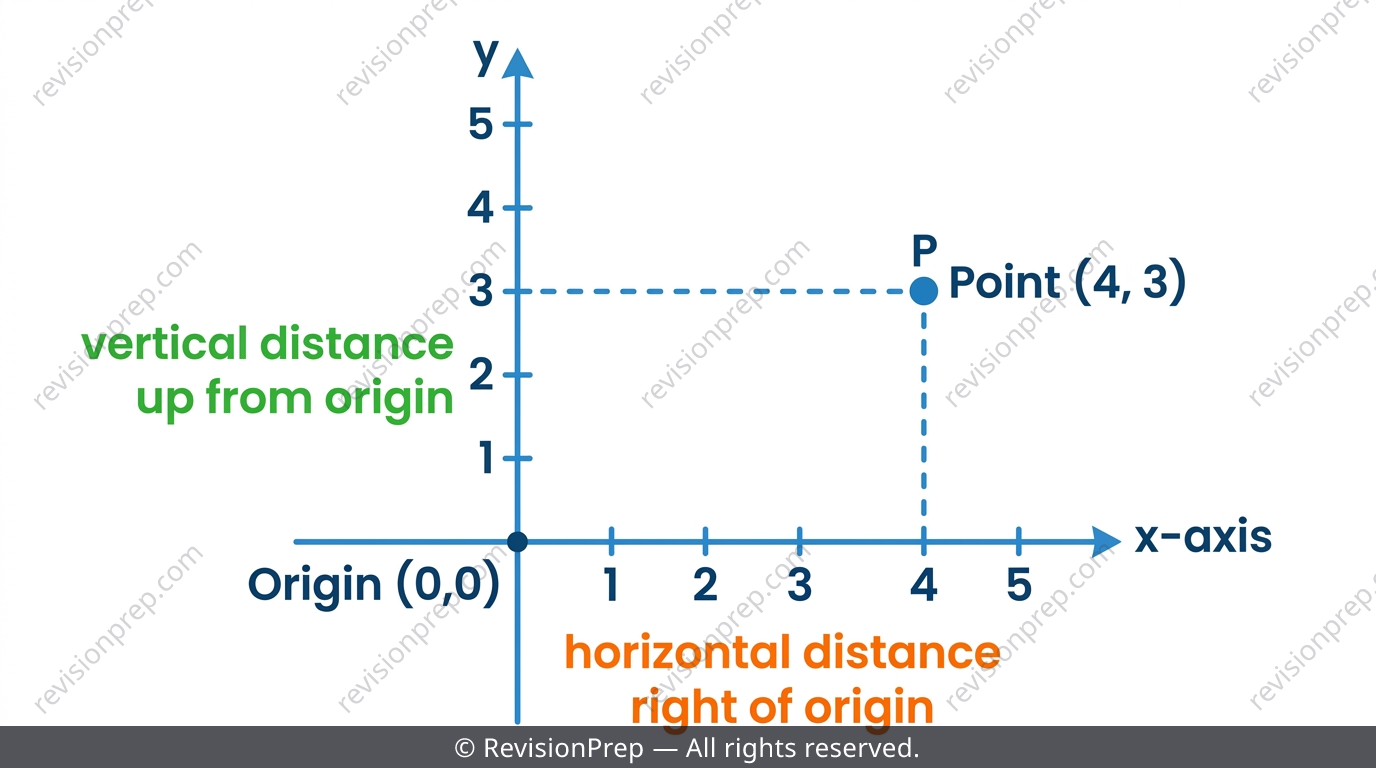
When a question uses the command term 'Describe', simply stating the coordinates isn't enough — you need to explain what each number physically represents: distance right of the origin, then distance up from the origin. This is exactly how examiners award the AO2 mark beyond basic identification.
Exam tip
For 'Describe' questions, always pair the numbers with their meaning: '3 units right of the origin, 2 units up from the origin' — not just 'x=3, y=2'.
Quick formula sheet
Practice questions
- State the coordinates of the origin.
- Which quadrant contains the point ?
- Is the point inside a quadrant? Explain.
- Point is reflected across the x-axis. Find the new coordinates.
- Point is reflected across the y-axis. Find the new coordinates.
- A point is 5 units left and 2 units down from the origin. Write its ordered pair.
- Points and are given. Describe the transformation that maps to .
- A student claims the point 6 units up and 1 unit right of the origin is . Explain the error and give the correct coordinates.
- Triangle with vertices , and is reflected across the y-axis. Find all three new vertices.
Frequently asked questions
What is the difference between the x-axis and the y-axis?+
The x-axis is the horizontal number line and controls left-right position; the y-axis is the vertical number line and controls up-down position. They cross at the origin.
Why does the order of numbers in an ordered pair matter?+
The first number is always the horizontal (x) movement and the second is always the vertical (y) movement. Swapping them, like writing instead of , gives a completely different point.
Is a point on an axis part of a quadrant?+
No. Points like or sit exactly on an axis and are not counted as being inside any of the four quadrants.
How do I reflect a point across the x-axis versus the y-axis?+
Reflecting across the x-axis flips only the y-coordinate's sign: . Reflecting across the y-axis flips only the x-coordinate's sign: . Never flip both.
How are quadrants numbered on the Cartesian plane?+
Quadrants are numbered I to IV going anticlockwise, starting from the top-right region where both x and y are positive.
What should I include when a question asks me to 'describe' coordinates?+
State what each number physically represents — the distance right of the origin and the distance up from the origin — not just the bare numbers, to earn full marks.
Master coordinates and transformations with the full MYP 1 revision notes
Related articles