
Energy Forms and Transfer
Master conservation of energy, heat transfer and resources for your MYP 2 Sciences unit test
Quick facts
Energy forms and transfer is one of the most tested topics in IB MYP 2 Sciences, showing up in both Criterion A knowledge checks and Criterion C efficiency or transformation calculations. The good news is that almost every question — bouncing balls, swinging pendulums, heat moving through a pan — comes back to the same handful of ideas: the law of conservation of energy, the three heat transfer mechanisms (conduction, convection, radiation), and the split between renewable and non-renewable resources. Examiners love catching students who write that energy is 'lost' or that nuclear power is 'renewable because it's clean' — both are traps this guide helps you avoid. Below are the five concepts that appear most often in unit tests, with the formulas, common mistakes, and exam tips you need before diving into the full revision notes for complete worked examples.
What you’ll be able to do
Energy Forms, Transfer and Transformation
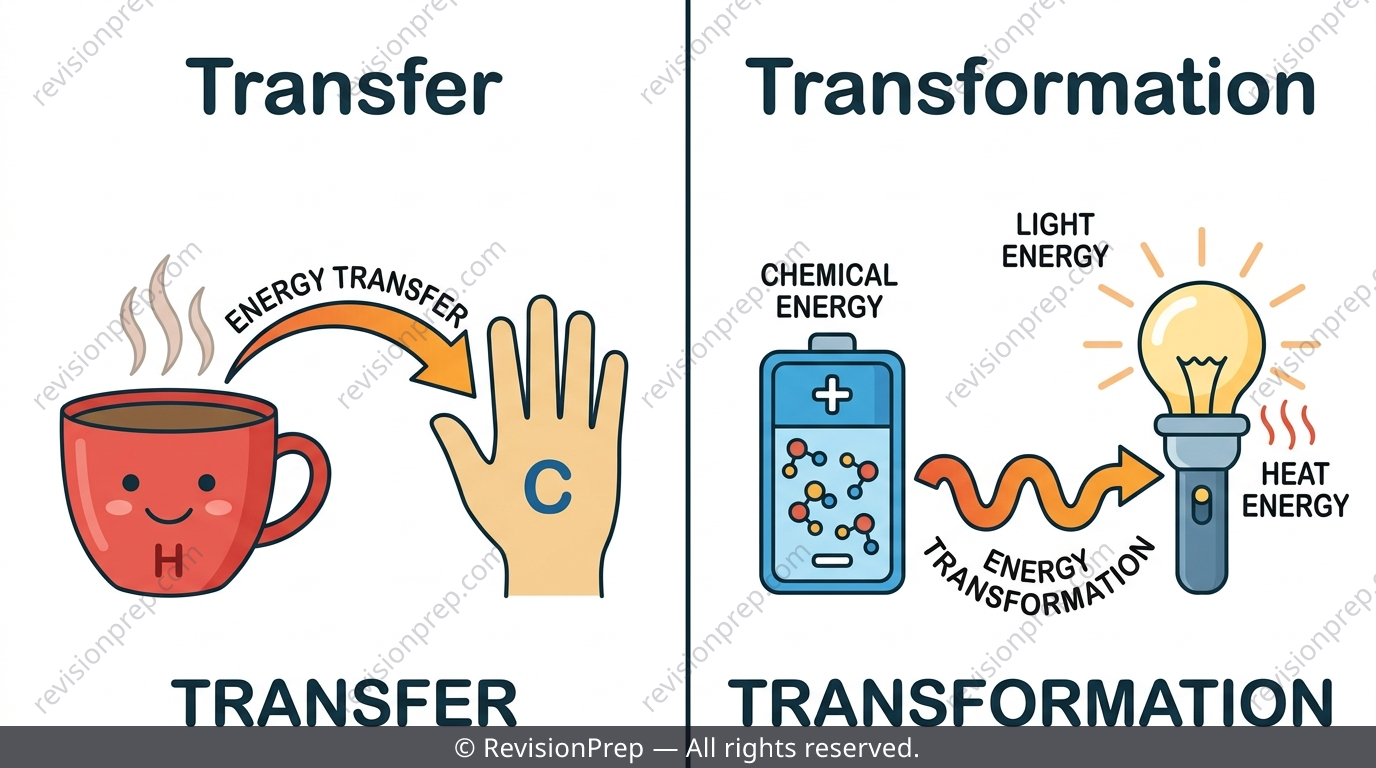
Energy exists in several recognisable forms and can move between objects (transfer) or change identity (transformation), but it always keeps its total amount fixed. Almost every exam question in this unit is really asking you to track energy through a process and name exactly where it ended up, rather than letting it vaguely 'disappear'.
Exam tip
If a question shows energy changing during a process, expect it to ask you to name the specific form it became — not just describe that a change happened.
Mini summary
Energy transfers between objects or transforms between forms, but the total never changes.
The Law of Conservation of Energy
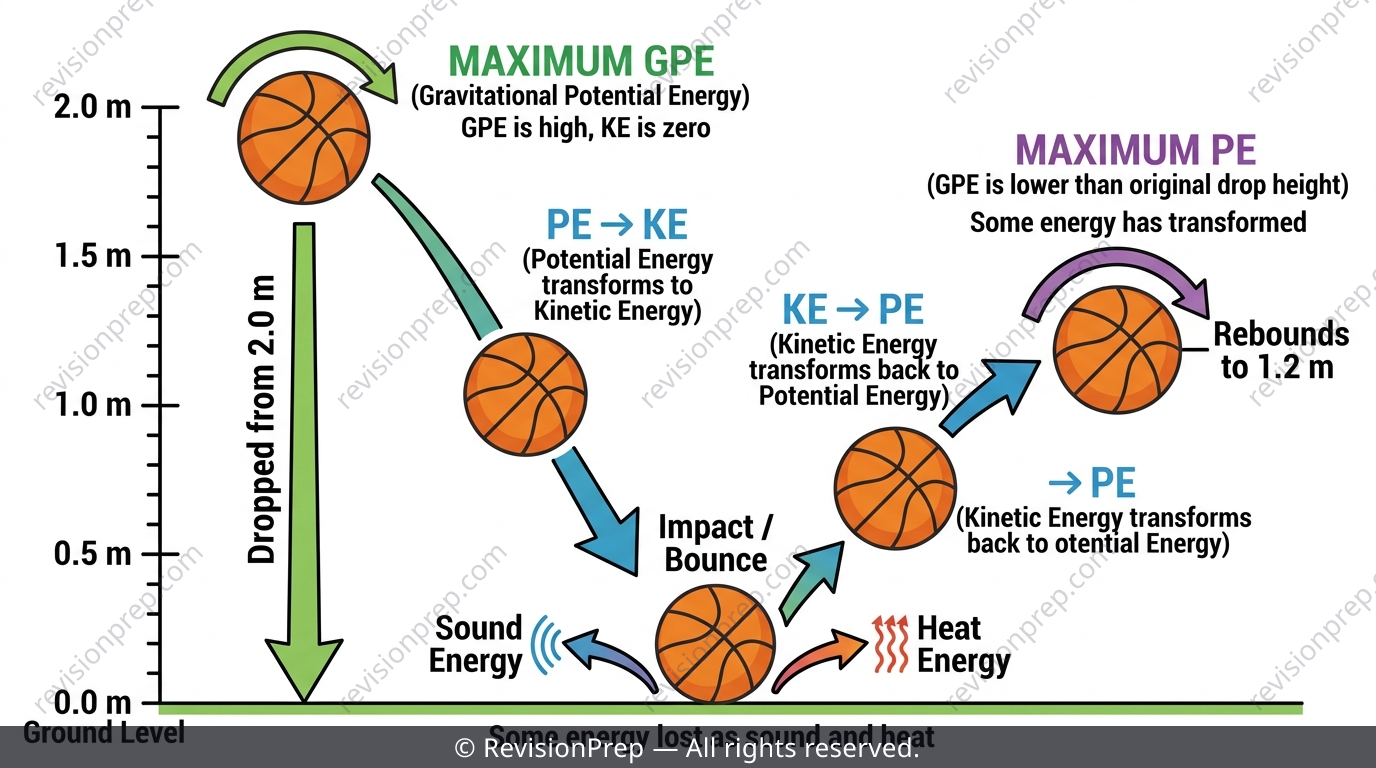
The total energy in a closed system never changes — only its form does. A dropped ball loses height on each bounce not because energy vanishes, but because some of it transforms into sound and heat at the point of impact, which are hard to measure and no longer useful for tracking the ball's motion.
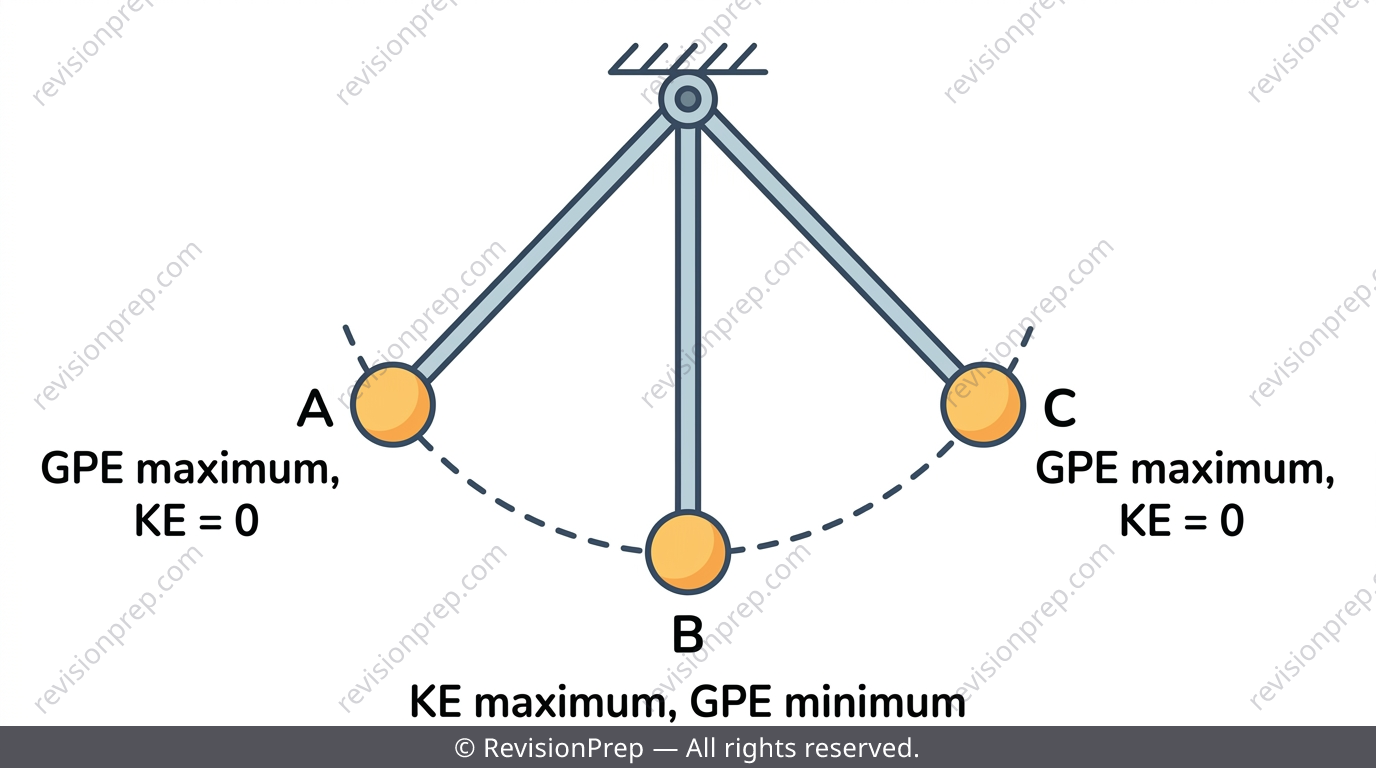
| Position | Dominant Energy Form |
|---|---|
| Highest point (start or turning point) | Gravitational potential energy (GPE) maximum |
| Lowest point (fastest motion) | Kinetic energy (KE) maximum |
Exam tip
When asked to 'state the law of conservation of energy', write the one-sentence definition and stop. Save scenario-specific reasoning for the explain or compare part that follows.
Common mistake
Writing that a ball or swing 'loses energy' or 'energy is used up'. Always finish the sentence with the specific form it transformed into — sound, heat, or another named form.
Mini summary
Total energy in a closed system is constant; GPE is greatest at turning points, KE is greatest at the fastest point.
Heat Transfer: Conduction, Convection, Radiation
Heat always flows from hotter to colder regions, but the mechanism depends entirely on what material is available. Conduction needs touching particles in a solid, convection needs a fluid that can physically circulate, and radiation needs no medium at all — it's the only way the Sun's energy reaches Earth.
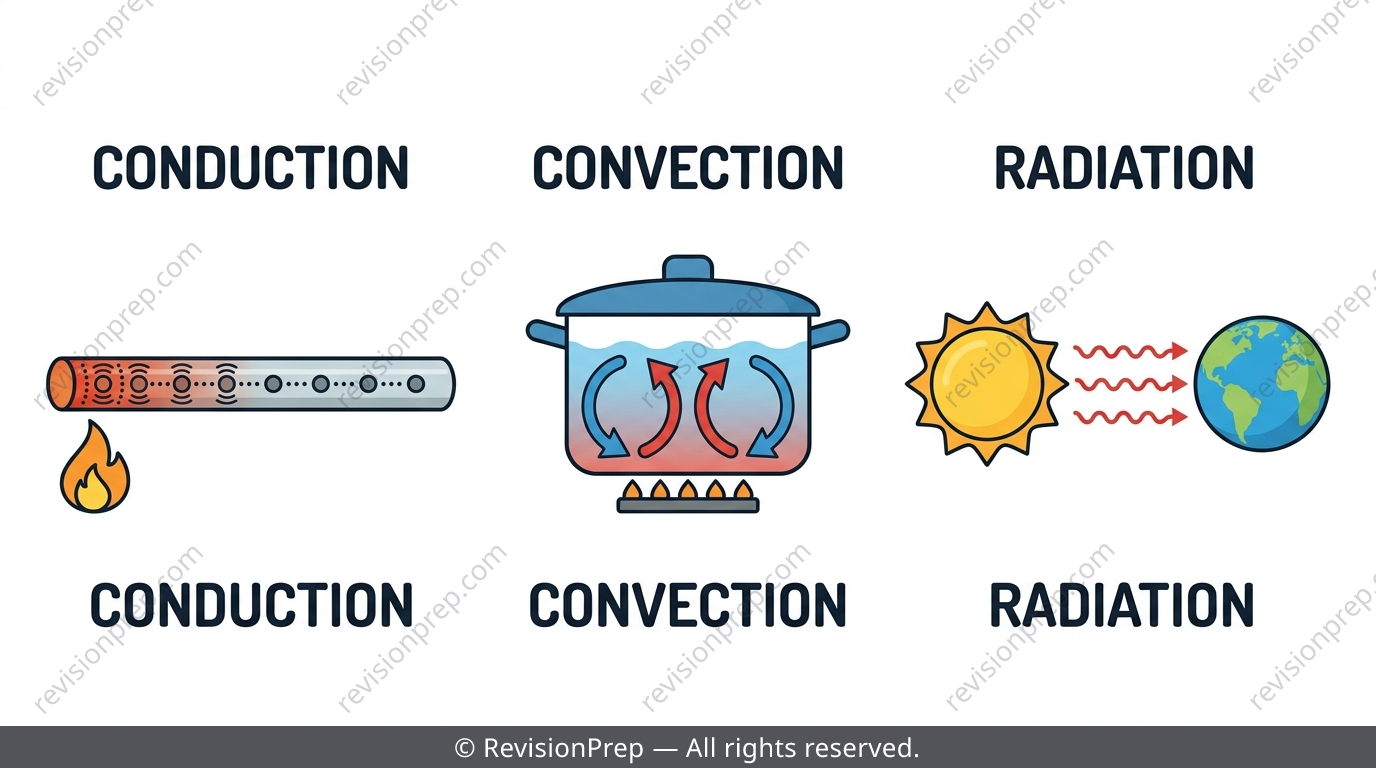
| Feature | Conduction | Convection | Radiation |
|---|---|---|---|
| Medium needed | Solid (touching particles) | Fluid (liquid or gas) | None — works in a vacuum |
| How it moves | Particle-to-particle vibration and collision | Bulk movement of heated, less dense fluid rising | Electromagnetic (infrared) waves |
| Works in space? | No | No | Yes |
Common mistake
Assuming radiation needs warm air to 'carry' heat, or claiming convection can happen in a solid. Fix the rule: solids → conduction only; fluids → conduction and convection; anything (or nothing) → radiation.
Mini summary
Match the mechanism to the material: solid = conduction, fluid = convection, any medium or empty space = radiation.
Renewable vs Non-Renewable Resources
Resources are classified purely by how fast nature replaces them compared to how fast we use them — not by how clean or environmentally friendly they are. Fossil fuels and uranium are non-renewable because they exist in finite amounts formed over millions of years, while solar, wind, hydro, geothermal and biomass are renewable because nature replenishes them at a comparable rate.
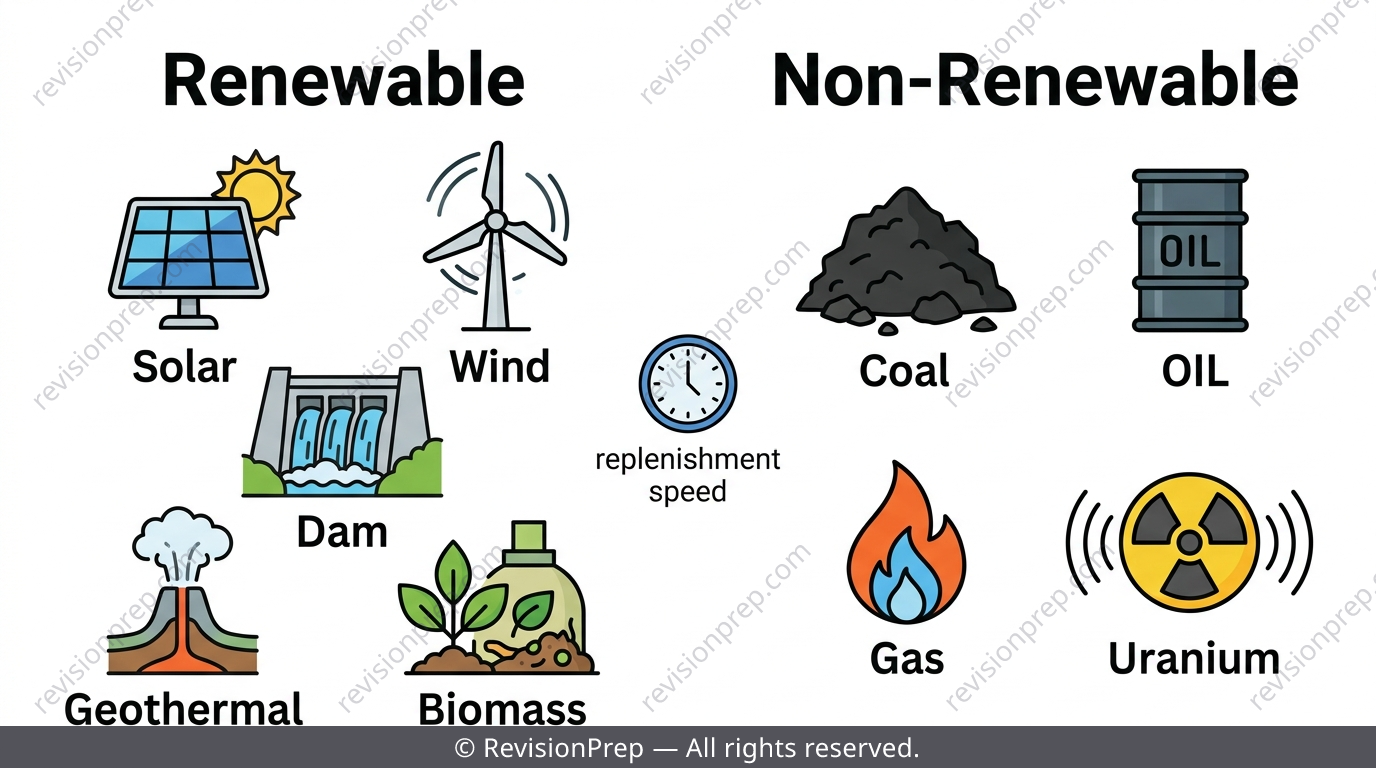
| Resource Type | Examples | Formation Time | Key Limitation |
|---|---|---|---|
| Renewable | Solar, wind, hydroelectric, geothermal, biomass | Replenished naturally at a comparable rate to use | Not automatically 'clean' — building turbines/dams and burning biomass still have impacts |
| Non-renewable | Coal, oil, natural gas, uranium | Millions of years, or doesn't reform at all | Fixed, finite supply that decreases with use |
Common mistake
Classifying nuclear power as renewable because it 'doesn't produce CO2' or 'is clean'. Ask only: does nature replace this as fast as we use it? Uranium's answer is no, so it's non-renewable regardless of emissions.
Mini summary
The renewable/non-renewable split is about replenishment speed, never about how clean the resource is.
Efficiency: How Much Energy Is Actually Useful
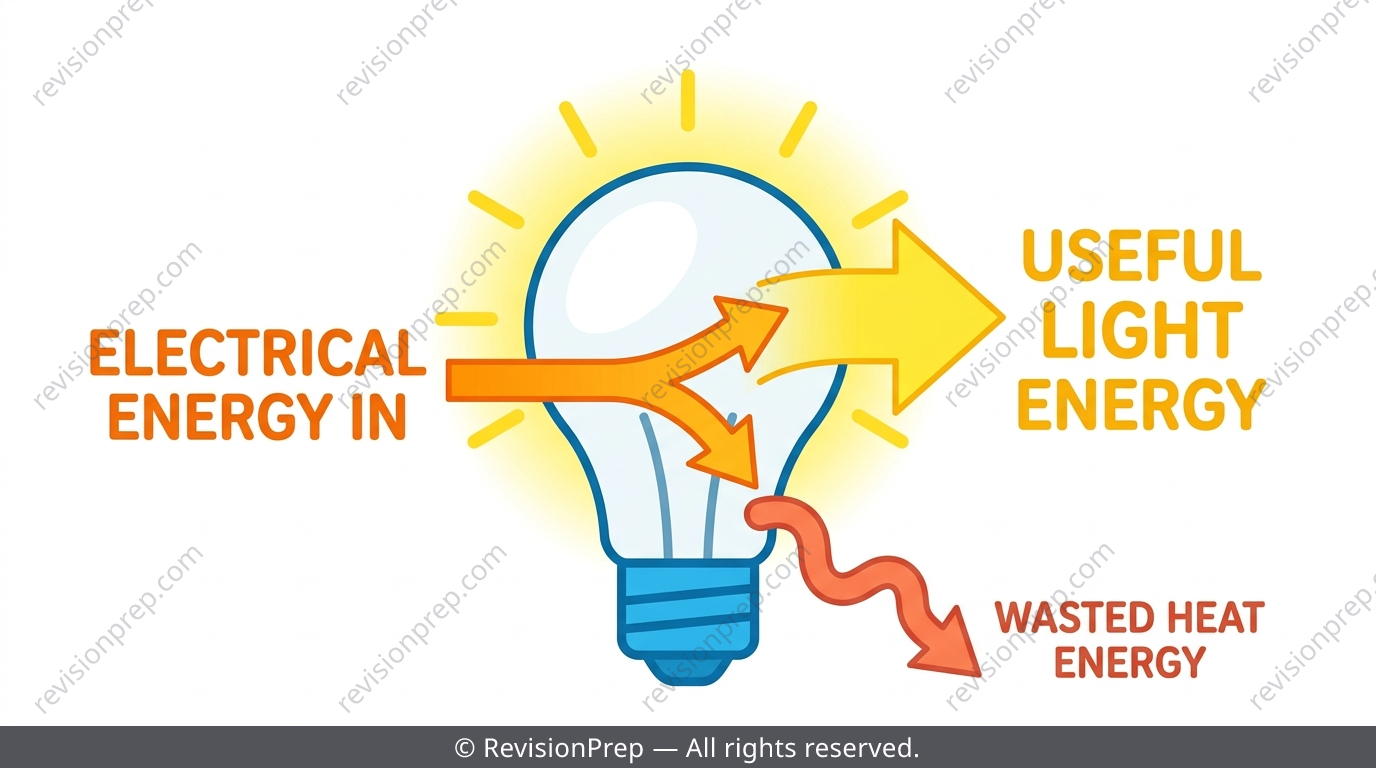
Efficiency describes how much of the energy put into a device comes out in the form you actually wanted, rather than being lost to unwanted forms like heat or sound. Total energy in and out is still conserved — an inefficient device doesn't destroy energy, it just converts more of it into forms that aren't useful for the job at hand.
Mini summary
Efficiency compares useful energy output to total energy input; wasted energy hasn't vanished, it's just in an unwanted form.
Quick formula sheet
Practice questions
- State the law of conservation of energy in one sentence.
- Name the three methods of heat transfer.
- Give one example each of a renewable and a non-renewable resource.
- A ball dropped from 2.0 m bounces back to only 1.2 m. Explain where the missing energy went.
- Explain why convection cannot occur in a solid.
- Explain why uranium is classified as non-renewable even though it doesn't release CO2 when used.
- For a pendulum swinging between two equal-height turning points, compare the total energy at both turning points and at the lowest point of the swing.
- A student claims that biomass energy is 'completely clean' because it is renewable. Evaluate this claim using the definitions of renewable and non-renewable resources.
- Explain, using conduction, convection and radiation, how heat from a stove eventually warms the air across a kitchen.
Frequently asked questions
Why doesn't a bouncing ball return to its original height?+
Because some of its total energy transforms into sound and heat at the moment of impact — energy isn't lost, it just becomes harder to measure and no longer useful for the ball's motion.
Is nuclear power renewable or non-renewable?+
Non-renewable. Even though it produces no combustion emissions, uranium exists in a finite supply that Earth cannot replace as fast as it's used.
What's the difference between conduction, convection and radiation?+
Conduction transfers heat through touching particles in a solid, convection moves heat through circulating fluid, and radiation transfers heat as electromagnetic waves through any medium or a vacuum.
Can convection happen in a solid?+
No. Convection requires a fluid that can physically move — solids can only transfer heat by conduction.
Does 'renewable' mean the same as 'clean' energy?+
No. Renewable only describes how fast a resource is naturally replenished. Biomass is renewable but still releases CO2, and building wind turbines or dams still has environmental costs.
How do I know where GPE and KE are maximum in a swing or fall?+
GPE is maximum at the highest or slowest points (turning points), and KE is maximum at the lowest or fastest point — their sum stays constant if friction and air resistance are ignored.
Get the Full Energy Forms and Transfer Revision Notes
Related articles