
Forces and Motion
Friction, motion graphs, speed vs velocity, and net force — the two skills every MYP 2 exam question is really testing
Quick facts
Forces and motion is one of the most exam-friendly topics in IB MYP 2 Sciences because it keeps testing the same two skills in different costumes: reading a distance-time graph as a speed story, and correctly naming and combining forces. Whether the question is about a toy car sliding across carpet, a block on a force meter, or air resistance on a falling object, you're really being asked to calculate speed, velocity or acceleration, or to work out which force wins when several act at once. This teaser walks through friction and drag, distance-time graphs, the speed/velocity/acceleration trio, and net force — the five ideas that show up in almost every MYP 2 forces unit test. For the full worked examples, formula derivations, and every marked common mistake, the complete revision note has you covered.
What you’ll be able to do
Friction, Air Resistance and Drag
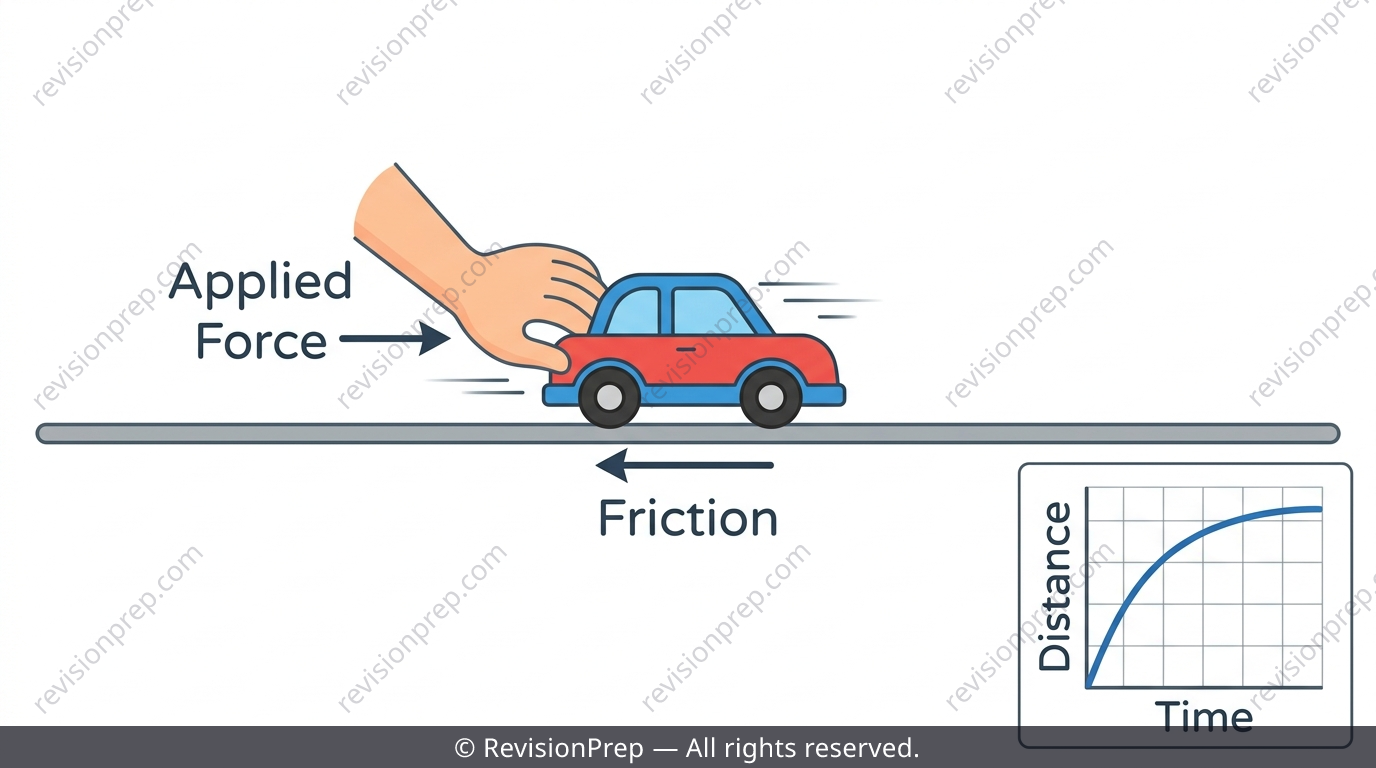
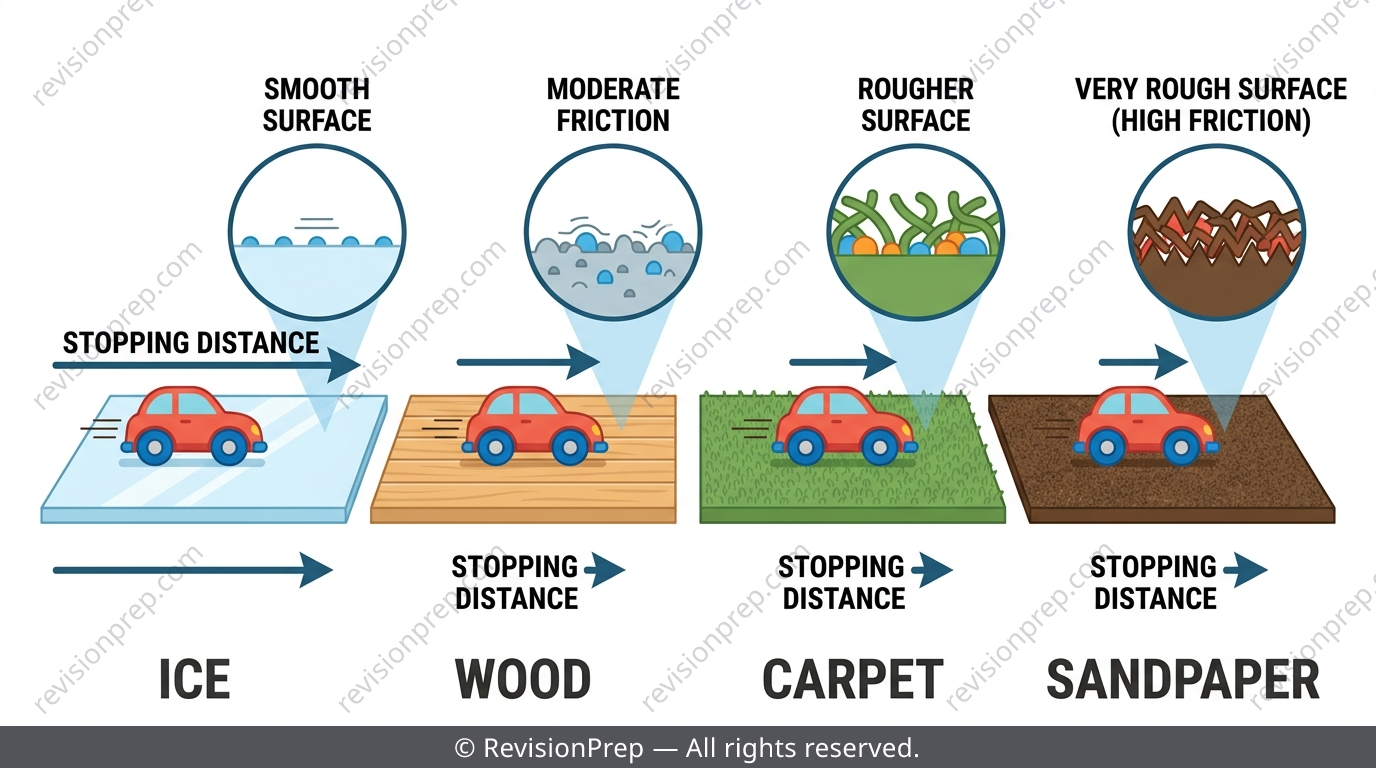
Friction is a contact force that opposes relative motion between two touching surfaces — it always acts backward, opposite to the direction of movement. No surface is truly smooth: microscopic bumps interlock, and rougher surfaces create more interlocking points, so friction is bigger. Air resistance is the same idea caused by air molecules colliding with a moving object, and drag is the general term for this resistive effect in any fluid. Both friction and drag convert kinetic energy into heat, which is exactly why a pushed toy car eventually stops on its own.
Exam tip
Distance × friction force = constant is the exam relationship. If a question gives you distance and friction force for one surface, use that constant to find the unknown friction force on another surface.
Common mistake
Writing just 'because of friction' for a 2-mark explain question earns almost nothing. State the force AND its effect: 'Friction acts between the wheels and the surface, opposing motion, which decelerates the car and brings it to rest.'
Mini summary
Rougher surface = bigger friction force = shorter stopping distance for the same push.
Motion Graphs: Distance-Time
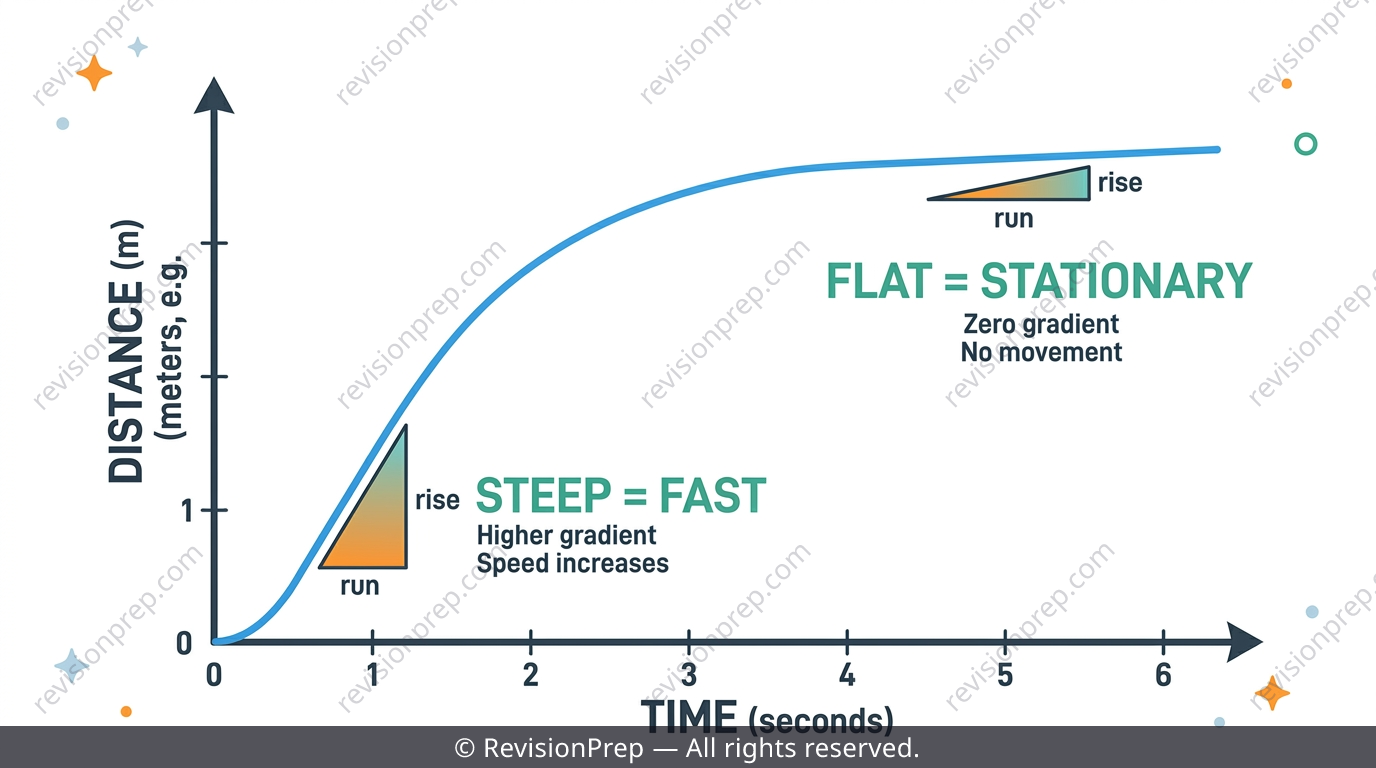
A distance-time graph plots how far an object has travelled against time, and it never decreases. The gradient of the line at any point IS the speed at that point: steep means fast, shallow means slow, and flat means stationary. A straight line means constant speed, while a curve means speed is changing — getting steeper is speeding up, flattening out is slowing down.
Exam tip
A curve flattening over time is the graph signature of friction decelerating a free-moving object — exactly what happens to a toy car released on a rough track.
Common mistake
Saying an object is 'fastest' because the graph is highest at that point confuses total distance with current speed. Speed is the gradient (steepness), not the height of the line.
Mini summary
Gradient = speed. Height alone tells you nothing about current speed — always check if the question wants average or instantaneous speed.
Speed, Velocity and Acceleration
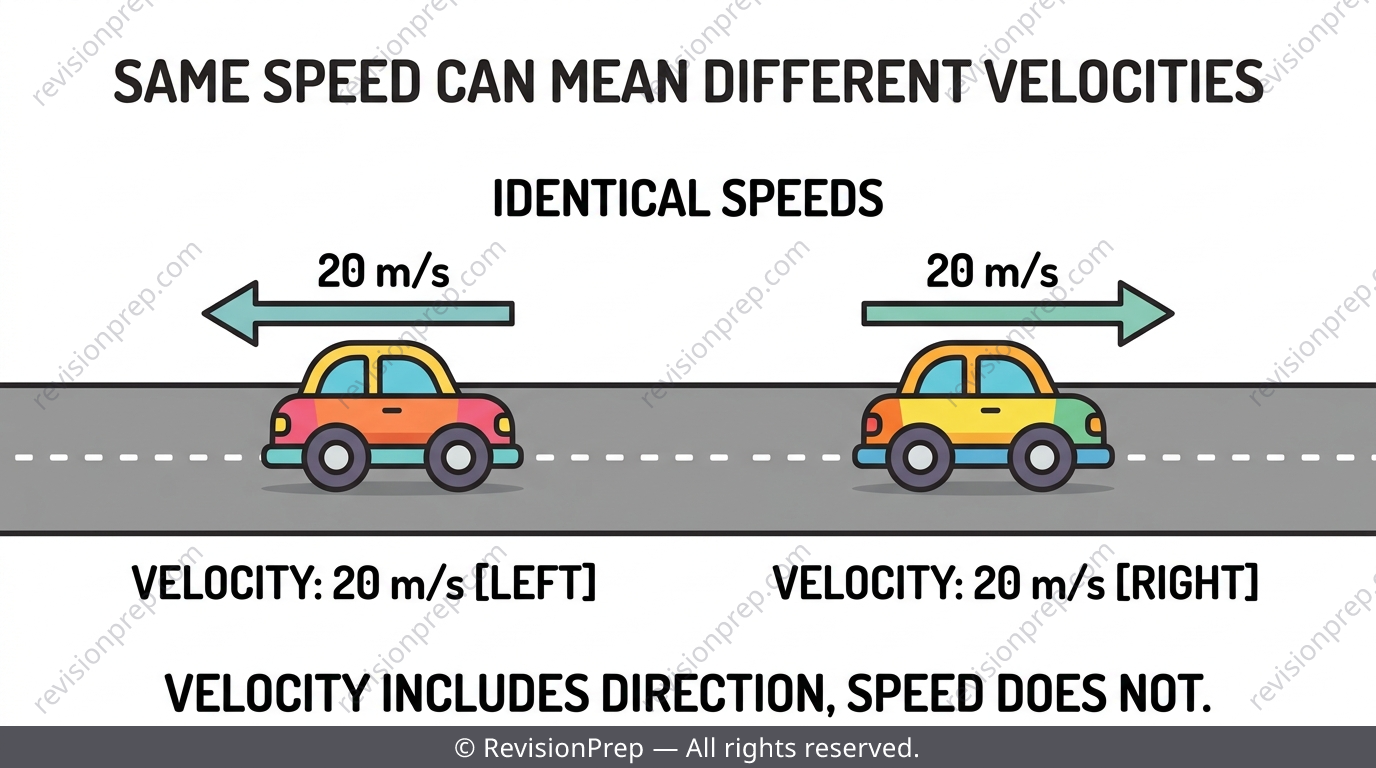
Speed is distance covered per unit time and is a scalar — no direction attached. Velocity is speed with a direction specified, making it a vector, so two objects moving at the same speed in opposite directions have different velocities. Acceleration is the rate of change of velocity, meaning it can describe speeding up, slowing down (a negative value), or even changing direction at constant speed.
| Quantity | Formula | Unit |
|---|---|---|
| Average speed | v = d/t | m/s |
| Acceleration | a = (v-u)/t | m/s² |
Exam tip
Always identify u (initial velocity), v (final velocity) and t before substituting into a = (v−u)/t — mixing these up is the most common setup error.
Common mistake
Writing the unit for acceleration as just 'm/s' instead of 'm/s²' loses a mark even when the working is fully correct.
Mini summary
Speed = scalar, velocity = vector, deceleration = negative acceleration. Units decide marks: m/s vs m/s².
Force Diagrams and Net Force
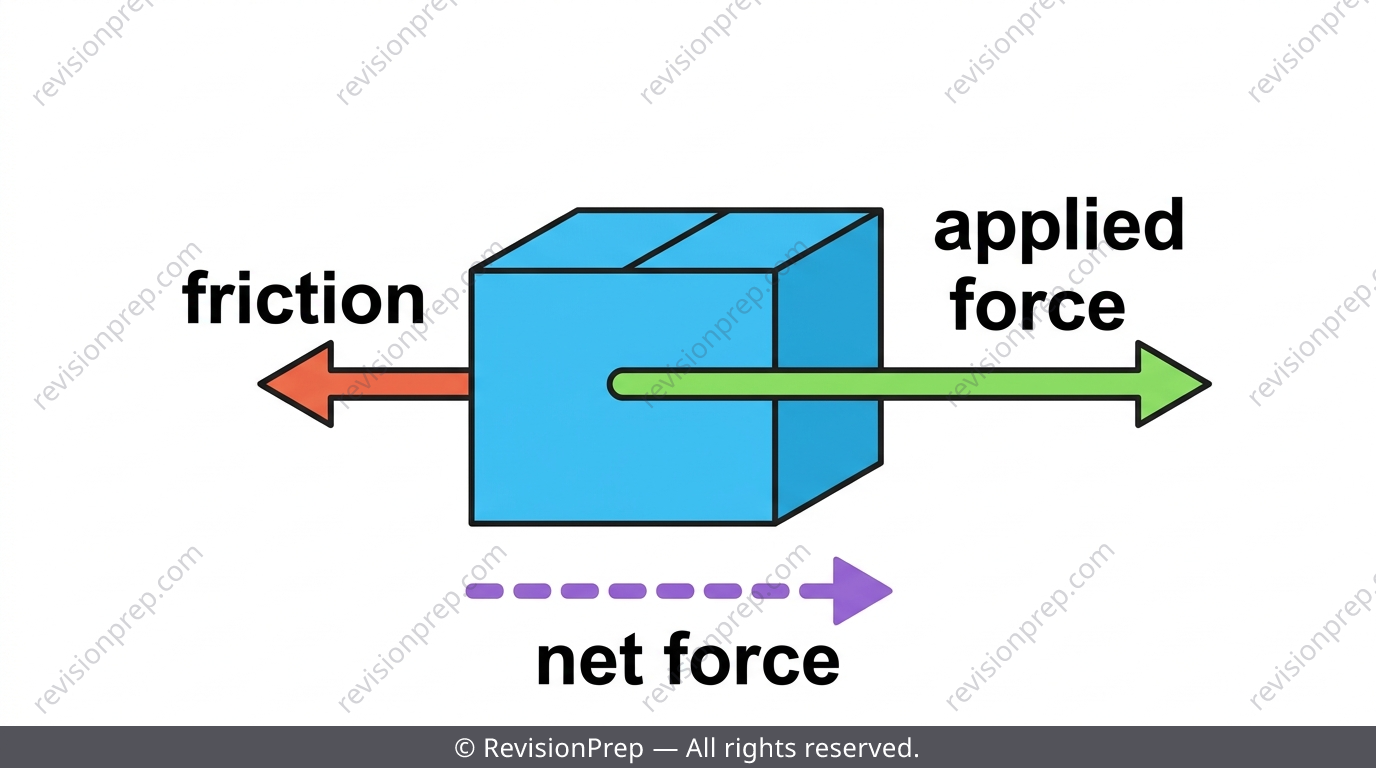
A free-body diagram shows one object with arrows representing every force acting on it, drawn in the direction each force points. Net force is what you get when you combine all those forces together, taking direction into account — forces in the same direction add, forces in opposite directions subtract. This single combined answer is what actually determines what happens to the object's motion.
Exam tip
Always draw or imagine the arrows before combining numbers — a force diagram question is really just careful addition and subtraction with direction attached.
Mini summary
Net force = all forces combined with direction — it's the one number that tells you what the object actually does next.
Balanced vs Unbalanced Forces
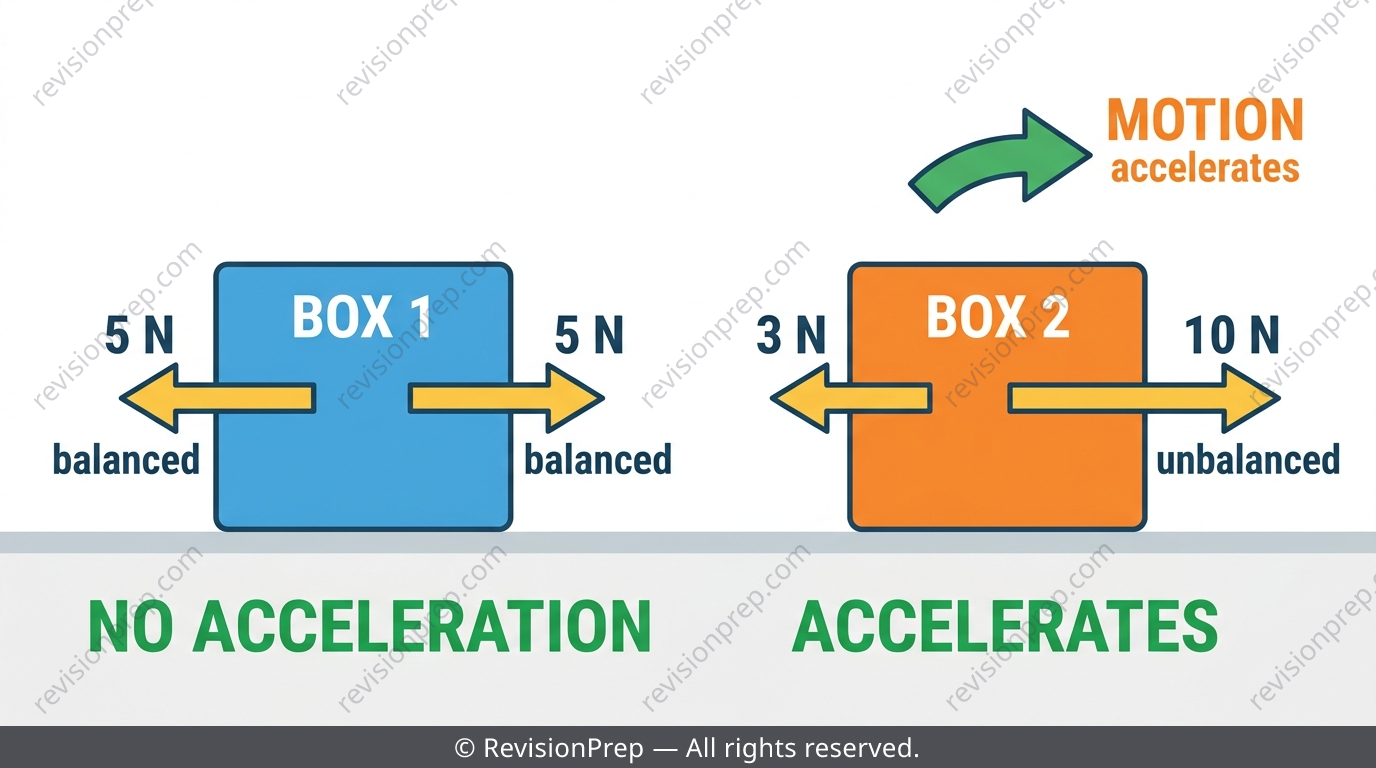
When the forces on an object are balanced, the net force is zero, and the object either stays still or keeps moving at constant velocity. When forces are unbalanced, there is a net force in some direction, and the object accelerates — speeding up, slowing down, or changing direction. This single idea decides whether an object accelerates at all, which is why it sits right at the center of almost every forces question.
Exam tip
Before calculating anything, ask 'are these forces balanced or not?' — it tells you immediately whether to expect constant velocity or acceleration in the rest of the question.
Mini summary
Balanced forces → constant velocity or rest. Unbalanced forces → acceleration.
Quick formula sheet
Practice questions
- Define friction and state the direction it acts in relative to motion.
- On a distance-time graph, what does a flat (horizontal) section represent?
- State whether speed is a scalar or a vector quantity.
- A car travels 6 m in 3 s at constant speed. Calculate its average speed with correct units.
- Explain why a curve flattening on a distance-time graph suggests friction is acting on a free-moving object.
- A toy car takes 4 s to reach 0.8 m/s from rest. Calculate its acceleration.
- Two surfaces give stopping distances of 90 cm and 30 cm for the same push, with a friction force of 0.4 N on the first. Find the friction force on the second surface.
- Explain, using the ideas of balanced and unbalanced forces, why an object moving at constant velocity is not necessarily force-free.
- A distance-time graph shows increasing steepness for the first 5 s, then flattening for the remaining 5 s. Describe the object's motion throughout, referring to both speed and possible forces acting.
Frequently asked questions
What is the difference between speed and velocity?+
Speed is how fast something moves and has no direction (a scalar). Velocity is speed with a direction attached (a vector), so two objects can have the same speed but different velocities if they move in different directions.
How do I calculate acceleration in MYP sciences?+
Use a = (v−u)/t, where u is initial velocity, v is final velocity, and t is the time taken for that change. Always give the unit as m/s².
Why does friction slow objects down?+
Friction is a contact force caused by microscopic bumps on surfaces interlocking as they slide against each other. It acts opposite to the direction of motion and converts kinetic energy into heat, decelerating the object.
How do you read a distance-time graph?+
The gradient of the line at any point equals the speed at that point. A straight line means constant speed, a curve means changing speed, and a flat section means the object is stationary.
What's the difference between air resistance and drag?+
Drag is the general term for a resistive force a fluid exerts on a moving object. Air resistance is simply drag caused specifically by air, a gas.
What are balanced and unbalanced forces?+
Balanced forces produce zero net force, so the object stays still or moves at constant velocity. Unbalanced forces produce a net force in some direction, causing the object to accelerate.
Get the full Forces and Motion revision note
Related articles