
Geometry: Coordinates and Transformations
Turn every geometric instruction into arithmetic on $(x,y)$ — and back again.
Quick facts
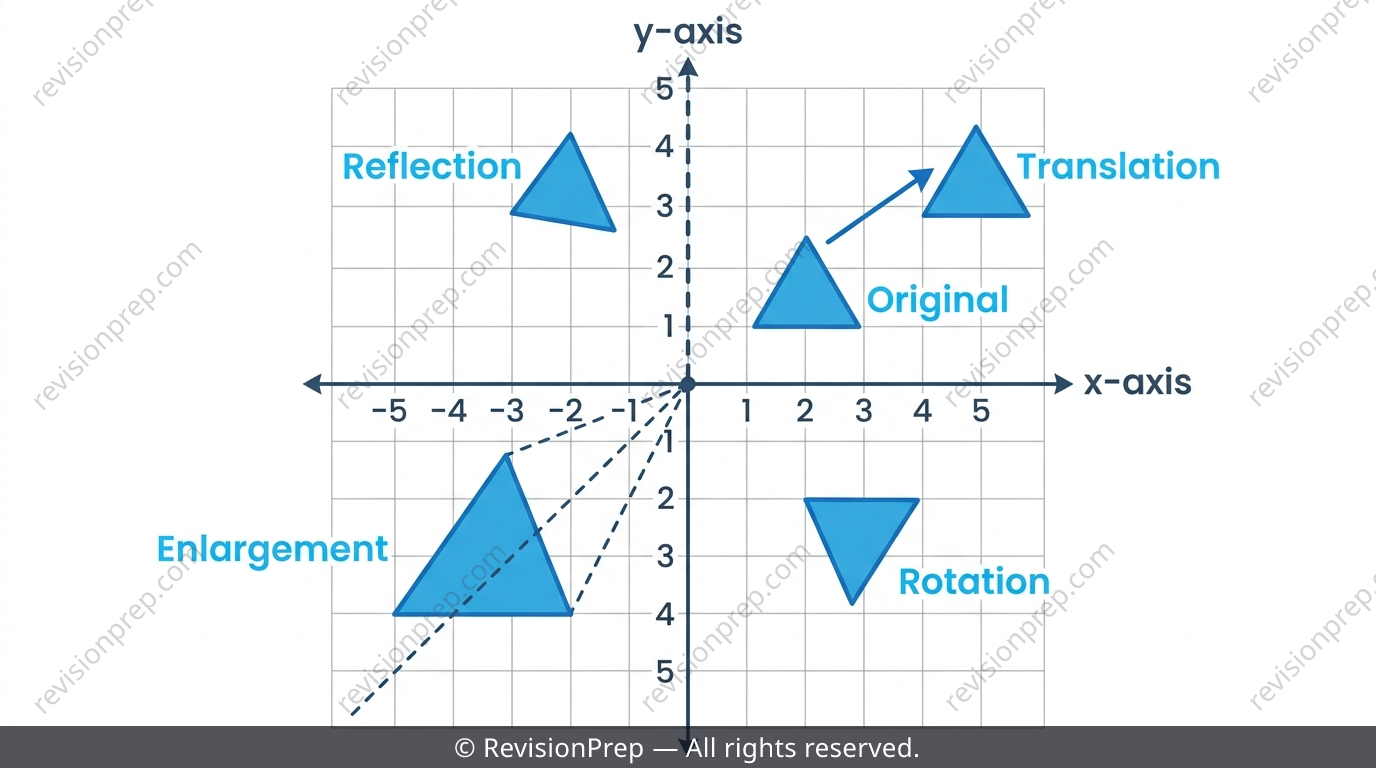
IB MYP 3 coordinates and transformations is really two skills working together: reading the Cartesian plane accurately, and applying transformation rules to move shapes around it. Once you can turn a geometric instruction — reflect, rotate, translate, enlarge — into arithmetic on , questions on distance, midpoint, congruence and similarity all become routine. This teaser walks through the five ideas examiners return to again and again: plotting ordered pairs correctly, the distance and midpoint formulas, why translation, reflection and rotation keep shapes congruent, the exact coordinate rules for each transformation, and how enlargement uses a scale factor to change size instead. Nail these five, and Criterion B investigation tasks and unit tests on coordinate geometry stop feeling unpredictable. The full revision notes on RevisionPrep go deeper with worked examples, tables and every common-mistake trap spelled out.
What you’ll be able to do
Reading and Plotting Coordinates
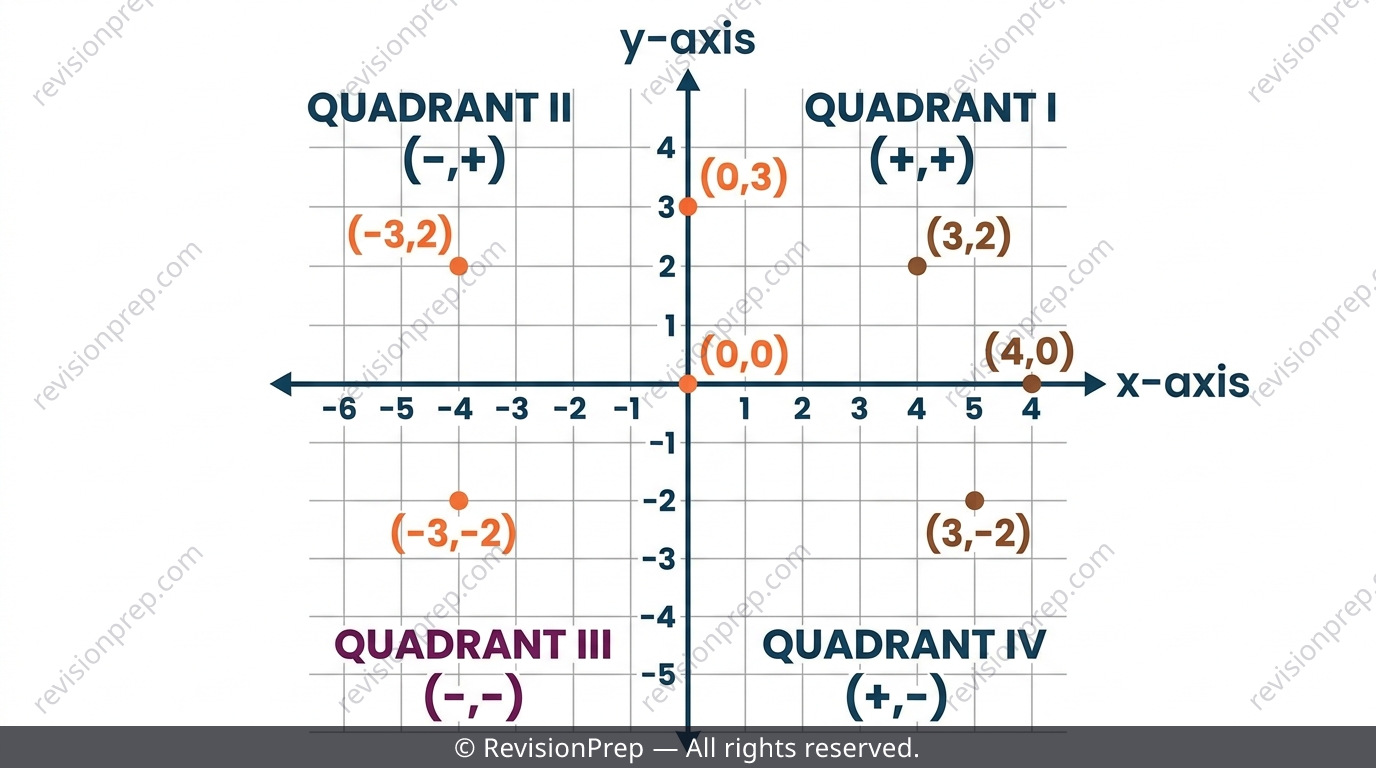
The Cartesian plane is two number lines meeting at right angles at the origin . Every point is named by an ordered pair : moves horizontally, moves vertically, and order always matters — is not the same point as . The plane splits into four quadrants with distinct sign patterns, and a point sits exactly on an axis when one coordinate equals zero.
Exam tip
Say 'across then up' out loud before plotting, then check your point actually lands in the quadrant its signs predict.
Common mistake
Reading coordinates as (y, x) like a row-column grid reference instead of (x, y) — this plots the point in completely the wrong place.
Mini summary
An ordered pair always lists horizontal position first, vertical second.
Distance and Midpoint Formulas
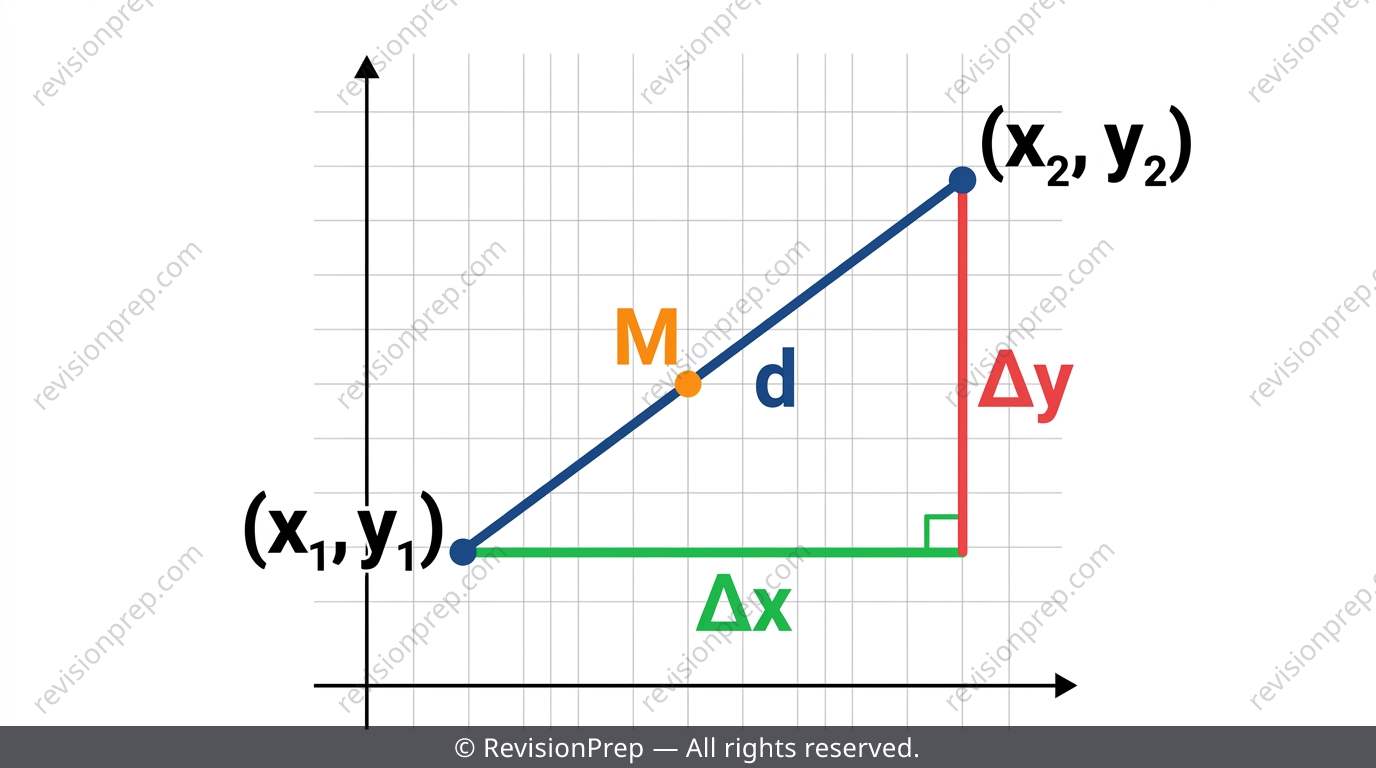
The distance formula, , is just Pythagoras applied to the horizontal and vertical gaps between two points. The midpoint formula, , averages the x-coordinates and the y-coordinates separately. On real maps, always check what one grid unit represents before converting a calculated distance into metres.
Exam tip
When asked to explain why a claimed distance is wrong, state your calculated value AND their claimed value explicitly — the mark sits on that comparison, not on saying 'it's incorrect'.
Common mistake
Calculating correctly but forgetting to multiply by the metres-per-unit scale before giving a final answer.
Mini summary
Find and , square, add, root — convert units last.
Translation, Reflection and Rotation
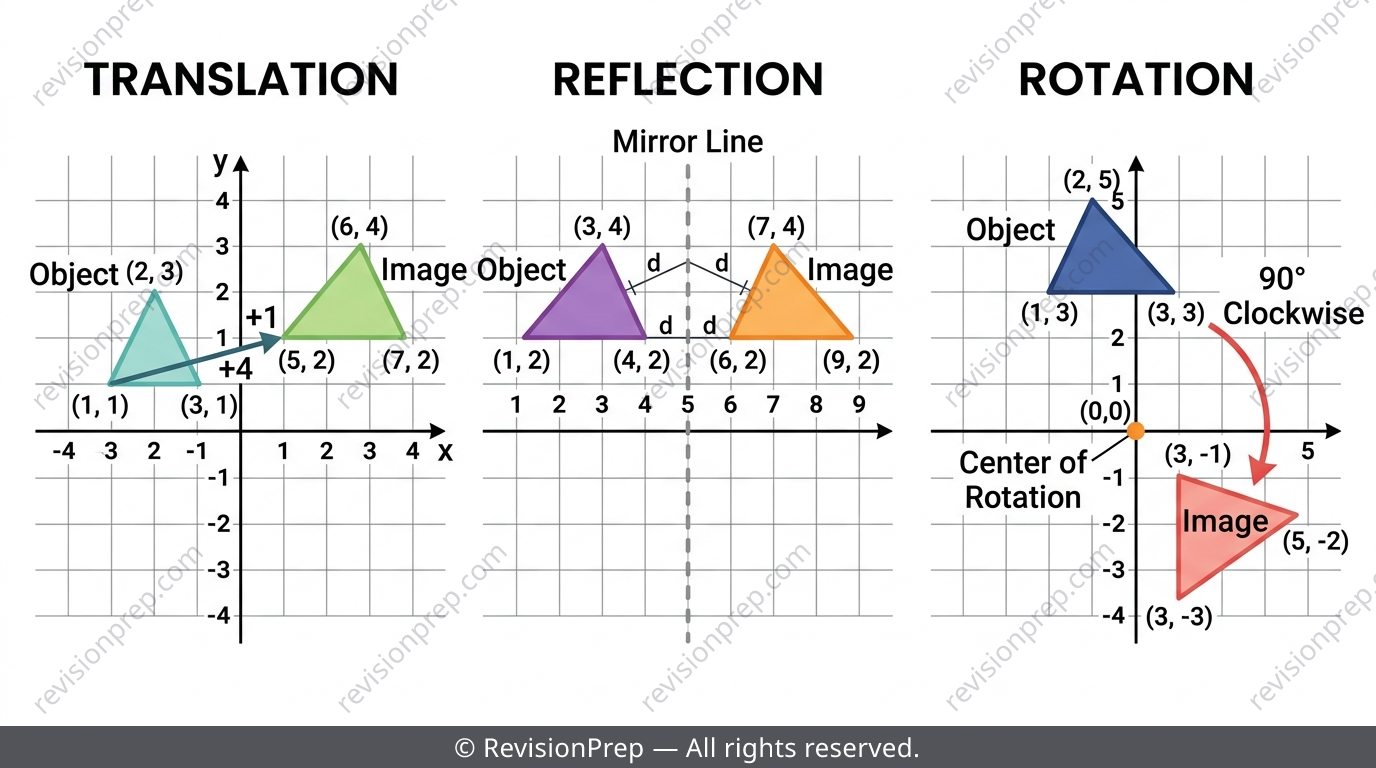
Translation, reflection and rotation reposition a shape without changing its size — the image is always congruent to the object. Translation slides every point by the same vector ; reflection flips the shape across a mirror line, reversing orientation; rotation turns it about a fixed centre through a stated angle and direction. Only reflection reverses orientation.
| Transformation | Changes size? | Changes orientation? | Congruent to object? | Reference needed |
|---|---|---|---|---|
| Translation | No | No | Yes | Vector |
| Reflection | No | Yes | Yes | Mirror line |
| Rotation | No | No | Yes | Centre, angle, direction |
| Enlargement | Yes | No | No (similar) | Centre, scale factor |
Exam tip
A full description needs type + detail: 'translation by vector (a,b)', 'reflection in the y-axis', or 'rotation of 90° anticlockwise about the origin'. Naming only the type scores at most one mark.
Common mistake
Confusing clockwise with anticlockwise and applying the wrong rotation rule — sketch a rough quarter-turn first to check which quadrant your answer should land in.
Mini summary
Translation, reflection and rotation are all rigid: object and image are congruent.
Coordinate Rules You Must Memorise
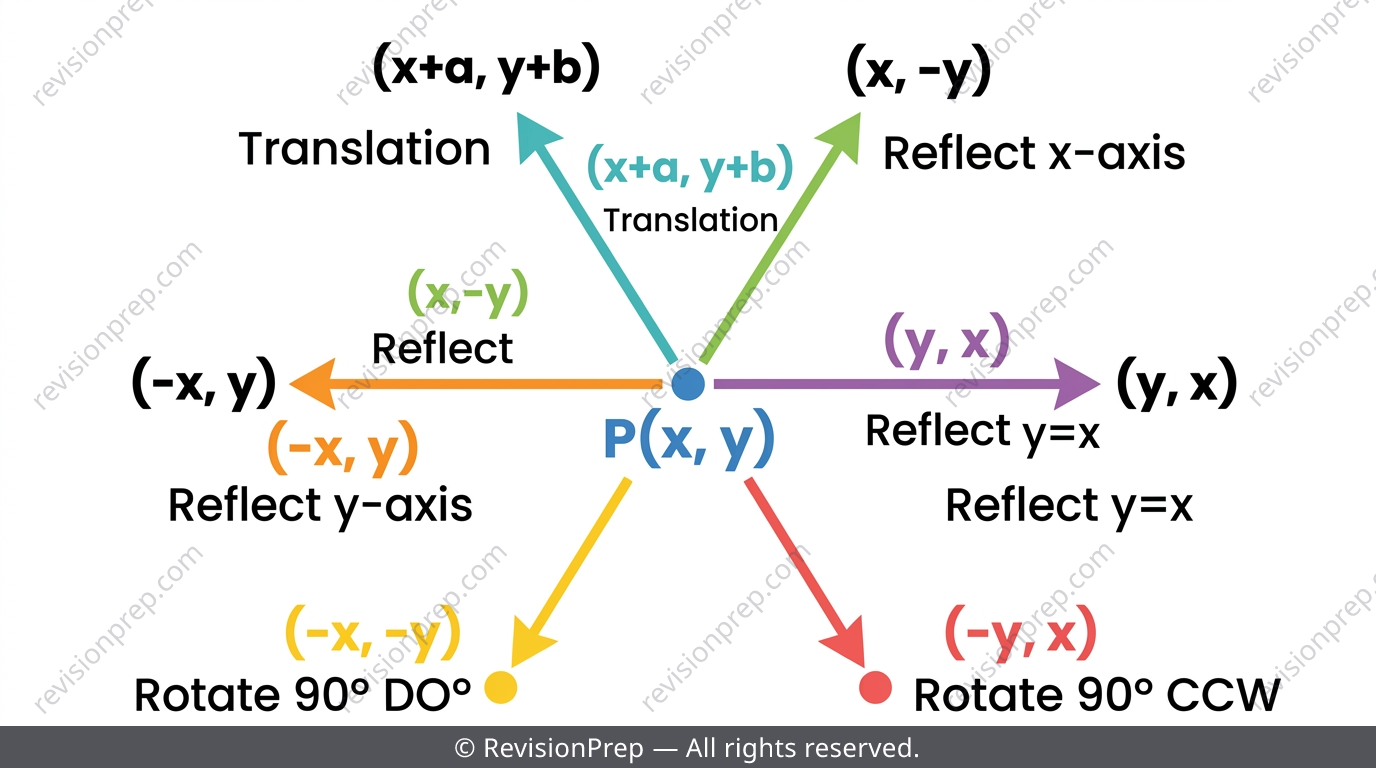
Each rigid transformation about the origin has a short function rule worth memorising rather than re-deriving each time. Translation: . Reflections: in the x-axis, in the y-axis, and in the line . Rotations about the origin: for 90° anticlockwise, for 180°, and for 90° clockwise.
Exam tip
Always apply the rule to the most recent image, not back to the original object, when a question chains two transformations together.
Common mistake
Mixing up which rule belongs to which rotation direction — check your algebraic answer lands in the same quadrant as a rough sketch of the turn.
Mini summary
Learn these coordinate rules as functions, not just diagrams.
Enlargement and Scale Factor
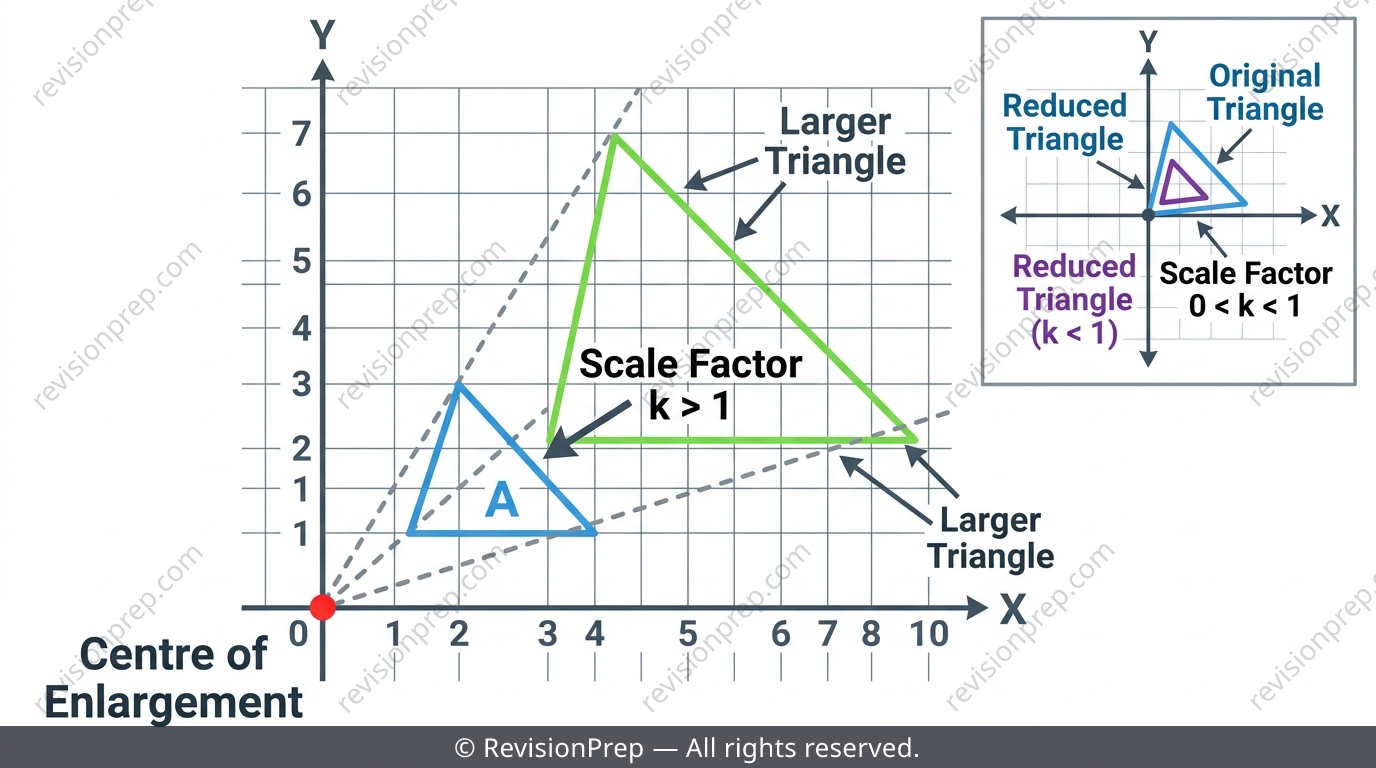
Enlargement is the transformation that changes size: every point moves along a straight line through a fixed centre, and distances from that centre are multiplied by the scale factor . From the origin, the rule is simply . When the image grows, when it shrinks, and a negative flips the shape through the centre as well as resizing it — but in every case, sides scale by and area scales by , so the image is similar, not congruent.
Exam tip
If a question asks you to compare side lengths after enlargement, remember: equal angles and same shape, but sides are multiplied by — not added to.
Common mistake
Assuming an enlarged shape is congruent to the original because it 'looks the same shape' — it's similar, and only congruent when or .
Mini summary
Enlargement changes size using a scale factor from a fixed centre — the image is similar, not congruent.
Quick formula sheet
Practice questions
- Plot the point and state which quadrant it lies in.
- Find the midpoint of and .
- Write the coordinate rule for reflecting a point in the y-axis.
- Triangle is rotated 90° anticlockwise about the origin. Find the coordinates of the image.
- Two points are at and on a grid where 1 unit = 5 m. Calculate the real-world distance between them.
- Describe fully the single transformation that maps to .
- A rectangle has vertices . Enlarge it by scale factor 2 from the origin, then reflect the image in the x-axis. State the final coordinates.
- Explain, using coordinates, why an enlargement with scale factor both resizes and rotates a shape.
- A student claims two shapes are congruent after an enlargement with . Explain, with reference to side lengths, why this claim is incorrect.
Frequently asked questions
What's the difference between coordinates (x,y) and a grid reference?+
Coordinates always list the horizontal x-value first and vertical y-value second, unlike some grid references that use row-then-column order — mixing this up plots the point in the wrong place entirely.
How do I remember the rotation coordinate rules?+
Learn them as functions: 90° anticlockwise swaps and negates one coordinate, ; 180° negates both; 90° clockwise is the mirror rule, . Sketching a rough turn first helps you check the sign pattern.
Is enlargement a rigid transformation?+
No. Translation, reflection and rotation are rigid and produce congruent images; enlargement changes size using a scale factor, producing a similar but not congruent image.
Why do I lose marks on distance questions even when my formula is right?+
The most common lost mark is forgetting to convert grid units into real-world units (like metres) after calculating the raw distance value.
What must a full description of a rotation include?+
The angle, the direction (clockwise or anticlockwise), and the centre of rotation — naming only 'rotation' without these details scores at most one mark.
How does scale factor affect area, not just side length?+
Side lengths scale by the factor , but area scales by , because area involves two dimensions being multiplied by .
Ready to master coordinates and transformations fully?
Related articles