
Geometry – Measurement & Calculation
Surface area, volume, compound solids, and scale — the MYP 3 unit that shows up on almost every test
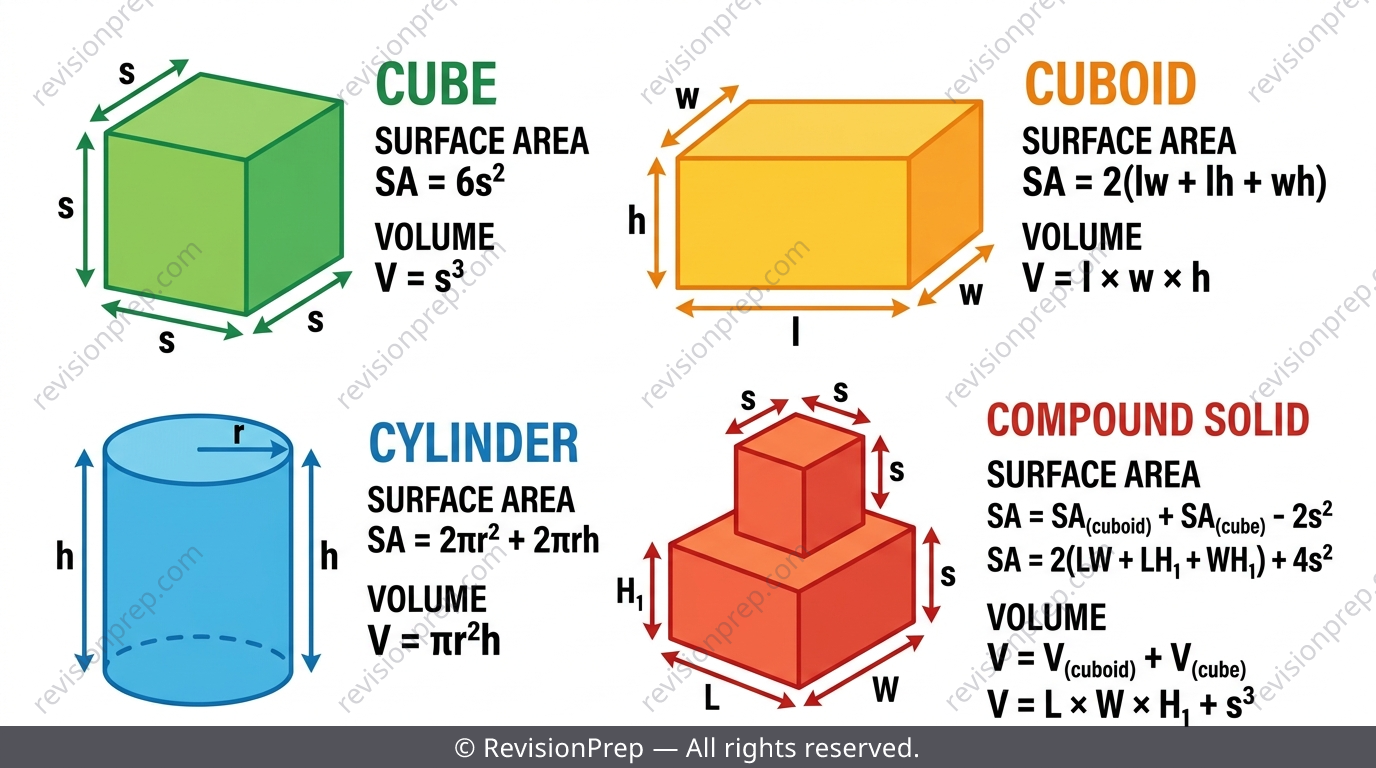
Quick facts
Surface area, volume, and scale calculations sit at the core of the MYP 3 geometry unit, and they resurface constantly across unit tests, eAssessments, and Criterion A/C tasks. The trick to mastering this topic isn't memorising five separate formulas — it's understanding the pattern underneath them. Surface area always covers a region (squared units), volume always fills a space (cubed units), and both concepts extend naturally into compound solids and real-world scale drawings with bearings. This teaser walks through the five ideas that generate the most exam marks: the units trap, surface area of prisms, volume as cross-section × length, hidden faces in compound solids, and converting between map and real distances. For the full worked examples, formula derivations, and complete practice sets, the full revision note on RevisionPrep has everything you need.
What you’ll be able to do
Linear, Squared, Cubed: The Units Trap
Every calculation in this unit is either a 2D measurement (perimeter, area) or a 3D measurement (surface area, volume). Perimeter and length use plain linear units like cm, area and surface area use squared units like cm², and volume uses cubed units like cm³. The single biggest source of lost marks in this whole chapter is mixing these three up — especially when converting between units or reading off a final answer.
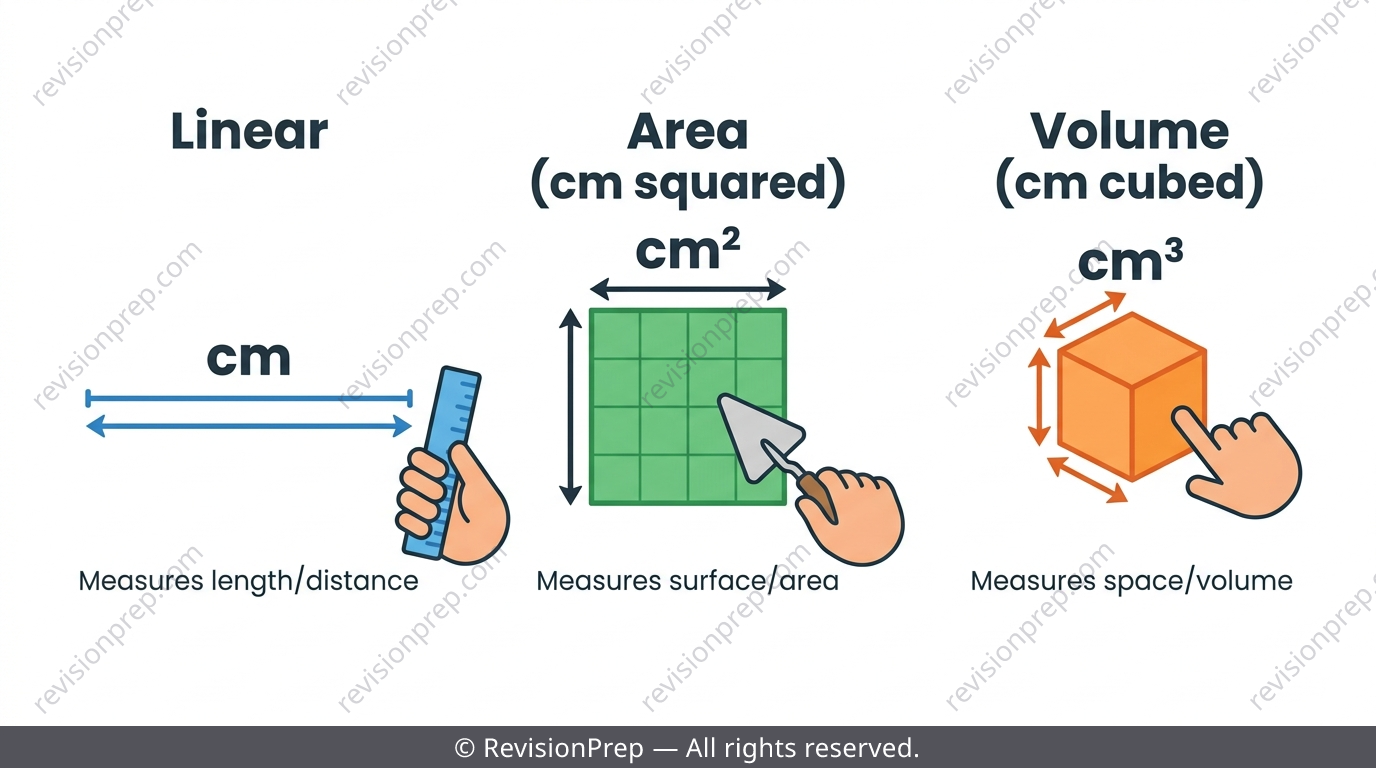
| Measurement | What it describes | Units |
|---|---|---|
| Perimeter / length | Boundary or straight distance | cm, m, km |
| Area / surface area | A region or the total skin of a solid | cm², m² |
| Volume | The space a solid fills | cm³, m³ |
Exam tip
Before writing your final answer, glance at the unit you calculated last — if you found an area but wrote 'cm', you've made the exam's most common silent error.
Common mistake
Writing a volume answer in squared units, or a surface area answer in cubed units, because the working was correct but the unit label was copied from the question rather than derived from the formula.
Mini summary
Linear = length, squared = area/surface area, cubed = volume — always match the unit to the formula, not the question wording.
Surface Area of Cubes, Cuboids & Prisms
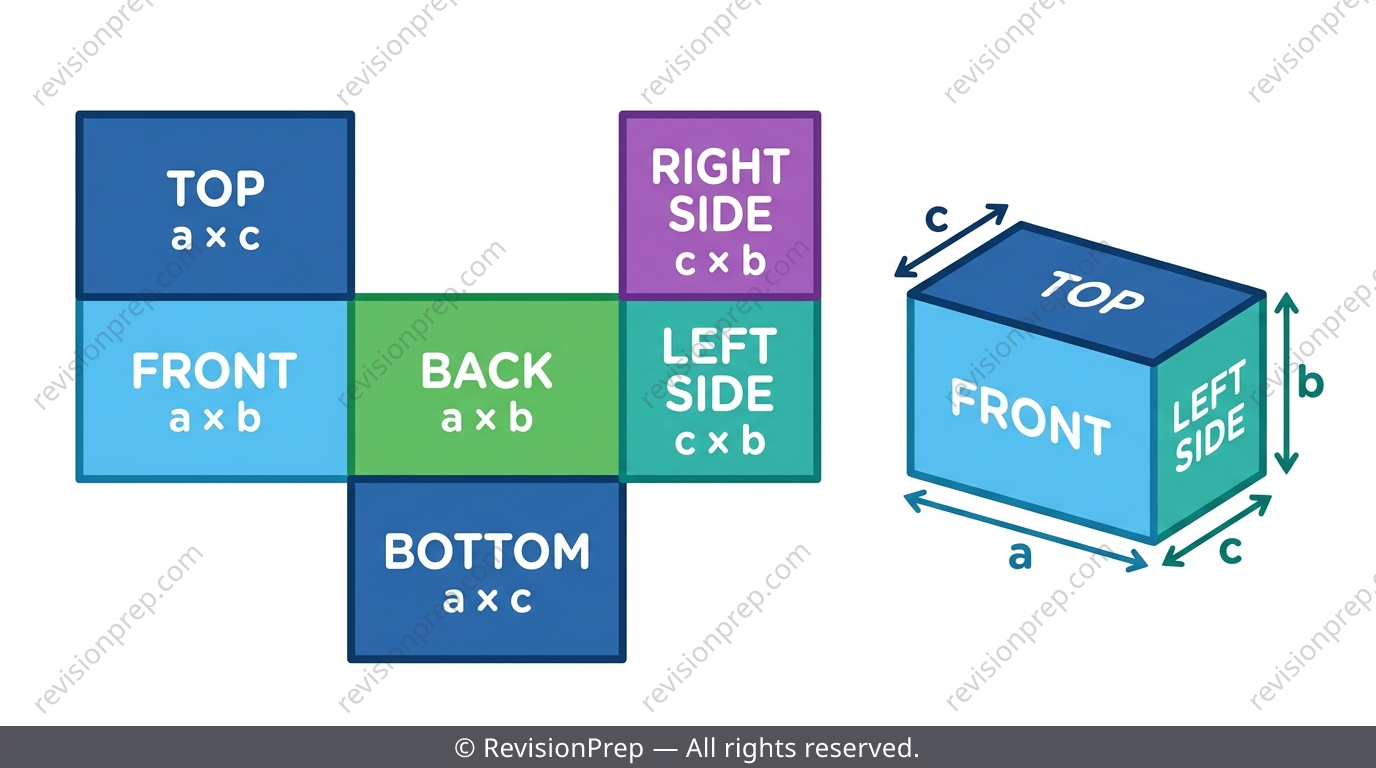
Surface area is the total area of every face on a solid, and every formula in this section comes from doubling pairs of matching faces. A cube has , a cuboid has , and a prism has — two identical ends plus rectangular sides whose combined width equals the cross-section's perimeter. A classic exam trap tests whether students realise that scaling a linear dimension by factor scales surface area by , not by .
Exam tip
Name which two faces each product represents in your working (e.g. 'lw = top and bottom') — even a wrong final number can earn the method mark.
Common mistake
Writing and forgetting to double each pair of opposite faces — say the formula out loud as 'two lots of (lw plus lh plus wh)' before substituting.
Mini summary
Surface area = sum of every face, always doubled in pairs; scaling side length by scales area by , not .
Volume: Cross-Section × Length
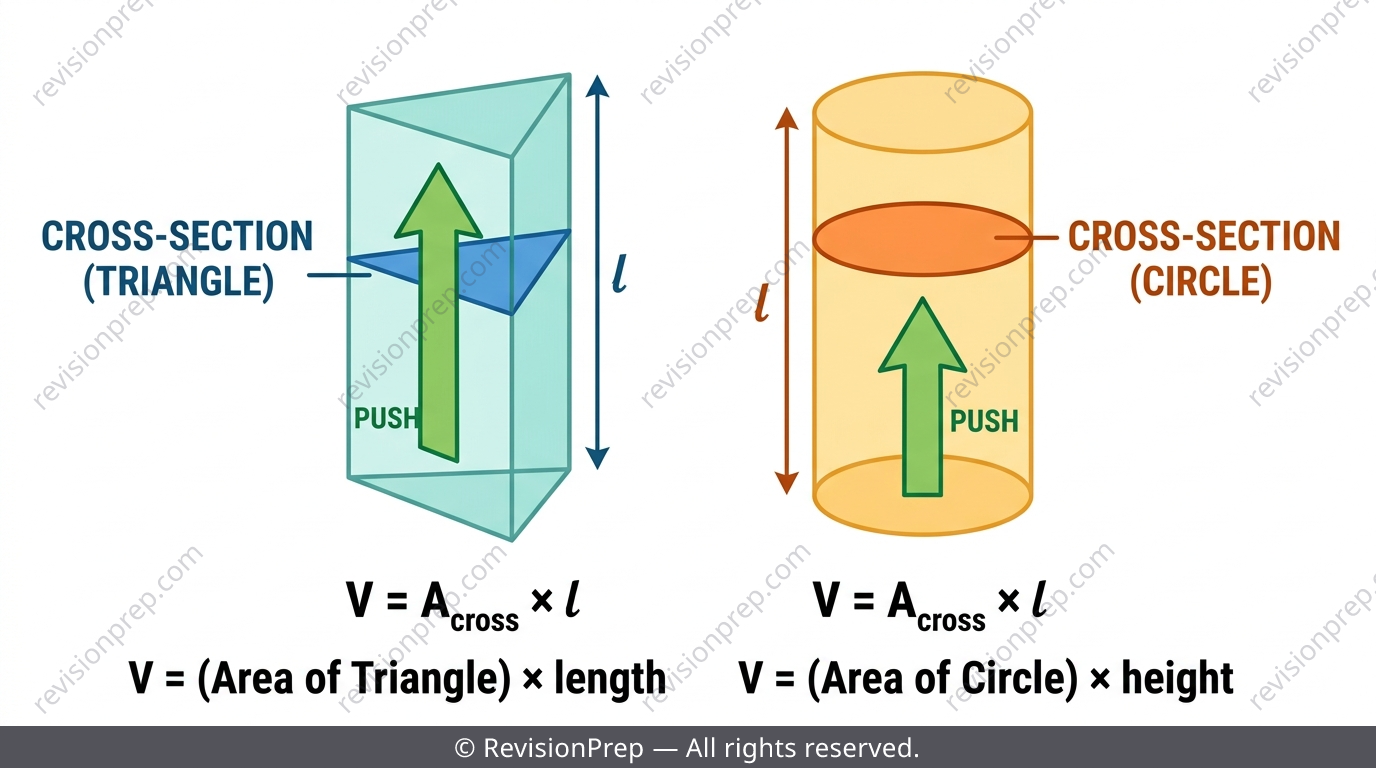
Every volume formula in this unit is the same idea in disguise: volume = area of the cross-section × the length it's pushed through. A cuboid is a rectangle pushed through a height (), a cylinder is a circle pushed through a height (), and the general prism formula works for any cross-sectional shape — which is why it's worth memorising over the individual formulas. Working backwards from volume to a linear dimension means checking the power first: needs a cube root, not a square root.
Exam tip
When a question gives volume and asks for a linear dimension, check the exponent in the formula before you start undoing it — cube roots and square roots are not interchangeable.
Common mistake
Using a slant or diagonal length instead of the perpendicular height in — mark the right-angle height on your sketch before substituting.
Mini summary
Volume = cross-sectional area × length for every prism, including cylinders — one relationship, not five formulas.
Compound Solids: Add Volume, Subtract Hidden Faces
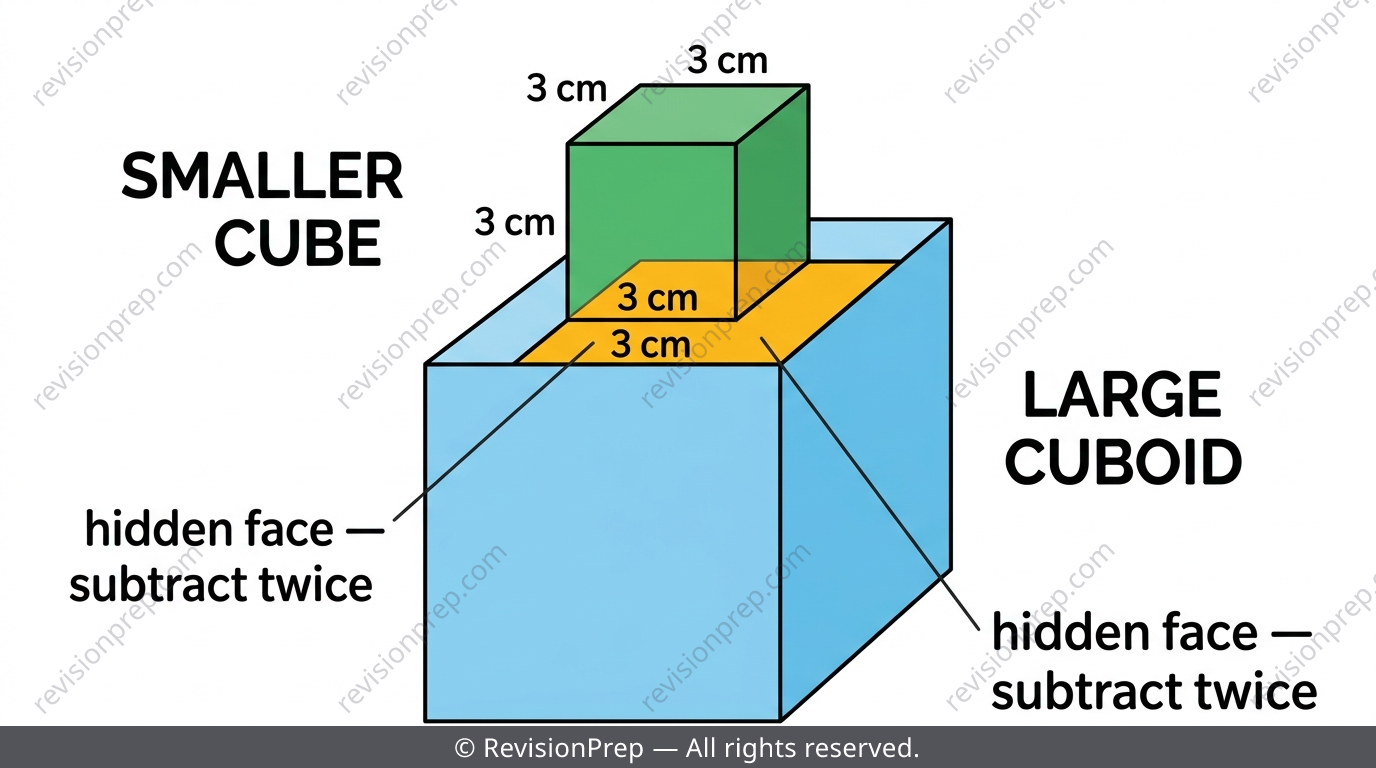
A compound solid is built from two or more simple solids joined together. Volume always just adds — the total space enclosed is the sum of the pieces' individual volumes, no exceptions. Surface area is different: wherever two solids touch, both contact faces become internal and must be subtracted from the sum of the separate surface areas.
Exam tip
Build a two-column table — 'Piece' and 'Area/Volume' — before calculating anything. Examiners award method marks for each correctly calculated piece, but only if it's visible in your working.
Common mistake
Adding the two solids' surface areas without subtracting the hidden contact faces — always ask 'do these solids touch?' and subtract that area twice if they do.
Mini summary
Volume of a compound solid = sum of the pieces; surface area = sum of the pieces MINUS twice every hidden contact face.
Scale Drawings, Maps & Bearings
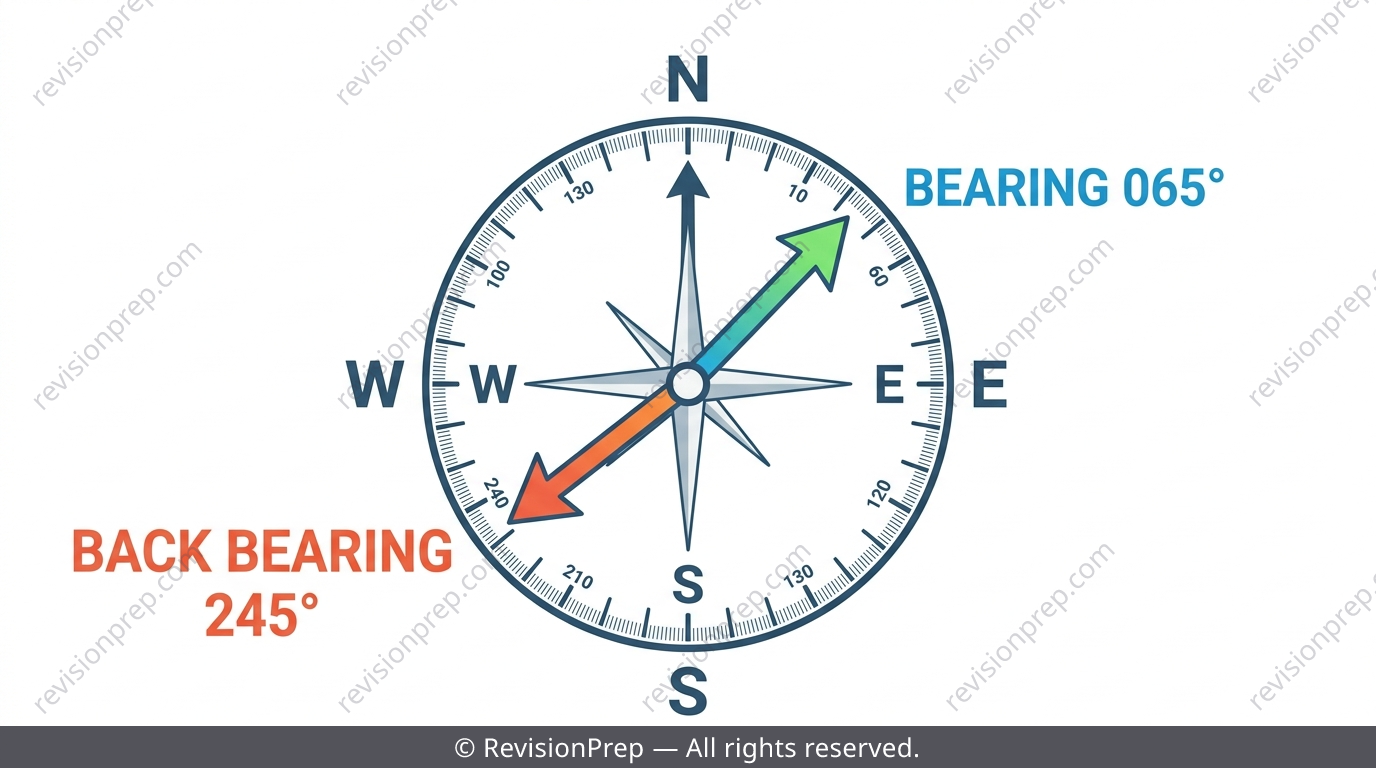
A scale like 1:50,000 compares a length on a drawing to the real-world length it represents, and the scale factor is the single number you multiply or divide by to convert between them: . A bearing is a clockwise angle from North, always written with three figures (e.g. 065°). The back bearing — the direction along the same line but the opposite way — is found by adding or subtracting 180° depending on whether the original bearing is below or above 180°.
Exam tip
Always check whether your bearing is below or above 180° before applying the back-bearing rule — using the wrong operation is a quick, avoidable mark loss.
Common mistake
Forgetting to write bearings with three figures (writing 65° instead of 065°), which examiners mark as an incomplete answer.
Mini summary
Scale factor converts map distance to real distance; back bearing = bearing ± 180° depending on its size.
Quick formula sheet
Practice questions
- Calculate the surface area of a cube with side length 5 cm.
- Find the volume of a cuboid measuring 4 cm × 3 cm × 6 cm.
- Write the bearing 315° as a back bearing.
- A cylinder has radius 4 cm and height 10 cm. Calculate its volume, giving your answer in terms of .
- A triangular prism has a cross-sectional area of 12 cm², a cross-sectional perimeter of 16 cm, and a length of 9 cm. Find its total surface area.
- A map has a scale of 1:25,000. A distance on the map measures 6 cm. Find the real distance in kilometres.
- A cube with side 4 cm has surface area 96 cm². Explain why the surface area of a cube with side 8 cm is not simply double this, and calculate the correct value.
- A cuboid (10 cm × 6 cm × 4 cm) has a cube of side 4 cm attached to one of its faces, sharing a 4 cm × 4 cm contact face. Find the total surface area of the compound solid.
- A box is a cuboid with dimensions cm, cm, and 5 cm. Write a simplified expression for its total surface area and determine the minimum value of for the surface area to be at least 220 cm².
Frequently asked questions
What's the difference between surface area and volume?+
Surface area measures the total area of every face on the outside of a solid, given in squared units. Volume measures the space enclosed inside the solid, given in cubed units — they answer completely different questions about the same shape.
Why doesn't surface area double when you double a cube's side length?+
Surface area depends on , so scaling the side by factor scales the surface area by , not by . Doubling the side actually quadruples the surface area.
How do I find the volume of any prism without memorising lots of formulas?+
Use — the cross-sectional area multiplied by the length. This single relationship works for cuboids, triangular prisms, and cylinders alike.
Do I add or subtract when finding the surface area of a compound solid?+
Volume of a compound solid always adds directly. Surface area is the sum of each piece's surface area minus twice the area of every face where the solids touch, since those faces become internal.
How do I calculate a back bearing?+
If the original bearing is less than 180°, add 180°. If it's 180° or more, subtract 180°. This gives the direction along the same line but pointing the opposite way.
Why do bearings always need three figures?+
Three-figure notation (e.g. 065° instead of 65°) avoids ambiguity and is the standard convention examiners expect — writing fewer digits is marked as an incomplete answer.
Master Every Formula in the Full MYP 3 Measurement Notes
Related articles