
Geometry – Properties of Shape
Master triangle classification, polygon angles, symmetry, tessellations, congruence and similarity for MYP 3
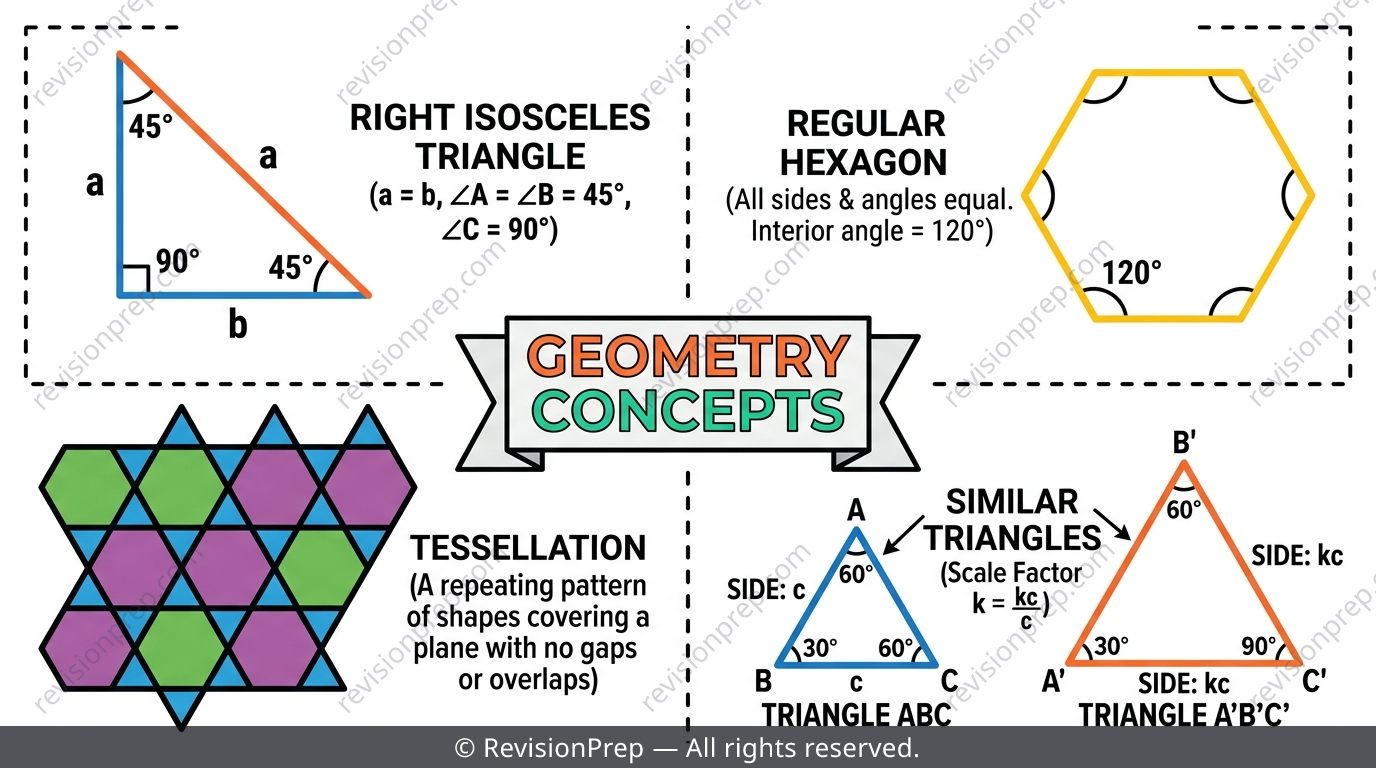
Quick facts
Geometry – Properties of Shape is one of the most consistently tested strands in IB MYP 3 mathematics, showing up in nearly every Shape and Space assessment task. The core skill examiners look for is always the same: describe a shape, name the exact rule that justifies your description, then apply it to real numbers. This teaser covers the five ideas that carry the most marks — triangle classification by angle and side, polygon angle-sum formulas, the Pythagorean inequality test for acute/right/obtuse triangles (including how measurement error can flip a classification), symmetry and tessellation rules, and congruence versus similarity with scale factor effects on area and volume. Precision of language matters here — 'isosceles' needs a stated reason, not just a label. Read on for the highlights, then dive into the full revision note for worked examples and every exam trap.
What you’ll be able to do
Classifying Triangles: Angles AND Sides
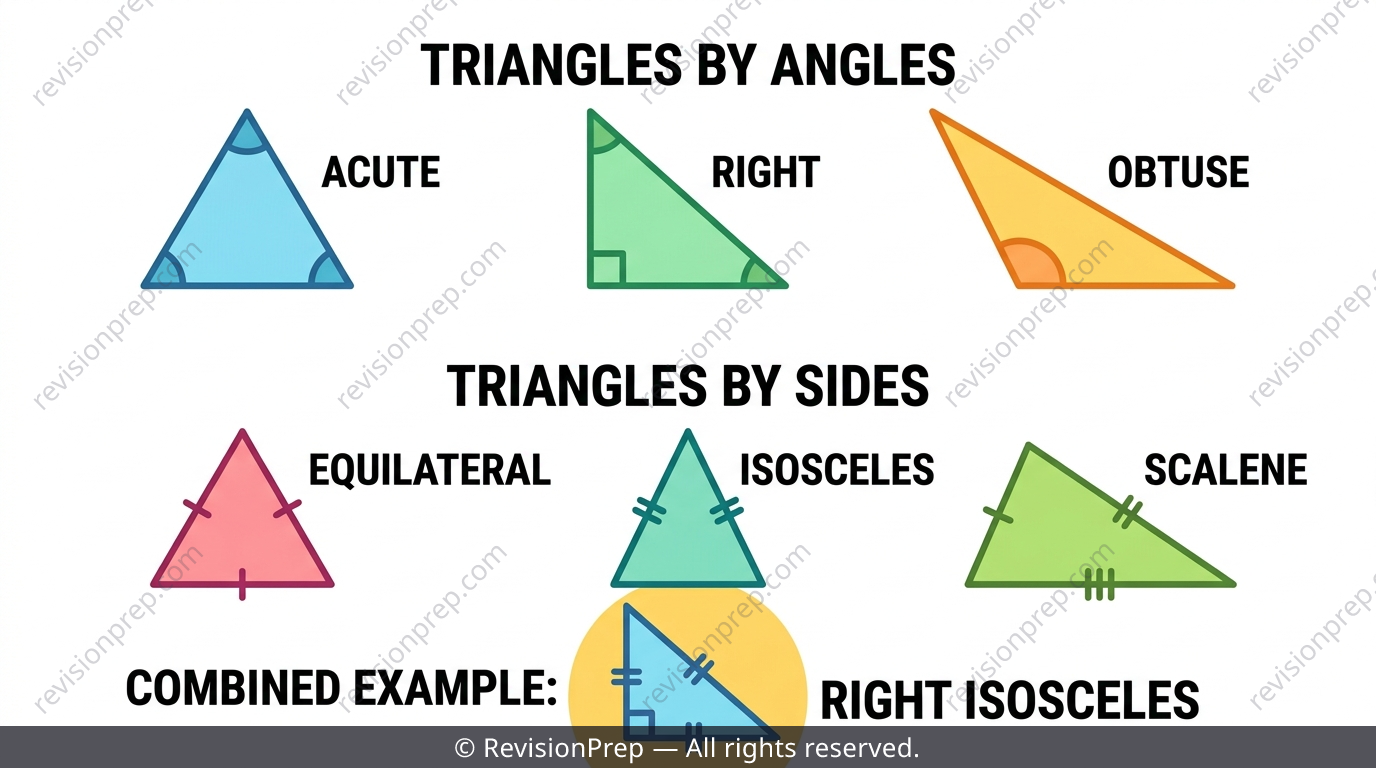
Triangles are classified on two independent systems: by angle (acute, right, obtuse) and by side (equilateral, isosceles, scalene). A full classification needs both labels — 'right isosceles' is a complete, commonly tested answer. Check the two systems separately, since a triangle can be obtuse and scalene, or right and isosceles, but equilateral only ever pairs with acute.
| Basis | Type | Rule |
|---|---|---|
| Angles | Acute | All three angles under 90° |
| Angles | Right | Exactly one angle equals 90° |
| Angles | Obtuse | Exactly one angle over 90° |
| Sides | Equilateral | Three equal sides, automatically 60° angles |
| Sides | Isosceles | Exactly two equal sides, opposite angles equal |
| Sides | Scalene | No equal sides, no equal angles |
Exam tip
When asked to 'justify' whether a triangle could be isosceles, list the actual angle values and check for an exact equality — a rough visual guess earns nothing.
Common mistake
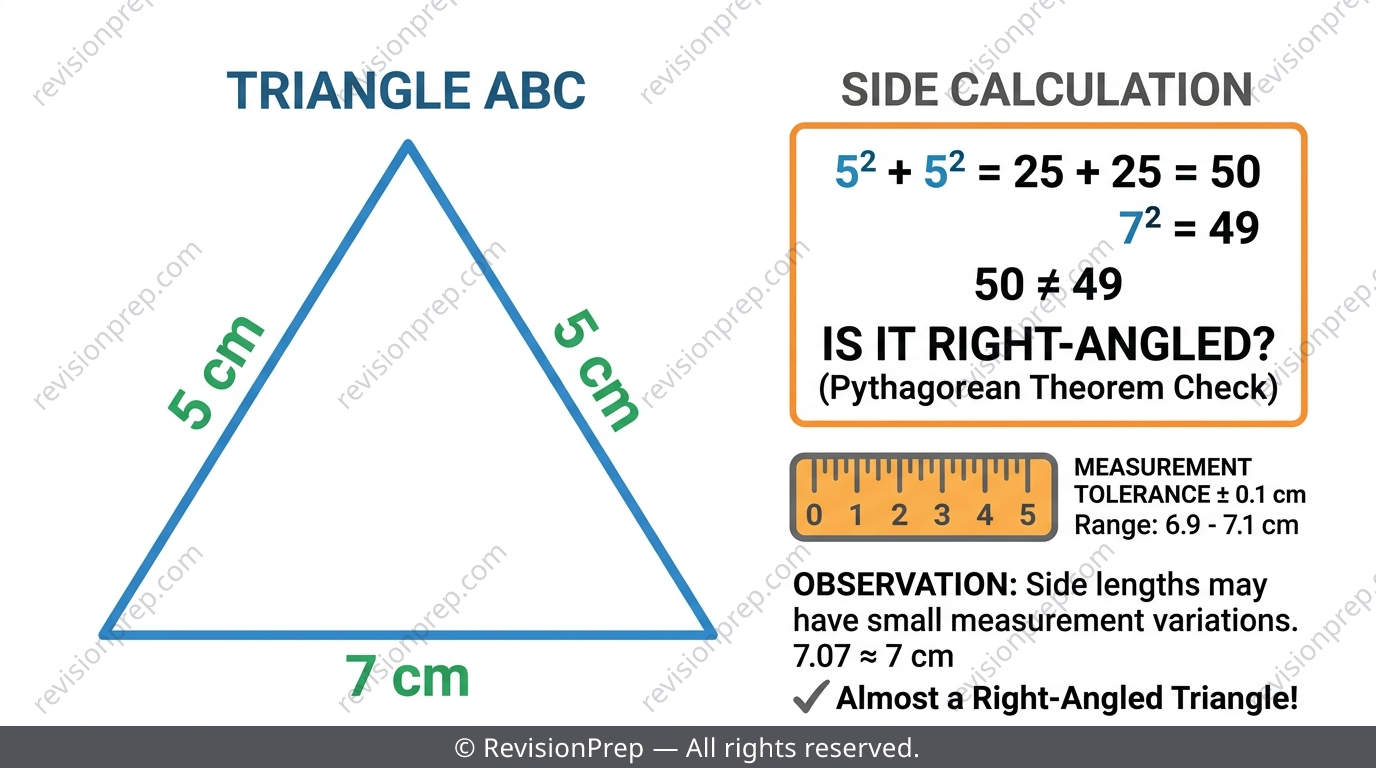
Assuming an isosceles triangle (e.g. 5, 5, 7 cm) must have neat angles or be right-angled — always test with the Pythagorean inequality instead of guessing.
Polygon Interior and Exterior Angle Sums
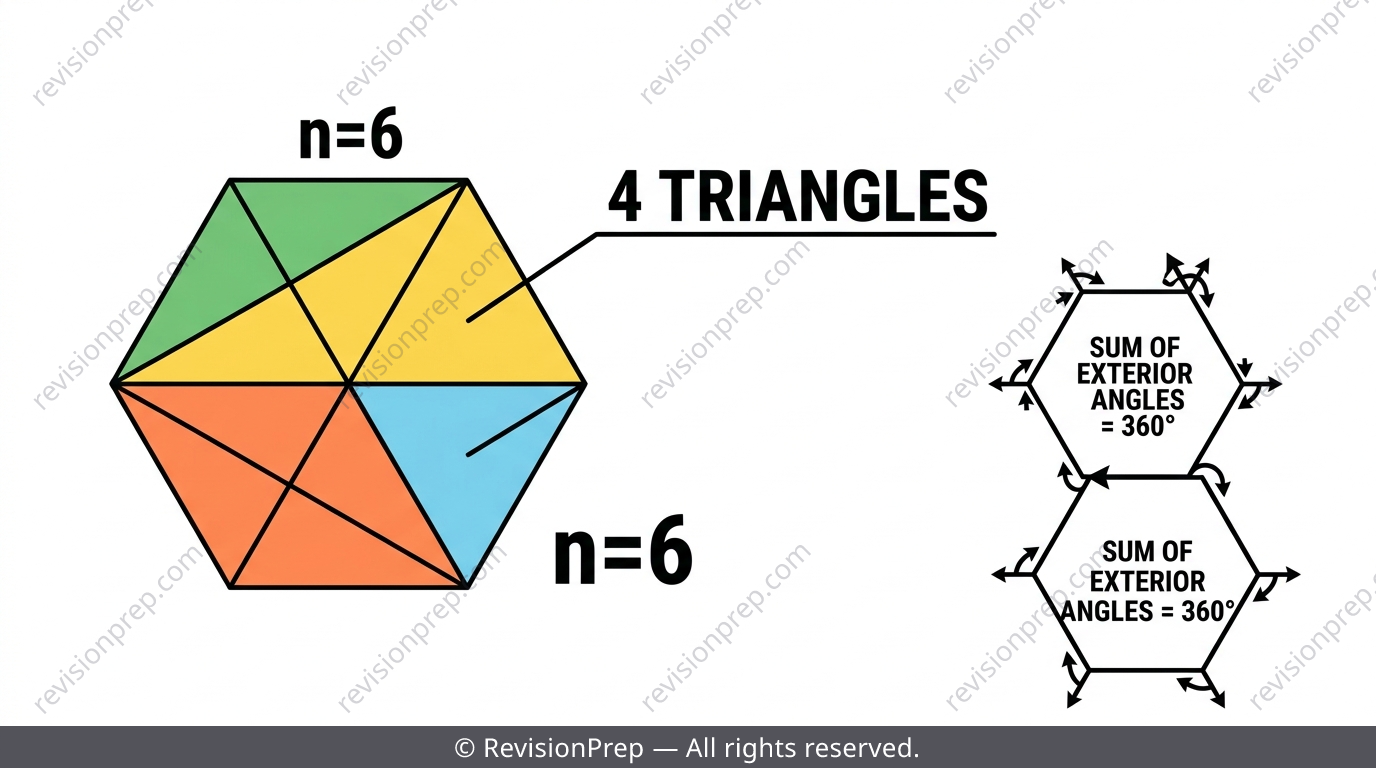
The interior angle sum of any convex -gon is , found by splitting the polygon into triangles from one vertex. Exterior angles of any convex polygon always sum to , regardless of the number of sides. For a regular -gon, each interior angle equals .
Exam tip
Remember the split-into-triangles idea when you forget the formula — it rebuilds instantly under exam pressure.
Mini summary
Interior sum = ; exterior sum is always ; regular polygon interior angle = interior sum ÷ n.
The Pythagorean Inequality & Measurement Error
To classify a triangle as acute, right, or obtuse from side lengths alone, compare with , where is the longest side. Mark schemes reward showing both numbers side by side (e.g. '50 vs 49') rather than a bare final answer. Real measurements carry tolerance, and that tolerance can genuinely shift which category a triangle falls into — check whether lands inside the stated error range before claiming certainty.
Exam tip
Always write and as two separate numbers before concluding acute/right/obtuse — this earns the method mark even if your final word is wrong.
Common mistake
Adding the full tolerance to every measured angle (e.g. +2° to each of 90°, 45°, 45°) gives a set summing to more than 180° — pick tolerance-band values that still sum to exactly 180°.
Symmetry and Tessellations
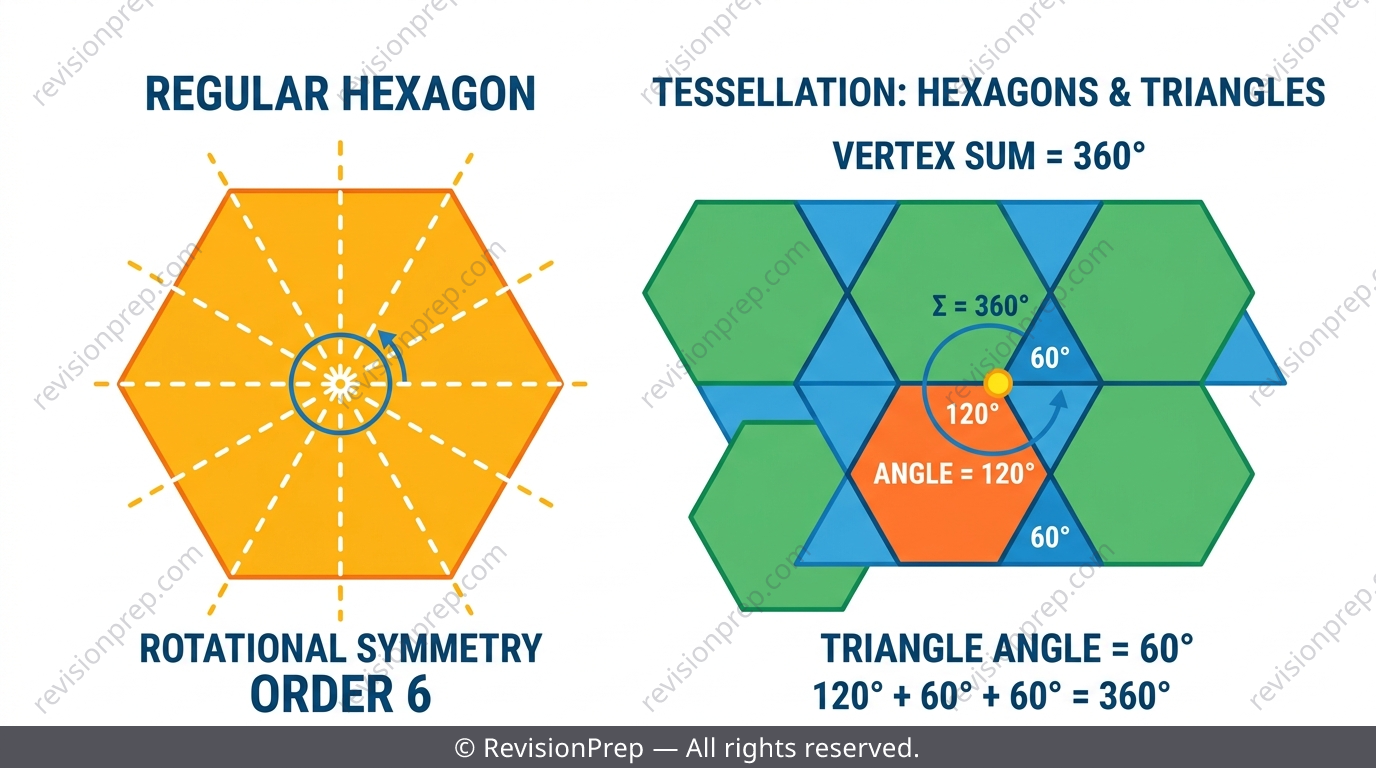
Line symmetry counts the fold lines that map a shape onto itself; rotational symmetry counts how many times a shape matches itself within one full turn, called its order. A regular -gon always has lines of symmetry and rotational symmetry of order . A shape tessellates alone only if its interior angle divides exactly — true for equilateral triangles, squares, and regular hexagons, but false for regular pentagons.
Exam tip
Test rotational symmetry by physically rotating the shape and finding the smallest angle under 360° where it looks identical — don't assume a symmetric-looking shape automatically has order 2 or higher.
Common mistake
Assuming a shape with no lines of symmetry (like a non-rectangular parallelogram) also has no rotational symmetry — it can still have rotational symmetry of order 2.
Congruence and Similarity
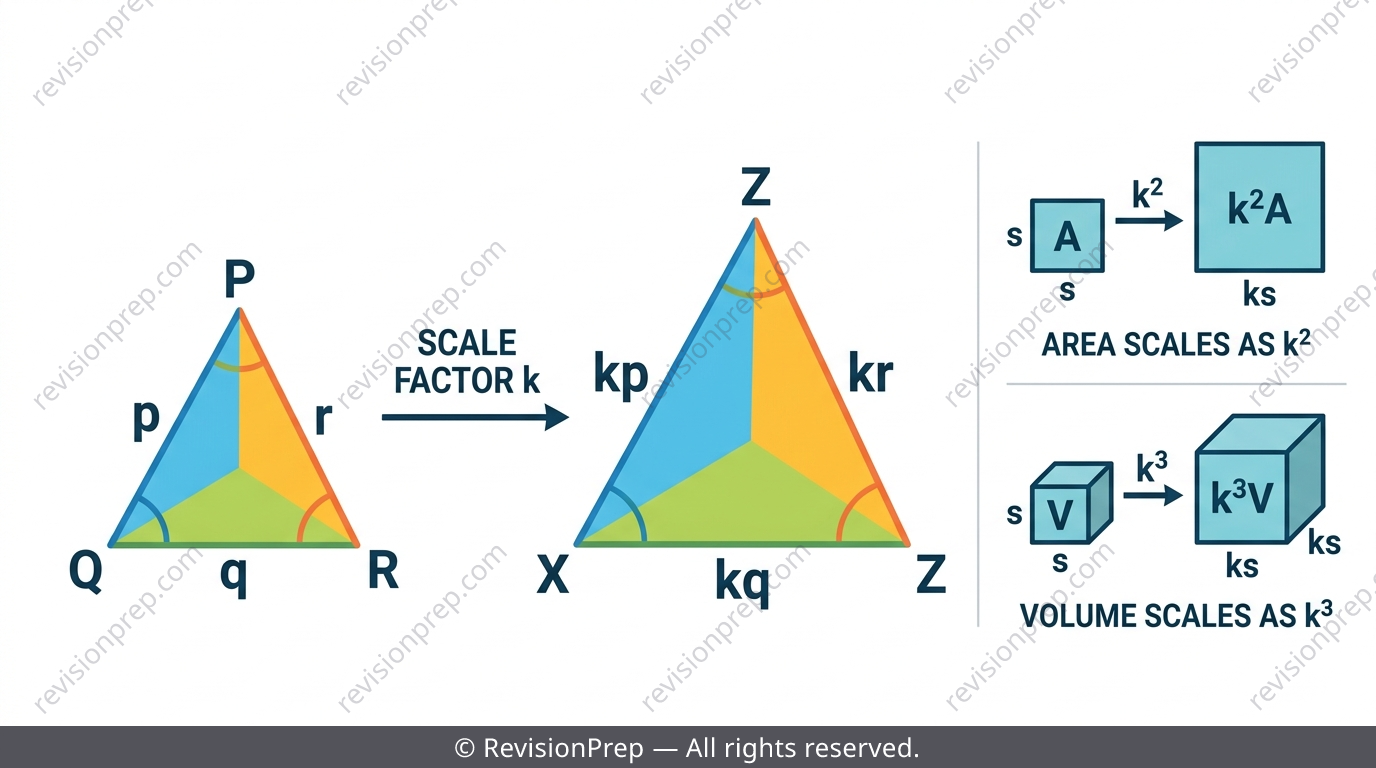
Congruent shapes match exactly in every side and angle, proven with minimum tests: SSS, SAS, ASA, AAS, and RHS (right triangles only). Similar shapes have equal corresponding angles and sides in a fixed ratio, the scale factor , proven with AA, SAS, or SSS similarity tests. Scale factor stretches length by , but area scales by and volume by , since area and volume are two- and three-dimensional measurements.
Exam tip
Writing claims a specific vertex correspondence — get the letter order wrong and you've matched the wrong sides.
Common mistake
Using the linear scale factor directly on an area or volume instead of squaring it for area or cubing it for volume.
Quick formula sheet
Practice questions
- Classify a triangle with sides 6 cm, 6 cm, 6 cm by both angle type and side type.
- Find the sum of interior angles of a hexagon.
- State whether a non-square rectangle can tessellate alone on a flat plane.
- A triangle has sides 9 cm, 12 cm, and 15 cm. Use the Pythagorean inequality to determine if it is acute, right, or obtuse, showing both numbers.
- Two similar triangles have a scale factor of 3. If the smaller triangle has an area of 10 cm², find the area of the larger triangle.
- A regular polygon has an exterior angle of 40°. How many sides does it have?
- A steel truss measures 8.0 m, 15.0 m, and 17.0 m using a rangefinder accurate to ±0.2 m. Classify the triangle and discuss whether the uncertainty could change your conclusion.
- Show that a semi-regular tessellation can be built from two regular hexagons and two equilateral triangles meeting at a single vertex.
- Two similar solids have a linear scale factor of 1.5. Find the ratio of their surface areas and the ratio of their volumes.
Frequently asked questions
What's the difference between congruent and similar shapes?+
Congruent shapes are identical in every measurement — matching sides and angles are exactly equal. Similar shapes have equal corresponding angles but sides in a fixed ratio, the scale factor k.
How do I know if a triangle is acute, right, or obtuse from side lengths?+
Compare to where c is the longest side. If it's acute, if equal it's right, and if less it's obtuse — always show both numbers.
Why do exterior angles of any convex polygon always add to 360°?+
As you walk around the polygon's perimeter, you make one full turn overall regardless of the number of sides, so the exterior angles must total exactly 360°.
Do all shapes have rotational symmetry?+
No. Only shapes that map onto themselves after a rotation of less than 360° have rotational symmetry of order greater than 1 — you must test this by rotating, not by looking.
How does scale factor affect area and volume?+
Length scales by k, but area scales by and volume scales by , because area and volume involve multiplying two or three linear dimensions.
What's the safest way to answer a 'could this triangle be isosceles' justify question?+
Calculate the exact angle values and check for a genuine equality between two of them — isosceles requires exact equality, not values that merely look close.
Get the Full MYP 3 Geometry Revision Notes
Related articles