
Physics: Why Electrical Insulation Degrades Over Time
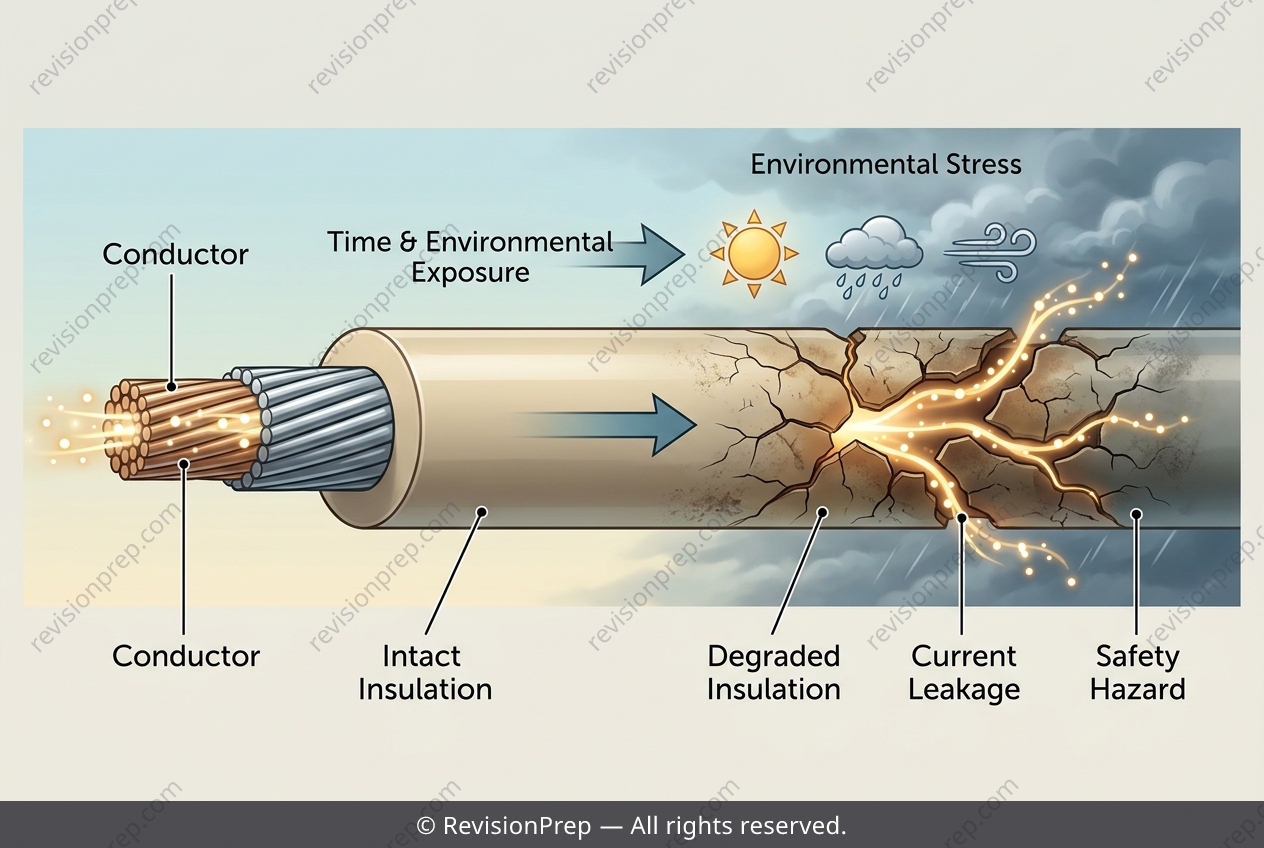
Electrical insulation is the unseen barrier that keeps current where it belongs. Materials like rubber are insulators: their electrons are tightly bound, so current cannot flow freely through them. Copper, by contrast, is a conductor, packed with delocalised electrons that carry charge with little resistance. Wrapping a conducting core in an insulating sheath exploits this contrast — the copper carries the current, while the rubber confines it, preventing shock to anyone or anything that touches the line. That protection is not permanent. Sunlight, rain, and wind act on insulation over years: UV radiation makes rubber brittle and prone to cracking, water seeps into those cracks, and wind abrades the surface against supports. Once the sheath fails, the live conductor beneath is exposed, creating risks of electric shock, short circuits, and fire. Insulation degradation is therefore a safety issue, not just a materials one — the same properties that make a material a good insulator determine how long it can keep us safe.
Start practising IB questions today
150,000+ IB-styled questions, criteria-mapped and instantly accessible.