
Waves, Sound and Light
The IB MYP 3 core physics strand, decoded: light, sound, colour, pitch and what happens at a boundary.
Quick facts
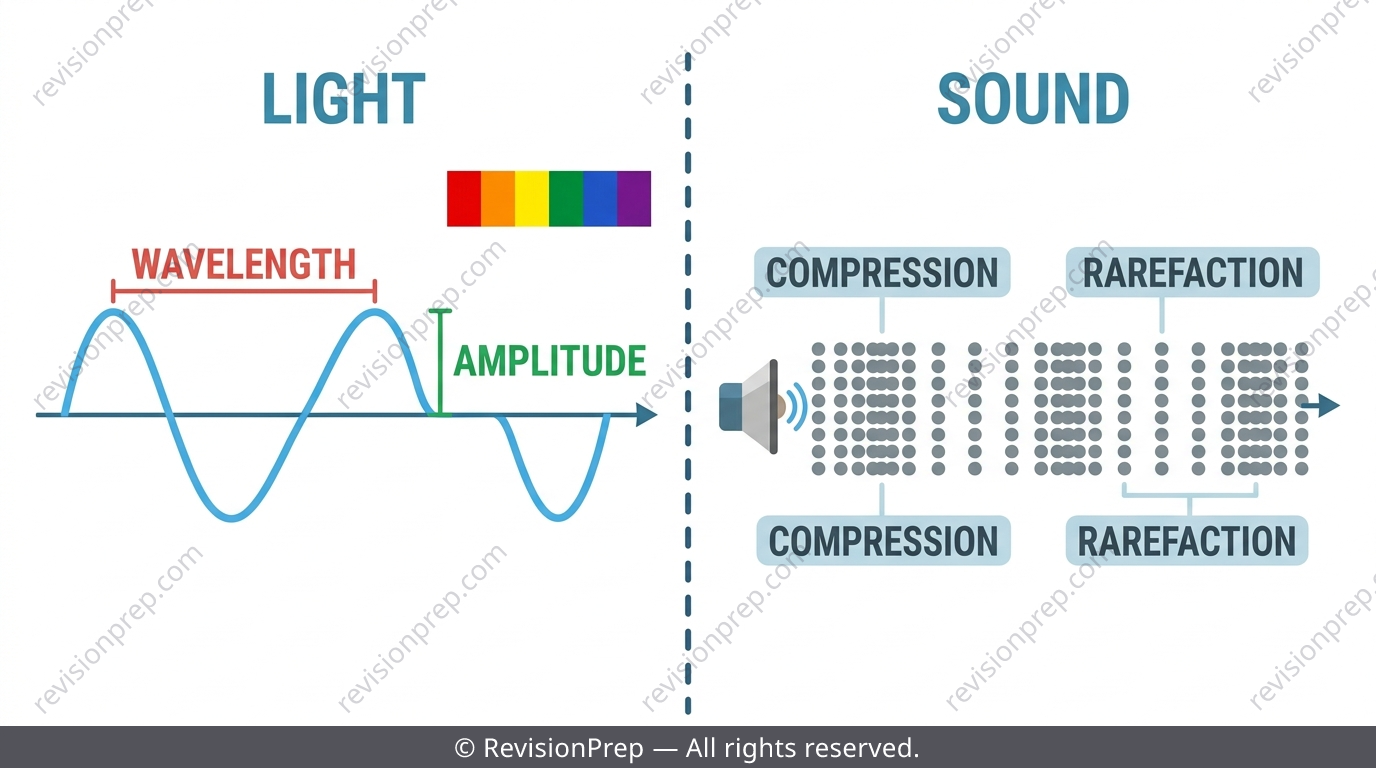
Waves, Sound and Light is one of the most recurring strands in IB MYP 3 Sciences — it shows up in unit tests, data-based tasks, and on-screen assessments again and again. The trick is keeping light and sound straight: light is a transverse wave that needs no medium and travels at m/s, while sound is a longitudinal wave that needs a medium and travels much slower, around 340 m/s in air. Colour and pitch both come from frequency/wavelength; brightness and loudness both come from amplitude. Add in what happens when waves hit a boundary — reflection and refraction — and you've got the whole core physics strand in one connected picture. This teaser walks through the five ideas examiners test most, with the common traps students fall into and how to avoid them. For the full breakdown with worked examples, head to the complete revision note.
What you’ll be able to do
Light vs Sound: The Two Halves of This Topic
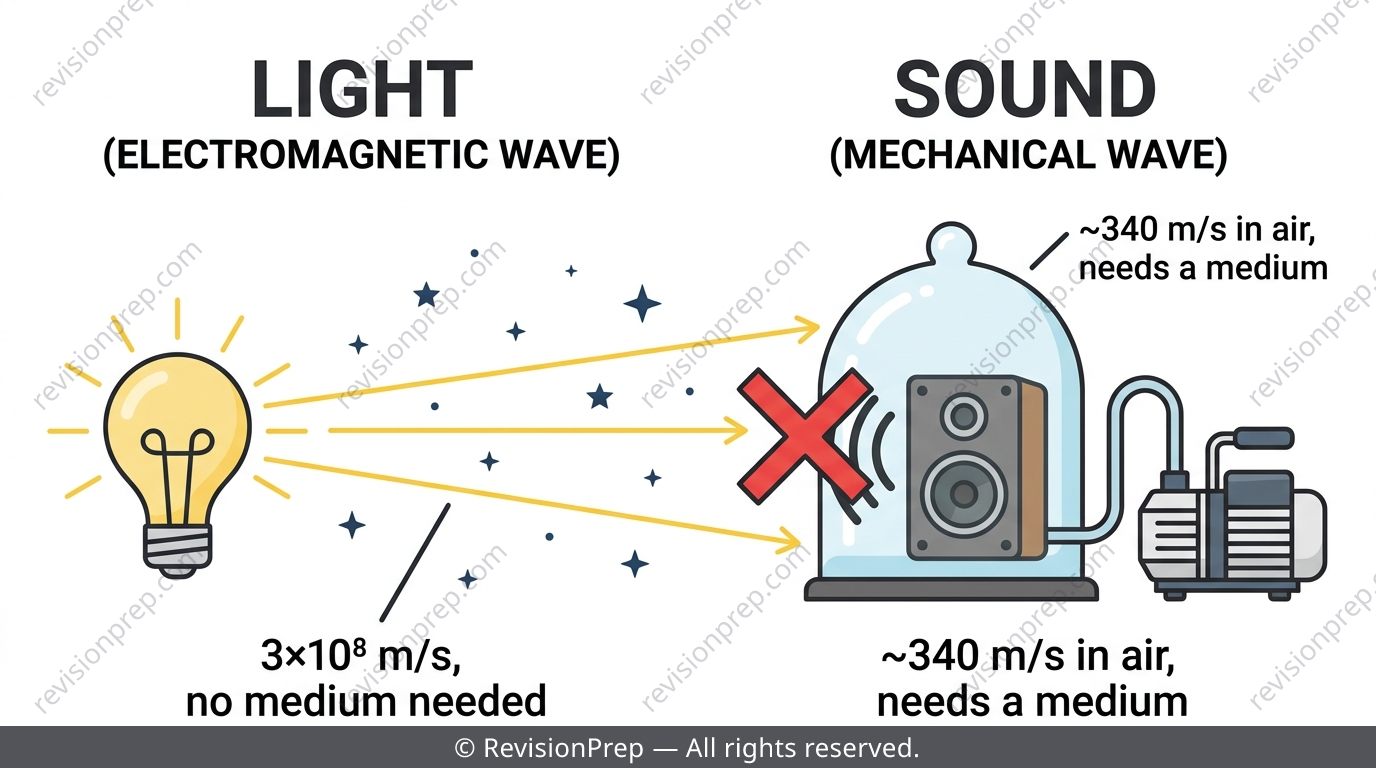
A wave transfers energy without transferring matter — the medium (or the EM field, for light) just wobbles in place while the disturbance moves on. Light is transverse and needs no medium, travelling at m/s in a vacuum; sound is longitudinal and needs a medium, travelling much slower — about 340 m/s in air. Keep this contrast in your head and most exam questions become a matter of sorting facts into the right column.
Exam tip
If a question mentions 'travels through space' or 'vacuum', it's testing light. If it mentions 'cannot be heard on the Moon' or similar, it's testing sound needing a medium.
Mini summary
Light = transverse, no medium, fast. Sound = longitudinal, needs a medium, slower.
Colour and the Electromagnetic Spectrum
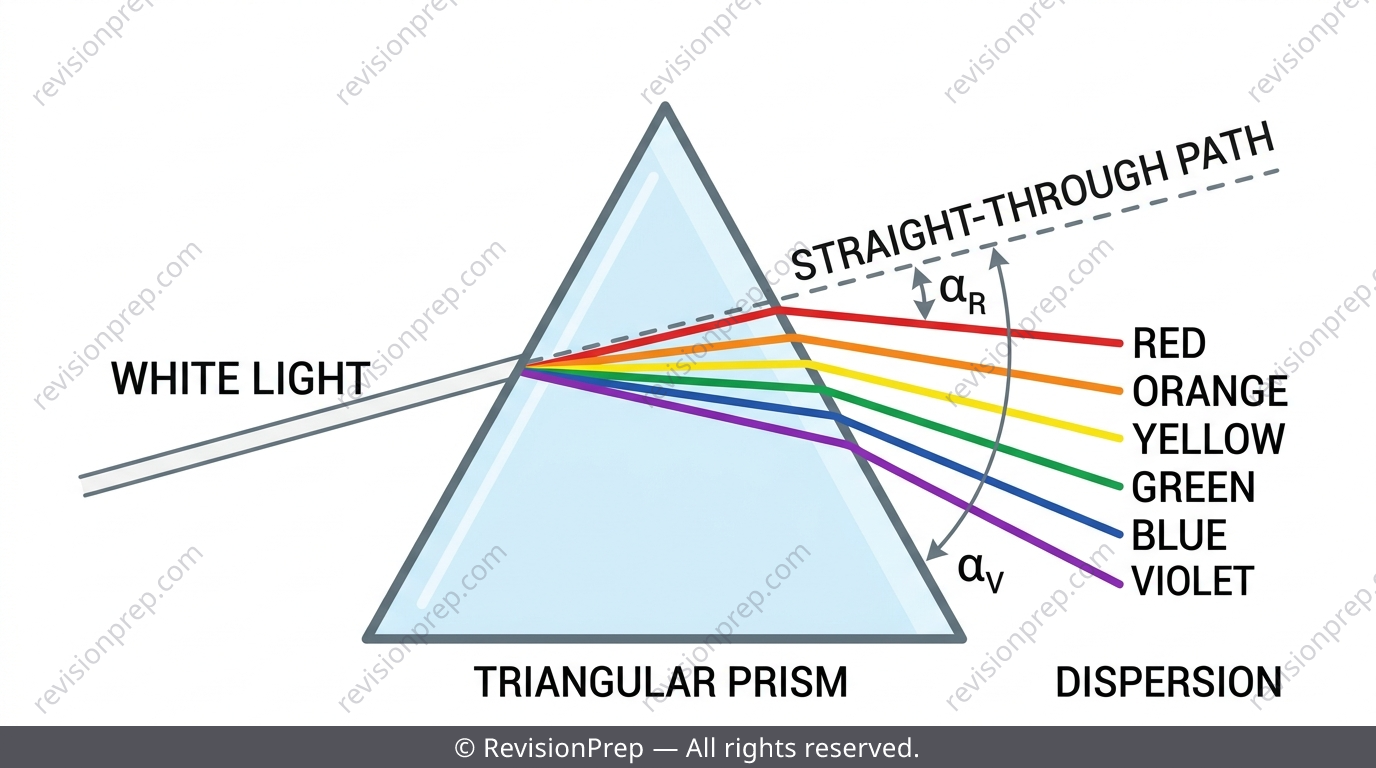
Visible light is a tiny 400–700 nm slice of the EM spectrum, and colour is coded by wavelength: red is longest, violet is shortest. A prism disperses white light because each wavelength refracts by a slightly different amount — violet bends most, red bends least. Filters and gels don't create colour; they subtract every wavelength except the one they transmit, so light labelled 'green' from a gel is usually a narrow band or mixture of wavelengths, not one pure spectral colour.
Exam tip
For 'is this pure spectral colour?' questions, always state the transmitted light is a band/mixture of wavelengths clustered around a hue — never just 'it looks green'.
Common mistake
Calling a filter/gel result 'the light being made green' — it's subtraction. White light already contains green; the filter just removes everything else.
Mini summary
Red = long wavelength, violet = short. Prisms disperse by unequal refraction; filters subtract, they never add colour.
Sound Waves: Compressions and Rarefactions
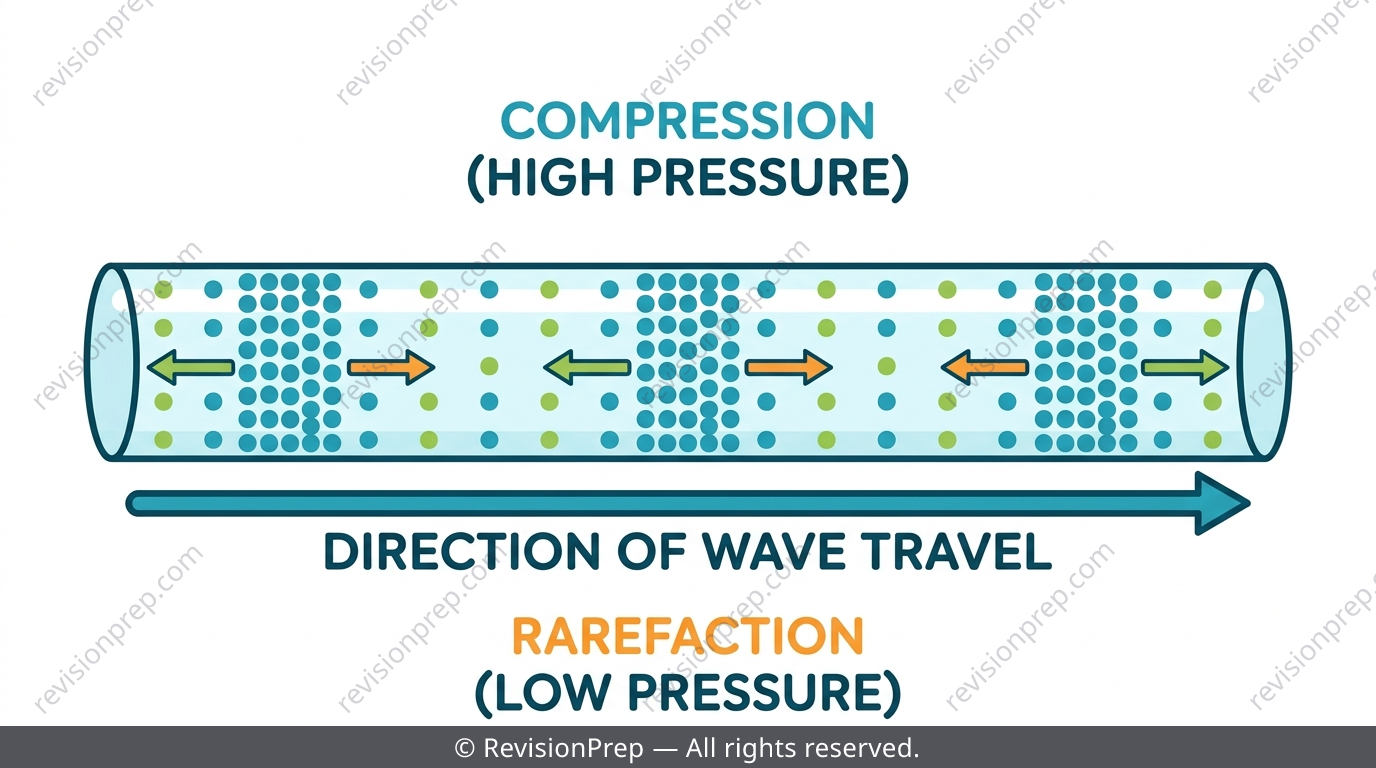
Sound comes from a vibrating source pushing and pulling on particles of a medium, creating a longitudinal wave — particle motion is parallel to the direction of travel, not sideways. A compression is where particles bunch together (higher pressure); a rarefaction is where they spread out (lower pressure). Speed of sound depends on the medium: fastest in solids, slower in liquids, slowest in gases like air (~340 m/s).
Common mistake
Thinking sound particles move sideways because the pressure-vs-distance graph looks like a sine curve. That's a graph of pressure, not a picture of particle motion — the particles themselves oscillate back and forth along the direction of travel.
Mini summary
Sound is longitudinal: compressions (high pressure) and rarefactions (low pressure) travel through a medium, fastest in solids and slowest in gases.
Pitch vs Loudness: Two Independent Properties
Frequency gives sound its pitch; amplitude gives it its loudness — and the two vary completely independently. A sound can be high-pitched and quiet, or low-pitched and loud, in any combination. Human hearing spans roughly 20 Hz to 20,000 Hz; below that is infrasound, above it ultrasound, both inaudible to us but usable by technology and some animals. Loudness is measured in decibels (dB), and prolonged exposure above about 85 dB risks hearing damage.
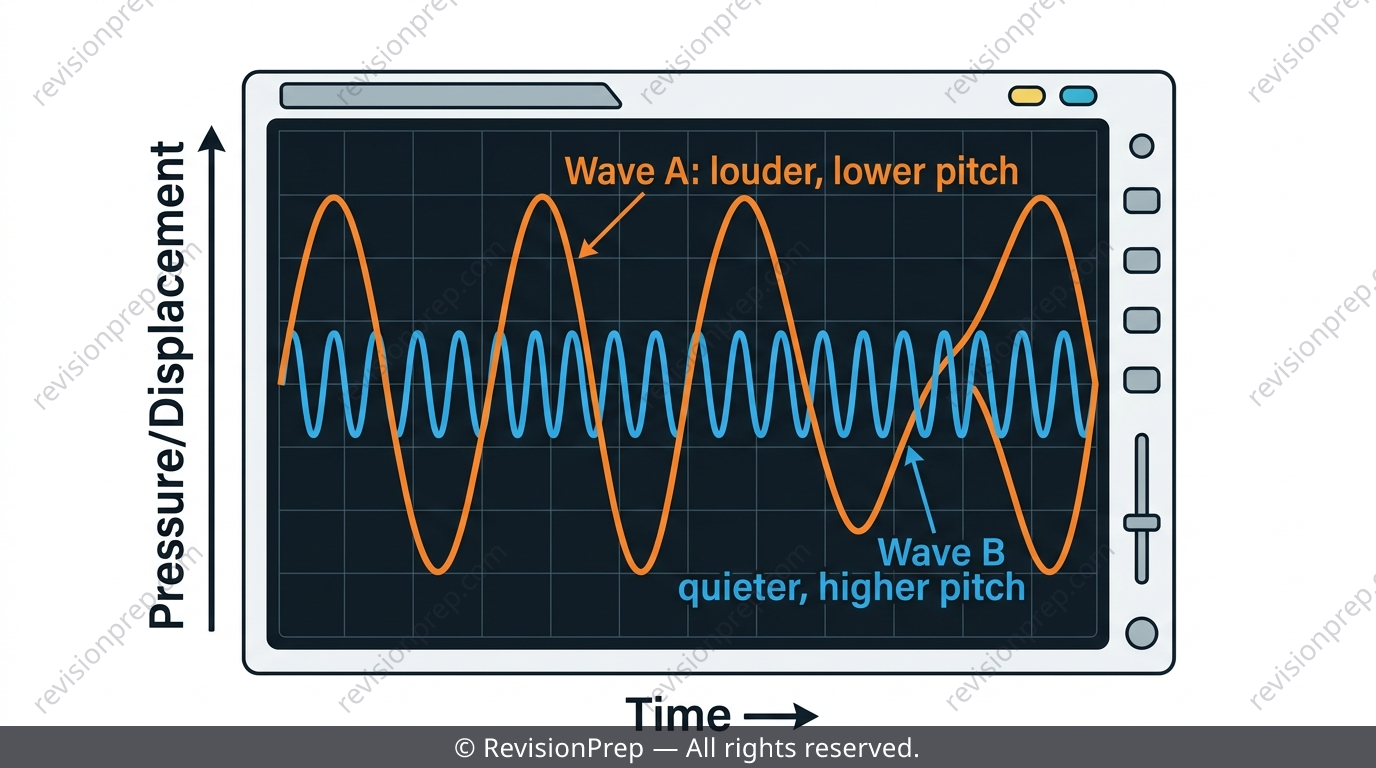
| Property | Depends on | Unit | Perceived as when increased |
|---|---|---|---|
| Pitch | Frequency | Hz | Higher note |
| Loudness | Amplitude | dB | Louder sound |
Exam tip
For 'compare pitch and loudness' questions, write two separate sentences — one for frequency/pitch, one for amplitude/loudness. Blending them loses comparison marks.
Common mistake
Assuming 'bigger wave = higher pitch'. Amplitude controls loudness only; frequency/wavelength/period controls pitch — a wave can be big and low, or small and high.
Mini summary
Pitch ← frequency; Loudness ← amplitude. They're independent, and hearing range is roughly 20 Hz–20 kHz.
Reflection and Refraction at a Boundary
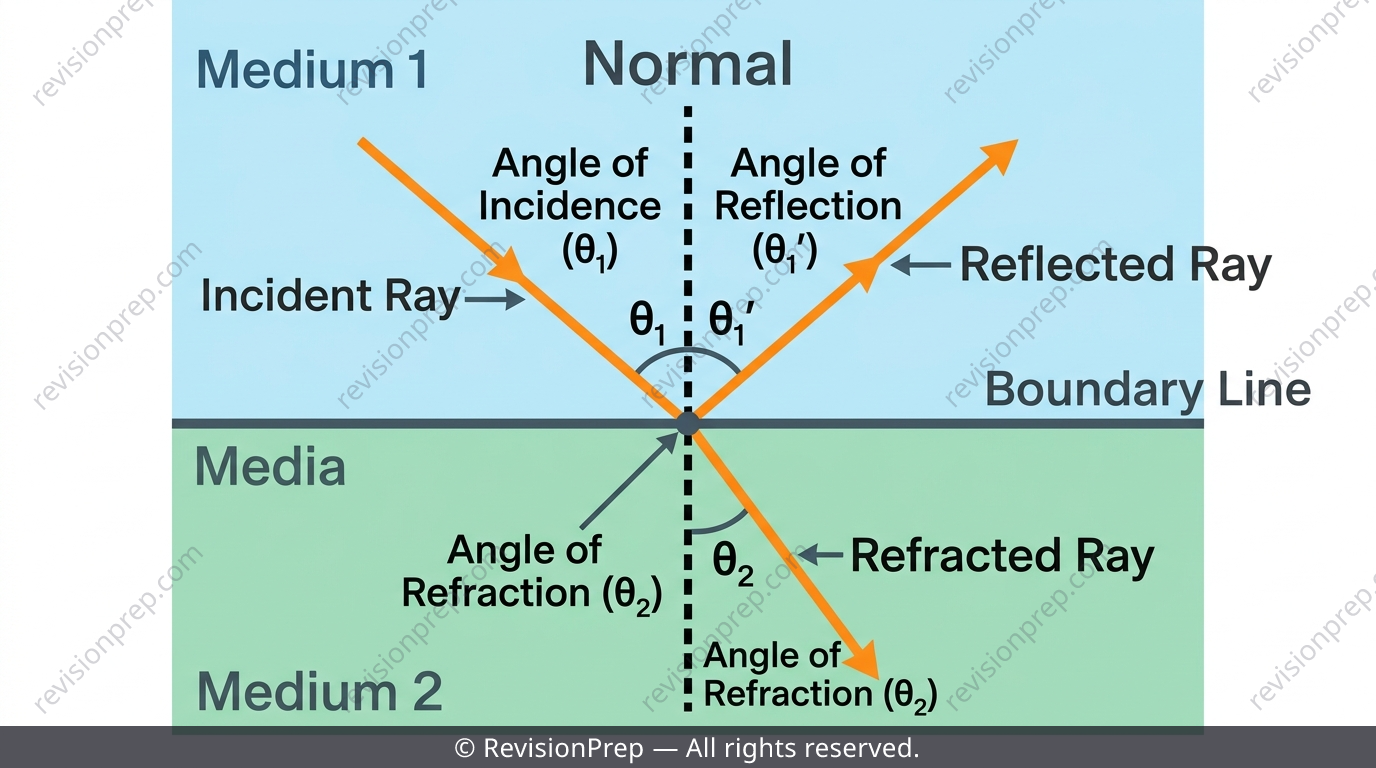
Whether it's light or sound, when a wave meets a boundary between two media, it either bounces back (reflection) or bends and carries on into the new medium (refraction). The prism example is refraction in action: light slows down entering glass and speeds up leaving it, and because different wavelengths slow by different amounts, dispersion happens as a direct result.
Mini summary
At a boundary, a wave reflects (bounces back) or refracts (bends and continues) — dispersion in a prism is refraction happening differently for each wavelength.
Quick formula sheet
Practice questions
- State whether light and sound are transverse or longitudinal waves.
- Which visible colour has the longest wavelength, and which has the shortest?
- Give the approximate speed of sound in air and the speed of light in a vacuum.
- Explain why sound cannot travel through a vacuum but light can.
- A tuning fork vibrates at 320 Hz in air (speed 340 m/s). Calculate its wavelength.
- Explain why a red filter appears red in terms of subtraction, not addition of colour.
- Two waves on an oscilloscope: Wave X has a larger amplitude and shorter period than Wave Y. Compare their pitch and loudness with reasoning.
- Explain, using the idea of refraction, why violet light bends more than red light when passing through a glass prism.
- A student claims sound particles move up and down as they travel. Using the terms compression and rarefaction, explain why this is incorrect.
Frequently asked questions
What's the main difference between light waves and sound waves?+
Light is a transverse wave that needs no medium and travels extremely fast ( m/s in a vacuum); sound is a longitudinal wave that needs a medium (solid, liquid or gas) and travels much slower — about 340 m/s in air.
Why does colour depend on wavelength?+
Each wavelength of visible light is perceived by the eye as a different colour — red has the longest visible wavelength, violet the shortest — so changing wavelength changes the colour we see.
Do coloured filters create colour or remove it?+
They remove colour. A filter or gel absorbs every wavelength of white light except the one(s) it transmits — it subtracts, it never adds a new colour that wasn't already in the white light.
What determines pitch and what determines loudness?+
Pitch depends on frequency — higher frequency means a higher-pitched sound. Loudness depends on amplitude — a bigger amplitude means a louder sound. The two vary independently of each other.
What is the human range of hearing?+
Roughly 20 Hz to 20,000 Hz (20 kHz). Sounds below this range are called infrasound and sounds above it are ultrasound — both inaudible to humans.
Is this blog enough to fully revise Waves, Sound and Light for MYP 3?+
This teaser covers the five most-tested ideas, but the full revision note on RevisionPrep includes complete worked examples, all definitions, and extra exam-style practice for deeper revision.
Get the Full Waves, Sound and Light Revision Note
Related articles