
Earth and Space Science
Weathering, the Solar System, Moon phases and eclipses — the five ideas MYP 3 examiners test most
Quick facts
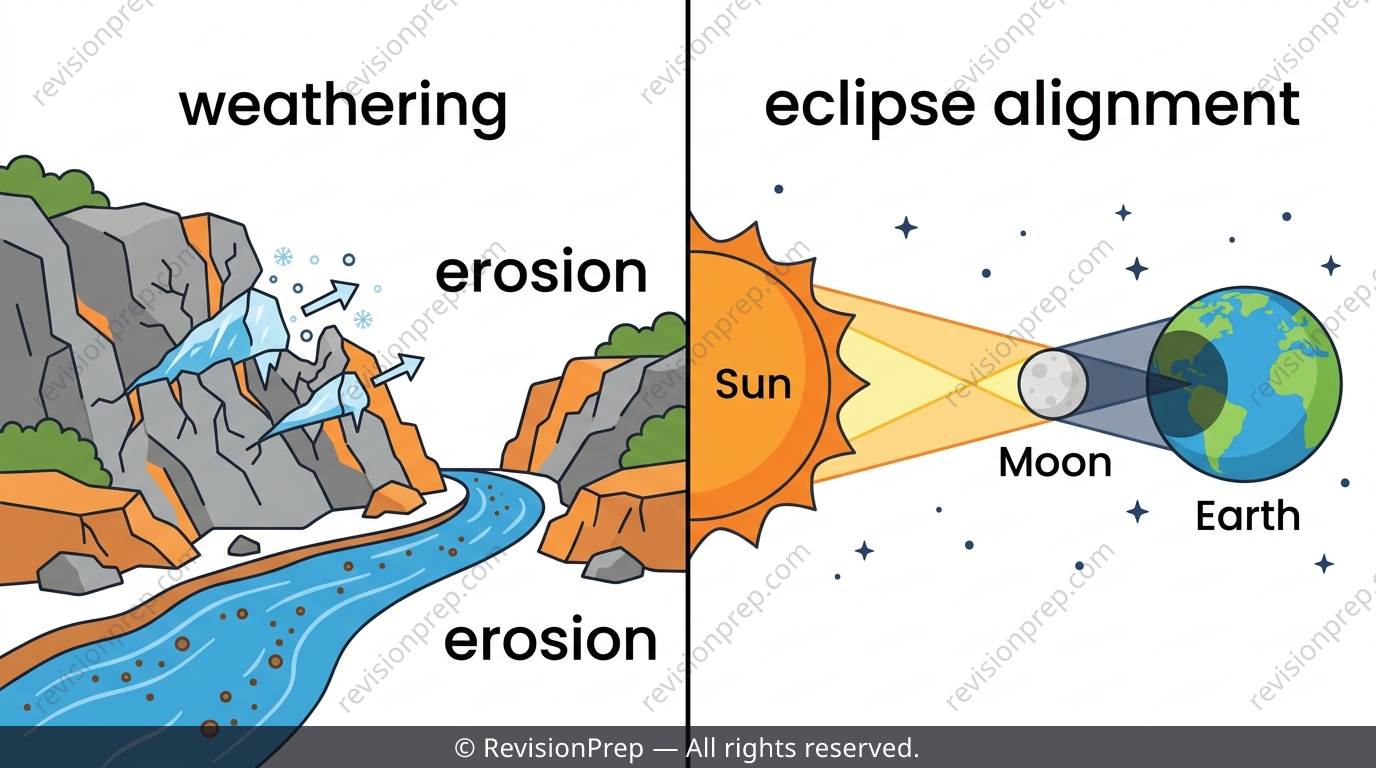
Earth and Space Science in IB MYP 3 stretches from the ground beneath your feet to the Sun-Earth-Moon system millions of kilometres away. On the surface, weathering, erosion and deposition slowly break down and move rock — and MYP examiners love data-based questions on measuring these rates. Zoom out and the Solar System sorts planets into small rocky worlds and giant gas planets, with dwarf planets like Pluto in a category of their own. Zoom in on geometry, and the Moon's changing phases and the rare alignments that cause solar and lunar eclipses become logical rather than mysterious. This blog is a fast teaser through the five ideas that appear most often in MYP 3 short-answer and data questions. For full definitions, diagrams, worked examples and every common mistake explained, the complete revision note has everything you need before your assessment.
What you’ll be able to do
Weathering, Erosion and Deposition — Don't Mix Them Up
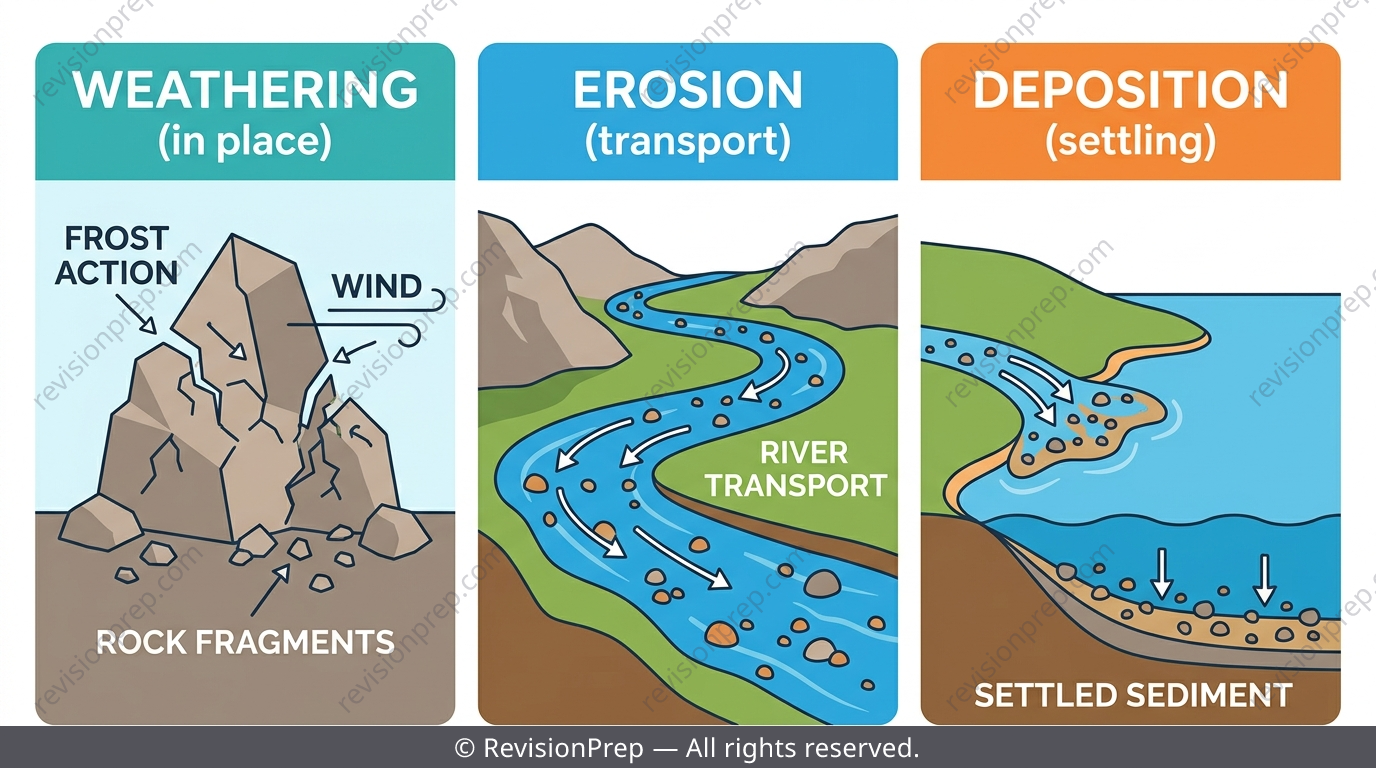
Weathering breaks rock down WHERE IT SITS, with no movement involved. Erosion is the next step: an agent like water, wind, ice or gravity picks up the broken fragments and carries them away. Deposition happens when that agent runs out of energy and drops the sediment. Mixing these three up is one of the most common ways students lose marks even when they understand the science.
Exam tip
If a question asks you to define weathering, never mention transport or movement — that belongs to erosion.
Common mistake
Writing 'the rock is worn away and carried down the river' when asked to define weathering — that describes erosion, not weathering.
Mini summary
Weathering = breakdown in place; erosion = transport; deposition = settling.
Mechanical, Chemical and Biological Weathering
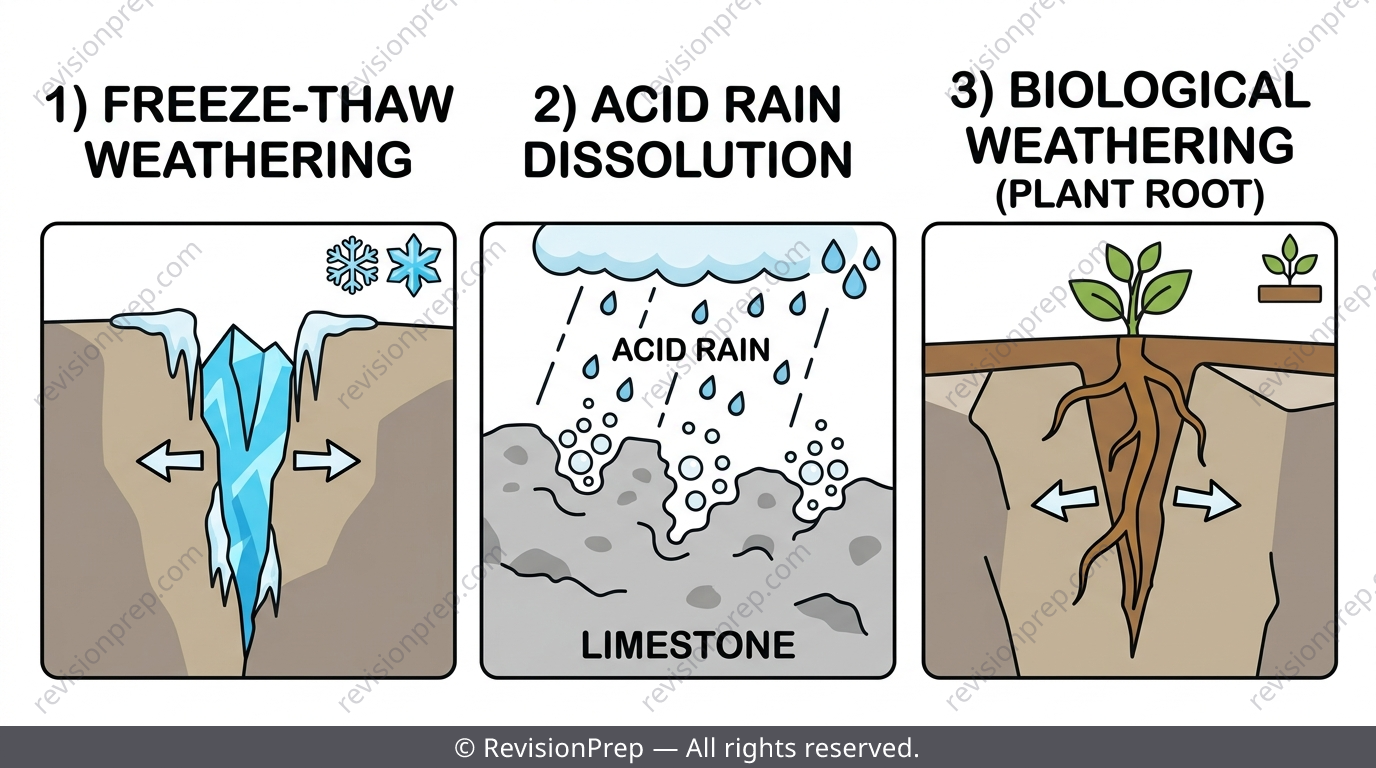
Mechanical weathering breaks rock into smaller pieces without changing its chemistry — freeze-thaw action, exfoliation and abrasion are classic examples. Chemical weathering actually changes the mineral composition, such as acid rain dissolving limestone or iron oxidising to a reddish colour. Biological weathering is caused by living things, like plant roots widening cracks or burrowing animals exposing fresh rock.
Exam tip
For freeze-thaw questions, build the answer as a chain: water enters crack → freezes → ice expands (~9% more volume) → pressure on crack walls → rock fractures. Missing a named keyword like 'expansion' or 'pressure' costs marks.
Mini summary
Mechanical = physical breakup; chemical = mineral change; biological = living organisms.
Calculating Rate of Weathering
Rate of weathering is measured experimentally, often as mass lost from a rock sample over time, and different rock types can be compared directly. The formula is simple: rate equals mass lost divided by time. Limestone reacts strongly with acid because calcium carbonate reacts directly with it, so it typically weathers far faster than granite or sandstone.
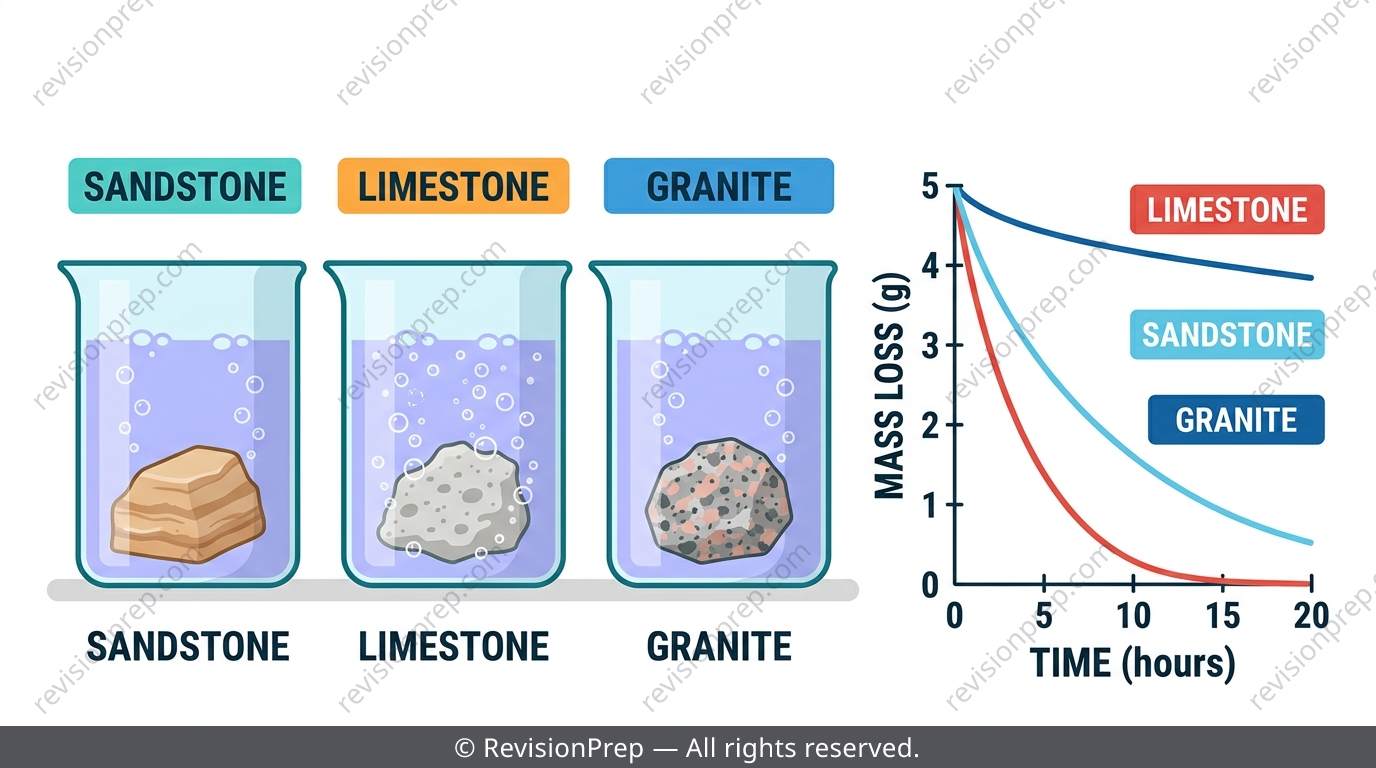
| Rock type | Mass lost (g) | Time (h) | Rate (g/h) |
|---|---|---|---|
| Sandstone | 4.8 | 24 | 0.2 |
| Limestone | 12.0 | 24 | 0.5 |
| Granite | 1.2 | 24 | 0.05 |
Exam tip
Always divide mass loss by the TIME stated in the question — never by the number of samples being compared.
Common mistake
Dividing by the number of rock samples instead of the time given, which produces a completely wrong rate.
Mini summary
Rate = mass lost ÷ time; limestone weathers fastest in acid because it's calcium carbonate.
The Solar System: Inner vs Outer Planets
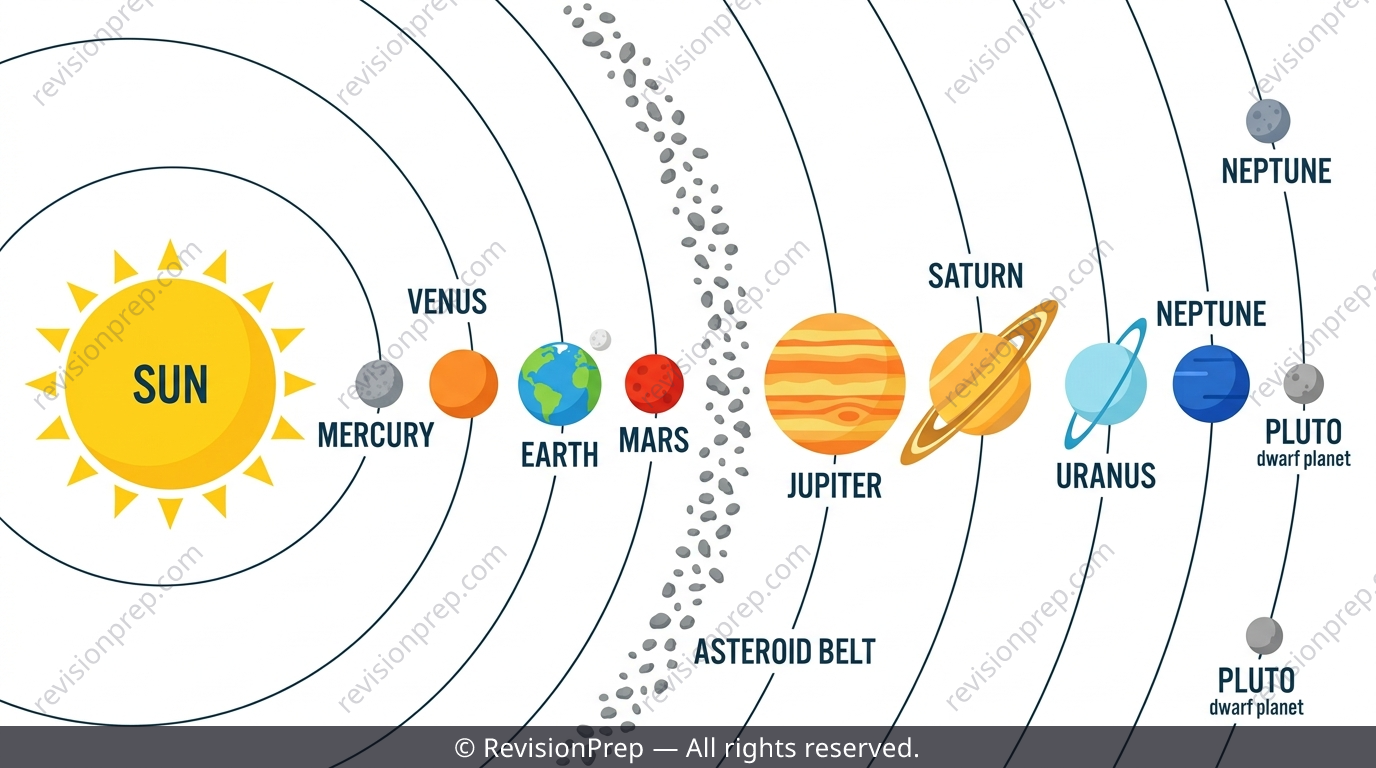
The Solar System is the Sun plus everything gravitationally bound to it — planets, dwarf planets, moons, asteroids and comets. Inner terrestrial planets (Mercury, Venus, Earth, Mars) are small, rocky and dense, while outer gas/ice giants (Jupiter, Saturn, Uranus, Neptune) are large, low-density and made mostly of hydrogen, helium and ices. The asteroid belt between Mars and Jupiter roughly marks the boundary between the two families, and closer planets orbit faster with shorter years.
Exam tip
A planet must clear its orbital neighbourhood of debris — that's exactly why Pluto is classed as a dwarf planet, not a full planet.
Common mistake
Calling Pluto 'the ninth planet' — the eight official planets stop at Neptune.
Mini summary
Inner planets: small, rocky, dense. Outer planets: large, gas/ice-rich. Pluto is a dwarf planet.
Moon Phases and Eclipses
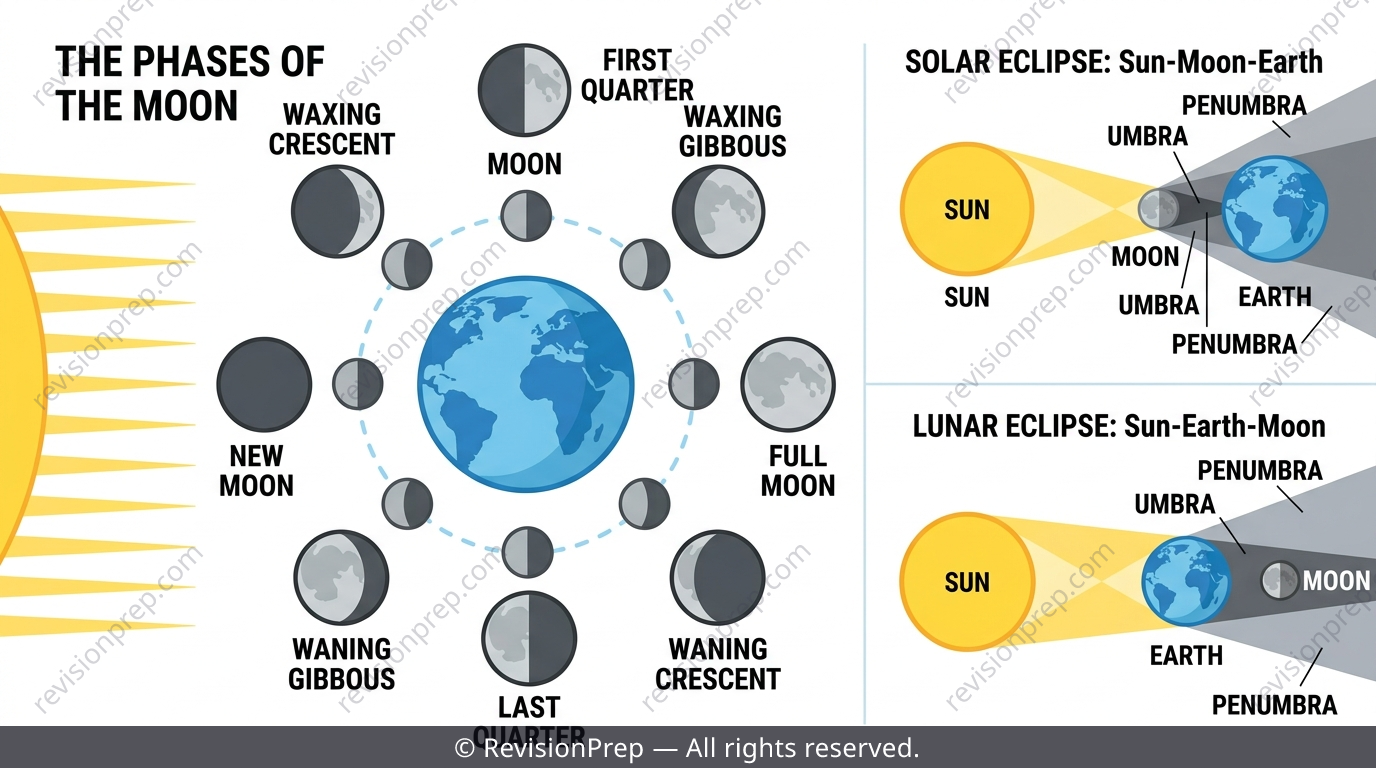
The Moon produces no light of its own — we only see sunlight reflected off it, and half of the Moon is always lit just like half of Earth is always in daylight. Phases occur because the Moon orbits Earth, changing how much of its lit half we can see over about 29.5 days. Eclipses only happen when Sun, Earth and Moon line up almost exactly: a solar eclipse needs the Moon between Sun and Earth (only at new moon), and a lunar eclipse needs Earth between Sun and Moon (only at full moon) — both are rare because the Moon's orbit is tilted about 5°.
Exam tip
Learn the alignment order as a phrase: Solar eclipse = Sun-Moon-Earth; Lunar eclipse = Sun-Earth-Moon.
Mini summary
Phases are about geometry, not light output; eclipses need near-perfect Sun-Earth-Moon alignment.
Quick formula sheet
Practice questions
- Define weathering and explain how it differs from erosion.
- Give one example each of mechanical, chemical and biological weathering.
- State why Pluto is classified as a dwarf planet rather than a planet.
- A rock sample loses 6.0 g of mass over 12 hours in acid. Calculate its rate of weathering in g/h.
- Explain, using the terms expansion, pressure and fracture, how freeze-thaw weathering breaks rock apart.
- Compare one physical feature of inner (terrestrial) planets with one physical feature of outer (gas/ice giant) planets.
- A limestone statue becomes pitted after 50 years in a polluted city. Identify the type of weathering and explain the chemical mechanism, referring to calcium carbonate.
- Explain why a solar eclipse can only occur at new moon and a lunar eclipse can only occur at full moon.
- Sandstone loses 4.8 g and granite loses 1.2 g in acid over the same 24-hour period. Explain, with reference to their composition, why the two rocks weather at different rates.
Frequently asked questions
What is the main difference between weathering and erosion?+
Weathering breaks rock apart in place with no movement, while erosion is when an agent like water, wind, ice or gravity actually carries the broken fragments away.
Why is Pluto not one of the eight planets?+
Pluto orbits the Sun and is roughly spherical, but it hasn't cleared its orbital neighbourhood of other debris, so it's classified as a dwarf planet rather than a full planet.
Why does the Moon have phases if half of it is always lit?+
Phases happen because the Moon orbits Earth, changing how much of its permanently lit half is visible from our viewpoint over about 29.5 days — it's purely about geometry.
When exactly can a solar eclipse happen?+
Only at new moon, when the Moon passes directly between the Sun and Earth, casting its shadow onto Earth's surface.
How do you calculate the rate of weathering from an experiment?+
Divide the mass lost by the rock sample by the exact time given in the question, and give the answer with correct units such as g/h.
Why does limestone weather faster than granite in acid?+
Limestone is made of calcium carbonate, which reacts directly with acids, whereas granite's minerals are far more resistant to acid attack.
Get the Full Earth and Space Science Revision Note
Related articles