
Chemistry: Separation Techniques in Wastewater Recovery
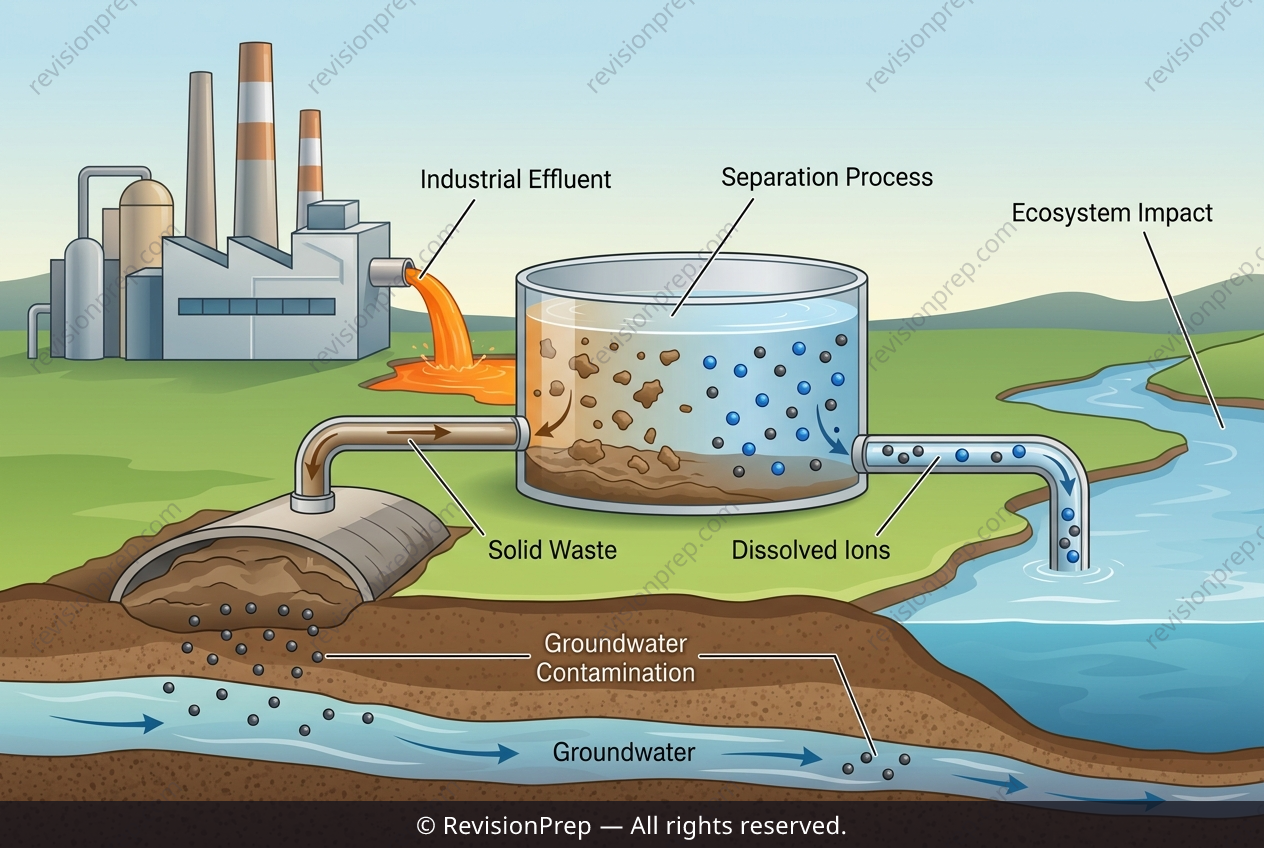
Filtration, evaporation and crystallisation are separation techniques that underpin sustainable industrial wastewater management. In mining, vacuum filtration recovers dissolved copper(II) sulfate, CuSO₄, from acidic wastewater by separating particles according to size relative to the filter pore diameter. Because dissolved Pb²⁺ and Cd²⁺ ions are far smaller than any filter pore, they pass through with the filtrate, while the recovered CuSO₄ can be sold or reused in processes such as electroplating and fungicide production, generating revenue and reducing demand for virgin materials. This matters because recovery conserves a non-renewable mineral resource, lowering the environmental impact of primary copper extraction. Yet the filter cake retains toxic heavy metals, and rainwater percolating through landfill can leach Pb²⁺ and Cd²⁺ into soil and groundwater. Persistent contamination renders drinking water unsafe, bioaccumulates through aquatic food chains, and reduces agricultural productivity, so effective separation must connect resource recovery with long-term environmental protection.
Start practising IB questions today
150,000+ IB-styled questions, criteria-mapped and instantly accessible.