
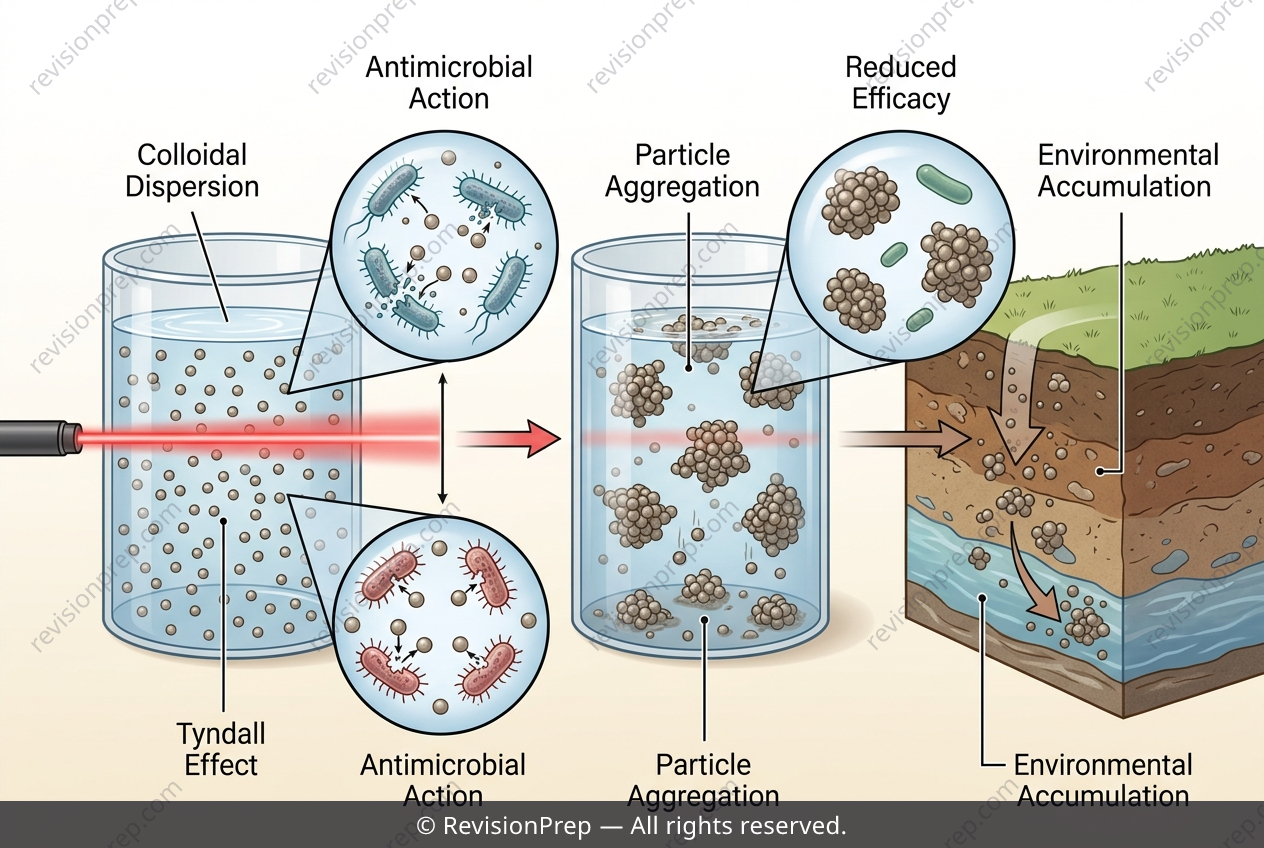
Chemistry: Silver Nanoparticle Dispersion in Water Filters
Silver nanoparticles in community water filters sit at the centre of a striking chemistry story: a colloid that kills bacteria, confirmed by the Tyndall effect, yet one that may leach into soil and groundwater over time. This matters because the same properties that make the technology effective — tiny particles, hugely exposed surfaces — also raise questions about environmental impact and long-term human safety. The parts connect through dispersion. When light passes through the colloid, the nanoparticles scatter it in all directions, making the beam visible as a bright cone; this happens because the particles are large enough to interact with light but small enough to stay suspended. That visible beam confirms the nanoparticles remain dispersed rather than aggregated or settled. Dispersion also drives function: a high surface-area-to-volume ratio means more particles contact the water and bacteria, so more silver ions are released and killing continues. Lose dispersion, and surface area drops sharply, weakening the filter.
Start practising IB questions today
150,000+ IB-styled questions, criteria-mapped and instantly accessible.