
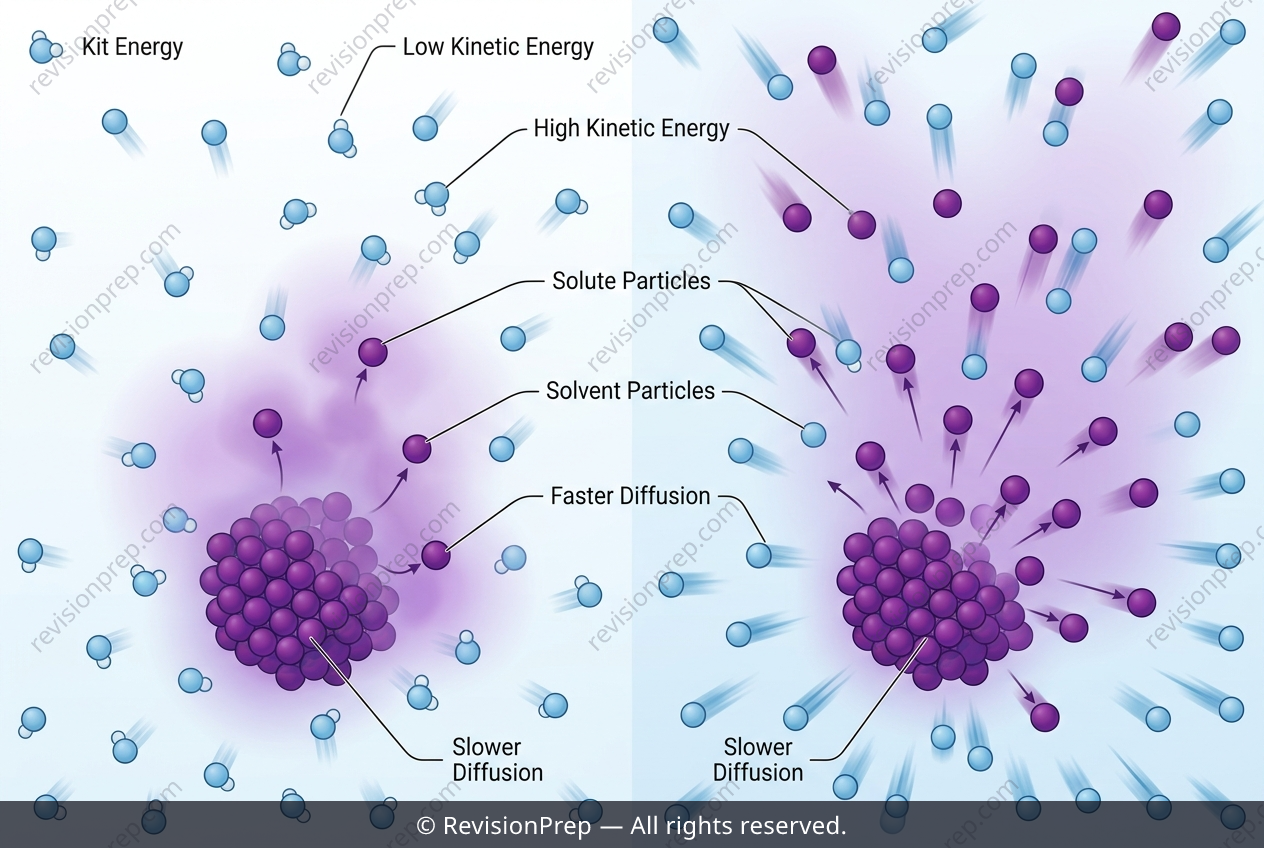
Chemistry: Temperature Governs Diffusion in Liquids
Diffusion is the net movement of particles from a region of higher concentration to one of lower concentration, driven entirely by their random motion. The kinetic particle theory explains this: every particle possesses kinetic energy proportional to its temperature, so heating a system increases average kinetic energy, particle speed, and the frequency and energy of collisions. In a liquid, water molecules and dissolved particles constantly jostle one another, and it is these countless random collisions that gradually displace particles such as KMnO₄ throughout the beaker. Temperature therefore acts as the master variable controlling diffusion rate. Doubling the thermal energy available does not merely warm the liquid; it accelerates every particle, steepens the effective spreading of concentration, and shortens the time needed for uniform colour. Surface area and concentration gradient matter too, since they govern how many particles enter solution at once. Together, these factors connect microscopic particle behaviour to observable macroscopic change.
Start practising IB questions today
150,000+ IB-styled questions, criteria-mapped and instantly accessible.