
Chemistry: Why Gases Spread by Diffusion
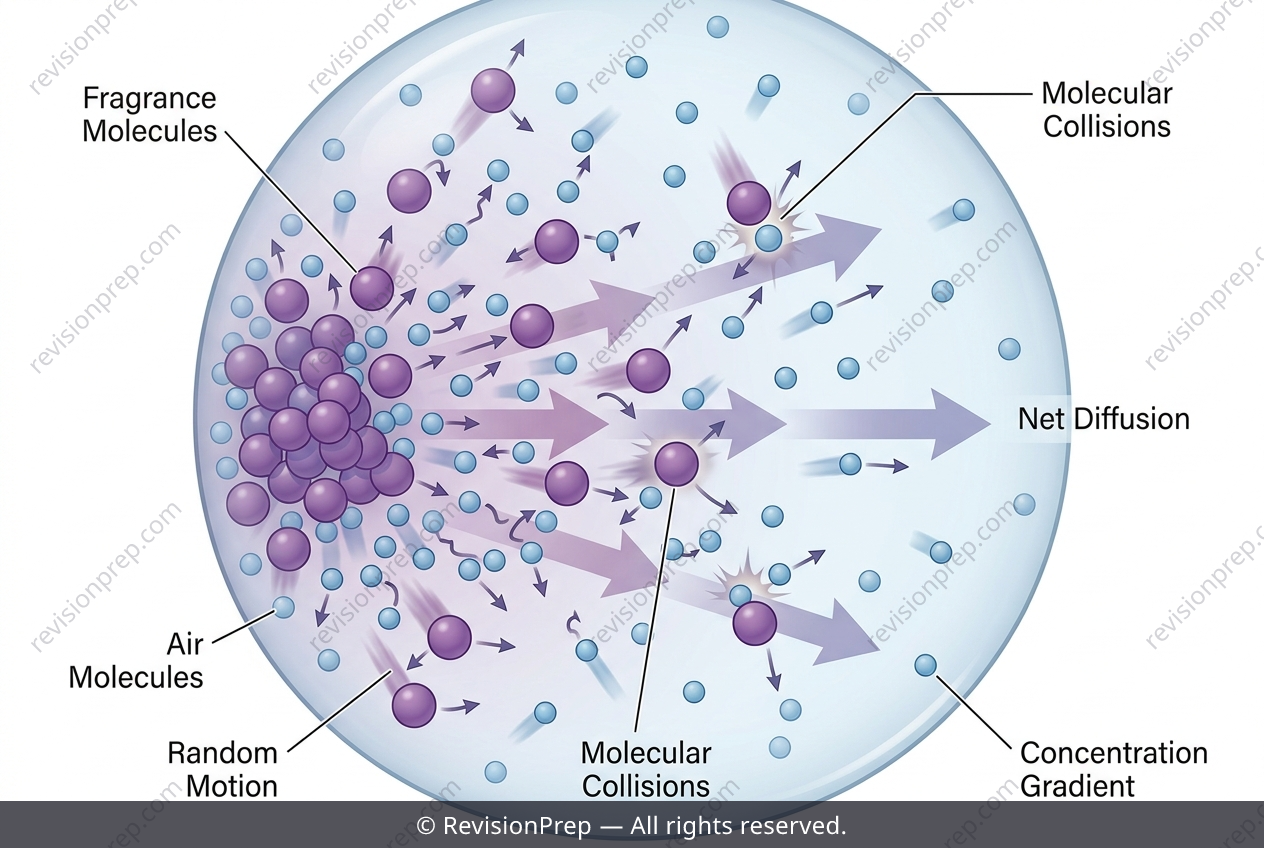
Diffusion is the net movement of particles from a region of higher concentration to one of lower concentration, and it explains why a sprayed fragrance eventually reaches every corner of a room. The kinetic particle theory underpins this: air molecules and volatile organic compounds (VOCs) are in constant, random motion, colliding endlessly with one another. Those collisions are Brownian motion — the erratic, unpredictable jostling that pushes VOC particles away from the spray point. Individually random, the overall effect is directional: particles drift down the concentration gradient until the mixture becomes roughly uniform. This matters beyond perfume, since VOCs are linked to indoor air pollution and asthma, with indoor concentrations often two to five times higher than outdoors. Understanding diffusion therefore connects molecular behaviour to real questions about health, air quality, and product design.
Start practising IB questions today
150,000+ IB-styled questions, criteria-mapped and instantly accessible.