
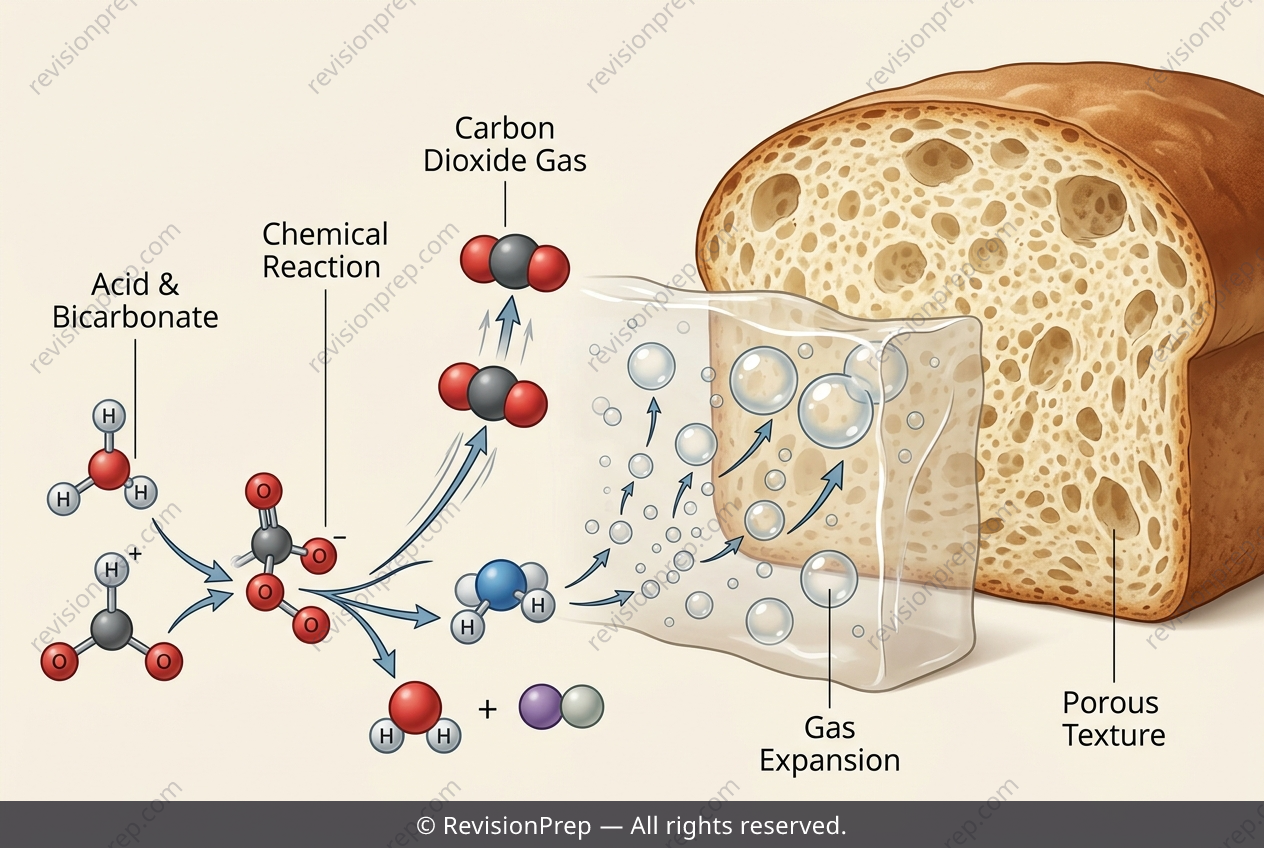
Chemistry: Why Muffins Rise - Chemical Leavening Explained
Chemical changes are not just a laboratory curiosity — they are the reason a muffin rises in your oven. When baking soda, sodium hydrogencarbonate (NaHCO3), meets an acid such as lactic acid from buttermilk or acetic acid from vinegar, the two reactants undergo a reaction that releases carbon dioxide gas, water, and a salt. This is chemical leavening: an acid–base reaction where new substances form, and it sits at the heart of distinguishing physical from chemical changes. The concept matters because it links observable material properties to molecular events. The CO2 produced does not simply disappear; it forms bubbles throughout the dough. During baking, heat causes these trapped bubbles to expand, so the dough rises and sets into a light, airy texture. Without that gas, the product would be dense and flat. Understanding how reactants, gas production, and texture connect turns a kitchen observation into a clear model of chemical change and material behaviour.
Start practising IB questions today
150,000+ IB-styled questions, criteria-mapped and instantly accessible.