
Maths: Budgeting Income with Percentages and Savings
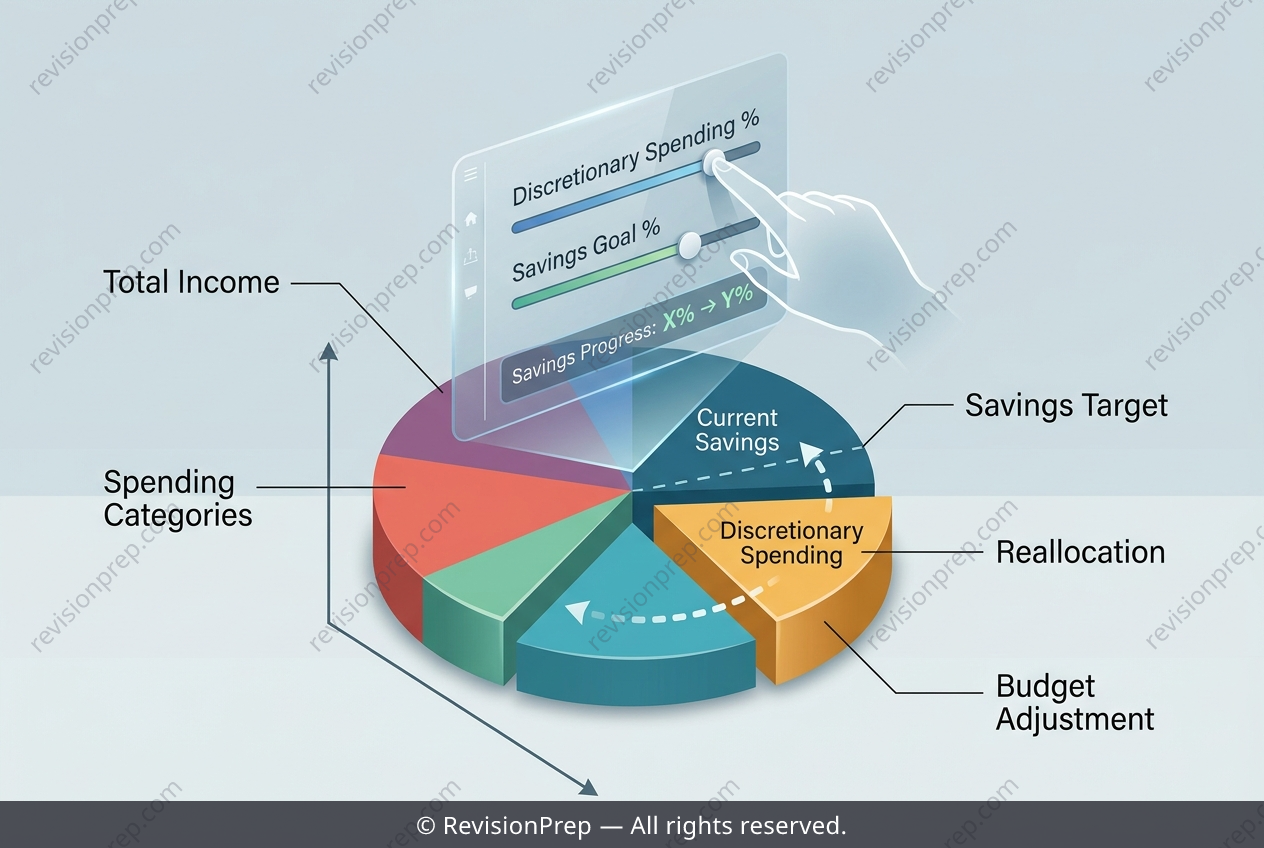
Financial mathematics turns a monthly income into a set of decisions. Here, a household earning 3 600 dollars splits its budget across Housing, Food, Transport, Entertainment, Savings and Other, each expressed as a percentage of total income. Converting a percentage into an amount uses a simple relationship: amount = percentage × total income, so Housing at 35% and Food at 25% together represent the largest shares of the budget. What matters is how those shares interact. Savings is treated as an allocation like any other, meaning the household's savings rate is simply its percentage share — currently below the 10% target. Closing that gap requires reallocating income rather than earning more, since every percentage point moved from one category adds an equal amount to another. Reducing a non-essential category such as Entertainment frees a fixed dollar amount, which can be redirected into Savings to raise the savings rate without touching essential spending.
Start practising IB questions today
150,000+ IB-styled questions, criteria-mapped and instantly accessible.