
Maths: Estimating Fish Populations Using Capture-Recapture
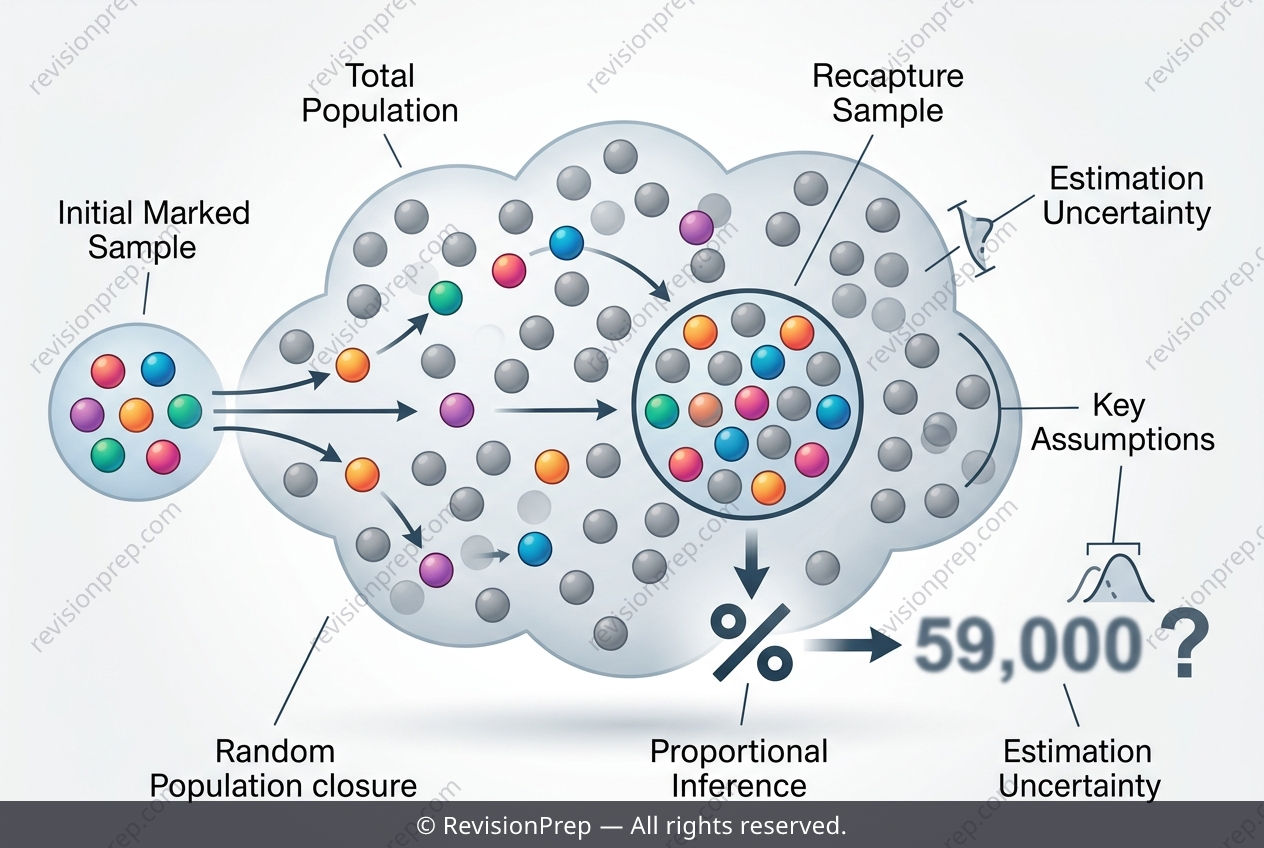
Capture-recapture offers a striking way to estimate a population you can never fully see. By tagging a first sample, releasing it, then examining the proportion of tagged individuals in a second sample, the unknown total N can be inferred from N = (M × n) / m, where M is the number initially tagged, n the size of the second sample, and m the number of tagged fish recaptured. This matters because such estimates often inform real decisions, like whether a fish population is large enough to sustain a new fishing licence. Yet the formula's reliability rests on assumptions: the population must remain closed, with no births, deaths, or migration between samples; every fish must have an equal chance of capture; and tagged fish must mix randomly before resampling. When these hold, the proportion recaptured mirrors the true proportion in the lake. When they fail, the estimate may mislead, so mathematical results must always be weighed against ecological uncertainty.
Start practising IB questions today
150,000+ IB-styled questions, criteria-mapped and instantly accessible.