
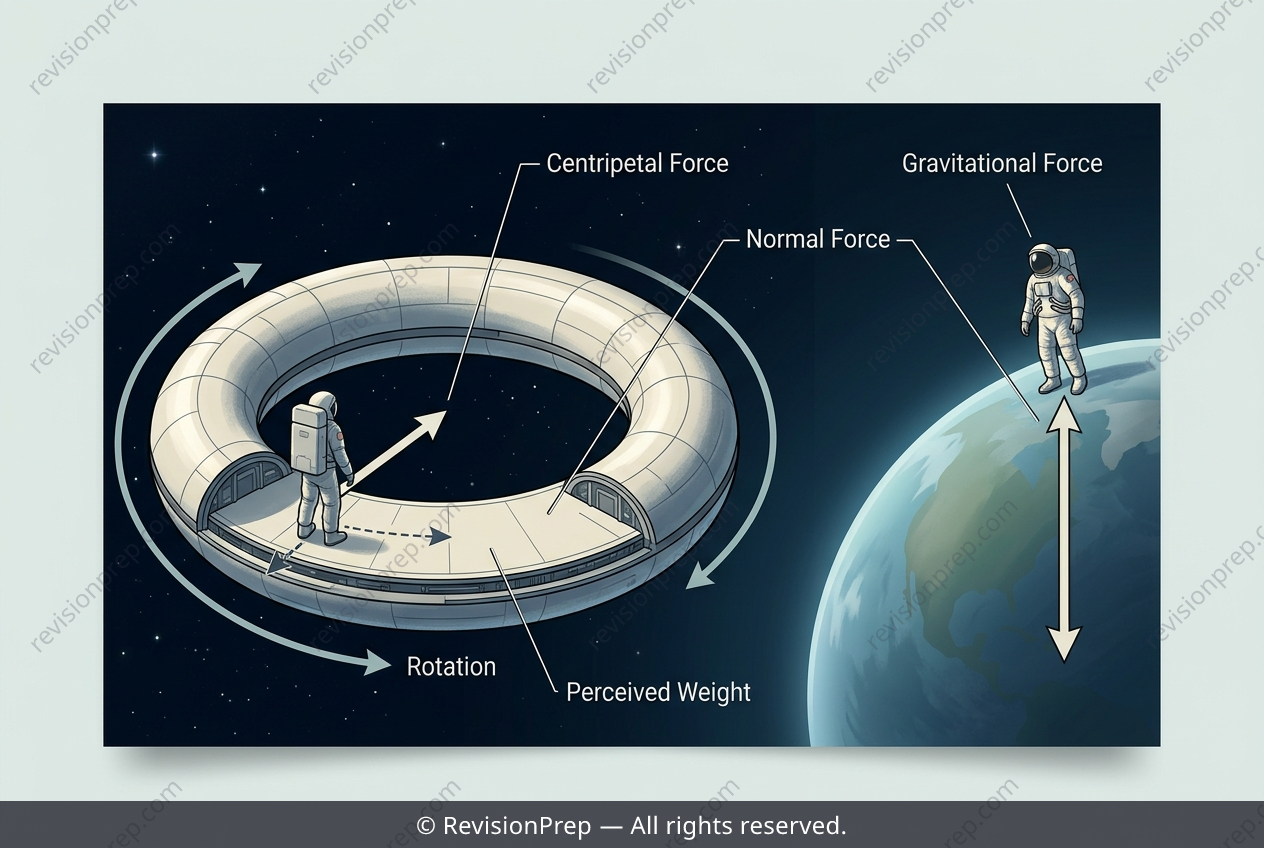
Physics: How Rotation Mimics the Feeling of Gravity
Artificial gravity is the apparent weight experienced in a rotating reference frame, where circular motion replaces the pull of a gravitational field. For a space station shaped as a rotating ring, astronauts stand on the inner surface while the ring spins, forcing them to travel in a circle at constant speed. The centripetal force required for this motion is supplied not by gravity but by the normal contact force from the floor pushing inward toward the ring's centre, described by F = mv²/r. This matters because it reveals how the sensation of weight can be manufactured without any planet nearby. The inward push from the surface acts along the astronaut's body from feet to head, and this continuous contact is interpreted by the body as pressure against a floor — mimicking the feeling of standing on Earth. Crucially, this apparent weight is not equivalent to true gravitational weight: real weight arises from a gravitational field acting on mass across a distance, whereas the ring's effect is a fictitious inertial consequence of rotation, not a field at all.
Start practising IB questions today
150,000+ IB-styled questions, criteria-mapped and instantly accessible.