
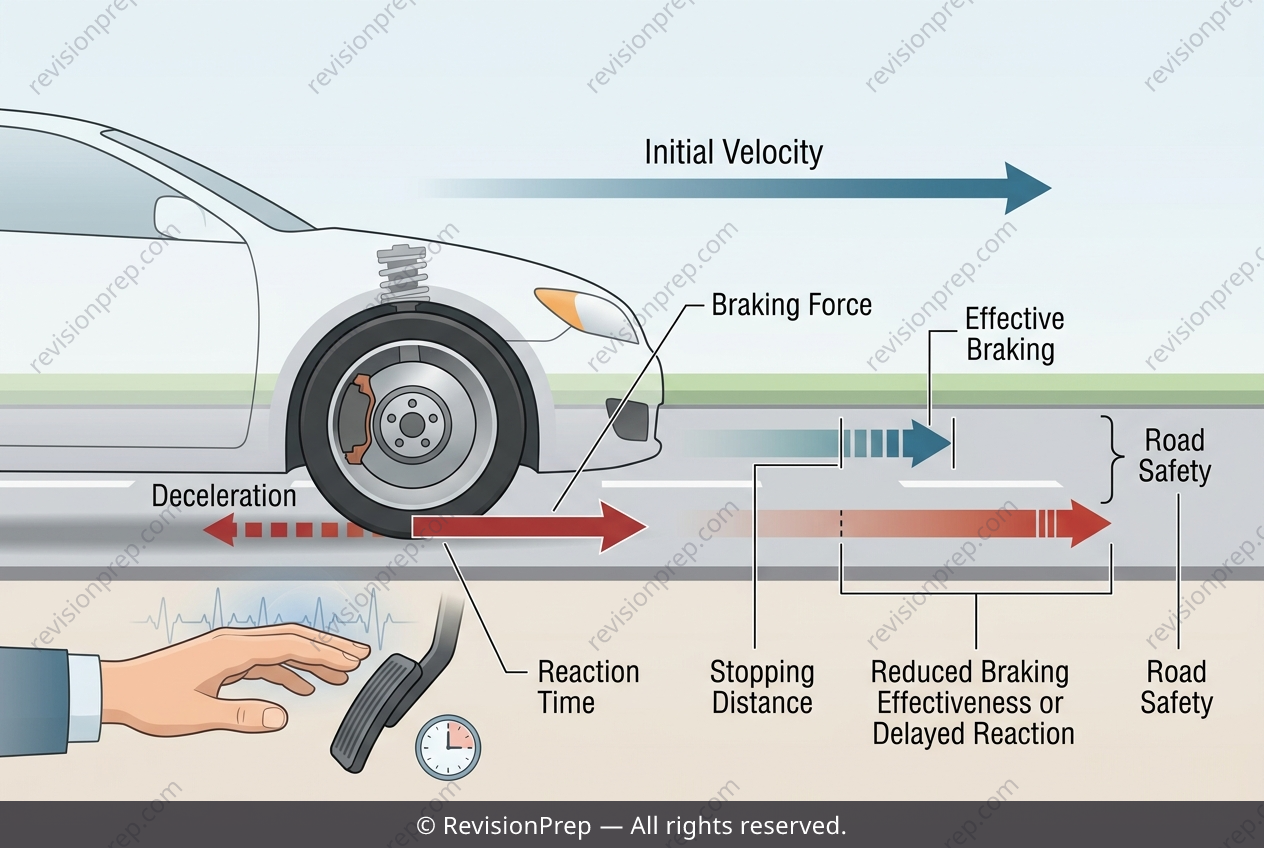
Physics: Why Reaction Time Extends Stopping Distance
Stopping a moving car comes down to one idea: an unbalanced force. When a driver brakes, friction between the tyres and the road acts opposite to the car's motion, creating a net force. Newton's Second Law, F = ma, tells us this net force produces a negative acceleration — a deceleration — that steadily reduces the car's speed until it comes to rest. This matters because braking is where physics meets everyday safety. The faster a car travels, the more distance it needs to shed that speed, and the more that distance depends on forces and human limits. Effective braking systems directly reduce collision frequency, injuries, and fatalities on our roads. The concept connects several parts: the size and direction of the net force, the resulting deceleration, and the human factor of reaction time. Before a driver even presses the pedal, the car keeps moving at full speed, so any delay lengthens the total stopping distance — a gap that fatigue, distraction, or impairment widens further.
Start practising IB questions today
150,000+ IB-styled questions, criteria-mapped and instantly accessible.