
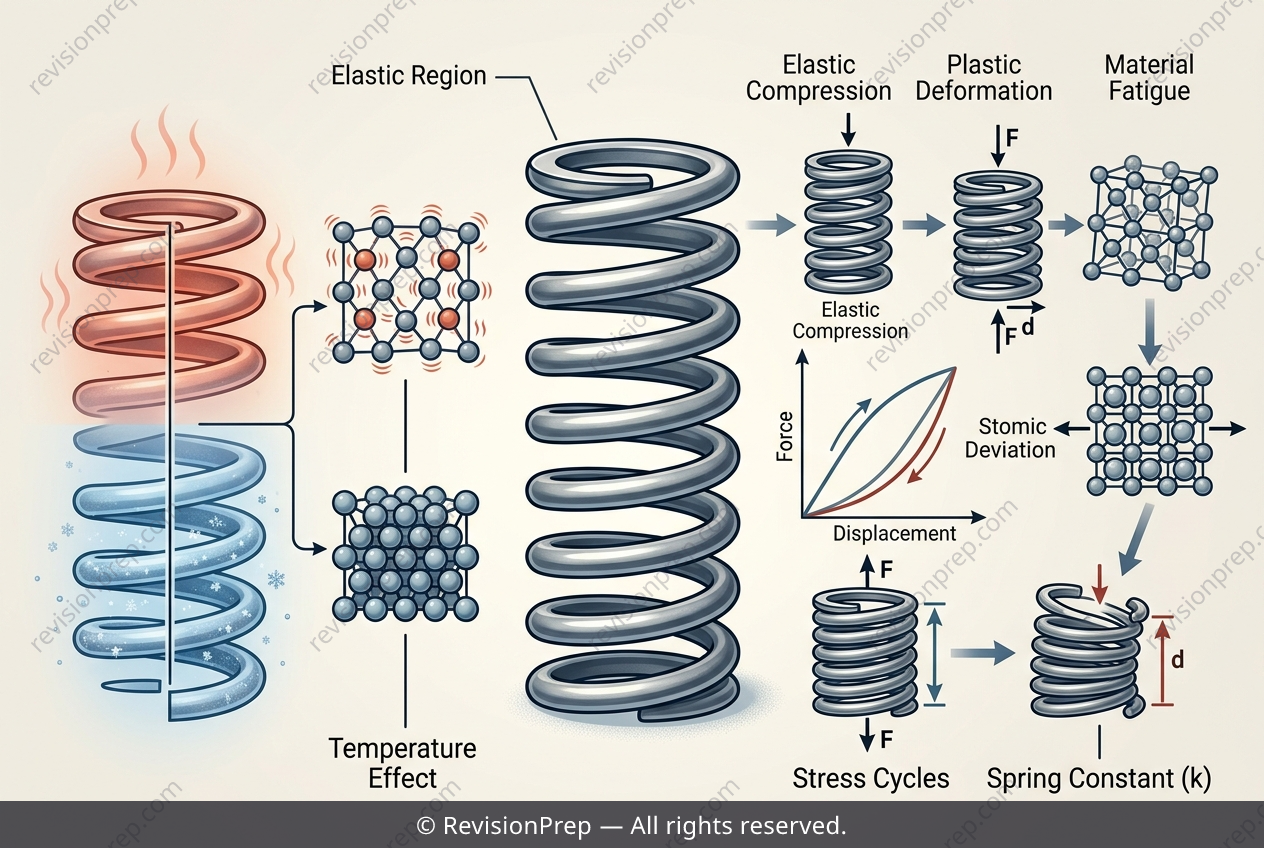
Physics: Why Springs Eventually Break Hooke's Law
Hooke's Law describes a spring's linear response to force, F = kx, where k is the spring constant. Real materials, however, only obey this relationship within limits. Temperature changes alter interatomic bond stiffness, shifting k and breaking the linearity the law assumes. Push a spring past its elastic limit and the force–extension graph curves, leaving permanent plastic deformation behind. This matters because components like car suspension springs endure countless compression cycles. Each cycle seeds microscopic cracks and dislocations in the steel's crystal structure. These accumulate as material fatigue, steadily reducing k and the spring's shock-absorbing capacity, and in extreme cases causing sudden fracture. Elasticity, plasticity and fatigue together define where Hooke's Law holds, where it fails, and why engineers design springs to stay safely within the elastic region.
Start practising IB questions today
150,000+ IB-styled questions, criteria-mapped and instantly accessible.