
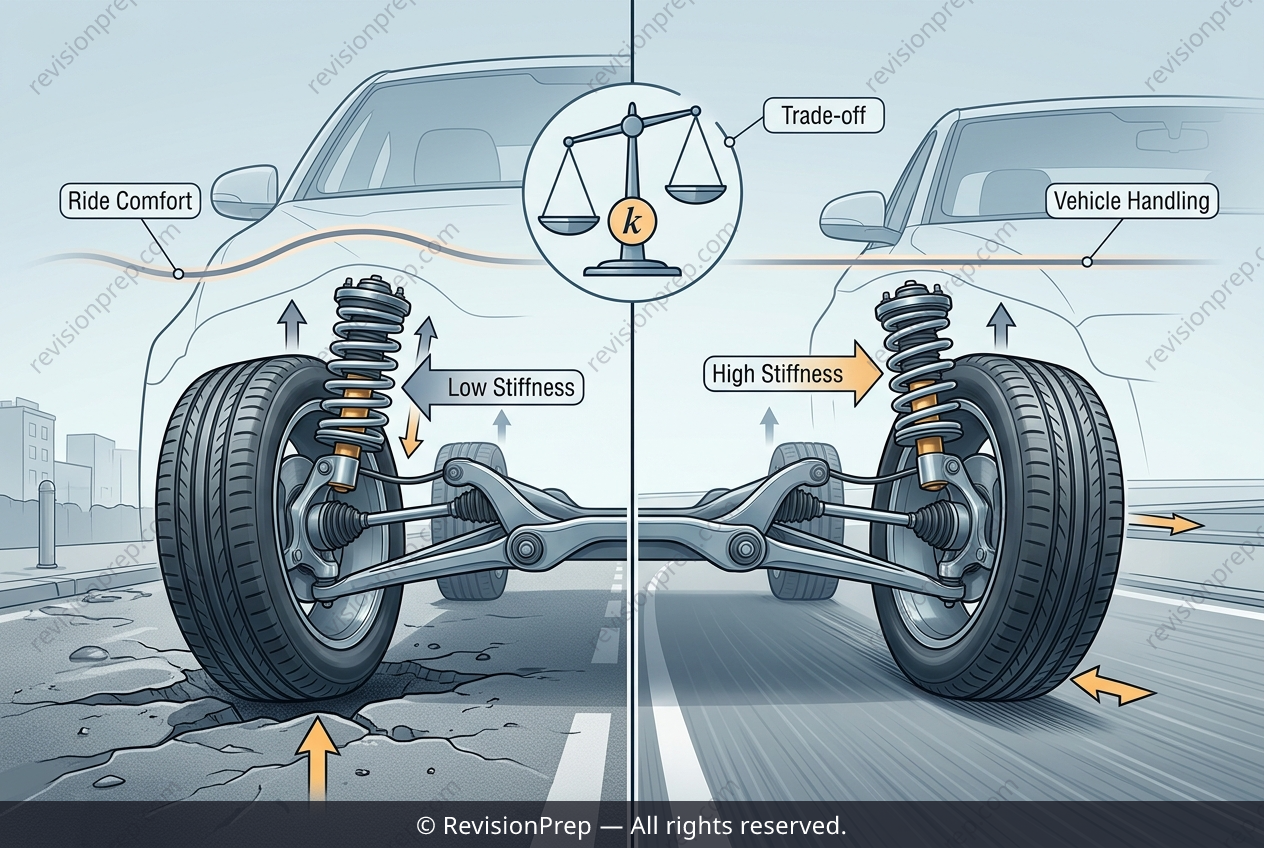
Physics: Why Stiffer Springs Trade Comfort for Control
Spring stiffness sits at the heart of every suspension design, and Hooke's Law, F = kx, tells you why. The spring constant k measures how much force is needed to compress a spring by a given distance. A larger k means a stiffer spring: the same compression x now demands a greater force, so the spring feels harder to push down. That single number shapes two things drivers feel every day. During cornering, lateral forces push the car's body outward, and stiffer springs resist compression more strongly, generating a larger restoring force that keeps the body level and sharpens handling. Yet the same stiffness that helps on smooth motorways transmits more road vibration to occupants on uneven urban roads, eroding comfort. Control and comfort pull in opposite directions, so engineers tune k to suit the intended use case, balancing stability against ride quality.
Start practising IB questions today
150,000+ IB-styled questions, criteria-mapped and instantly accessible.