
Physics: Why Real Cables Don't Match Ideal Models
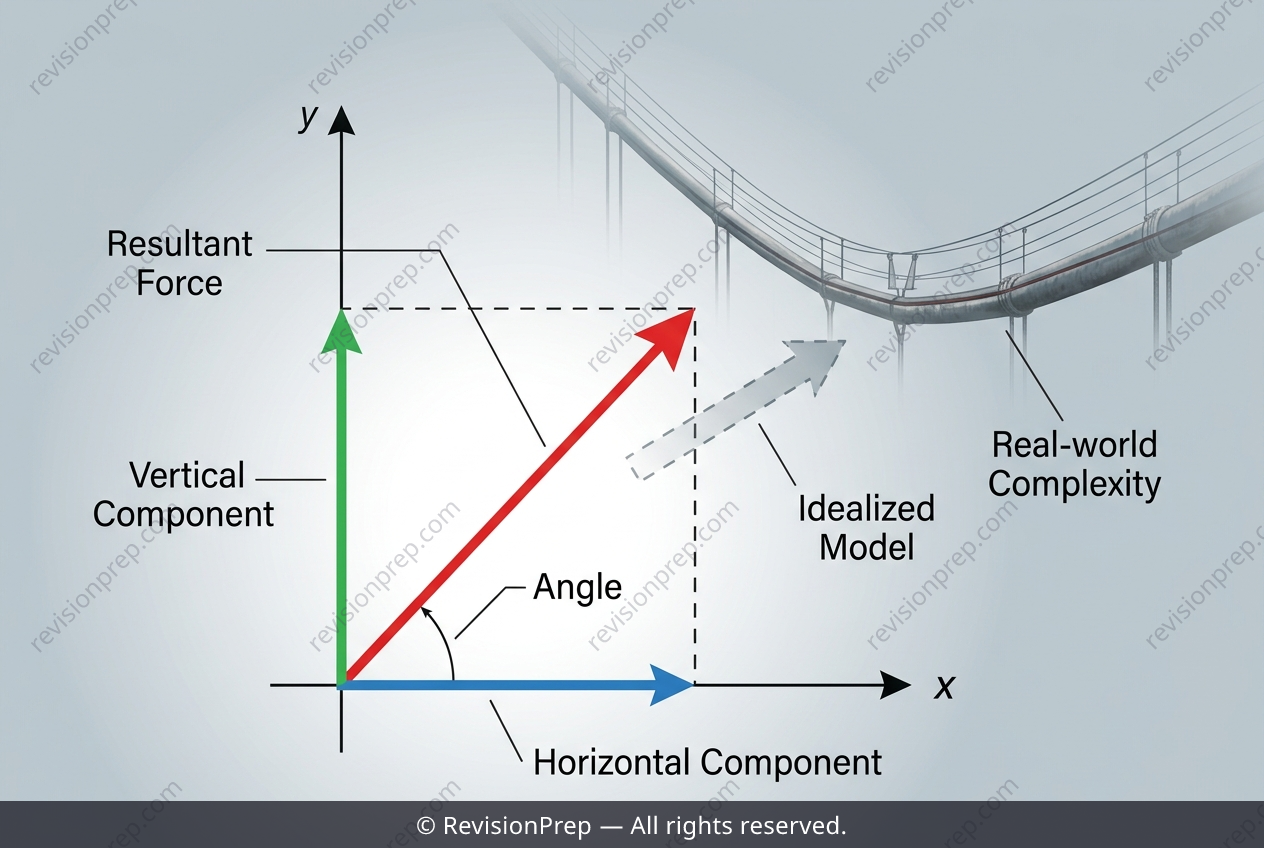
Forces rarely act in the neat horizontal or vertical directions that textbook diagrams suggest, which is why vector decomposition sits at the heart of mechanics. Any force applied at an angle can be split into perpendicular components using trigonometry: a tension T at an angle θ above the horizontal resolves into a horizontal part T cos θ and a vertical part T sin θ. This lets us treat a single slanted force as two independent straight-line forces, each obeying Newton's laws in its own direction. That skill matters enormously in structural engineering, where cables, beams and anchors must withstand loads that are seldom perfectly aligned. Yet the numbers we calculate are only as reliable as the model behind them. Idealised models quietly assume massless cables, static loading and no wind or temperature effects. Each simplification introduces error — a cable's own weight, for instance, adds a distributed downward load, increasing sag and the true tension throughout. Understanding both the mathematics and its limits is what separates a calculation from a sound design.
Start practising IB questions today
150,000+ IB-styled questions, criteria-mapped and instantly accessible.