
Physics: Why Torque Isn't Captured by a Resultant
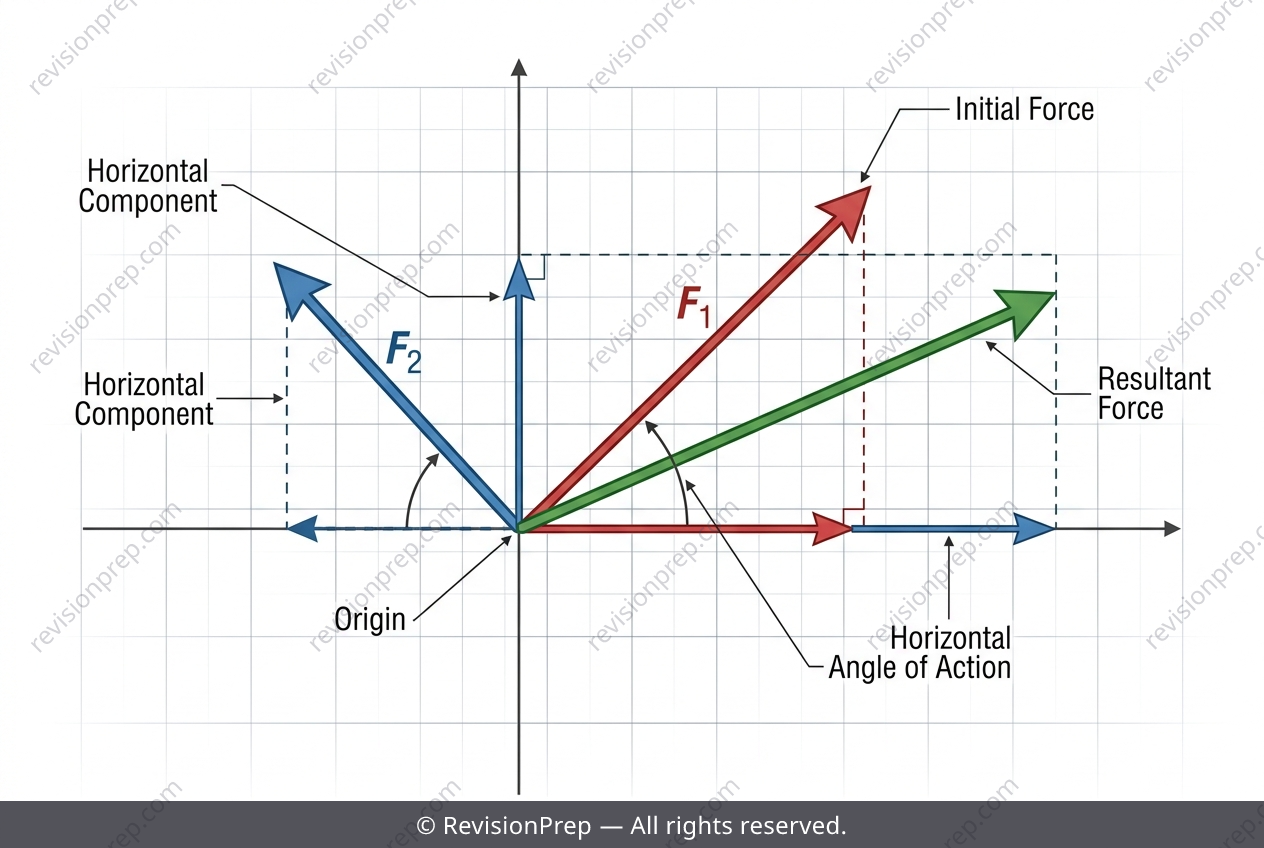
Forces rarely act alone. When several push or pull on the same object, each one can be split into perpendicular components using trigonometry — Fx = F cos θ horizontally and Fy = F sin θ vertically — so that forces pointing in different directions can be compared and combined. Adding the horizontal components together and the vertical components together produces a single resultant force, whose magnitude follows from Pythagoras' theorem and whose direction comes from the inverse tangent of the ratio of those components. This matters because Newton's second law responds to the resultant force, not to the individual ropes, engines, or pushes involved. A vehicle dragged by two angled ropes accelerates exactly as it would under one equivalent force of the same magnitude and direction. Yet force is only half the story: where each force acts determines the torque, or turning effect, on the body. Two ropes attached at different points can rotate a vehicle that a single central rope would leave steady, so resolving vectors reveals both the motion produced and the rotation that a resultant alone conceals.
Start practising IB questions today
150,000+ IB-styled questions, criteria-mapped and instantly accessible.