
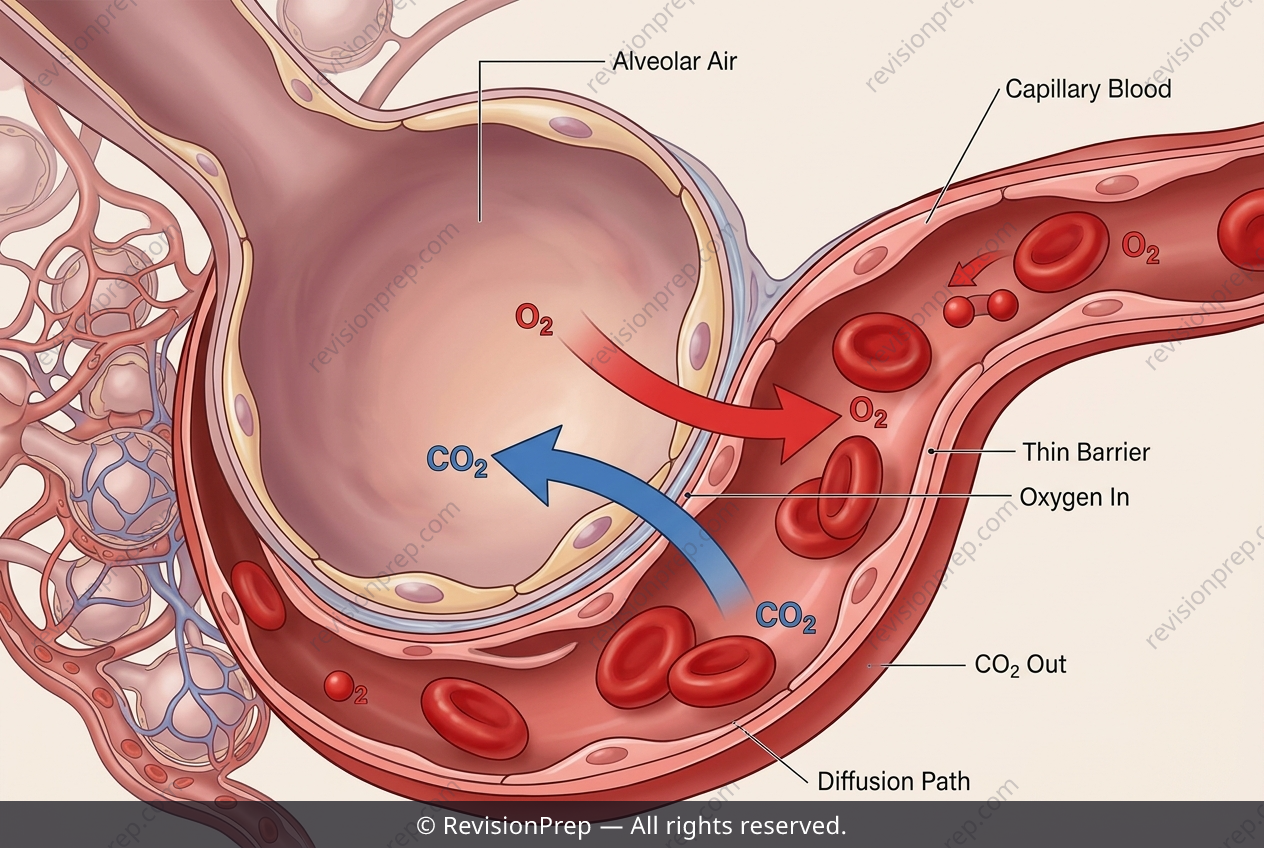
Biology: How Alveolar Structure Speeds Gas Exchange
Efficient gas exchange is one of biology's clearest examples of how structure dictates function. In the lungs, millions of alveoli provide an enormous surface area, while their walls are just one cell thick and wrapped in a dense capillary network. Together, these features create the conditions Fick's law describes: the rate of diffusion is directly proportional to surface area and the concentration gradient, and inversely proportional to the distance the gases must travel. This matters because oxygen must reach the blood and carbon dioxide must leave it quickly enough to sustain cellular respiration. Every structural detail — thin walls, rich blood supply, moist surfaces — shortens the diffusion path or maintains a steep gradient between air and blood. Understanding how these parts connect explains why even small changes in alveolar structure can dramatically affect how efficiently the respiratory system delivers oxygen and removes carbon dioxide.
Start practising IB questions today
150,000+ IB-styled questions, criteria-mapped and instantly accessible.