
Biology: How Cells Route Proteins From RER to Vesicles
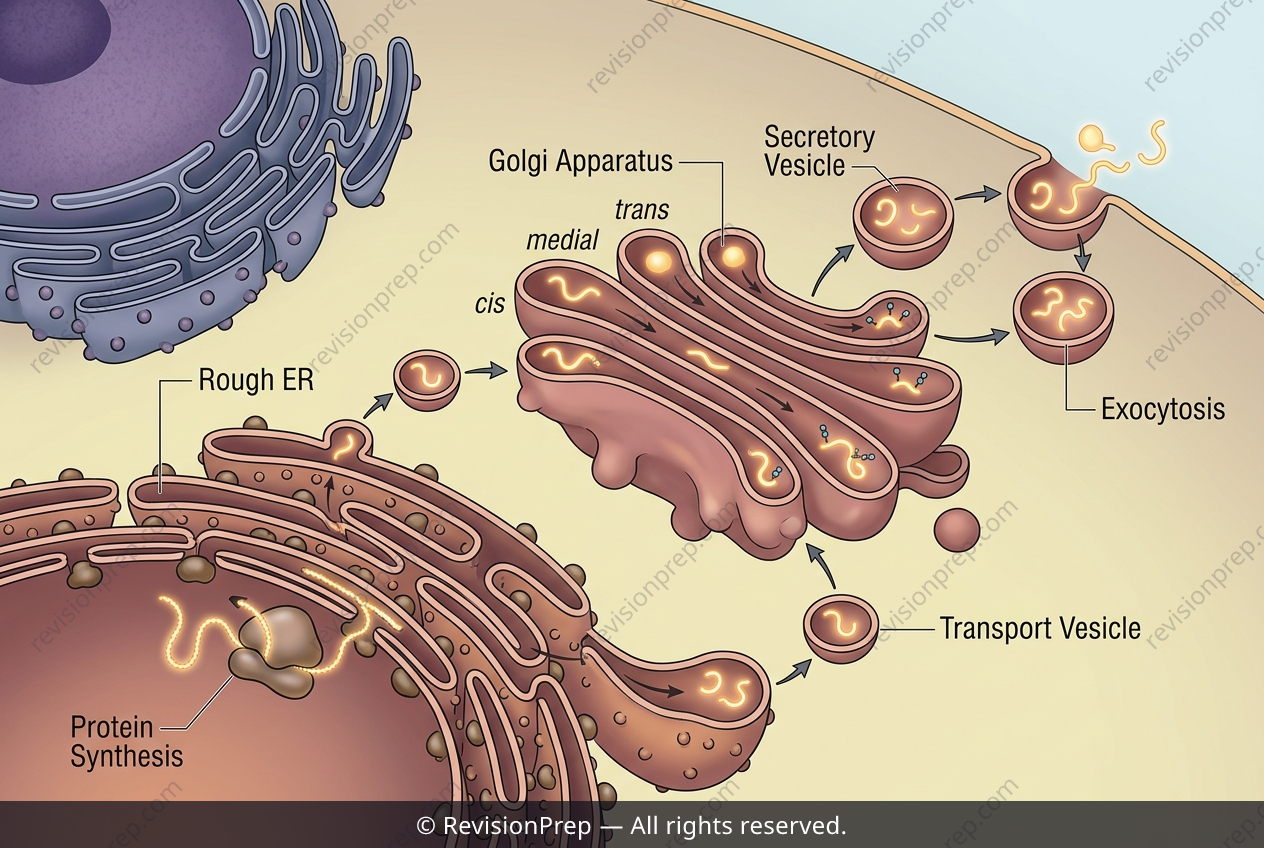
The endomembrane system is the cell's internal production and delivery network, where the rough endoplasmic reticulum (RER), Golgi apparatus, and secretory vesicles work in sequence to synthesise, modify, and export proteins. Pancreatic acinar cells offer a striking example: they secrete amylase, and tracking newly made protein with radioactive 3H-leucine reveals how material moves through these compartments over time. This matters because compartmentalisation lets each organelle specialise, separating synthesis from modification and storage so that amylase is not activated prematurely and quality control can occur at every stage. The mechanism is directional: leucine is incorporated into amylase at ribosomes bound to the RER, transport vesicles bud and fuse with the cis-face of the Golgi, and the protein is sorted and packaged into secretory vesicles at the trans-Golgi network. Radioactivity peaks sequentially — RER, then Golgi, then vesicles — and percentage change can be calculated as (new − old) ÷ old × 100.
Start practising IB questions today
150,000+ IB-styled questions, criteria-mapped and instantly accessible.