
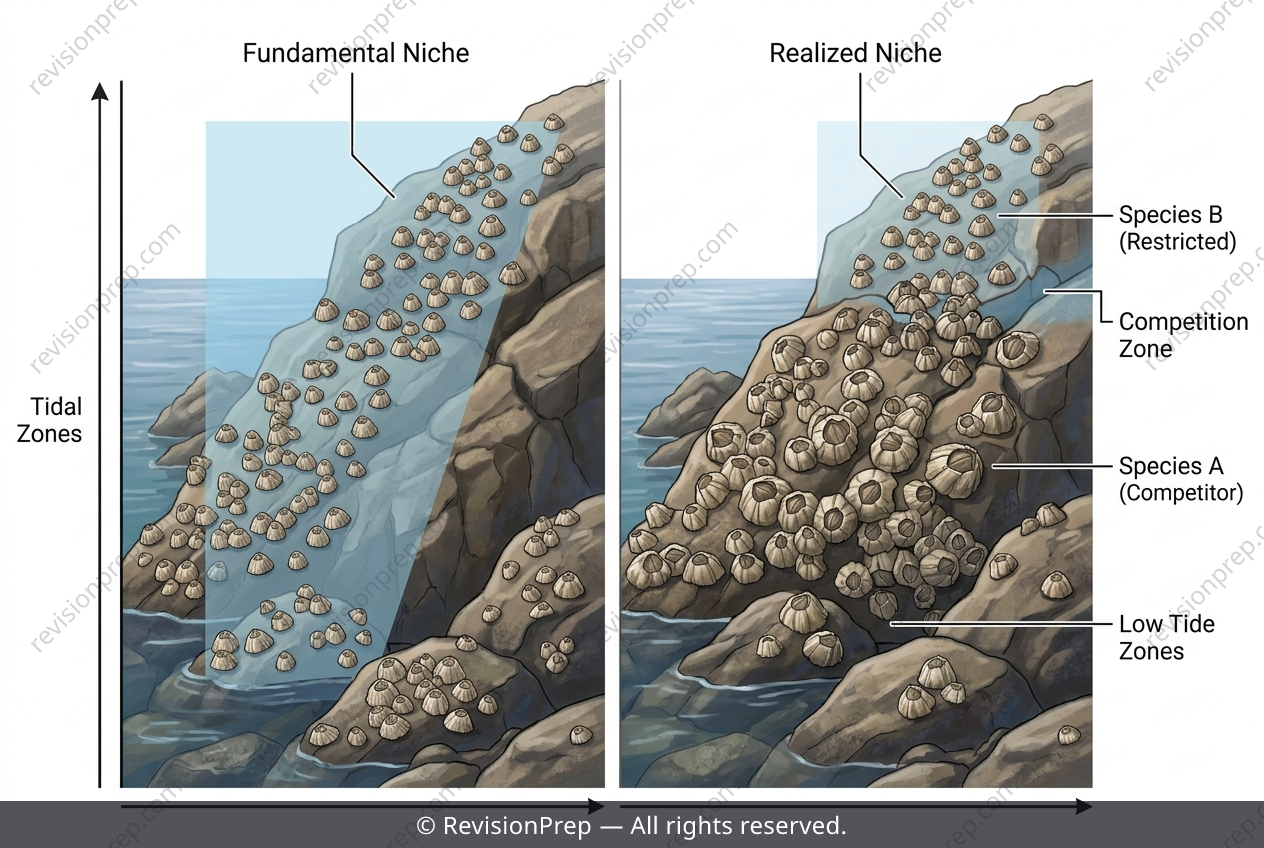
Biology: How Competition Narrows a Realized Niche
Every organism has a fundamental niche — the full range of conditions where it could theoretically survive — and a realized niche, the narrower slice it actually occupies once competitors, predators, and other biotic pressures are at play. On a Scottish rocky shore, Chthamalus stellatus can live across the entire intertidal zone (0–10 m), yet when Semibalanus balanoides is present, it is pushed up to 4–10 m. Competition for space, not physical tolerance, redraws the map. This distinction matters because it explains why a species is absent from places it could otherwise inhabit. Where S. balanoides is the stronger competitor on the lower shore, C. stellatus loses ground, and its density at a given height drops accordingly — a reduction calculated as (density alone − density with competitor) ÷ density alone × 100. Realized niches are therefore dynamic outcomes of species interactions, not fixed properties, which is why removal experiments can reveal a niche far wider than the one we observe.
Start practising IB questions today
150,000+ IB-styled questions, criteria-mapped and instantly accessible.