
Biology: How Sodium Gradients Shape Action Potentials
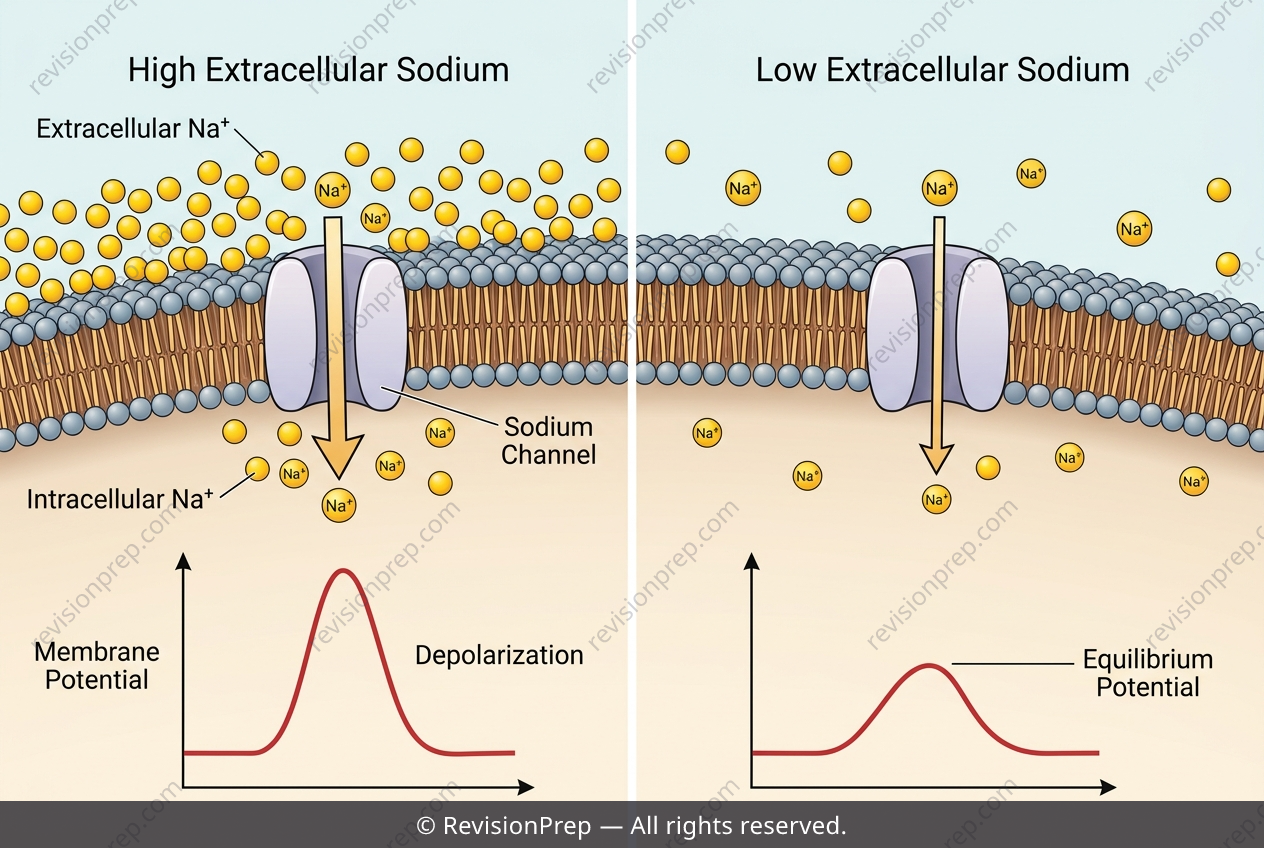
The action potential is a transient reversal of membrane potential driven by ion movements across the axon membrane. Its amplitude depends on the electrochemical gradients for sodium and potassium, and can be predicted using the Nernst equation, ENa = 58 log10([Na+]out/[Na+]in), which links extracellular sodium concentration to the equilibrium potential for sodium. Because the resting membrane potential stays relatively constant, the peak of the action potential approaches ENa, so altering the sodium gradient shifts the peak height. This matters because it explains how signals are generated and propagated, and why the nervous system is sensitive to changes in the ionic environment. When voltage-gated sodium channels open at threshold, sodium enters down its electrochemical gradient, depolarising the membrane toward ENa. Halving extracellular sodium reduces this gradient, making ENa less positive and lowering the driving force for sodium entry, so the peak amplitude falls. The same logic does not apply universally, since some cells rely on calcium channels instead.
Start practising IB questions today
150,000+ IB-styled questions, criteria-mapped and instantly accessible.