
Biology: Physical Limits vs Competitive Limits
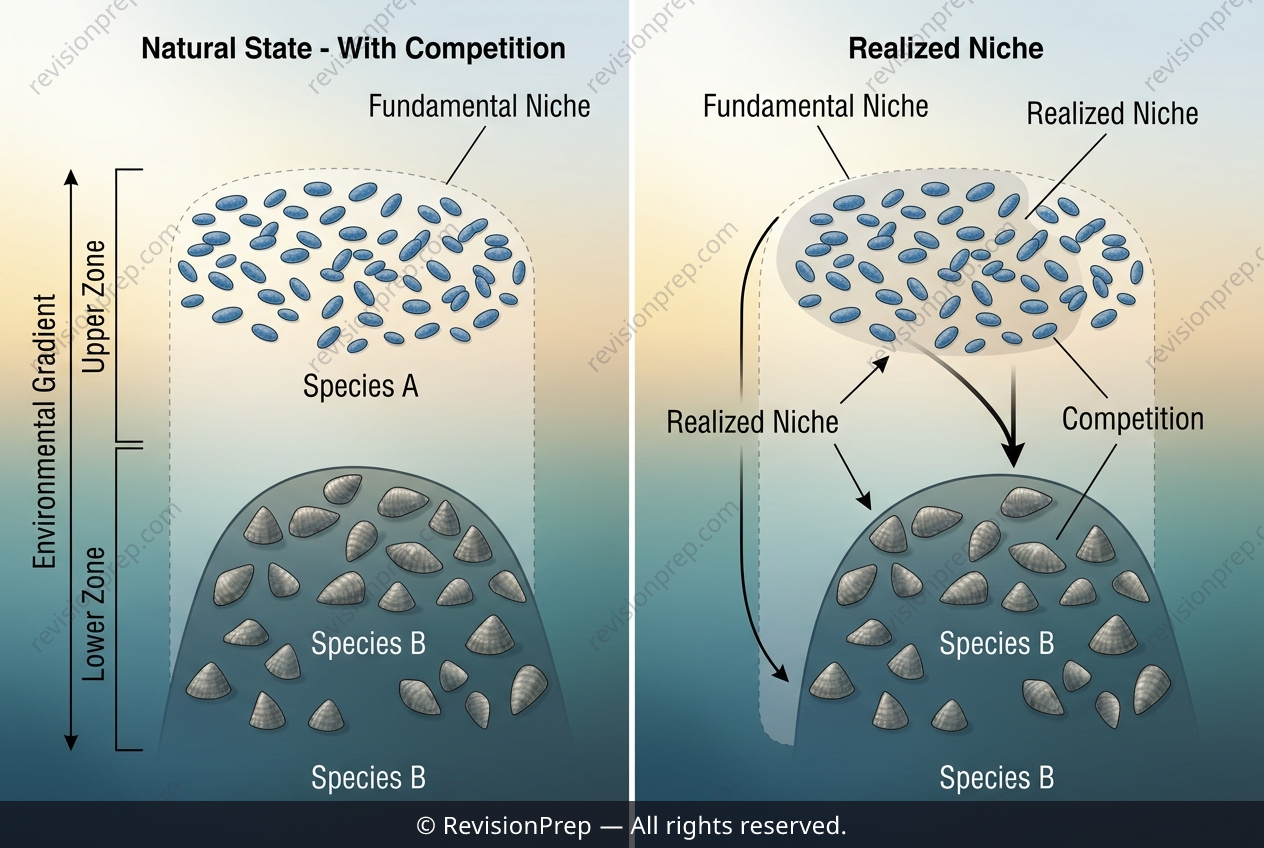
Every organism has two niches: the fundamental niche, the full range of conditions it could survive in without competitors, and the realized niche, the smaller portion it actually occupies once competition and other biotic pressures are factored in. The gap between them reveals how strongly other species shape where an organism can live. Rocky shore barnacles offer a classic illustration. Chthamalus can physiologically tolerate both upper and lower shore conditions, yet it is normally confined to the upper shore. When Balanus is experimentally removed, Chthamalus quickly colonises the lower zone, showing that competition, not physical tolerance, had been restricting it. Balanus, by contrast, cannot survive the upper shore at all, so its limitation is physiological rather than competitive. The key relationship is that the fundamental niche is always at least as broad as the realized niche; competition narrows the latter. Removal experiments expose this hidden potential, making them a powerful tool for distinguishing physical limits from competitive ones.
Start practising IB questions today
150,000+ IB-styled questions, criteria-mapped and instantly accessible.