
Biology: What Sets a Neuron's Resting Potential?
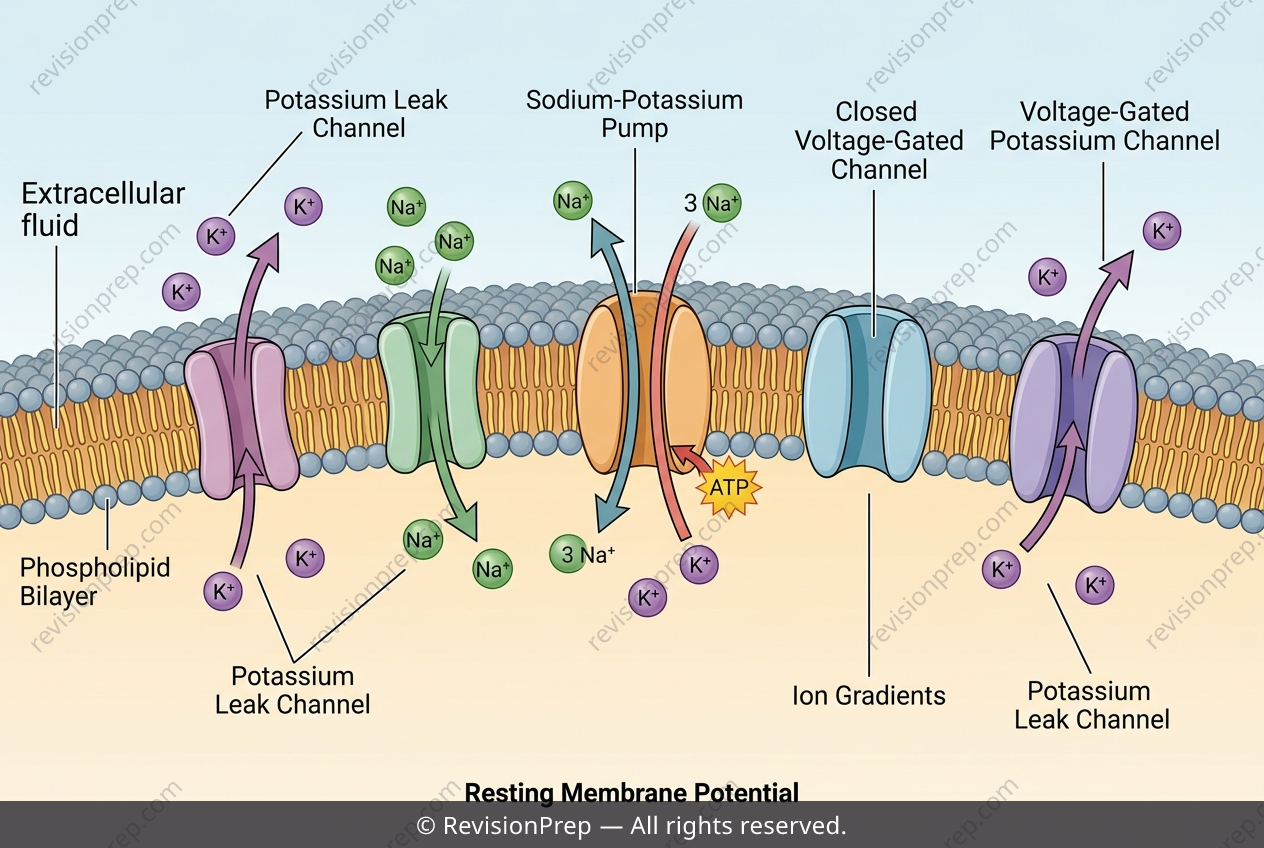
At rest, a neuron sits at a negative voltage, typically around -70 mV, maintained across its membrane. This resting membrane potential arises from two cooperating mechanisms: potassium leak channels, which allow K⁺ to diffuse outward down its gradient, and the Na⁺/K⁺ pump, which exports three sodium ions for every two potassium ions imported, leaving the interior relatively negative. Together these establish the baseline voltage that makes neurons electrically excitable. Crucially, the channels responsible for action potentials — voltage-gated sodium channels — remain closed at rest. They open only when the membrane depolarises past a threshold, so they contribute nothing to the resting potential itself. This distinction matters because it separates the machinery that sets the baseline voltage from the machinery that fires signals. Understanding which channels are active at rest, and which are merely waiting, is central to predicting how the membrane responds when specific ion channels are blocked or opened.
Start practising IB questions today
150,000+ IB-styled questions, criteria-mapped and instantly accessible.