
Chemical Reactions and the Periodic Table
Position predicts properties, properties predict reactivity — the core MYP 3 chemistry chain in one revision teaser
Quick facts
Chemical reactions and the periodic table sit at the heart of IB MYP 3 Sciences, and the good news is that everything connects. Once you know where an element lives on the periodic table, you can predict whether it's a metal or non-metal, how reactive it is, and what kind of reaction it's likely to undergo. This teaser walks through the five ideas MYP 3 exams and investigations return to again and again: metallic bonding and physical properties, reading groups and periods, the reactivity series, recognising reaction types, and spotting real evidence of chemical change. Get comfortable linking position → properties → reactivity → observable evidence, and data-response questions on metals, non-metals and reactions become far more predictable. For the full depth, worked examples and definitions, the complete revision note is linked at the end.
What you’ll be able to do
Metals vs Non-Metals: One Structure Explains Everything
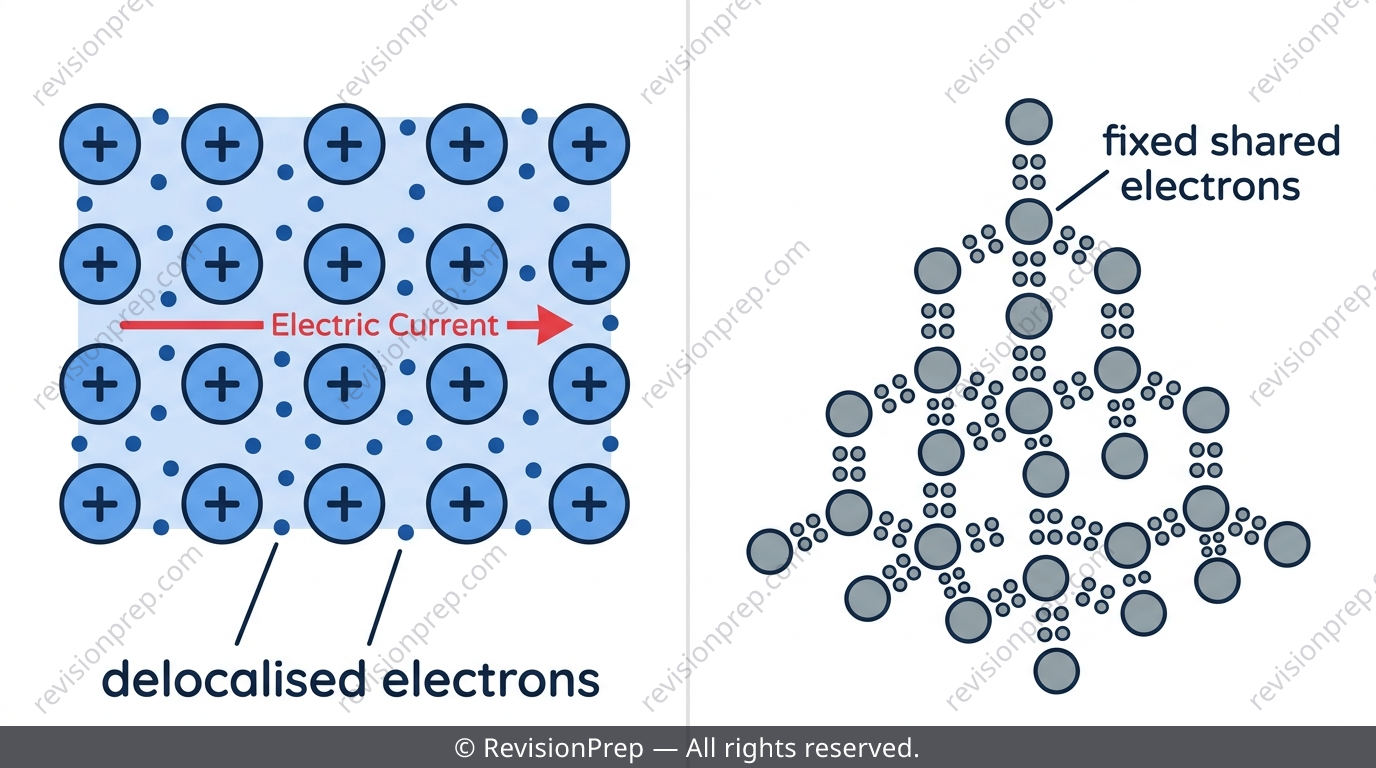
Metal atoms hold their outer electrons loosely, so in a solid metal those electrons detach and roam freely as a 'sea' of electrons around a lattice of positive ions. Every classic metallic property — conductivity, malleability, ductility, lustre, sonority — traces back to this single structural fact. Non-metals are mostly covalent, with electrons fixed between specific atoms, which is why they're typically brittle, dull and poor conductors (graphite is the famous exception, thanks to its layered structure).
| Property | Metals | Non-Metals |
|---|---|---|
| Conductivity | High — free electrons carry charge | Poor (graphite is the exception) |
| Malleability / Ductility | Yes — ion layers slide past each other | No — typically brittle |
| Lustre | Shiny when polished/cut | Usually dull |
| Density | Generally high | Generally lower |
Common mistake
Writing 'metals have electrons that move' without the word free/delocalised/mobile — that specific vocabulary is what earns the explain mark.
Mini summary
Free-moving delocalised electrons in metals explain conductivity, malleability, ductility and lustre; fixed covalent electrons explain non-metal brittleness and poor conduction.
Reading the Periodic Table: Groups, Periods and the Staircase
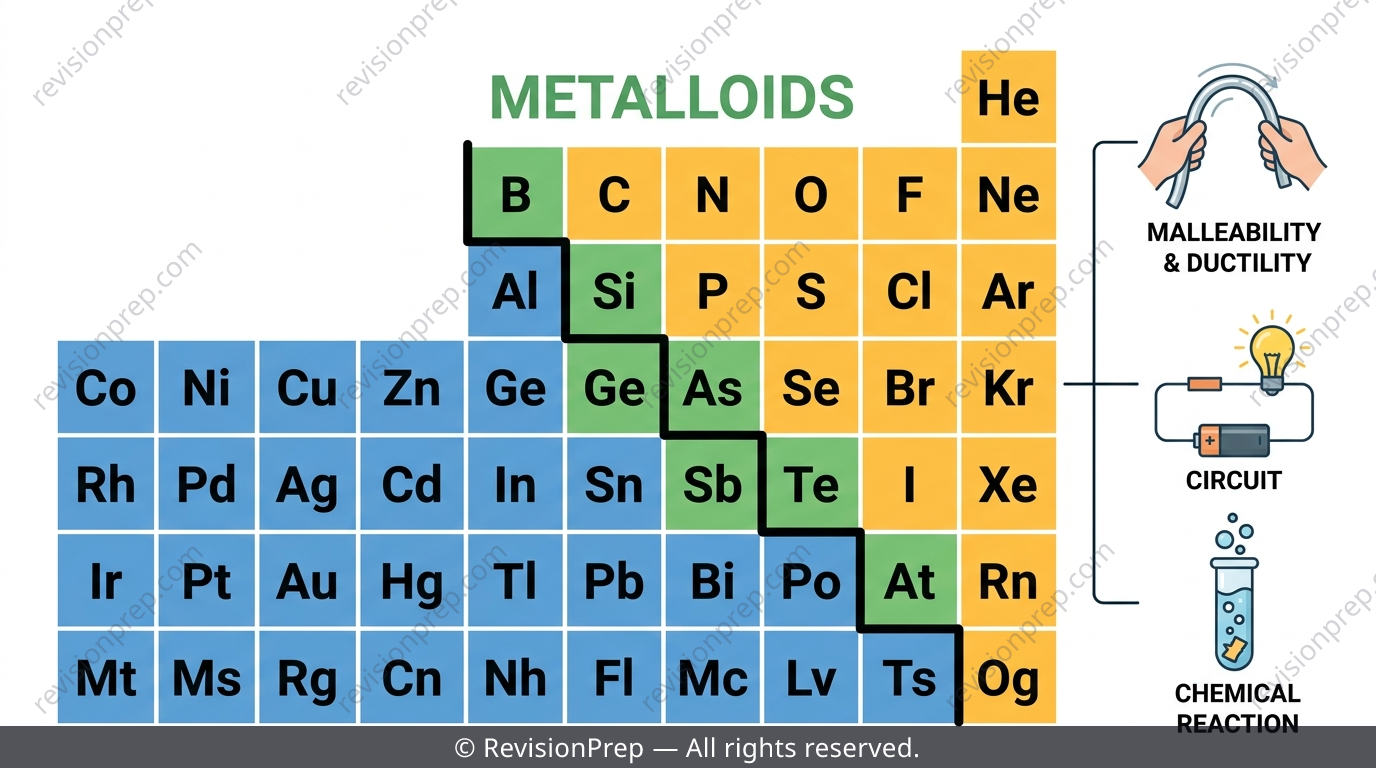
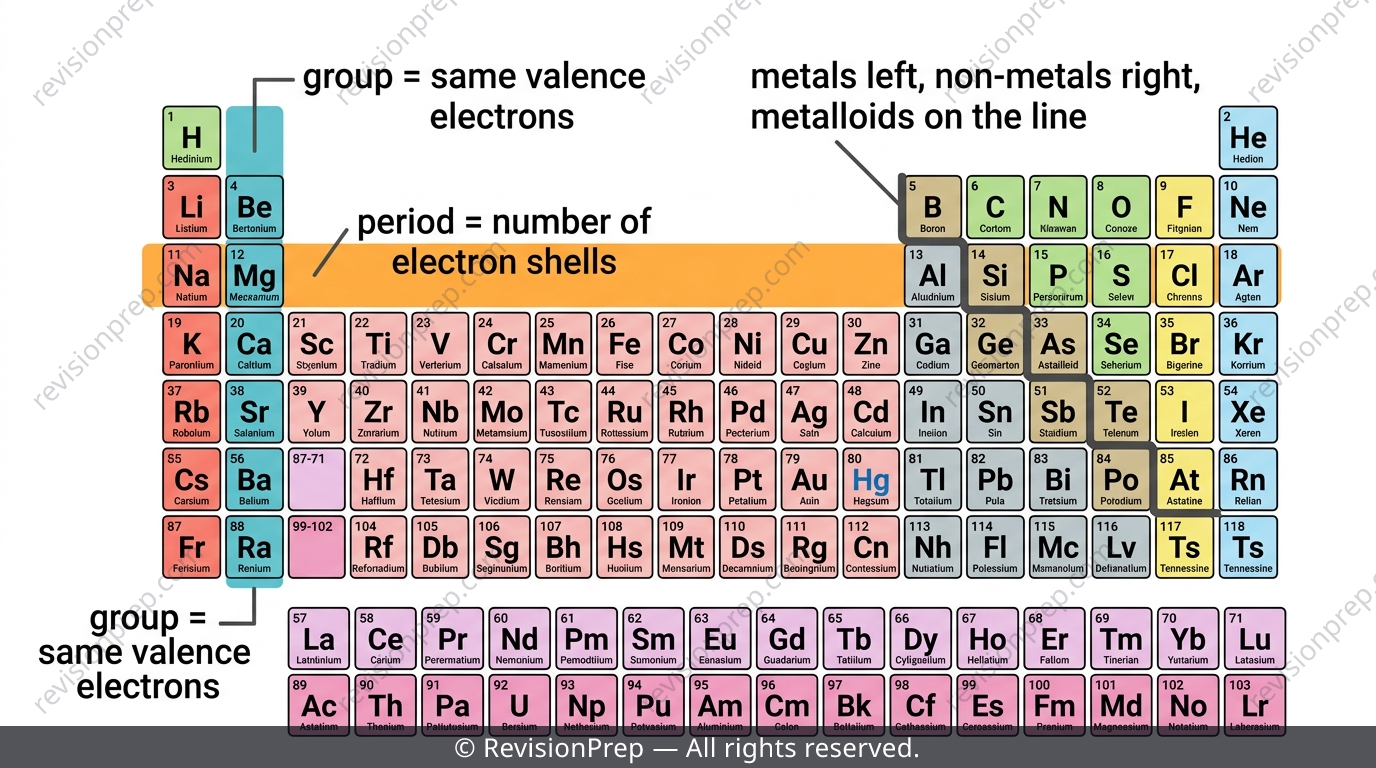
The periodic table sorts elements by increasing proton number: periods are horizontal rows (period number = number of electron shells), and groups are vertical columns (elements in the same group share the same number of valence electrons and similar chemical behaviour). A zig-zag staircase line running roughly from boron to astatine separates metals from non-metals, with metalloids like silicon and germanium straddling the line as semiconductors. Group 1, Group 17 (halogens) and Group 18 (noble gases) are the three columns MYP exams reference most often.
Exam tip
'Identify the group/period' questions want a bare number and/or element name — writing a paragraph about reactivity wastes time when only 1 mark is available.
Common mistake
Confusing group with period — e.g. giving a row number when asked which group chlorine is in. Remember: groups go up/down like table legs; periods go across like a line of a sentence.
Mini summary
Period number = electron shells; group number = valence electrons and predicts chemical similarity; the staircase line sorts metal / metalloid / non-metal at a glance.
The Reactivity Series: Predicting How Metals Behave
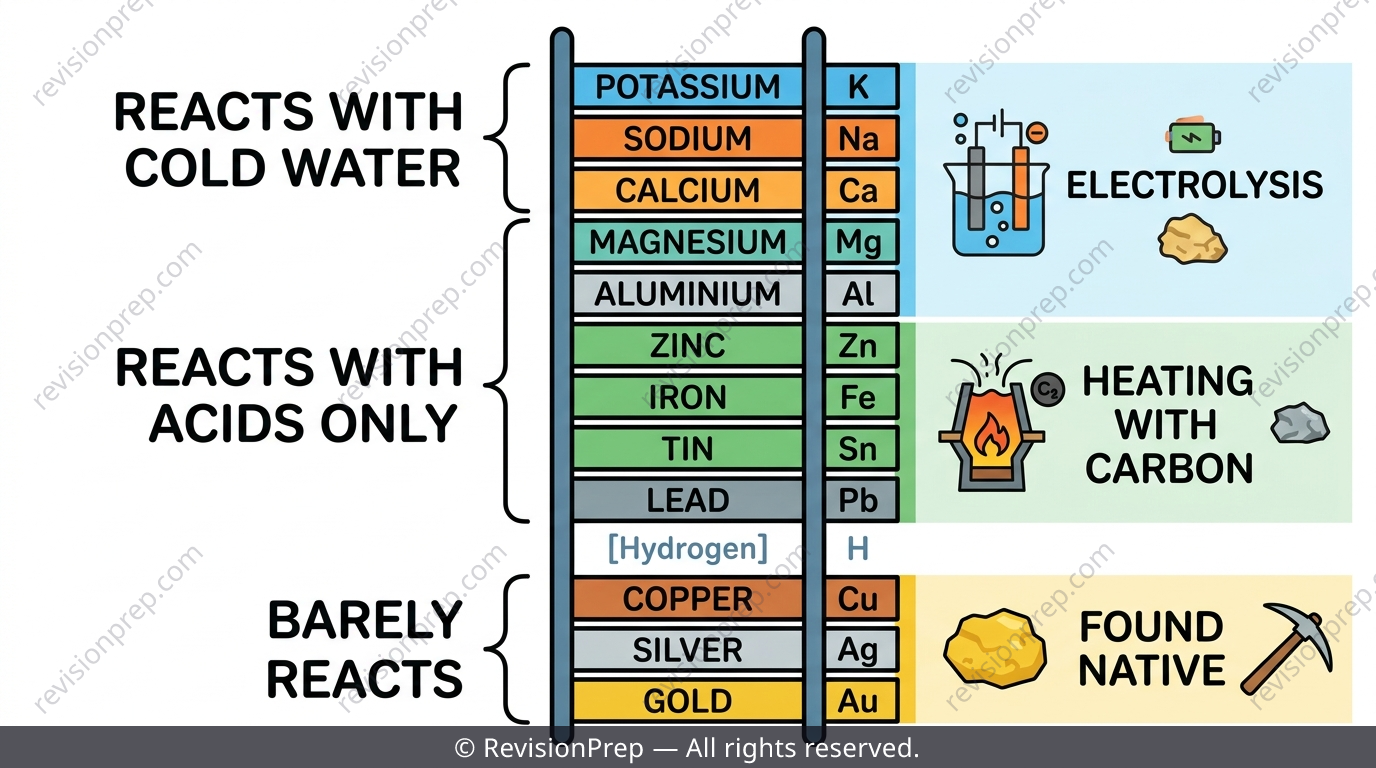
Reactivity for metals is about how easily an atom gives up its outer electrons to form a positive ion — the more readily it loses electrons, the higher it sits in the reactivity series and the more vigorously it reacts with acids, water and oxygen. Highly reactive metals like potassium, sodium and calcium even react with cold water; moderately reactive metals like magnesium, zinc and iron react with acids but not cold water; unreactive metals like copper, silver and gold barely react with either. This ranking also decides extraction method: the most reactive metals need electrolysis, moderately reactive ones are extracted by heating with carbon, and very unreactive metals can be found native.
Mini summary
The reactivity series ranks metals by how easily they lose electrons, predicting reactions with acids/water/oxygen and the extraction method used to obtain each metal.
Types of Chemical Reactions You Need to Recognise
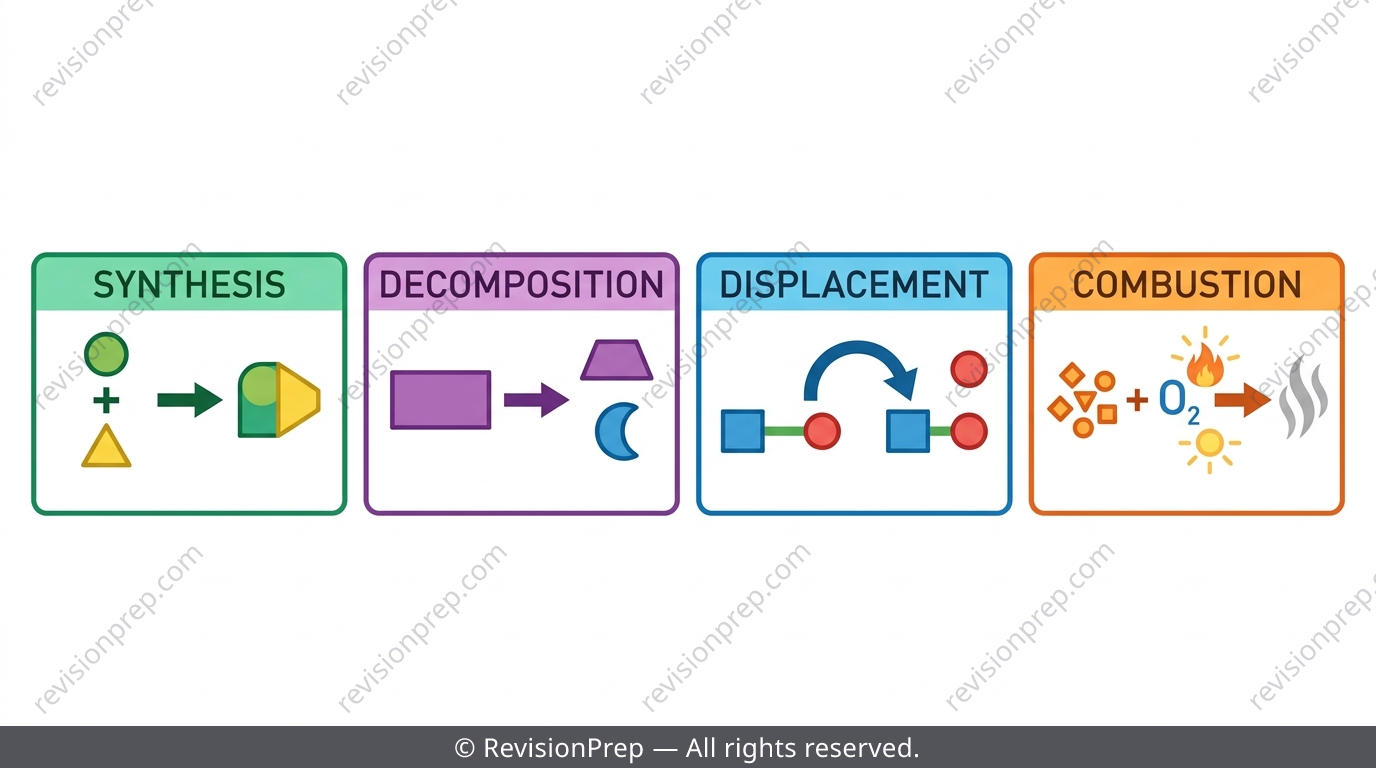
Reactions in MYP 3 tend to fall into a handful of recognisable patterns: synthesis (two or more substances combine into one), decomposition (one substance breaks into two or more), displacement (a more reactive element replaces a less reactive one in a compound), and combustion (a substance reacts with oxygen, usually releasing heat and light). A key exam skill is looking at an equation and quickly naming which type it is, since the pattern often hints at what evidence to expect.
Mini summary
Spotting whether an equation shows synthesis, decomposition, displacement or combustion is a core skill tested through data-response and investigation tasks.
Spotting Evidence of a Chemical Change
A chemical change always leaves evidence — gas bubbles, a colour change, a precipitate forming, a temperature change, or light/odour — but that evidence must be linked to the formation of a genuinely new substance, not just assumed from a physical change. When answering investigation or data-response questions, always name the specific observation and connect it explicitly to a new product, rather than simply listing 'something happened'.
Common mistake
Describing an observation (e.g. 'the solution got hot') without explicitly stating that a new substance formed — the link to a new product is what separates a chemical change from a physical one.
Mini summary
Gas, colour change, precipitate, temperature change and light/odour are the classic signs — but always tie the observation to a new substance forming.
Quick formula sheet
Practice questions
- State the term for a metal's ability to be hammered into thin sheets.
- Which group of the periodic table contains the noble gases?
- Name two pieces of evidence that show a chemical reaction has occurred.
- Explain why metals conduct electricity but most non-metals do not, using the correct vocabulary.
- A wire connects a battery to a bulb, which lights; a plastic rod in the same circuit leaves the bulb off. Explain this difference in terms of electron behaviour.
- Identify whether Mg + 2HCl → MgCl2 + H2 is a synthesis, decomposition, displacement or combustion reaction, and justify your choice.
- Aluminium (2.70 g/cm³, 310 MPa), steel (7.85 g/cm³, 520 MPa) and titanium (4.51 g/cm³, 900 MPa) are candidates for a bike frame. Calculate each strength-to-weight ratio and decide which material is the best overall choice, considering cost.
- Using the reactivity series, predict and justify the extraction method (electrolysis, heating with carbon, or native) for a highly reactive metal versus copper.
- A student observes a colour change and a temperature rise when two solutions mix. Explain what additional evidence they would need to confirm a new substance has formed.
Frequently asked questions
What's the difference between malleable and ductile?+
Malleable means a metal can be hammered or rolled into thin sheets; ductile means it can be drawn out into a thin wire. Think 'mallet' for sheets and 'duct' (like ductwork) for wires.
Why do metals conduct electricity but non-metals usually don't?+
Metal atoms release their outer electrons into a shared 'sea' of delocalised electrons that move freely through the lattice, carrying charge. Non-metals mostly have covalent bonds with electrons fixed between specific atoms, so there's nothing free to carry current.
How do I tell a group from a period on the periodic table?+
Groups are vertical columns and tell you the number of valence electrons (predicting chemical behaviour); periods are horizontal rows and tell you the number of electron shells.
What is the reactivity series used for?+
It ranks metals by how easily they lose electrons, letting you predict which metals react with cold water, acids, or barely react at all — and it also determines the extraction method used for each metal.
What are the main types of chemical reactions in MYP 3?+
Synthesis (substances combine), decomposition (one substance breaks apart), displacement (a more reactive element replaces a less reactive one), and combustion (reaction with oxygen, often releasing heat and light).
What counts as evidence of a chemical reaction?+
Gas production, colour change, precipitate formation, temperature change, or light/odour — but the evidence must be linked to a new substance forming, not just a physical change.
Master Chemical Reactions and the Periodic Table with the Full MYP 3 Notes
Related articles