
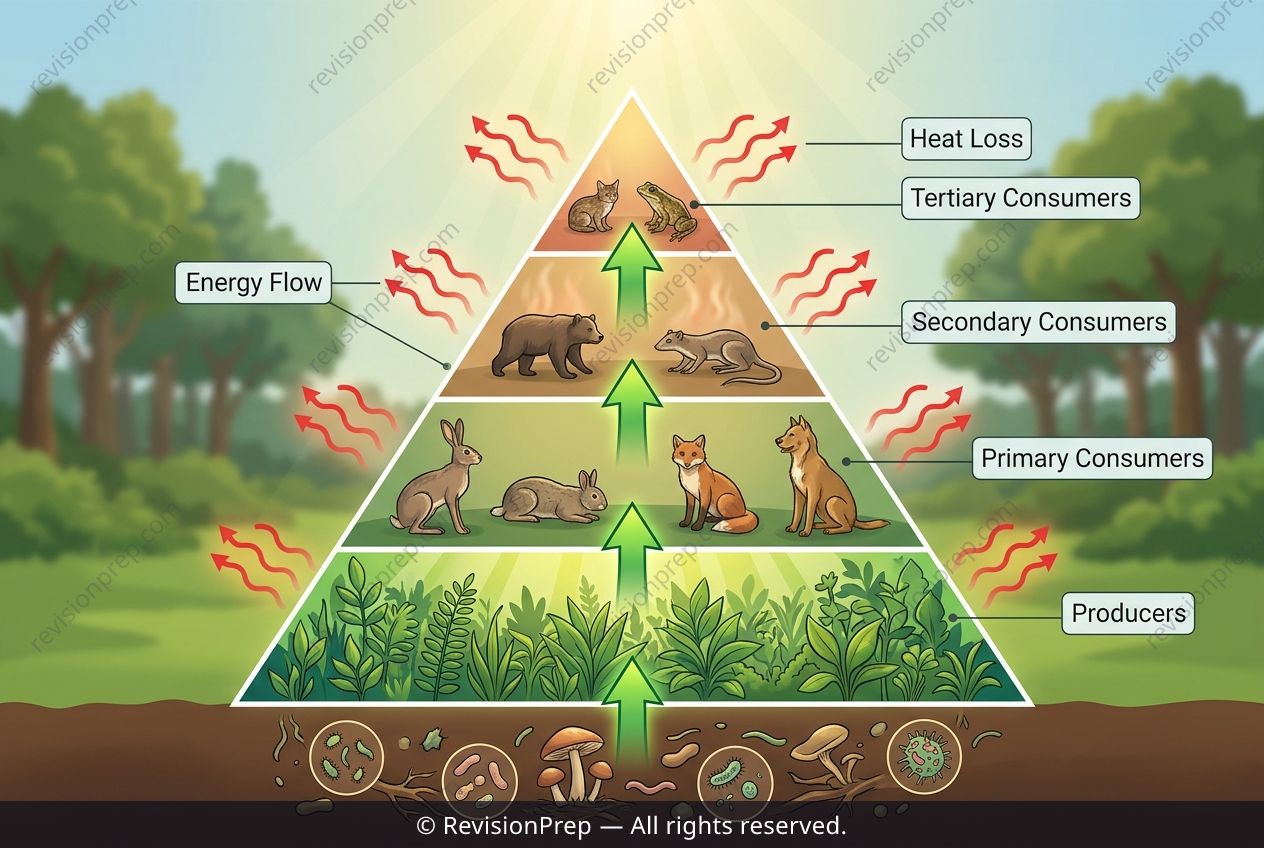
Biology: Why Energy Decreases Up the Trophic Levels
Energy flows through ecosystems in one direction, from the sun to producers and then along a chain of consumers. In the food chain grass → grasshopper → frog → snake, grass is the producer: it captures sunlight and makes its own food through photosynthesis, forming the base of every food chain. Every other organism is a consumer, gaining energy by eating the organism before it. Energy therefore passes from grass to grasshopper to frog to snake, moving up each trophic level as one organism is consumed by the next. This matters because energy does not travel endlessly or without loss. At each step, much of the energy is used for respiration, movement, and heat, so only a fraction transfers to the next consumer. This explains why food chains rarely have many links and why fewer organisms exist at higher trophic levels. Understanding this flow connects producers, consumers, and trophic levels into a single picture of how ecosystems are powered and why energy diminishes as it moves upward.
Start practising IB questions today
150,000+ IB-styled questions, criteria-mapped and instantly accessible.